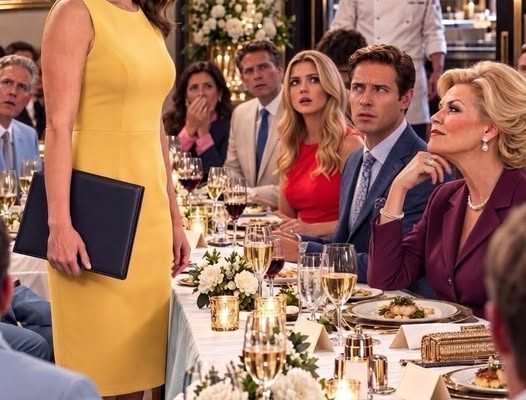
Dismissing his wife as the nanny was embarrassing enough, but finding out she owned the company changed everything.

Maxwell placed the microphone in my hand as calmly as if he were handing me a glass of champagne.

But nothing in that ballroom felt calm anymore.

The chandeliers still sparkled overhead.

Waiters stood frozen with silver trays balanced in their hands.

The string quartet had stopped mid-song, bows suspended above their instruments as everyone waited to see what would happen next.

Ethan answered that question for them.

He hurried toward the stage and grabbed my wrist.

“Claire,” he said through a tight smile, “stop this right now.”

His fingers tightened.

He kept his face angled toward the crowd, still trying to look composed.

But I could hear panic in his breathing.

He wasn’t worried about me.

He was worried about being embarrassed.

And somehow, that told me everything I still needed to know.

Before I could pull away, Maxwell stepped between us.

“Let go of her.”

He didn’t shout.

He didn’t need to.

Maxwell Reed had spent years leading rooms full of powerful people.

He knew how to make someone listen without raising his voice.

Ethan released me immediately.

Then he laughed.

Too quickly.

Too loudly.

“There’s obviously been a misunderstanding,” he said, turning toward the audience.

“My wife—”

He stopped.

That word had come far too late.

Wife.

I looked at him.

For the first time that evening, I let him see exactly how I felt.

Not rage.

Not heartbreak.

Disgust.

From below the stage, Vanessa stared at him.

“Your wife?”

Her wineglass hung loosely from her fingers.

“Ethan, what is happening?”

Maxwell gently took the microphone from me.

“Ladies and gentlemen,” he said, “before we continue tonight’s gala, there is someone this room should properly meet.”

The ballroom fell silent.

Ethan looked from Maxwell to me.

Then toward the side doors.

They opened.

Harold Benson, chairman of Zenith’s board, walked inside carrying a black leather folder.

Two board members followed.

Then Zenith’s general counsel.

My attorney.

And the head of corporate communications.

It was clear this was no longer a private family disagreement.

Harold walked onto the stage and gave me a small nod.

Then he turned toward the room.

“It appears our host has created an unexpected opportunity for an introduction we had planned to make later this evening.”

A murmur passed through the ballroom.

At the bottom of the stage, Ethan had gone completely still.

Vanessa looked from him to me, and I could almost see her realizing she had misjudged the situation.

Harold opened the folder.

“Six months ago, Zenith Holdings entered a controlling acquisition through Marlowe Capital Partners, approved by this board.”

The room quieted again.

“That transaction helped stabilize the company, protected jobs, and funded the restructuring many of you have praised this evening.”

He turned the page.

“The majority owner of Zenith Holdings is here tonight.”

By then, people were already looking at me.

Maxwell knew.

The board knew.

Several senior executives knew.

The investors were beginning to understand.

Ethan still refused to believe it.

“No,” he said with a nervous laugh.

“That’s impossible.”

Harold lifted the page.

“Ms. Claire Marlowe.”

A collective murmur swept through the room.

I stepped forward and took the microphone.

Ethan stared at me as if the floor had shifted beneath him.

“Good evening,” I said.

My voice carried farther than I expected.

“For those of you who don’t know me, I’m Claire Marlowe.”

I paused.

“And yes, I am the majority owner of Zenith Holdings.”

Somewhere in the room, a fork slipped from someone’s hand and struck a plate.

Ethan looked up at me.

“Claire…”

His voice had gone quiet.

“What are you doing?”

I looked down at him.

Seven years of marriage.

Seven years of making myself smaller because his ambition always seemed to need more space.

Seven years of being supportive.

Useful.

Quiet.

Convenient.

Then one gala.

One humiliation too many.

“Cleaning up a problem,” I said.

A few people shifted uncomfortably.

Maxwell almost smiled.

I let the silence settle.

“Tonight, my husband introduced me to people in this room as his nanny because he didn’t want them to know I was his wife.”

Several heads turned toward Ethan.

“A few minutes later, his sister spilled wine on me.”

Vanessa stiffened.

“Then Ethan pointed at the floor and told me to clean it.”

The room went completely still.

People looked at him differently now.

Not because I was powerful.

Because they were finally hearing the behavior described plainly.

Vanessa stepped closer.

“That isn’t what happened.”

I turned toward her.

“Did you spill wine on me?”

She opened her mouth.

Then closed it.

“Did Ethan introduce me as the nanny?”

Silence.

“Did he tell me to clean the floor?”

She looked away.

That was enough.

Ethan recovered quickly.

He stepped forward wearing the polished expression he used with clients.

“Claire, sweetheart, you’re upset.”

There it was.

The voice he always used when he wanted to turn my reaction into the real problem.

“Let’s not turn a private misunderstanding into a public spectacle.”

I almost laughed.

“Private?”

I looked directly at him.

“You embarrassed me in front of this entire room.”

He said nothing.

“You made it public.”

That landed harder than yelling ever could.

Ethan glanced toward the security team at the ballroom entrance.

They had quietly repositioned themselves.

His voice dropped.

“We can discuss this at home.”

“Home?”

I looked at him.

“You mean the penthouse I purchased?”

That got a reaction.

Several guests turned openly toward us.

I continued.

“The car downstairs is mine.”

His face tightened.

“The penthouse is mine.”

Another pause.

“The trust income that supported most of our lifestyle came from my family.”

Then I looked around the ballroom.

“And Zenith Holdings—the company you’ve spent the last year using to build your reputation—is majority-owned by me.”

Ethan’s face slowly lost color.

Vanessa shook her head.

“You hid all this from him.”

I looked at her.

“I kept my financial identity private because I wanted to know whether the people closest to me valued me without it.”

She had no answer.

An older investor near the front table spoke up.

“Mr. Cole, did you really introduce the majority owner of this company as your nanny?”

No one laughed.

That made the question even heavier.

Ethan adjusted his collar.

“It was a joke.”

Still, nobody rescued him.

Maxwell stepped forward.

“Zenith does not consider humiliating an employee, spouse, or owner at a corporate event an acceptable joke.”

Then he turned toward me.

“Ms. Marlowe, the board has prepared the documents you requested.”

General counsel handed me the folder.

Inside were three documents.

The first placed Ethan on immediate termination.

The second removed him from leadership consideration and suspended his authority over major client portfolios pending internal review.

The third documented what had happened during the gala, supported by statements from several senior witnesses.

I looked at Ethan.

He had already understood.

“Claire, no.”

For the first time that night, the charm disappeared.

“You can’t end my career over one mistake.”

“One mistake?”

I kept my voice calm.

“What happened tonight wasn’t one careless sentence.”

He stared at me.

“You chose to hide your own wife because you believed I would make you look less important.”

He swallowed.

“Then when your sister humiliated me, you expected me to accept it quietly.”

Security moved slightly closer when Ethan stepped toward the stage.

Two guards positioned themselves between us without touching him.

That was when Ethan finally looked around the ballroom.

At executives.

Board members.

People he had spent years trying to impress.

No one stepped forward for him.

Vanessa’s voice trembled.

“You can’t fire someone over a family argument.”

Harold responded before I could.

“This is not simply a family dispute.”

He spoke with the measured tone of someone who knew every word might later be examined by attorneys.

“This is a corporate conduct matter involving dishonesty, reputational risk, and unacceptable behavior toward the majority owner during an official company event.”

Vanessa went quiet.

Ethan looked at me like he no longer recognized me.

But the truth was much simpler.

I had not changed.

I had simply stopped pretending I was smaller than I was.

Then he said one word I had almost never heard from him.

“Please.”

His voice was barely above a whisper.

“Don’t do this here.”

I stepped down from the stage.

I stopped a few feet in front of him.

“This is exactly where you chose to do it to me.”

I handed his termination packet back to Maxwell.

“Effective immediately.”

Maxwell held it out.

Ethan stared at the papers before finally taking them.

Around us, several guests looked away.

Not because they felt sorry for him.

Because watching someone realize the consequences of his own choices had become uncomfortable.

Vanessa moved beside him.

“We should go.”

Ethan didn’t move.

He was still staring at me.

Then he asked the question that confirmed everything.

“Why didn’t you tell me?”

I almost couldn’t believe it.

Not:

Why did I treat you this way?

Not:

How did our marriage become this?

But:

Why didn’t you tell me who you really were?

Because for Ethan, respect had always depended on status.

“I wanted one part of my life where someone loved me without my last name doing the work for me.”

That finally reached him.

His expression changed.

For the first time that evening, I think he understood what he had actually lost.

Not the promotion.

Not the executive title.

Not his reputation.

His marriage.

Security escorted Ethan and Vanessa out through a side entrance.

Eventually, the gala resumed.

The quartet began playing again.

Servers moved through the room.

Glasses clinked.

Conversations restarted, though much quieter than before.

Several executives approached me and apologized for not stepping in sooner.

Most admitted they hadn’t fully understood what was happening until I explained it.

Later, Maxwell found me near the terrace doors.

He handed me a glass of sparkling water.

“You okay?”

I looked through the windows at the dark Florida water.

“I think I will be.”

He glanced toward the ballroom.

“For what it’s worth, I would have stopped him the moment he introduced you that way.”

I smiled for the first time that evening.

“I know.”

Then he looked at the wine stain across my dress.

“You handled it better than I would have.”

I looked back toward the ballroom.

“I handled it in a way he couldn’t ignore.”

The divorce moved quickly after that.

Not because Ethan suddenly became cooperative.

But because the balance between us had changed.

The board’s investigation also uncovered other concerns in his work.

Inflated projections.

Questionable entertainment expenses.

A pattern of taking credit for projects largely completed by other people.

None of it led to criminal charges.

But it was enough to damage the professional reputation he had spent years building.

Vanessa posted several vague messages online about betrayal and loyalty.

Then she disappeared from social media for a while.

Ethan sent flowers once.

I didn’t accept them.

He called repeatedly.

I never answered.

Eventually, his attorney contacted mine.

Ethan wanted to know whether I would agree to keep the gala incident private so he could rebuild his career.

I told my attorney to respond simply:

He chose to make our marriage public when he introduced his wife as staff.

I am not responsible for managing the consequences.

As for Zenith, the next several months were among the strongest the company had seen in years.

Maxwell remained CEO with unanimous support from the board.

We expanded two profitable divisions.

Sold an asset that had been draining resources.

And invested more heavily in retaining good employees.

Three months later, I attended another Zenith event.

Same hotel.

Same ballroom.

Same chandeliers.

But this time, I walked in alone.

I wore navy silk.

And I carried my own name without apology.

Nobody asked who I was.

They already knew.

Harold spoke about rebuilding.

Maxwell toasted the company’s growth.

And for once, the evening felt uncomplicated.

At one point, I stood near the stage and looked toward the marble floor where Vanessa’s wine had spilled months earlier.

There was no trace of it now.

Someone had cleaned it long ago.

That felt appropriate.

Some stains disappear with soap.

Others disappear when the truth finally reaches the surface.

When the event ended, I stepped onto the terrace.

Warm ocean air moved across my face.

Miami glittered beyond the hotel.

And I thought about the woman I had been before that first gala.

Standing in front of a mirror.

Smoothing down her dress.

Wondering whether she was impressive enough to stand beside her own husband.

I wished I could go back and tell her something.

You are not difficult to love.

You are simply standing beside someone who benefits from making you feel small.

People often ask how someone misses the warning signs.

But I think that is the wrong question.

Sometimes love teaches us to excuse small humiliations one at a time.

Until one final moment makes the entire pattern impossible to ignore.

Ethan didn’t lose me because I owned Zenith.

He lost me because the moment he believed I had no status worth respecting, he showed me exactly how he saw me.

And once I understood that clearly, there was nothing left to misunderstand.

Dismissing his wife as the nanny was embarrassing enough, but finding out she owned the company changed everything. Read More

My mother-in-law set up a dinner at an exclusive venue but left me without a seat, smirking that a budget place suited me better.

My mother-in-law arranged a dinner at an exclusive restaurant, but when I arrived there was no seat reserved for me; she smirked: “Maybe a budget place suits you better!” I burst out laughing and asked the owner for a seat, because the owner was…

He barely looked at it.

“Mom probably ran out of room.”

“There’s a 2-in margin, Daniel.”

He kissed my forehead before leaving.

“She didn’t mean it like that.”

That sentence had become a loadbearing wall in our marriage.

Diane didn’t mean it when she cropped me out of the family Christmas photo.

She didn’t mean it when she introduced me to her garden club as Daniel’s little helper at the office.

She didn’t mean it when she told the caterer at our anniversary party I could eat in the kitchen because I’d feel more comfortable there.

Daniel had a gift for repackaging cruelty as carelessness.

And for six years, I let him.

Not because I believed him.

Because I was busy running the company that paid for all of it—the foil invitations, the Savannah stationary, the client happy hours.

Nobody at that dinner table knew that yet.

And the word guest was about to cost the Marshes more than they could afford.

I started washing dishes at a seafood shack called Mullers the summer I turned 16.

Minimum wage.

No air conditioning.

Grease burns covered both forearms by August.

The head cook was Sal Pcelli, 60 years old, with a voice like a blown speaker and hands capable of breaking down a halibet in 45 seconds.

He watched me clear tables for 3 weeks without speaking to me.

Then one night after closing, he placed an 8 in chef’s knife on the prep counter and slid it toward me.

“You don’t flinch,” he said. “That’s half the job.”

The knife came inside a canvas roll held shut by a rubber band.

Chipped rosewood handle.

A blade sharpened so often its spine had become thinner than a butter knife.

I still own it.

I carried it through culinary school, my first sue chef job at 21, and years managing kitchens in three cities.

Along the way, I learned everything cooking shows ignored—vendor contracts, leases, labor compliance, health inspections, insurance claims.

At 25, I filed the paperwork for Keystone Hospitality Group, an LLC with my name on the operating agreement and my savings in the capital account.

Keystone didn’t build restaurants.

We developed them.

Concept.

Financing.

Buildout.

Staffing.

Launch.

I took failing locations, rebuilt menus, renegotiated leases, recruited talent, and returned profitable kitchens to operators within 14 months.

I specialized in invisible work.

The work keeping the lights on while somebody else accepted the praise.

That habit would eventually cost me.

At the time, it simply felt like the right way to build.

The Marshes lived inside a frame they had constructed around a picture that no longer existed.

25 years earlier, Gerald Marsh, Daniel’s father, ran a development company that bet everything on a resort project outside Hilton Head.

It collapsed publicly.

The kind of failure covered by the local business journal.

The kind where neighbors know before the children do.

Gerald drank himself into a quiet disappearance afterward.

He died before Daniel turned 20.

Diane was left with two children, a last name that used to open doors, and enough anger to rebuild its reputation.

She rebuilt it through performance.

The right country club.

The right lunchon circuit.

The right vocabulary.

Intimate instead of small.

Curated instead of cheap.

She taught Daniel and Whitney that looking wealthy could last longer than actual wealth.

For years, she was right.

Everyone still believed the Marshes were the Marshes.

Nobody checked.

Diane’s problem wasn’t that she was simply mean.

Mean people are predictable.

Diane was strategic.

Every insult was calculated.

Every exclusion deniable.

She never screamed.

She just rearranged the room until you were outside it, then acted surprised to find you there.

She decided what I was the first night Daniel brought me home.

I was 28, still carrying fryer oil beneath my perfume, discussing food cost ratios instead of vacation homes.

To Diane, I wasn’t a threat to Daniel.

I threatened the story.

A daughter-in-law who started as a dishwasher didn’t fit the frame.

And Diane would rather break me than resize it.

Daniel was charming the way a hotel lobby is charming—polished, climate-controlled, designed to welcome you without ever letting you behind the desk.

He had his mother’s jaw and his father’s talent for speaking confidently about things he barely understood.

When we met, he managed a bar three months from shutting down.

Over one weekend, I restructured its lease, replaced the supplier, and rebuilt the cocktail program.

Daniel watched me with dazzled admiration.

I mistook admiration for respect.

We married when I was 28.

By then, Keystone was producing real revenue, and I needed someone who could serve as its public face.

Someone for investor dinners and ribbon cuttings.

Daniel fit perfectly.

Diane had trained him for performance.

I made him Keystone’s managing partner on salary and gave him a 10% equity stake from my own holdings.

Harrove Capital Partners already held 20% from a growth round I had pitched in Charlotte the year before our marriage.

That left me with 70% as majority member.

My attorney, Francis Doyle, insisted the agreement include a managing partner removal clause.

“Insurance,” she called it.

I told her she was being dramatic.

The arrangement worked because I let myself remain invisible.

Daniel attended conferences.

Daniel took meetings.

Daniel’s name appeared on business cards my capital paid to print.

Everyone assumed he had built Keystone.

I never corrected them.

That was my weakness.

Not naivity.

Not people pleasing.

I was isolated inside my own competence.

I believed good work should speak for itself.

I carried everything because asking for recognition felt too much like asking permission.

But the work never spoke.

It simply kept working.

And my silence allowed a false story to harden until everyone accepted it as truth.

The Marshes held Sunday dinners at Dian’s house.

Cream tablecloth.

Matching napkins.

Seasonal centerpiece.

Everyone had an assigned seat.

Daniel sat on Diane’s right.

Whitney and her husband Brad sat across from him.

Gerald’s chair remained empty at the head of the table, a monument to grief Diane had never processed.

My seat was at the short end, beyond the good flatear and wine glasses, where the kitchen draft hit my neck whenever someone opened the door.

I never complained.

I brought dessert.

Cleared dishes.

Asked about Whitney’s Pilates and Diane’s Garden Club.

For 6 years, I played the perfect daughter-in-law in every way except the one that counted.

They never treated me as family.

The worst moment came at Diane’s 62nd birthday in front of 11 people.

A photographer arrived for a family portrait.

Diane, Daniel, Whitney, Brad.

They gathered before the fireplace.

I stood to join them.

Diane raised one hand, smiled toward the camera, and said the sentence that stayed with me for the next 14 months.

“You’re staff, dear, not family.”

Nobody reacted.

Daniel coughed.

Whitney adjusted an earring.

The photographer took six pictures.

I returned to the kitchen and wrapped leftovers in foil.

Later that night, Daniel insisted she was joking.

“You know Mom. She’s got a dry sense of humor.”

I understood dry humor.

I grew up in kitchens where line cooks roasted one another professionally.

Diane wasn’t joking.

She was filing me into the category she needed so her frame wouldn’t crack.

3 weeks before the dinner at Salen, I secured the largest letter of intent Keystone had ever received.

Signed, pending final contract.

Howerin Hotel Group wanted a flagship restaurant inside its new downtown property.

200 seats.

A rooftop bar.

A tasting room.

More than $4 million for buildout alone.

I had pursued them for 11 months.

Twice, I flew to their Atlanta headquarters.

I built the pitch deck, proforma, staffing model, and sourced the architect.

When the LOI arrived, it was addressed to Keystone Hospitality Group LLC.

Attention: Athena Exley, managing member.

Daniel’s contribution had been a handshake during the first meeting and a follow-up email sent from his phone while watching golf.

Yet Dian’s invitation read, “Celebrating Daniel’s landmark partnership with Howerin Hotel Group.”

His partnership.

His landmark.

The morning it arrived, Daniel called Diane to thank her.

I heard him from the hallway.

“Mom, it means a lot. Really. This is the one that changes everything for us.”

Us meant the Marshes.

Not Athena.

The invitation named Sen, a restaurant with a threemonth waiting list and a prefix beginning at $240 ahead.

Exactly the kind of room where Diane could perform status before an audience willing to believe her.

What she didn’t know was how Sen’s owner had started.

Or who had given him his first kitchen.

Some questions answer themselves when you pay attention.

The Marshes rarely paid attention to anything that didn’t already carry their name.

The morning of the dinner, I drove to Francis Doyle’s office on King Street.

Francis wore reading glasses on a beaded chain and dismantled liability clauses like a surgeon removing splinters—quietly, precisely, without drama.

I hired her 9 years earlier to draft Keystone’s operating agreement.

She had insisted on protections I thought I’d never use.

A managing partner removal clause triggered by majority member vote.

A 12-month non-compete cooling period.

Annual capital account reconciliations requiring every member’s signature.

Daniel had signed them every year.

He had never read them.

I handed Francis the Navy folder.

Soft leather.

Midnight blue.

Keystone’s logo embossed in one corner.

Inside were the operating agreement, Daniel’s signed acknowledgements, the capital contribution ledger, and the Howerin LOI.

“You want me to have this notorized today?” Francis said.

“Not a question. I want originals certified and a duplicate set locked in your office.”

She looked over her glasses.

“You’re sure about the timeline?”

“Monday,” I said. “After the dinner.”

“After,” she repeated.

For a moment, I thought she might ask why.

Instead, she opened a drawer, removed her notary stamp, and started working.

I sat across from her with the folder on my lap.

It weighed almost nothing.

A few papers.

Some signatures.

Several numbers.

The entire structure of the life the Marshes believed they controlled fit inside my tote bag.

When Francis finished, I zipped it closed and drove home.

Whitney called that afternoon.

“Just confirming the headcount for tonight,” she said with the particular brightness that meant she was managing something. “Diane wants to keep it intimate. Close family only.”

“I’m close family,” I said.

“Of course you are. I just mean it’s a small table. We had to be selective.”

Selective.

I pictured her rehearsing the word before dialing.

“Is there a seat for me, Whitney?”

Silence.

3 seconds.

Long enough to hear her swallow.

“I’m sure Daniel can figure something out. He’s so good at that.”

She disconnected before I answered.

I stood alone in the kitchen holding the phone.

Something in my chest became completely still.

Not anger.

Not sadness.

Recognition.

I had stood here before.

Outside the frame.

Beyond the good flatear.

Beyond the photographer’s lens.

The Marshes had a system.

For 6 years, I had cooperated because carrying the weight seemed easier than setting it down and seeing what collapsed.

Whitney’s call didn’t surprise me.

It confirmed everything.

Close family.

I would remember those words.

I texted Daniel: Whitney says, “The table is full. Is there a seat for me?”

Three dots appeared.

Vanished.

Appeared again.

20 minutes later:

I’ll talk to mom.

He wouldn’t.

I knew it the way I knew a kitchen was failing before tickets started backing up.

The rhythm changes.

Everything gets strangely quiet.

And suddenly you realize nobody is running the pass.

Daniel wasn’t running anything.

He was waiting for somebody else to fix it.

As always.

Sen had dominated the city’s food scene for four years.

Visionary.

Unmissable.

Transcendent roasted carrots.

Its chef-owner, Declan Hail, was 39, Irish American, built like a middleweight, with a pairing-knife tattoo on his left wrist and a James Beard nomination on the wall.

Every profile told the same origin story.

Declan Hail, self-taught prodigy who opened his first restaurant at 27 through grit and vision.

I had read those profiles.

I never corrected them.

The missing part—one Declan also left out because I asked him to—was that he wasn’t self-taught.

At 22, he had been my line cook.

He burned stocks and overcooked rado in a kitchen I managed when I was barely older than him.

I taught him proteins.

I taught him mislass.

When he was ready to open his own place, I co-signed his first commercial lease because no bank would finance a 27year-old without collateral.

That lease became a restaurant.

The restaurant became a reputation.

The reputation became Sen.

When Daniel casually said over breakfast, “Mom booked Sen. Can you believe it?” something flickered behind my sternum.

Not nostalgia.

Not concern.

Recognition.

Like a forgotten card suddenly turning face-up.

“Nice,” I said, pouring coffee.

Two days before dinner, I tried once more.

Daniel stood in our bedroom choosing between ties.

Navy silk.

Diane’s taste.

I sat on the bed holding the invitation.

“Can you call your mother and ask her to add a seat for me?”

He never looked up.

“It’s handled.”

“How is it handled?”

“I mentioned it. She said the table’s already set.”

“Then I’ll call the restaurant myself and add a chair.”

He turned around.

For a second, I thought he might finally say something honest.

Then he straightened the tie against his chest and chose cowardice instead.

“Athena, don’t make it weird. It’s one dinner. Mom’s been planning it for weeks. I don’t want to rock the boat.”

The boat.

I had built it.

Waterproofed its hull.

Replaced the engine.

Charted the course.

And my husband, wearing a tie his mother chose, was asking me not to rock it.

“I won’t make it weird,” I said.

Relief spread across his face.

“That’s my girl.”

He kissed the top of my head and left.

I remained on the bed.

Not crying.

Not even planning.

Just feeling the specific weight of being somebody’s girl instead of somebody’s partner.

My phone buzzed.

A calendar reminder.

Francis, notary appointment, 9:00 a.m. Friday.

I turned the phone face down.

I wasn’t going to make anything weird.

I was going to make it permanent.

Whitney preferred operating in the margins.

Whispered comments.

Brunch invitations sent to everyone except the person being discussed.

She was Dian’s logistics officer, and she had spent the month quietly campaigning.

I learned about it sideways.

That’s how you learn most things in families built on omission.

Brad, Whitney’s husband, had begun appearing at Keystone events.

This was a man whose primary professional achievement was being fired from a commercial real-estate firm during a market when those firms were practically begging for staff.

He showed up at team lunches.

A Howerin sitewalk.

Coffee with our project architect.

I asked Daniel why.

“Whitney thought Brad could use some exposure. He’s been down lately.”

“Exposure to what exactly?”

“The business. Get a feel for things. Maybe take on a role eventually.”

“A role?”

“Something operational. Whitney thinks he’s got potential.”

I poured water and drank slowly so I wouldn’t say Brad had roughly the potential of a screen door on a submarine.

Instead:

“Whose idea was this?”

“It came up at mom’s. Whitney mentioned it, and mom thought it made sense.”

Of course she did.

It made perfect sense if they were quietly positioning Brad to replace the person Diane never wanted inside the family to begin with.

The woman whose name wasn’t on the invitation.

The former dishwasher who had somehow washed up into the Marsh family.

They weren’t merely excluding me from dinner.

They were rehearsing my replacement.

The night before dinner, I couldn’t sleep.

Daniel was already out.

He slept like a man with no conscience, which, to be fair, requires having one in the first place.

I went downstairs for water.

His phone lay face-up and unlocked on the kitchen counter.

I didn’t intend to look.

I walked toward the sink.

Then the screen lit up.

A notification from Marsh family.

Three words appeared in the preview from Diane.

She’s staff staff.

Then the message cut off.

My hand stopped over the faucet.

The kitchen was dark except for the phone’s blue glow.

I wasn’t someone who searched her husband’s phone.

I tracked invoices, contracts, and compliance reports.

I read documents professionally.

And documents had taught me something.

Information doesn’t care how you discover it.

It only matters whether it’s true.

I picked up the phone.

43 messages from the previous 2 weeks.

I read them standing barefoot on cold tile with the focus I reserved for contracts containing hidden clauses.

The first thread covered Sen’s seating chart.

Every name was listed.

Daniel.

Whitney.

Brad.

The Callaway cousins.

Two Garden Club friends.

A Howerin Hotel Group representative, so they can see the whole family behind Daniel’s success.

No Athena.

Whitney replied: Perfect. Keep it tight.

12 messages later came the thread that hardened my jaw.

Diane: We need to talk about the company. Daniel should be the sole face going forward. Athena can step back. She’s operational. She doesn’t need a title.

Whitney: Brad can handle the operational side. He’s motivated.

Diane: Exactly. Daniel runs the client relationships. Brad handles operations. And Athena can consult quietly.

Whitney: Does Daniel know?

Diane: Daniel will do what makes sense for the family. He always does.

Earlier, Whitney had asked, “Doesn’t Athena have some kind of stake in the company?”

Dian’s reply: Daniel says it’s mostly his. She helps with the dayto-day.

Daniel had told them that.

Or at minimum, he had allowed them to believe it.

His mother had designed a takeover around a lie he found too convenient to correct.

Then came Daniel’s contribution to the conversation.

One thumbs-up emoji.

No objection.

No reminder that I founded Keystone.

No suggestion that perhaps they should speak to me before deciding my future.

Just a yellow thumbs-up floating beneath a plan to remove his wife from the company she created.

Farther down, Diane discussed the dinner.

No seat for her. If she shows up, she’ll get the message. If she doesn’t, even better.

Then came the line that settled everything.

She’s staff. Staff doesn’t sit at the family table.

There it was.

Not humor.

Not misunderstanding.

Strategy.

Typed in complete sentences and coordinated by three Marshes—including the man sleeping upstairs—who agreed that I was something to manage, rearrange, and eventually remove.

I returned the phone exactly where I found it.

Face down.

My hands stayed steady.

So did my pulse.

Upstairs, I opened my laptop and sent Francis a twoline email.

Proceed with the notary on Friday and bring a second set of the Howerin Li.

Then I shut the laptop and lay beside the husband who had responded to my erasure with a thumbs-up.

Friday morning, Francis notarized the documents.

The Navy folder lay open between us.

Operating agreement.

Capital ledger.

Daniel’s annual acknowledgements.

Howerin Li.

I had read those documents a hundred times.

That morning, they looked different.

Article 3, membership interest.

Athena Kxley, 70%.

Daniel R. Marsh, 10%.

Harrove Capital Partners, 20%.

That 20% belonged to the institutional investor that had backed me—not Daniel—after a Charlotte pitch the year before our marriage.

Article seven covered removal of the managing partner.

A majority member could initiate removal with 30 days written notice for cause or 60 days without cause.

Cause included material breach, failure of duty, or conduct harmful to the company.

Francis slid the notarized copies across her desk.

“The removal notice is drafted,” she said. “You just need to sign.”

“Monday.”

“Monday works.” She paused. “You know, they’ll claim it’s retaliatory.”

“They can claim whatever they want. I’ve got 9 years of signed acknowledgements proving he knew the terms.”

She nodded.

“What about tonight?”

“I’m going to the dinner.”

“Even without a seat?”

“Especially without a seat.”

I zipped the folder and placed it in my bag.

The leather felt almost weightless.

The documents weren’t heavy.

The weight came from six years spent pretending they didn’t matter.

Francis walked me out.

“Athena.”

I turned.

“Don’t lose your temper tonight. Whatever happens, you have the paperwork. That’s enough.”

I drove home in silence with the folder on the passenger seat.

That afternoon, I called Keystone’s project coordinator.

“The Howerin rep?” I said.

“Patricia Engel. She’s attending.”

“Confirmed?”

“She RSVPd through Dian’s office.”

“Good.”

Patricia Engel was Howerin Hotel Group’s vice president of development.

She had sat across from me twice in Atlanta.

She knew my name.

My pitch deck.

My square-footage projections.

My revenue model.

My staffing timeline.

Because I had built every piece.

What she didn’t know was that the man introduced three months earlier as the company’s founder was actually a salaried managing partner holding 10% equity and wearing a tie chosen by his mother.

Tonight, she would discover that.

Not because I planned to make a speech.

Not because I intended to create a scene.

Truth is quiet.

When you stop covering for a lie, truth tends to walk into the room by itself.

At the kitchen counter, I reviewed the evening the way I prepared restaurant openings.

Logistics.

Timing.

Exits.

I wasn’t angry.

I was clear.

Clarity is what arrives when you finally stop translating someone else’s cruelty into language you can tolerate.

If you’ve ever sat at a table that pretended you weren’t there, you already know the silence I carried that week. I didn’t argue. I didn’t beg. I just kept reading the one document none of them thought to ask about.

Stay with me. The dinner is where everything turns.

And if quiet women winning is your kind of story, subscribe so the next one finds you.

At 6, I dressed.

Black sheath dress.

Low heels.

Small earrings.

Nothing designed to announce itself.

My tote bag sat on the bed with the Navy folder beside my keys and lipstick I would probably forget to reapply.

Across the room, my old knife roll sat on the shelf above my desk.

Still wrapped in its rubber band.

S’s knife.

Chipped rosewood.

Blade worn thinner than a credit card by years of sharpening.

It had followed me through every kitchen, every buildout, every late-night soft opening.

Probably the most honest thing I owned.

For one strange moment, I considered taking it.

Not as a weapon.

As a talisman.

Something solid to hold if the room shifted beneath me.

I left it there.

Tonight, I didn’t need a knife.

The tool I needed was already inside my bag.

And it was sharper than anything S ever put on a wet stone.

Daniel had already left for Sen.

He went early to help mom with the setup, which likely meant standing in the foyer drinking procco while Diane ordered staff around like a four-star general.

The house was silent.

I checked myself in the hallway mirror.

Calm.

Steady.

A woman who had washed dishes since 16 and built companies since 25, about to enter a room where everyone believed she was nobody.

I picked up my bag.

The folder settled against the lining like a heartbeat.

Don’t fight for a chair, I told the mirror. You own the building.

Then I locked the house and drove to Sen.

Sen occupied the ground floor of a converted cotton warehouse on East Bay Street.

Exposed brick.

Iron beams.

Candle light turning everything amber.

The bread course alone probably cost more than my first week at Mullers.

I gave the hostess my name.

She checked the list twice.

“I’m sorry, I don’t see a reservation under Exley.”

“Try Marsh.”

Recognition brightened her face.

“Of course. The Marsh party. Right this way.”

She led me to a long table beneath a rod iron chandelier.

14 seats.

14 place cards.

Copper ink on heavy creamtock.

I counted as she checked her chart.

Diana at the head.

Daniel on her right.

Whitney and Brad opposite.

The Callaway cousins.

Garden Club women.

A man I recognized as Howerin’s regional director.

Not Patricia Engel.

The bigger gun was arriving later.

Three unfamiliar names completed the table.

14 cards.

14 chairs.

I walked the entire length.

My name wasn’t there.

The hostess waited behind me.

Everyone else was already seated.

Daniel looked up from his wine.

Whitney adjusted her napkin.

Brad studied the bread basket.

Diane sat at the head with both hands folded over her place card.

Then she smiled at me.

The smile of a woman admiring a room arranged exactly according to plan.

My chair wasn’t accidentally missing.

The missing chair was the message.

I was supposed to absorb it.

Then leave.

The space where chair 15 should have stood was louder than anything anyone could say.

I remained at the end of the table.

14 faces turned toward me like a jury.

The chandelier hummed.

A plate clattered somewhere behind the kitchen doors.

Diane tilted her head and finally delivered the sentence she’d been rehearsing for six years.

“Maybe a budget place suits you better.”

The table laughed.

Not everyone.

Daniel didn’t.

He stared at his fork.

Brad coughed into one fist.

The Garden Club women laughed openly.

So did the Callaway cousin at the opposite end.

Whitney made a small bright sound she disguised as clearing her throat.

Diane’s smile never moved.

Everything had been choreographed.

The seating chart.

The missing card.

The line.

She wanted me standing.

Wanted witnesses.

Wanted me to understand publicly that the table, the family, the company, and the life had no room for the former dishwasher.

I looked at Diane.

Then at the empty space where the 15th card belonged.

Then Daniel, rotating his wine glass and saying nothing.

And I laughed.

Not politely.

Not nervously.

A genuine belly laugh that came because it had nowhere else to go.

Diane’s smile flickered.

“Something funny?” she said.

I placed my bag on the floor, smoothed my dress, and addressed the nearest server.

“Could you ask the owner to come out, please?”

He hesitated.

Looked at the table.

Then me.

Then the kitchen.

“The owner?”

“Declan Hail. Tell him Athena is here.”

His posture changed instantly.

Recognition.

He nodded and disappeared toward the kitchen.

Silence replaced the laughter.

Dian’s smile remained, but the structure behind it had started shifting.

Whitney whispered to Brad.

Daniel put down his wine and finally looked directly at me.

Confusion.

Perhaps the beginning of dread.

I waited without explaining.

Without fidgeting.

Hands folded in front of me the way S taught me to stand during service.

Still.

Grounded.

Ready.

The kitchen door swung open.

Declan Hail emerged in his chef’s coat, wiping his hands on a towel.

The moment he saw me, his face changed.

His eyes crinkled.

His shoulders relaxed.

Four strides carried him across the room.

He wrapped me in a hug smelling of brown butter and thyme.

“Chef,” he said.

Not Athena.

Chef.

That word hit the room like a stone dropped into still water.

The Garden Club women stopped talking.

The Callaway cousin lowered his bread.

Patricia Engel, who had apparently arrived sometime during the last 5 minutes and was standing by the bar with her coat still on, turned toward us.

Declan stepped back.

“We saved your seat,” he said. “We always save your seat.”

Then he turned toward the hostess.

“Chef’s table. Set it now.”

His chef’s table was a six-seat counter facing the open kitchen.

Best seats in the building.

$400 ahead.

A waiting list longer than the regular dining room.

Declan personally pulled out a chair.

Then he placed a fresh card on the counter.

Copper ink.

Creamtock.

Athena Xlay.

I sat.

Inside the kitchen, threeline cooks, a pastry chef, and a Sue who looked barely 24 glanced up.

One said, “Chef.”

Another lifted a ladle.

They knew me.

They had always known.

Because Declan told every cook who entered his kitchen the same story.

I got my first shot from a 23-year-old woman who ran a kitchen like a surgeon runs an O. She signed a lease for me when no bank would. Everything I built started in her kitchen.

After Sen received its first major review, he told me over drinks that he shared that story.

I asked him to stop.

He looked at me like I’d asked him to stop breathing.

“I’ll stop when it stops being true.”

He never stopped.

The dining room began recalibrating.

You could feel it like a temperature change.

One degree at a time.

The Garden Club women leaned together.

The Callaway cousin typed on his phone.

And at the Marsh table, Diane stared at me with an expression I’d never seen before.

The frame she spent 25 years building had cracked.

She hadn’t heard the sound yet.

Declan personally brought my first course.

Seared scallops with saffron burblanc.

The dish that helped earn his James Beard nomination.

He [snorts] set the plate in front of me and leaned against the counter.

“Still got the knife S gave you?” he asked.

I smiled.

“On the shelf at home.”

“That knife taught me more than culinary school. You holding it over a cutting board at 7 a.m. That’s the first thing I think about when I build a menu.”

He spoke loudly enough for the dining room to hear.

Not for performance.

Declan simply didn’t know how to whisper about things that mattered.

The long table watched.

All 14.

Daniel had turned pale.

Whitney gripped her napkin.

Brad looked like a man realizing the job promised to him never existed.

Diane’s mouth was open.

No words came.

I tasted the scallop.

Perfect.

Then placed my fork down.

“He learned to cook in my kitchen.”

Nothing more.

No explanation.

Just a sentence that landed like a deed because, in a way, it was.

Declan nodded once.

A man acknowledging a truth he had carried for 12 years.

Then returned to his kitchen.

Silence filled the room, broken only by somebody setting down a glass too hard.

Diane’s fingers curled into fists on the tablecloth.

The frame was no longer merely cracked.

It was hanging by one nail.

Patricia Angle crossed the room.

She moved with the deliberate calm of someone who had negotiated hotel deals across four continents and recognized a power shift instantly.

She stopped at my counter.

“Athena Xley,” she said.

Not a question.

“You pitched the Howerin flagship in Atlanta last March, the rooftop concept with the vertical garden.”

I shook her hand.

“And again in June.”

“And again in June.” She smiled. “You run Keystone.”

Every person heard it.

I didn’t turn toward the Marsh table.

I didn’t need to.

I could feel Daniel shift.

Whitney stop whispering.

Diane tighten.

Patricia took the stool beside me.

“I’ve been looking forward to meeting the rest of the team tonight,” she said. “But the pitch, the proforma, the staffing model, the build schedule, that was all your work.”

“It was.”

“I thought so.”

She leaned closer.

“Between us, the gentleman at the cocktail reception in January, Daniel, he’s charming, but he couldn’t answer a single question about the revenue model.”

I remained silent.

She nodded as though I had confirmed something.

“I’ll have my office send a revised LOI on Monday, addressed correctly this time.”

She didn’t need to say to you.

She tapped the counter, stood, and returned toward the bar.

14 people sat absolutely silent.

I could hear candle wicks hiss.

Daniel turned toward me.

I looked back.

No anger.

No triumph.

Only the deep calm of a woman who had stopped protecting a lie.

Whitney moved first.

She grabbed Daniel’s arm.

“What is she talking about?” she hissed. “Who runs the company?”

Daniel opened his mouth.

Closed it.

Opened it again.

He looked like a fish dropped on a countertop.

Diane remained still.

Her fists relaxed.

Perhaps she had realized gripping the table wouldn’t stop the ground from moving.

The Garden Club women traded quick calculating looks.

Monday brunch was already writing itself.

Brad reached for water and missed the glass.

Howerin’s regional director cleared his throat and pretended to study the menu.

And I sat at the chef’s counter with perfect scallops and my own place card, watching the room that excluded me reorganize itself around a truth that had been sitting inside my Navy folder all along.

Nobody asked me to explain.

Nobody called me a liar.

The silence confirmed everything.

And I still hadn’t opened the folder.

I removed it from my bag and placed it on the counter.

Soft Navy leather beneath my fingers.

Keystone’s logo catching the candle light.

I unzipped it slowly.

Not for drama.

For precision.

The same precision I brought to everything I built.

“Daniel,” I said.

My voice remained level.

“I’m going to read something and I’d like you to listen.”

He didn’t answer.

I wasn’t asking permission.

I opened the operating agreement to article 3.

Keystone Hospitality Group LLC membership interest: Athena Kxley 70%, Daniel R. Marsh 10%, Harrove Capital Partners 20%.

I looked up.

Every face stared back.

Patricia Angel watched from the bar with crossed arms.

Declan leaned against the kitchen pass.

“You signed this 9 years ago, Daniel. You signed the acknowledgement every year since. Your 10% stake entitles you to a salary and a distribution schedule. It does not entitle you to the company.”

Diane shot to her feet.

Her chair cracked against the hardwood like a gunshot.

“This is absurd. Daniel built that company from nothing.”

“Diane.”

I faced her.

“You’re welcome to read the document yourself. Page four, paragraph 2. The founding member is listed by name. It isn’t Daniel.”

I laid the agreement flat where everyone could see.

9 years of signatures.

9 years of capital contributions.

Mine.

Nine years of Daniel signing documents he never bothered reading—documents clearly stating that his wife owned the company he allowed everyone to believe belonged to him.

The room was so quiet I heard ice melt.

Diane’s lower lip trembled.

Not from grief.

From fury trying to disguise itself as pain.

I looked across the room at her.

Across the long table.

Across the missing chair.

“Funny,” I said. “The staff owns the place.”

Diane erupted.

Not like someone facing an uncomfortable truth.

Like someone watching a false ceiling she spent 25 years constructing collapse.

“After everything this family gave you,” she said, and her voice cracked on the word family, like a windshield hitting a rock. “We took you in, we gave you a name, we introduced you to people you never would have met on your own, and this is how you repay us?”

I said nothing.

“You were nobody, Athena. Nobody. A girl who smelled like a kitchen. Daniel gave you a life.”

“Daniel gave me a business card,” I said. “I gave him the business.”

Her hands shook.

She turned toward Daniel.

Waiting for him to defend her.

Waiting for the son she trained to perform to perform one more time.

Whitney was already crying.

Not for me.

Not Daniel.

She was mourning the operational job promised to Brad, the income she had counted on, the chair that had just disappeared beneath them.

“This isn’t legal,” Whitney said. “You can’t just—you can’t take it.”

“I’m not taking anything. I’m keeping what’s mine.”

Brad stared at the tablecloth.

The Garden Club women looked horrified and delighted in equal measure.

Enough material for 6 months of brunch.

Howerin’s regional director was already on his phone.

Diane continued.

Louder.

Faster.

Her performance collapsing in real time.

Ungrateful.

Cold.

Someone who would never understand family.

Through all of it, I remained at the chef’s counter with folded hands and a level voice.

I never raised it.

There was no reason to.

The documents were open.

The truth was sitting in the room.

And the woman who had called me staff was standing inside a restaurant owned by a man I trained, screaming at the woman who owned the company supporting the lifestyle she treasured.

Eventually, the noise faded.

It always does.

Like a kitchen fire when you cut the gas.

Then I spoke.

“Here’s what happens on Monday,” I said. “Francis Doyle, my attorney, will file the managing partner removal notice under article 7 of the operating agreement. Daniel’s role as managing partner terminates with 60 days written notice. The agreement allows removal by majority member vote without cause.”

I looked at my husband.

“I don’t even need a reason. But if anyone asks, six years of misrepresenting his authority to clients and investors, a capital account he never funded, and telling his own family he owned a company that was never his, are all on the record.”

Daniel made a sound.

Not quite a word.

“The salary stops,” I continued. “The distribution stops. The title stops. Brad will not be offered a position because there is no position to offer. The company isn’t hiring family members who can’t explain a food cost ratio.”

Whitney flinched.

“Howerin will be notified that all future correspondents should be directed to me. Patricia has already indicated her office will reissue the LOI under the correct contact.”

Then I looked directly at Daniel.

“And I’m filing for divorce. My attorney will handle the asset separation. The operating agreement is clear on what belongs to the company and what belongs to the marriage. You’ll find they don’t overlap much.”

Nobody spoke.

Diane sank into her chair.

Face blotchy.

Hands gripping the armrests.

Whitney typed furiously on her phone.

Probably calling an attorney.

Or searching, “Can my sister-in-law fire my husband?”

Brad pushed his chair away from the table like a man preparing to evacuate a burning building.

The 14 copper place cards remained exactly where Diane had arranged them.

And the 15th—mine—sat beneath the kitchen lights at the chef’s counter.

Exactly where it belonged.

Daniel stood.

His chair scraped the floor.

For one brief, honest moment, he looked at me the way he had when we first met.

Back when I was saving his failing bar.

Back when he looked at me as if I were the most capable person he had ever known.

“Mom,” he said.

His voice sounded rough.

“She built all of it.”

The room froze.

Diane looked at him with something I had never seen before.

Not rage.

Not manipulation.

Fear.

Real fear.

The fear that comes when the performance ends and nothing exists behind the curtain.

Daniel opened his mouth again.

I saw the fork in the road.

The exact second when he could have finally chosen honesty.

He could have turned to me.

Could have admitted he knew.

Could have admitted he was afraid.

Instead, he faced Diane.

“I’m sorry, Mom. I should have managed this better.”

Managed.

Not told the truth.

Not defended my wife.

Managed.

The word lingered like smoke.

He reached for Diane’s hand.

She took it.

Her chin trembling.

Already creating the version she would tell at Garden Club.

Athena the villain.

Daniel the victim.

The Marshes as a loving family ambushed by an ungrateful wife.

I watched my husband choose her.

Choose the frame instead of the picture.

Performance instead of the person.

The mother who taught him that love was staged for an audience.

Something inside me finally released.

Not a crack.

A click.

A lock opening.

“I’m not leaving the table,” I said. “I’m leaving the marriage.”

I picked up my bag.

Then the Navy folder.

And walked out of Sen the same way I had entered kitchens since 16.

Upright.

Steady.

Ready for whatever came next.

Outside, the May air in the Low Country was cool.

Jasmine bloomed nearby, making the night smell almost sweet enough to forget that 20 minutes earlier I had detonated the central lie of my six-year marriage before 14 witnesses and a James Beard nominee.

Declan caught me beside my car.

He had removed his chef’s coat.

Plain white T-shirt.

Arms folded.

The steady look of a man who might have known this was coming before I did.

“You good?”

“I’m good.”

“You need anything?”

“A decent night’s sleep and a real estate attorney.”

He almost smiled.

“I’ll have the scallops boxed up for you.”

“Keep them. Feed the staff.”

He nodded.

Then Declan did something he almost never did publicly.

He hugged me again.

And didn’t immediately let go.

“Chef,” he said quietly into my shoulder. “Thank you for all of it.”

I drove home with the windows open and radio off.

The Navy folder rested on the passenger seat.

The house was dark.

Daniel wasn’t home.

I hadn’t expected him.

I changed into sweats, made tea, and sat at the same kitchen counter where I had read the Marsh family chat 24 hours earlier.

The phone screen remained dark.

The counter was clean.

Jasmine drifted through the open window.

I didn’t cry.

I wasn’t sad.

I felt the strange calm that comes after carrying something so long that setting it down feels like floating.

Monday unfolded exactly as Mondays do when you spend the weekend preparing.

Francis filed Daniel’s removal notice at 9:00 a.m.

By noon, Keystone had suspended his access to company accounts, email, and project systems.

By 300 p.m., his corporate card stopped working.

He called me twice.

I didn’t answer.

Brad received a formal letter rescending the informal offer that technically had never existed because Diane’s brunch promises couldn’t survive contact with an operating agreement.

Patricia Engel’s office issued a revised LOI for the Howerin flagship.

Athena K. Exley, managing member, Keystone Hospitality Group.

Project budget: $4.2 2 million.

My name appeared on every page.

The divorce filing went through Wednesday.

Asset separation was straightforward.

Francis had intentionally structured the operating agreement to distinguish company assets from marital property.

Daniel kept the house and car.

His 10% equity stake remained frozen pending an independent appraisal Francis estimated would take four to six months.

I kept Keystone.

The Howerin contract.

The nine years of sweat.

The silent 6:00 a.m. sitewalks.

The midnight spreadsheets.

Everything the Marshes had convinced themselves belonged to them.

Diane never called.

A mutual acquaintance later told me she informed her Garden Club that I had suffered a breakdown at dinner.

The Garden Club women, who had witnessed the entire evening, politely changed the subject.

Two months later, I walked through Keystone’s new flagship space.

Construction had just started.

Bare concrete.

Exposed wires.

Sawdust.

Possibility.

On the future host stand, Declan had left one place card.

Copper ink on creamtock.

A Xlay owner.

A chair only has power if you believe the room must grant you permission to sit.

I stopped asking permission the night I realized the table had been arranged against me long before I arrived.

That’s my story.

One missing chair.

One smirk.

And a company they never bothered reading the paperwork on.

If this reminded you that what you built should carry your name, go check whose name is really on the things you made. Do it this week.

Share this with someone who needs the nudge. Drop a comment, hit subscribe, and I’ll see you in the next.

My mother-in-law set up a dinner at an exclusive venue but left me without a seat, smirking that a budget place suited me better. Read More

My sister thanked me for the house over breakfast, leaving me stunned before Dad revealed he used my $1.4 million inheritance to buy it for her.

At breakfast, my sister hugged me and whispered, “Thank you for the house!” I nearly dropped my coffee. Mom smiled. Dad calmly added, “I already signed the $1.4 million purchase with your inheritance.” They thought I was trapped. What they didn’t know was that at 11:58 the night before, I had moved all $2.4 million into a trust they couldn’t touch. I smiled back—and let them keep talking.

At 11:58 p.m. on my eighteenth birthday, I transferred every dollar of my $2.4 million inheritance into a trust my parents couldn’t access.

Ten hours later, my sister hugged me over pancakes and thanked me for buying her a $1.4 million house.

I froze with my coffee halfway to my lips.

“Thank you?” I asked.

Lena laughed. “Don’t act surprised. Mom said you wanted to do something meaningful for family.”

Mom smiled across the table while Dad calmly cut his eggs.

“We wanted it to be a surprise,” Mom said.

Dad finally looked up. “I signed the purchase agreement yesterday. Beautiful place. Six bedrooms. Pool. Gated community.”

“With my inheritance?”

His expression hardened instantly, the way it always did whenever I questioned him.

“Don’t be dramatic, Ava. That money came from your grandfather. He believed in family.”

My grandfather also believed in contracts.

Six months before he died, he named me sole beneficiary of a $2.4 million investment account and gave Dad temporary custodial authority only until my eighteenth birthday.

For years, my parents treated the money as family property.

Lena was always the golden child.

Her private college was necessary.

Her designer clothes were networking.

Her failed business became “an investment in her future.”

Whenever I asked about my inheritance, Dad said, “Adults are handling it.”

They planned vacations around the money.

Mom once joked that Lena’s future wedding would “barely dent Ava’s little fortune.”

Nobody ever asked me.

Three months before my birthday, I discovered an email Dad had accidentally left open on the family computer.

The subject line read:

LENA’S HOUSE — FUNDING CONFIRMED.

That afternoon, I contacted my grandfather’s estate attorney, Miriam Cole.

She explained exactly how the account worked.

At midnight on my eighteenth birthday, Dad’s custodial authority ended. But if he had already prepared another authorization—or simply claimed I had approved something—he could create serious problems before the financial institutions caught up.

So Miriam helped me prepare in advance.

I revoked every existing authorization.

Created a trust with an independent corporate trustee.

And at 11:58 p.m., after the brokerage confirmed my identity, I transferred the inheritance into it.

Dad knew nothing.

Lena squeezed my shoulder.

“You’re the best little sister ever.”

Mom raised her orange juice like champagne.

Dad smiled.

“Closing is Friday.”

I looked at all three of them.

Then I laughed.

Dad’s smile vanished.

“What’s funny?”

I put down my coffee.

“Nothing.”

I stood and picked up my bag.

“Please don’t cancel anything.”

Mom frowned. “Ava?”

But I was already leaving.

Because for the first time in my life, I wanted my family to finish exactly what they had started.

By noon, Dad had called six times.

I ignored every call and drove straight to Miriam’s office.

She already had the purchase agreement when I arrived.

“How did you get that?”

“The title company contacted the brokerage this morning requesting proof of funds.”

She turned the contract toward me.

Buyer: Lena Whitmore.

Funding source: Ava Whitmore inheritance account.

Authorized representative: Thomas Whitmore.

My father.

I stared at his signature.

“Can he do that?”

“He can sign anything he wants,” Miriam replied. “That doesn’t make it binding on your assets.”

Then she pointed to an attached certification.

My stomach tightened.

It claimed I had authorized Dad to use up to $1.5 million for “family real-estate investment purposes.”

“I never signed this.”

“I know.”

The signature resembled mine.

Almost.

Miriam’s expression hardened.

“Your father submitted this two days ago.”

That changed everything.

They hadn’t simply assumed I would agree.

They had prepared for me to refuse.

Worse, Dad had already personally advanced the earnest-money deposit because he was certain my inheritance would reimburse him at closing.

My phone buzzed.

Lena: You’re being weird. Mom says you’re jealous because I’m finally getting something.

Another message followed.

Mom: Don’t embarrass this family over money you didn’t earn.

I showed Miriam.

“Save everything,” she said.

So I did.

Dad became more reckless as the day went on.

At three, he left a voicemail.

“You are eighteen, Ava, not an adult in any meaningful sense. I handled that money for years. You will not sabotage your sister’s future because you suddenly think you’re powerful.”

At five, Lena posted photos outside the mansion, posing by the gates as though she already owned it.

I saved screenshots.

Meanwhile, Miriam notified the brokerage, independent trustee, title company, seller’s attorney, and escrow officer that I disputed every authorization Dad had submitted.

The trust confirmed that no funds could leave without approval from its independent trustee.

The $1.4 million Dad expected to access was suddenly behind a legal wall.

He still didn’t understand.

That evening, Mom called.

“What have you done?”

“I protected my inheritance.”

“You humiliated your father!”

“He used a signature I never gave him.”

Silence.

Then she whispered, “He was going to tell you.”

“When?”

“After closing.”

I laughed once.

Mom’s voice went cold.

“Lena already gave notice on her apartment. She ordered furniture. The seller expects the money. You’re destroying everything.”

“No,” I said. “I’m refusing to finance it.”

“You owe your sister something.”

“I owe her nothing.”

The next morning, Dad stormed into Miriam’s office without an appointment.

I was already there.

He stopped when he saw me.

Miriam placed the disputed authorization in the middle of the conference table.

“Thomas,” she said calmly, “before you say another word, understand that this document has now been preserved by four separate institutions.”

For the first time in my life, my father looked at me with something other than authority.

Fear.

Dad recovered quickly.

Or tried to.

“This is a family matter,” he snapped.

Miriam folded her hands. “Then why did you submit a false authorization to a regulated financial institution?”

Mom arrived ten minutes later with Lena.

My sister was furious.

“You promised me that house!”

“I never promised you anything.”

“Dad said you would!”

I turned toward him.

“That was convenient.”

He slammed his palm against the table.

“Enough! You have more money than you need.”

“There it is,” I said.

Not love.

Not family.

Entitlement.

Without raising her voice, Miriam explained the situation.

My trust would not finance the house.

The seller could pursue whatever remedies the contract allowed against the actual buyer and guarantor.

The title company had flagged the authorization.

The brokerage fraud department was investigating how my supposed signature appeared on financial paperwork.

And Dad’s legal authority over my inheritance was over.

Mom stared at me.

“You planned this.”

“Yes.”

“Against your own family?”

“No. Because of my own family.”

Dad had gone pale.

“What do you want?”

The question almost made me laugh.

For eighteen years, he had taught me that the person controlling the money controlled the room.

He simply never expected that person to be me.

“I want written acknowledgment that neither of you has authority over my trust. I want Lena’s purchase completely separated from me. And I want every record involving my inheritance turned over to Miriam.”

Lena stared at me.

“So I lose the house?”

“You never owned it.”

The transaction collapsed two days later.

Dad lost much of the money he had personally committed to push the deal through and had to negotiate the remaining contractual costs directly with the seller.

The brokerage permanently removed him from every account or access point tied to my assets and cooperated with its fraud review.

But the house turned out to be only the beginning.

When Miriam examined the old custodial records, she discovered several earlier withdrawals Dad couldn’t properly document.

Three months later, represented by his own lawyer, he agreed to repay a substantial portion rather than fight me in court.

Mom stopped calling after I refused to pay for Lena’s wedding.

Lena moved into a modest apartment instead of a six-bedroom mansion.

She blocked me.

I slept beautifully.

One year later, I was studying finance two states away.

My trust paid tuition directly and invested the remainder under rules I had chosen with Miriam and the independent trustee.

I rented a small apartment with enormous windows and bought a used car using money I had earned myself.

On my nineteenth birthday, a card arrived from Mom.

Inside, she had written:

Family should forgive.

I stared at the words for several seconds.

Then I smiled.

I had learned that forgiveness didn’t require access.

I placed the card in a drawer, made coffee, and opened my quarterly trust statement.

The balance had grown.

So had I.

And for the first time, nobody was sitting at a breakfast table spending my future before I even arrived.

My sister thanked me for the house over breakfast, leaving me stunned before Dad revealed he used my $1.4 million inheritance to buy it for her. Read More

Hiding under the bed to surprise my husband on our wedding night, I overheard a phone call that changed everything.

Part 1: The Voice I Heard Beneath My Wedding Bed

On the night I married Owen, I hid beneath our bed because I wanted to surprise him.

My satin gown was still on, my veil had caught in the wooden frame above me, and I was trying not to laugh as I pictured his face when I crawled out and shouted, “Got you.”

Then the bedroom door opened.

The footsteps were not Owen’s.

They belonged to his mother, Lorraine.

She crossed the room in sharp heels and sat directly on the mattress above me. The springs dipped close to my back, and I flattened myself against the hardwood floor, suddenly afraid to move.

A lighter clicked.

The smell of cigarette smoke drifted beneath the bed.

Owen had told me Lorraine had quit years ago. But in that moment, I was less concerned about the lie than I was about the phone call she made next.

“Hello, Owen?” she said, placing her phone on speaker. “I’m in the bridal suite. Where is your wife?”

His voice came through the speaker, and I barely recognized it.

“She’s probably wandering around with her friends,” he said. “Don’t worry, Mom. She has no idea what we’re doing.”

My body went cold.

Lorraine gave a low laugh. “Good. Is the condo in Savannah under her name yet?”

“It is,” Owen replied. “I told her it would make her feel secure. She thinks I bought it for her, but I kept the receipts. Give it a few months, we’ll claim we are incompatible, and I’ll use the purchase records to take the property when we split.”

My hand flew to my mouth.

The condo had been our wedding gift to ourselves. Owen had insisted that it be titled solely in my name, telling me that a woman should always have something of her own.

I had believed it was love.

Now I understood it was strategy.

Lorraine took another drag from her cigarette. “She is so easy to manage. That little apartment you showed me was pathetic.”

My father was an engineer, but I had never told Lorraine that he was chief architect for a major aerospace contractor. The worn-down apartment she had seen belonged to my late grandmother, and Dad kept it because it held every memory of his childhood.

She had looked at it and decided my family had nothing.

“She thinks she married up,” Lorraine continued. “A girl like that will not fight people who know how the world works.”

Owen laughed softly. “Exactly. Her father is a nobody. She will be grateful for whatever we let her keep.”

Tears burned in my eyes, but they were not tears of heartbreak anymore.

They were tears of rage.

I had spent two years loving a man who had been studying me like an investment. I had welcomed his mother into family dinners, accepted her backhanded compliments, and listened when Owen told me to be patient because she “did not mean anything by it.”

All along, they had been waiting for the right moment to take what they believed I would not know how to protect.

Lorraine stood and crossed toward the mirror.

“Remember,” she said, “no weakness from the start. Let her know who makes decisions in that house.”

The door opened and closed behind her.

For several minutes, I remained under the bed, staring at the hem of my white dress. Then I reached into my clutch and pulled out my phone.

The recording app was still running.

I had started it before hiding because I thought I might want to save Owen’s reaction to my silly prank. Instead, it had captured every word of their plan.

When I finally crawled out, my dress was dusty and my veil was torn. I looked at myself in the mirror, wiped my cheeks, and felt something inside me become very calm.

They thought I was helpless because I had never needed to prove otherwise.

They were wrong.

I called my father first.

“Dad,” I said when he answered, “I need you to contact your attorney.”

His voice sharpened instantly. “What happened, Mara?”

I looked at the wedding ring on my hand.

“It is going to be a very long wedding night.”

Part 2: The Wife They Thought Would Never Fight

I did not leave that night.

I changed out of my wedding dress, tucked the recording into a secure folder, and sat at my desk until I could breathe normally again. Leaving in tears would have given Owen and Lorraine exactly what they expected: a frightened woman who could be pushed into accepting whatever they decided.

Instead, I called my father.

He answered on the second ring. “Mara, why are you calling me on your wedding night?”

“Dad, I need you to have the family attorney ready in the morning.”

There was a brief silence. “Did Owen hurt you?”

“Not physically,” I said. “But I found out why he wanted the condo in my name.”

My father did not make me explain everything over the phone. He only said, “I will be there at nine. And, Mara? Do not sign anything.”

My next call was to my best friend, Julia, a divorce attorney who had known me since college. When I told her what I had recorded, she went quiet.

“Save copies in three places,” she said. “Do not confront him yet. And find the transfer records for the money used to buy the condo.”

I already knew where to look.

Six months earlier, I had transferred $180,000 from a trust my grandmother established for me into Owen’s account. He told me he wanted to make the purchase feel like a gift from him and needed to handle the payment himself because the seller preferred a quick closing.

I had trusted him.

Now I understood why he had insisted on keeping the receipts.

When Owen came home, he wrapped his arms around me and kissed my forehead. I had to force myself not to pull away.

“Where were you?” he asked.

“Putting away gifts,” I said softly.

He smiled, entirely unaware that his mother’s voice was saved on my phone. “Tomorrow we start our honeymoon.”

“Yes,” I replied. “Tomorrow will be important.”

The next morning, Owen asked for coffee and mentioned that Lorraine would be coming for dinner.

“Make something nice,” he said. “Mom appreciates effort.”

I smiled at him over my mug. “Of course. I want us to get along.”

His relief was immediate. He did not see what I saw now—the small flicker of control beneath every casual request, the way he assumed my cooperation belonged to him.

Once he left, I met Julia and my father at the condo. My father arrived with a financial adviser and a notary, carrying documents I had never thought I would need.

He transferred a minority share in his engineering company into my name, along with the old apartment my late grandmother had owned. The apartment Lorraine called a “hovel” was now legally mine too, not because it made me wealthy, but because it reminded me that my family had always given me more than Owen understood.

Julia reviewed the condo purchase records.

“The money came from your trust,” she said. “Owen only acted as the messenger.”

“So the receipts do not prove it was his money?”

“They prove he paid the seller,” she replied. “Your bank records prove where the money came from.”

For the first time since hiding under the bed, I felt something close to relief.

That evening, Lorraine arrived in a cream suit and a sharp smile. She kissed the air beside my cheek, then looked around the condo as though inspecting an investment.

“What a charming place,” she said. “Owen made a wonderful choice.”

I set the dinner plates down carefully.

“Yes,” I said. “He did.”

During dessert, Owen leaned toward me. “I have been thinking. Since I am the husband now, maybe you should add me to the condo documents. It would make everything simpler.”

I held his gaze.

“Why would you need that?” I asked.

His smile faltered for only a second.

Then Lorraine looked at him across the table, and I understood from her expression that this was never merely a suggestion.

Part 3: The Evidence They Kept Handing Me

I did not agree to add Owen’s name to anything.

“I want to think about it,” I told him.

Lorraine’s smile turned thin. “A marriage should not involve so much suspicion.”

I almost laughed. She had spent my wedding night plotting to take the home I had paid for, yet she wanted to lecture me about trust.

Over the next week, I became the version of myself they expected: quiet, agreeable, and eager to please. I made coffee when Owen asked, listened when Lorraine criticized the way I folded towels, and nodded whenever either of them hinted that the condo should be “managed properly by the man of the house.”

But my phone recorded everything.

Owen did not know that I had copied the first recording to an encrypted drive. He did not know that Julia had helped me open new accounts, secure the trust funds he could not access, and document the original transfer from my grandmother’s trust into his account.

The money for the condo had always been mine.

He had simply made the payment look like it came from him.

One night, Owen invited his friend Nathan over for beer. I sat in the bedroom with the door almost closed while they talked in the living room.

“My mother has the whole plan figured out,” Owen said. “Mara thinks the condo is safe because it is in her name, but I paid the seller. Once we have been married long enough, I will claim I invested in it.”

Nathan laughed. “What if she hires a lawyer?”

“Her father is an engineer, not some big shot,” Owen replied. “She does not have the money or nerve to fight us.”

I saved that recording too.

The next morning, my father called to say the company-share transfer was complete. I now owned forty percent of his engineering firm, along with the family apartment and a separate investment account my grandmother had established years ago.

“You do not need any of this to prove your worth,” Dad said. “But you deserve to know that you are not alone.”

I sat at the kitchen table after we ended the call, looking around the condo Owen and Lorraine thought they would soon take from me. For the first time, I stopped seeing it as a place where I had been betrayed.

It was evidence.

Julia came over that afternoon with a folder of legal options. She could file immediately, freeze the disputed funds, and serve Owen with divorce papers.

“I will,” I said. “But not yet.”

She raised an eyebrow. “What are you waiting for?”

“For them to say it where other people can hear.”

Two days later, I called Lorraine.

“I have been thinking about our conversation,” I told her sweetly. “Could you come for dinner Friday? I want to start fresh.”

She sounded pleased. “That is a much better attitude, dear.”

Then I spoke to Owen.

“Why don’t you invite Nathan and a few friends?” I suggested. “It could be a family celebration.”

He smiled, believing he had finally trained me to cooperate. “Mom will love that.”

After he left, Julia called to confirm that she would bring the final documents. My father would be nearby, but he promised to let me lead.

I stood in the dining room and looked at the small speaker hidden beside the flowers.

Lorraine thought she was coming to a dinner where I would beg for acceptance.

Owen thought he was gathering witnesses for the life he planned to steal.

Neither of them knew that before dessert, every person at that table would hear exactly what they had said about me.

Part 4: The Dinner Where Their Plan Finally Spoke

I let Owen’s question hang in the air for a moment.

Then I smiled and set down my spoon. “You are right. We should make things simpler.”

Lorraine’s shoulders relaxed. Owen reached for my hand across the table, wearing the same gentle expression that had once made me feel safe.

“I knew you would understand,” he said.

“I do,” I replied. “That is why I invited a few people over Friday night. We can discuss everything properly.”

His smile sharpened with relief. Lorraine gave a small nod, as though I had finally accepted my place in the family.

Neither of them noticed that I had not said I would sign anything.

Friday arrived warm and clear. I set the dining table with my grandmother’s china and lit the candles Owen liked, creating the kind of dinner he would later describe as proof that our marriage had been fine.

My father came first, followed by Julia. Then Owen’s brother Nathan arrived with his wife, looking uneasy when he saw everyone gathered.

Owen glanced toward Julia. “Why is a lawyer here?”

“She is my friend,” I said. “And I wanted someone neutral.”

Lorraine laughed tightly. “A lawyer at a family dinner? Mara, that seems dramatic.”

I poured wine into everyone’s glasses. “You taught me that important decisions should be handled carefully.”

For the first half hour, they tried to act normal. Lorraine complimented the food. Owen told Nathan about our honeymoon plans. Nathan barely met my eyes.

Finally, Owen leaned back in his chair. “Since we are all here, Mara and I should discuss adding my name to the condo deed.”

Julia placed her napkin beside her plate.

“Before that,” I said, “I would like everyone to hear something.”

Owen frowned. “Hear what?”

I reached for my phone and connected it to the small speaker on the sideboard.

The first recording began with the soft music from our wedding reception. Then Lorraine’s voice filled the dining room.

“Once she signs the deed, we can deal with the rest. She is too trusting to notice how any of it happened.”

Nobody moved.

Owen’s face drained of color.

Then his own voice played.

“She thinks I paid for the condo. The receipts are in my name. If she ever asks questions, I will say it was a gift from me.”

Nathan’s wife covered her mouth. My father sat perfectly still, his eyes fixed on Owen.

The recording continued until Lorraine’s voice said, “A wife is easier to manage when she believes she owes her husband something.”

I stopped the audio.

For several seconds, the only sound in the room was the hum of the refrigerator.

Owen stood so quickly that his chair scraped the floor. “This is taken out of context.”

“Then explain the context,” I said.

Lorraine’s mouth tightened. “You recorded a private conversation? That is sick.”

“No,” Julia said calmly. “What is sick is planning to obtain property through deception.”

Owen looked toward Nathan. “You knew she was recording?”

Nathan lowered his eyes. “I knew you were using Mara’s money. I did not know how far Mom wanted to take it.”

Lorraine turned on him. “Do not you dare betray this family.”

He looked at her then, his face pale. “You were going to make her sign the refinancing papers too, weren’t you?”

The room went still again.

Owen’s head snapped toward his brother. “Nathan.”

Julia opened the folder beside her plate and slid a document across the table. “That is why I contacted the lender this morning. Mr. Hale submitted an application using Mara’s condo as collateral before she had agreed to any refinancing.”

My breath caught.

Owen stared at the page. “I only started the paperwork.”

“You forged my electronic authorization,” I said.

He reached for the document, but Julia pulled it away.

Lorraine stood, her composure finally breaking. “She was supposed to sign it first.”

The words landed harder than any recording.

Owen closed his eyes.

Across the table, my father quietly picked up his phone. “Julia,” he said, “should we call the investigator now?”

Owen looked at me with panic replacing every trace of affection.

And for the first time since our wedding night, he understood that I was no longer afraid of what he might do next.

Part 5: The Home I Kept for Myself

Owen did not answer Julia’s question.

He stood at the end of the table with his face drained of color, looking from the loan application to the guests who had heard every word. Lorraine reached for his arm, but he pulled away.

“You said you only started the paperwork,” she whispered.

“I was trying to protect us,” he said.

“By using my property as collateral?” I asked. “By forging my authorization?”

My father made the call to the financial-crimes investigator while Julia explained the evidence already secured: the falsified digital signature, the transfer records showing where the condo money came from, and the recordings of Owen and Lorraine discussing how to pressure me into signing.

Lorraine tried to blame everyone else. She said I had misunderstood, that Owen had been overwhelmed by wedding expenses, that a good wife would not turn a family disagreement into a legal matter.

But the room had changed. Nobody rushed to support her now.

Nathan’s wife looked directly at Lorraine. “You told Mara that her family had nothing. You wanted her to believe she needed Owen.”

Lorraine’s face hardened. “She did need him.”

“No,” I said quietly. “I only thought I did.”

Owen’s mistakes did not end that night. Julia discovered that the same lender application had been sent to two other financial institutions. He had been trying to find someone willing to approve a loan before I noticed the paperwork, intending to use the condo’s value to settle old business debts he had hidden from me.

The marriage had lasted less than a week, but the deception had been building for months.

I filed for an annulment based on fraud. The court rejected Owen’s claim that the condo had been a marital gift because every dollar could be traced back to my grandmother’s trust. His payment receipts showed only that he had delivered money that was never his to spend.

The attempted loan and forged documents led to an investigation. Owen eventually accepted a plea agreement, while Lorraine was named in the civil action for helping him pressure and misrepresent information to me.

She called twice after the hearing.

The first time, she said I had ruined Owen’s future. The second time, she cried and told me she had only wanted security for her son.

I did not argue with her.

“You tried to take mine,” I said. “That is the difference.”

Then I blocked her number.

Months later, I stood in the condo with the windows open, letting in the first cool air of autumn. The dining table was gone, along with the wedding gifts that had made the place feel like a stage where I was expected to play a role.

In its place, I put a wide desk beneath the window and filled the shelves with books, photographs, and the engineering sketches my father had saved from my childhood.

I kept the apartment my grandmother left me too. After repairs, I rented it to a young woman beginning her first job in the city. When she signed the lease, I made sure every clause was clear and every promise was written down.

My father visited one Sunday with coffee and a small lavender plant.

“For the balcony,” he said. “Your grandmother loved lavender.”

I took it from him and looked around the home Owen once believed he could quietly take from me.

The condo was still mine. The keys were still in my hand. And the future I had nearly surrendered was no longer something anyone else could negotiate.

For the first time, I understood what my grandmother had tried to give me.

Not money.

Not property.

The freedom to walk away when love demanded too much of my safety.

Hiding under the bed to surprise my husband on our wedding night, I overheard a phone call that changed everything. Read More

Trump’s son makes major hint to their family’s future following his dad’s second term as president

Eric Trump has claimed that his father’s time in the White House has cost the Trump family billions, even as he dropped a significant hint about his own political ambitions.

Now in his second term as president, Donald Trump has cultivated a powerful personal brand and a fiercely loyal following that has remained steadfast through numerous controversies.

Despite dabbling in politics over the years, Trump had primarily focused on leading the family business, the Trump Organization—established in 1927—until he launched his presidential campaign in 2015, marking a dramatic shift in the family’s trajectory.

Eric Trump, the second son of Donald and his late ex-wife Ivana, recently spoke to the Financial Times about whether he would consider running for president once his father steps down.

The 41-year-old responded with caution, saying, “The real question is: do you want to drag your family into it? Would I want my kids to go through what I’ve been through over the past decade? If the answer was yes, I think I could do it—and to be honest, I think others in the family could, too.”

When asked more directly whether the Trump name would disappear from presidential ballots after 2024, Eric responded vaguely: “I don’t know… Time will tell. But there’s more than just me.”

He added that it’s a deeply personal decision, noting, “You have to ask whether you’re willing to subject your loved ones to the harshness of this system. And I don’t yet know how to answer that.”

Over the past ten years, Donald Trump has arguably become one of the most recognized people on the planet.

But that global notoriety hasn’t necessarily translated into widespread popularity, and the public scrutiny has had clear ripple effects on his children.

For Eric, those effects weigh heavily when thinking about the future for his own family, including his wife Lara and their two children.

“If there’s one family that hasn’t made money from politics, it’s ours,” Eric said, firmly rejecting the widespread belief that the Trump family has financially benefited from Donald’s presidency.

“Honestly, I think we would have had far more zeros attached to our name if my father had never gone into politics. The opportunity costs, legal expenses, and emotional toll it’s taken on us have been staggering.”

Trump’s son makes major hint to their family’s future following his dad’s second term as president Read More

Trump’s son makes major hint to their family’s future following his dad’s second term as president

Eric Trump has claimed that his father’s time in the White House has cost the Trump family billions, even as he dropped a significant hint about his own political ambitions.

Now in his second term as president, Donald Trump has cultivated a powerful personal brand and a fiercely loyal following that has remained steadfast through numerous controversies.

Despite dabbling in politics over the years, Trump had primarily focused on leading the family business, the Trump Organization—established in 1927—until he launched his presidential campaign in 2015, marking a dramatic shift in the family’s trajectory.

Eric Trump, the second son of Donald and his late ex-wife Ivana, recently spoke to the Financial Times about whether he would consider running for president once his father steps down.

The 41-year-old responded with caution, saying, “The real question is: do you want to drag your family into it? Would I want my kids to go through what I’ve been through over the past decade? If the answer was yes, I think I could do it—and to be honest, I think others in the family could, too.”

When asked more directly whether the Trump name would disappear from presidential ballots after 2024, Eric responded vaguely: “I don’t know… Time will tell. But there’s more than just me.”

He added that it’s a deeply personal decision, noting, “You have to ask whether you’re willing to subject your loved ones to the harshness of this system. And I don’t yet know how to answer that.”

Over the past ten years, Donald Trump has arguably become one of the most recognized people on the planet.

But that global notoriety hasn’t necessarily translated into widespread popularity, and the public scrutiny has had clear ripple effects on his children.

For Eric, those effects weigh heavily when thinking about the future for his own family, including his wife Lara and their two children.

“If there’s one family that hasn’t made money from politics, it’s ours,” Eric said, firmly rejecting the widespread belief that the Trump family has financially benefited from Donald’s presidency.

“Honestly, I think we would have had far more zeros attached to our name if my father had never gone into politics. The opportunity costs, legal expenses, and emotional toll it’s taken on us have been staggering.”

Trump’s son makes major hint to their family’s future following his dad’s second term as president Read More

Trump’s son makes major hint to their family’s future following his dad’s second term as president

Eric Trump has claimed that his father’s time in the White House has cost the Trump family billions, even as he dropped a significant hint about his own political ambitions.

Now in his second term as president, Donald Trump has cultivated a powerful personal brand and a fiercely loyal following that has remained steadfast through numerous controversies.

Despite dabbling in politics over the years, Trump had primarily focused on leading the family business, the Trump Organization—established in 1927—until he launched his presidential campaign in 2015, marking a dramatic shift in the family’s trajectory.

Eric Trump, the second son of Donald and his late ex-wife Ivana, recently spoke to the Financial Times about whether he would consider running for president once his father steps down.

The 41-year-old responded with caution, saying, “The real question is: do you want to drag your family into it? Would I want my kids to go through what I’ve been through over the past decade? If the answer was yes, I think I could do it—and to be honest, I think others in the family could, too.”

When asked more directly whether the Trump name would disappear from presidential ballots after 2024, Eric responded vaguely: “I don’t know… Time will tell. But there’s more than just me.”

He added that it’s a deeply personal decision, noting, “You have to ask whether you’re willing to subject your loved ones to the harshness of this system. And I don’t yet know how to answer that.”

Over the past ten years, Donald Trump has arguably become one of the most recognized people on the planet.

But that global notoriety hasn’t necessarily translated into widespread popularity, and the public scrutiny has had clear ripple effects on his children.

For Eric, those effects weigh heavily when thinking about the future for his own family, including his wife Lara and their two children.

“If there’s one family that hasn’t made money from politics, it’s ours,” Eric said, firmly rejecting the widespread belief that the Trump family has financially benefited from Donald’s presidency.

“Honestly, I think we would have had far more zeros attached to our name if my father had never gone into politics. The opportunity costs, legal expenses, and emotional toll it’s taken on us have been staggering.”

Trump’s son makes major hint to their family’s future following his dad’s second term as president Read More

Trump’s son makes major hint to their family’s future following his dad’s second term as president

Eric Trump has claimed that his father’s time in the White House has cost the Trump family billions, even as he dropped a significant hint about his own political ambitions.

Now in his second term as president, Donald Trump has cultivated a powerful personal brand and a fiercely loyal following that has remained steadfast through numerous controversies.

Despite dabbling in politics over the years, Trump had primarily focused on leading the family business, the Trump Organization—established in 1927—until he launched his presidential campaign in 2015, marking a dramatic shift in the family’s trajectory.

Eric Trump, the second son of Donald and his late ex-wife Ivana, recently spoke to the Financial Times about whether he would consider running for president once his father steps down.

The 41-year-old responded with caution, saying, “The real question is: do you want to drag your family into it? Would I want my kids to go through what I’ve been through over the past decade? If the answer was yes, I think I could do it—and to be honest, I think others in the family could, too.”

When asked more directly whether the Trump name would disappear from presidential ballots after 2024, Eric responded vaguely: “I don’t know… Time will tell. But there’s more than just me.”

He added that it’s a deeply personal decision, noting, “You have to ask whether you’re willing to subject your loved ones to the harshness of this system. And I don’t yet know how to answer that.”

Over the past ten years, Donald Trump has arguably become one of the most recognized people on the planet.

But that global notoriety hasn’t necessarily translated into widespread popularity, and the public scrutiny has had clear ripple effects on his children.

For Eric, those effects weigh heavily when thinking about the future for his own family, including his wife Lara and their two children.

“If there’s one family that hasn’t made money from politics, it’s ours,” Eric said, firmly rejecting the widespread belief that the Trump family has financially benefited from Donald’s presidency.

“Honestly, I think we would have had far more zeros attached to our name if my father had never gone into politics. The opportunity costs, legal expenses, and emotional toll it’s taken on us have been staggering.”

Trump’s son makes major hint to their family’s future following his dad’s second term as president Read More

Trump’s son makes major hint to their family’s future following his dad’s second term as president

Eric Trump has claimed that his father’s time in the White House has cost the Trump family billions, even as he dropped a significant hint about his own political ambitions.

Now in his second term as president, Donald Trump has cultivated a powerful personal brand and a fiercely loyal following that has remained steadfast through numerous controversies.

Despite dabbling in politics over the years, Trump had primarily focused on leading the family business, the Trump Organization—established in 1927—until he launched his presidential campaign in 2015, marking a dramatic shift in the family’s trajectory.

Eric Trump, the second son of Donald and his late ex-wife Ivana, recently spoke to the Financial Times about whether he would consider running for president once his father steps down.

The 41-year-old responded with caution, saying, “The real question is: do you want to drag your family into it? Would I want my kids to go through what I’ve been through over the past decade? If the answer was yes, I think I could do it—and to be honest, I think others in the family could, too.”

When asked more directly whether the Trump name would disappear from presidential ballots after 2024, Eric responded vaguely: “I don’t know… Time will tell. But there’s more than just me.”

He added that it’s a deeply personal decision, noting, “You have to ask whether you’re willing to subject your loved ones to the harshness of this system. And I don’t yet know how to answer that.”

Over the past ten years, Donald Trump has arguably become one of the most recognized people on the planet.

But that global notoriety hasn’t necessarily translated into widespread popularity, and the public scrutiny has had clear ripple effects on his children.

For Eric, those effects weigh heavily when thinking about the future for his own family, including his wife Lara and their two children.

“If there’s one family that hasn’t made money from politics, it’s ours,” Eric said, firmly rejecting the widespread belief that the Trump family has financially benefited from Donald’s presidency.

“Honestly, I think we would have had far more zeros attached to our name if my father had never gone into politics. The opportunity costs, legal expenses, and emotional toll it’s taken on us have been staggering.”

Trump’s son makes major hint to their family’s future following his dad’s second term as president Read More

Trump’s son makes major hint to their family’s future following his dad’s second term as president

Eric Trump has claimed that his father’s time in the White House has cost the Trump family billions, even as he dropped a significant hint about his own political ambitions.

Now in his second term as president, Donald Trump has cultivated a powerful personal brand and a fiercely loyal following that has remained steadfast through numerous controversies.

Despite dabbling in politics over the years, Trump had primarily focused on leading the family business, the Trump Organization—established in 1927—until he launched his presidential campaign in 2015, marking a dramatic shift in the family’s trajectory.

Eric Trump, the second son of Donald and his late ex-wife Ivana, recently spoke to the Financial Times about whether he would consider running for president once his father steps down.

The 41-year-old responded with caution, saying, “The real question is: do you want to drag your family into it? Would I want my kids to go through what I’ve been through over the past decade? If the answer was yes, I think I could do it—and to be honest, I think others in the family could, too.”

When asked more directly whether the Trump name would disappear from presidential ballots after 2024, Eric responded vaguely: “I don’t know… Time will tell. But there’s more than just me.”

He added that it’s a deeply personal decision, noting, “You have to ask whether you’re willing to subject your loved ones to the harshness of this system. And I don’t yet know how to answer that.”

Over the past ten years, Donald Trump has arguably become one of the most recognized people on the planet.

But that global notoriety hasn’t necessarily translated into widespread popularity, and the public scrutiny has had clear ripple effects on his children.

For Eric, those effects weigh heavily when thinking about the future for his own family, including his wife Lara and their two children.

“If there’s one family that hasn’t made money from politics, it’s ours,” Eric said, firmly rejecting the widespread belief that the Trump family has financially benefited from Donald’s presidency.

“Honestly, I think we would have had far more zeros attached to our name if my father had never gone into politics. The opportunity costs, legal expenses, and emotional toll it’s taken on us have been staggering.”

Trump’s son makes major hint to their family’s future following his dad’s second term as president Read More