My Son Showed Up With Luggage to Take Over My House, Then Confessed He Already Knew What I Would Say

“You are not moving into my house.”

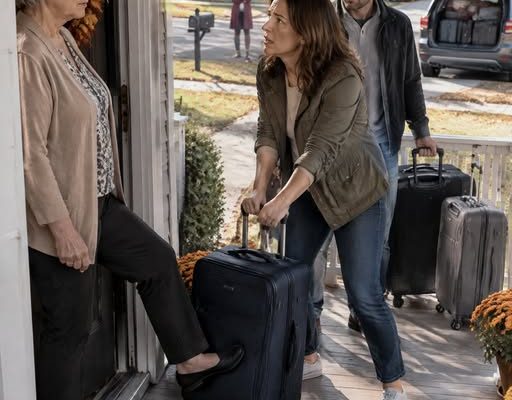
Dorothy Bennett said the words calmly as she planted one shoe against the navy suitcase that had already begun rolling across her threshold.

Amanda stopped instantly, both hands still wrapped around the handle.

Behind her, Michael stood on the porch holding two more suitcases, unable—or unwilling—to look his mother in the eye.

For several long seconds, nobody moved.

One wheel of the suitcase tapped softly against the wooden sill.

Dorothy heard that tiny sound more clearly than anything else.

Amanda slowly lifted her chin.

“What did you just say?”

Dorothy kept one hand against the white doorframe.

“You heard me.”

Amanda tugged the suitcase again.

Dorothy’s foot stayed exactly where it was.

“Move,” Amanda said.

“No.”

Michael shifted awkwardly behind his wife, one suitcase bumping against his leg.

“Mom, please.”

Dorothy looked past Amanda and directly at her son.

“No, Michael.”

His face tightened.

Amanda stared at Dorothy as though she expected her to laugh and admit this was some kind of joke.

Dorothy didn’t.

It was a bright October afternoon in suburban Columbus.

Orange leaves scraped across Dorothy’s porch.

Across the street, her neighbor Linda Harper had stopped beside her mailbox.

Two houses down, the sound of a lawn mower suddenly disappeared.

Amanda noticed.

Her expression hardened.

“We have nowhere else to go.”

Dorothy remained calm.

“That doesn’t give you the right to move into my house without asking.”

Amanda blinked.

“The right?”

“You showed up with luggage.”

“We lost our home.”

“I know.”

“You know?”

“Yes.”

“And you’re still going to leave us standing outside?”

“You came here without calling me first.”

Amanda pulled at the suitcase again.

Dorothy didn’t move.

Michael exhaled.

“Amanda, give her a minute.”

His wife spun toward him.

“We don’t have a minute anymore.”

Her voice carried across the lawn.

Linda suddenly became very interested in the grocery advertisement in her hands.

Dorothy knew she was listening.

Amanda knew it too.

Embarrassment flashed across her face.

Then anger replaced it.

“Can we at least discuss this inside?”

“No.”

Michael’s shoulders dropped.

“Mom.”

Dorothy felt that word.

For thirty-six years, she had heard every possible version of it.

Hungry.

Scared.

Excited.

Embarrassed.

This version sounded trapped.

Amanda stepped closer.

“You know what happened.”

“I know your house sale collapsed.”

“You know we lost everything.”

“I know you lost the house.”

Amanda gave a humorless laugh.

“That is everything.”

Dorothy studied her.

“No. It isn’t.”

Amanda narrowed her eyes.

Dorothy looked toward the street.

Michael’s SUV sat crooked near the curb.

Its cargo area was packed nearly to the ceiling.

Boxes filled the rear seats.

Garment bags hung from the hooks.

A rolled mattress pad was pressed against one window.

This wasn’t an emergency visit.

They hadn’t come to ask for help.

They had come to move in.

Dorothy pointed toward the vehicle.

“You packed your belongings.”

Amanda glanced back.

“So?”

“You filled the car.”

Michael looked at the porch.

“You brought suitcases.”

Dorothy lightly touched the navy case with the toe of her shoe.

“You drove here expecting to stay.”

Amanda crossed her arms.

“We’re family.”

“Family calls first.”

“We needed help.”

“Help starts with asking.”

Amanda’s cheeks reddened.

“You knew we were struggling.”

“Yes.”

“And you did nothing.”

Michael finally raised his head.

“That’s not fair.”

Amanda turned sharply.

“Michael, stay out of this.”

The words came so quickly that he stopped immediately.

Dorothy noticed.

Not just the silence.

She noticed how her son’s shoulders folded inward.

How his eyes dropped before Amanda had even finished speaking.

How naturally he surrendered his voice.

Dorothy had seen that expression before.

At Thanksgiving.

At Easter brunch.

At a summer barbecue.

Michael would begin saying something, Amanda would look at him, and somehow he would decide not to finish.

Dorothy had always explained it away.

Married couples developed habits.

They compromised.

They communicated without words.

But watching him now, Dorothy realized something.

This didn’t look like compromise.

It looked like retreat.

Amanda faced Dorothy again.

“Move your foot.”

“No.”

A dry leaf scraped across the porch between them.

Amanda looked over Dorothy’s shoulder and into the house.

It was modest, comfortable, and carefully maintained.

Family photographs covered one wall.

A small table near the entrance held a ceramic bowl for keys.

Beyond it, sunlight stretched across the hardwood floor.

A knitted blanket rested over one arm of the couch.

Amanda’s gaze moved toward the staircase.

Dorothy noticed.

“You have three bedrooms,” Amanda said.

“I’m aware of how many bedrooms my house has.”

“You only use one.”

“Yes.”

“So what is the problem?”

Dorothy tightened her fingers around the doorframe.

“The problem is that you made a decision about my home before you arrived.”

Amanda scoffed.

“We assumed you would help.”

“You were right about that.”

Amanda’s expression shifted.

Dorothy continued.

“You were wrong to assume that helping meant letting you move in.”

Michael lowered one suitcase to the porch.

It landed with a heavy thud.

“Can everybody stop for one second?”

Neither woman answered him.

Michael rubbed both hands across his face.

He looked exhausted.

For a moment, Dorothy nearly softened.

Then Amanda spoke again.

“You always make everything difficult.”

Dorothy turned toward her.

“Always?”

“Yes.”

“How?”

“You make everything about what makes you comfortable.”

Dorothy stared at her daughter-in-law.

Amanda continued.

“We just lost six hundred and twenty thousand dollars.”

The number seemed to travel across the street.

Linda lowered her grocery flyer.

Amanda saw her and immediately looked furious.

“Wonderful.”

Dorothy said nothing.

“Now the entire neighborhood knows.”

“You announced the amount.”

“You forced me to explain.”

“I didn’t force you to tell everyone the number.”

Amanda moved closer.

“Stop humiliating me.”

Dorothy almost laughed at the irony.

But nothing about this was funny.

“You brought your belongings onto my porch without permission.”

“You knew the investment failed.”

“Yes.”

“You knew the buyer backed out.”

“Yes.”

“You knew we were desperate.”

“I knew you were having problems.”

“And you did nothing.”

Michael looked up.

“Stop saying that.”

Amanda turned on him.

“I told you to stay out of this.”

Dorothy’s expression changed.

“You will not talk to him like that here.”

Amanda stared at her.

“He’s my husband.”

“And he’s an adult.”

“Exactly.”

“Then allow him to speak.”

Michael opened his mouth.

Nothing came out.

Amanda gave Dorothy a cold smile.

“See?”

Dorothy looked at her son.

He appeared miserable.

But there was something else in his expression.

Guilt.

Dorothy knew Michael’s guilty face.

She had seen it when cookies disappeared before dinner when he was seven.

When he dented the garage door at sixteen.

When his first credit-card statement arrived after college.

Back then, the guilt had come from knowing consequences were coming.

This was different.

He wasn’t simply ashamed.

He was hiding something.

Dorothy became certain of it.

“Amanda,” Michael said carefully, “maybe we should leave.”

Her head snapped toward him.

“And go where?”

“I don’t know.”

“Exactly.”

Michael looked at his mother for half a second.

Then his eyes fell again.

Dorothy could feel the secret between them.

She just didn’t know what it was yet.

Amanda grabbed the suitcase handle.

“We’re talking about this inside.”

Dorothy blocked her.

“No.”

Amanda looked down at Dorothy’s shoe, then back at her face.

“You really want to do this?”

“I’m not doing anything.”

“You’re rejecting your family.”

“I’m rejecting an uninvited move into my house.”

“That’s the same thing.”

“No, it isn’t.”

Amanda stepped closer.

“Yes, it is.”

Dorothy’s voice remained level.

“They are completely different.”

Another gust of wind carried leaves across the yard.

Somewhere nearby, a dog barked.

Dorothy could sense people watching from neighboring windows.

She hated that part.

She had lived there for nineteen years.

She knew which neighbors collected packages for one another.

Which teenagers shoveled snow for older residents.

Whose marriage had nearly ended and somehow survived.

Privacy in a neighborhood like theirs was often more illusion than reality.

But Dorothy wasn’t going to surrender control over her home simply because other people were watching.

Amanda glanced toward the houses again.

Then leaned toward Dorothy.

“You’re enjoying this.”

Dorothy’s eyes hardened.

“Enjoying what?”

“Making me beg.”

“You haven’t begged.”

Amanda recoiled.

Michael quietly said her name.

She ignored him.

Dorothy continued.

“You didn’t arrive asking for an answer. You arrived believing you already had one.”

“We had no choice.”

“You had a choice to call me.”

“You would’ve said no.”

Michael closed his eyes.

Dorothy caught it immediately.

That sentence mattered.

She looked at Amanda.

“How did you know?”

Amanda hesitated.

Only for a second.

“Because I know you.”

Dorothy turned toward Michael.

His face had gone pale.

There it was again.

Fear.

Guilt.

Knowledge.

Dorothy stored that moment away.

Amanda pushed forward.

“You have plenty of space.”

“That isn’t relevant.”

“You live here alone.”

“Also irrelevant.”

“Three bedrooms, two bathrooms, a finished basement—”

Dorothy raised her eyebrows.

Amanda stopped.

She had revealed too much.

Dorothy looked at her son.

“You discussed my basement?”

Michael rubbed the back of his neck.

“Mom, not exactly.”

Amanda interrupted.

“We discussed our options.”

“Without me.”

“We were trying to solve a problem.”

“With my house.”

Amanda threw up her hands.

“Why are you obsessed with technicalities?”

Dorothy glanced at the luggage.

“Permission is not a technicality.”

“Dorothy—”

“A locked door isn’t a technicality.”

“We’re family.”

“A boundary doesn’t disappear because we eat Christmas dinner together.”

Michael stared at the porch floor.

Amanda’s voice became colder.

“You’ve changed.”

Dorothy almost smiled.

“No.”

“Yes, you have.”

“I learned to recognize decisions disguised as requests.”

Amanda dropped her arms.

“This is unbelievable.”

Michael whispered, “She’s right about that.”

Amanda spun toward him.

“What?”

He swallowed.

“I said she’s right.”

Amanda stared.

For a second, Michael looked as if he might continue.

Then she gave him a look.

His mouth closed.

Dorothy felt her stomach tighten.

She remembered another afternoon several months earlier.

Michael and Amanda had visited in July.

Amanda criticized the way Michael parked the car.

He apologized three times.

Later, Dorothy had asked him whether everything was okay.

He smiled.

“Just stress, Mom.”

Dorothy had accepted that answer.

Now she wondered how many explanations she had accepted because questioning them would have required her to do something.

Amanda bent toward the suitcase again.

“We’re going inside.”

“No.”

“Stop saying that.”

“Then stop making the same demand.”

Michael stepped forward.

“Please.”

Dorothy looked at him.

“Please what?”

He hesitated.

“Can we at least talk somewhere the neighbors can’t watch us?”

That request softened her.

Dorothy understood his embarrassment.

But she also understood what opening the door would mean.

Once the luggage crossed the threshold, the situation would change.

Coats would come off.

Coffee would be offered.

Michael would sit on the couch, and Dorothy would see the little boy he had once been.

The suitcase would go upstairs.

Then perhaps another.

Amanda understood that too.

Dorothy remained in the doorway.

“We can talk here.”

Amanda laughed bitterly.

“How convenient.”

“No. It isn’t.”

Across the street, Linda finally went inside.

Dorothy wished that made things easier.

It didn’t.

Amanda looked toward the nearby windows again.

“You love making me look ridiculous.”

“You came here with an SUV full of possessions. The audience existed before I opened the door.”

“Stop acting superior.”

“I’m standing in my own doorway.”

“You’re acting like we’re trying to steal something.”

Dorothy looked at the packed vehicle.

“You are trying to enter someone’s home without that person agreeing.”

Amanda shook her head.

“Listen to yourself.”

“I am.”

“You sound heartless.”

The word hit Dorothy.

Amanda noticed.

So she pushed harder.

“What kind of mother does this?”

“Amanda,” Michael warned.

She ignored him.

“What kind of mother watches her son lose his home and leaves him standing outside?”

Dorothy looked at Michael.

That was the dangerous part.

Amanda’s accusation contained just enough truth to hurt.

Michael was her son.

He was struggling.

She loved him.

But none of those truths erased another truth.

This was Dorothy’s home.

She looked back at Amanda.

“The kind of mother who expects her grown son to ask before moving into her house.”

Amanda shook her head.

“Unbelievable.”

Michael sat on one suitcase.

Suddenly he looked much younger than thirty-six.

“Mom, we made a mistake.”

Dorothy’s anger shifted.

It didn’t disappear.

But it changed.

“What mistake?”

Michael glanced at Amanda.

Amanda answered for him.

“The investment.”

Dorothy kept her eyes on Michael.

“I asked my son.”

Amanda stiffened.

Michael rubbed his hands together.

“The investment was a mistake.”

Dorothy waited.

“We thought selling the house would cover more than it did.”

“I know.”

“We had a buyer,” Amanda added.

“I know.”

“They backed out.”

“I know.”

“The bridge financing became a disaster.”

“I know enough.”

Amanda frowned.

“Then why are you interrogating us?”

“Because you’re standing outside my house with everything you packed.”

Dorothy looked at Michael.

“How long were you planning to stay?”

Amanda answered immediately.

“As long as necessary.”

Dorothy didn’t look at her.

“I asked Michael.”

Amanda’s jaw tightened.

Michael inhaled slowly.

“We don’t know.”

Dorothy nodded.

There it was.

No week.

No month.

No move-out date.

No actual plan.

Amanda spread her hands.

“Why does it matter?”

“Because temporary has an ending.”

“We lost everything.”

“You lost money.”

Amanda stared.

“That feels like everything.”

“No.”

Dorothy lowered her voice.

“You both still have jobs.”

Michael nodded.

“You still own two vehicles.”

Another nod.

“You still have insurance.”

Amanda rolled her eyes.

“Wonderful.”

“You still have income.”

“Not enough.”

“You still have choices.”

“Terrible choices.”

“Terrible choices are still choices.”

Amanda stepped forward.

“You have no idea what we’ve been through.”

Dorothy didn’t answer.

She looked at Michael.

He seemed tired in a way that had nothing to do with money.

For a moment, Dorothy imagined stepping aside.

She pictured carrying the navy suitcase upstairs.

Michael sitting at her kitchen table.

Coffee brewing.

Scrambled eggs the following morning.

No more arguments tonight.

Michael had slept in that upstairs guest room during college vacations.

One of his old baseball trophies was still packed in a closet.

She remembered him at eight years old, running through the hallway in muddy shoes.

Opening the door would be easy.

That was exactly why she was afraid to do it.

Dorothy imagined the first week.

Amanda rearranging the guest bathroom.

Michael apologizing.

Dorothy telling herself not to be difficult.

Then the second week.

A shelf in the refrigerator becoming theirs.

Then two.

The basement becoming an office.

A spare key.

Mail arriving at her address.

One month becoming two.

Amanda arguing that moving again would be wasteful.

Dorothy lowering her television because Amanda had a work call.

Moving her sewing supplies from the spare room.

Coming home one afternoon and discovering furniture rearranged.

None of those things had happened yet.

Dorothy knew that.

But Amanda had already counted the bedrooms.

The bathrooms.

The basement.

Without ever asking Dorothy.

That mattered.

Dorothy looked at Michael.

“I love you.”

His expression tightened.

“I know.”

“I will help you.”

Amanda made a dismissive sound.

Dorothy ignored her.

“But letting you move into my home is not the help I’m offering.”

Michael gave a faint nod.

Amanda stared at him.

“You’re accepting this?”

“I’m listening.”

“No. You’re giving in.”

His shoulders tightened.

Amanda moved toward him.

“We talked about this.”

Michael looked at his mother.

Dorothy caught the meaning immediately.

“You talked about what?”

Amanda answered.

“Our options.”

“That answer keeps becoming less specific.”

“Because you twist everything.”

“I asked a simple question.”

Michael stood.

“Mom…”

“Yes?”

Before he could continue, Amanda interrupted.

“We knew this would happen.”

Dorothy became very still.

“Knew what?”

Amanda gestured toward her.

“This. You turning an emergency into some lecture about boundaries.”

The atmosphere changed.

Michael stared at his wife.

Amanda realized what she had revealed.

She tried to recover.

“You always do this.”

Dorothy ignored that.

“You knew I would object?”

“Oh, please.”

“How?”

“Because you’re predictable.”

Dorothy looked at Michael.

His face confirmed it.

He had known.

Her voice became softer.

“Michael, did you know I would say no?”

Amanda stepped between them.

“That’s ridiculous.”

Dorothy kept looking at him.

“Michael.”

He swallowed.

Amanda turned toward him.

“Don’t.”

One word.

Soft.

Sharp.

Michael’s eyes immediately dropped.

Something inside Dorothy hardened.

Not against her son.

Against the pattern.

“Look at me,” she said.

Michael raised his eyes.

“Did you know?”

He hesitated.

Amanda touched his arm.

“We don’t need to do this.”

Michael pulled his arm away.

The movement was tiny.

Amanda looked surprised.

Michael seemed surprised too.

“Amanda, let me speak.”

Her expression turned cold.

“We agreed.”

“Agreed to what?” Dorothy asked.

Amanda looked furious.

Michael stepped away from his wife.

“We agreed we needed somewhere to stay.”

“That isn’t what she meant,” Dorothy said.

Michael rubbed his forehead.

“I know.”

Amanda’s voice became dangerously calm.

“Michael.”

He looked at her.

Something silent passed between them.

But this time Michael didn’t immediately retreat.

Amanda tightened her jaw.

“We are not discussing this in front of your mother.”

Michael answered before Dorothy could.

“She’s already part of it.”

Amanda laughed.

“That’s exactly the problem.”

Dorothy raised an eyebrow.

“My problem?”

“You interfere.”

“You’re standing on my property.”

“That isn’t what I mean.”

“Then explain.”

Amanda pointed toward Michael.

“You make him feel guilty. One disappointed sentence from you, and suddenly he acts like he’s seventeen again.”

Michael frowned.

“That’s not fair.”

“There. You’re defending her again.”

Shame crossed his face.

Then Dorothy saw something different.

Anger.

Not sudden anger.

Old anger.

The kind that had been collecting quietly.

Amanda pointed at Dorothy.

“She has always treated you like you aren’t capable of handling your own life.”

Michael looked at his mother.

The accusation hurt.

Dorothy examined herself before answering.

Maybe she had worried too much.

Maybe she had sometimes given advice he never requested.

Maybe part of her still saw the young man he used to be.

Those things could be true.

But they didn’t change what was happening today.

“If Michael wants to talk to me about my mistakes, I’ll listen.”

Amanda blinked.

Dorothy continued.

“But my mistakes do not give either of you permission to move into my home.”

Amanda laughed bitterly.

“Everything is about permission with you.”

“Today? Yes.”

“You’re impossible.”

“Maybe.”

For half a second, Michael almost smiled.

Amanda noticed.

Her expression hardened.

Michael noticed that too.

Something changed in the silence that followed.

Amanda was no longer controlling every pause.

Dorothy looked at her son.

“What are you hiding?”

Michael froze.

Amanda answered instantly.

“Nothing.”

“I asked him.”

“He isn’t hiding anything.”

“Then he can tell me that himself.”

Michael stared down.

Amanda stepped toward Dorothy.

“You’re inventing drama because you don’t want to admit you’re selfish.”

Michael flinched.

Dorothy finally looked at Amanda.

“That’s enough.”

Amanda scoffed.

“What are you going to do?”

“Nothing dramatic.”

“Of course.”

“I’m going to keep my front door closed.”

Amanda stared at her.

“And Michael is going to decide whether he wants to tell me the truth.”

Amanda looked at him.

The entire porch seemed to hold its breath.

Michael slowly lifted his eyes.

They were wet.

Dorothy’s anger cracked.

“Son…”

Amanda sighed loudly.

“Oh, please.”

Michael turned toward her.

“Stop.”

Amanda froze.

So did Dorothy.

He hadn’t raised his voice.

He didn’t need to.

“What?” Amanda asked.

“I said stop.”

For the first time that afternoon, Amanda looked uncertain.

Michael rubbed both hands over his face.

“I can’t keep doing this.”

“Doing what?”

“This.”

“This what?”

Michael looked at the suitcases.

Then his mother.

Then Amanda.

“Pretending we didn’t already know.”

Amanda’s face emptied.

Dorothy felt her heartbeat change.

“Knew what?”

Amanda shook her head.

“Michael, don’t.”

He closed his eyes.

Then opened them.

The guilt was no longer hidden.

“I knew you would say no.”

Dorothy absorbed the words quietly.

“You knew?”

Michael nodded.

“Yes.”

“How?”

His mouth tightened.

“Because we talked about it.”

Amanda jumped in.

“Because you know your mother.”

Michael shook his head.

“No.”

She stared at him.

He continued.

“I told you she would never agree to us arriving with our belongings and simply moving in.”

Everything suddenly made sense.

The packed SUV.

Amanda knowing exactly how many bedrooms Dorothy had.

The finished basement.

The confidence with which she had walked toward the door.

Michael’s inability to meet his mother’s eyes.

“We knew this would happen.”

Dorothy felt sadness before anger.

Michael looked sick.

“I told Amanda we needed to call first.”

Amanda crossed her arms.

“We didn’t have time.”

Michael looked at her.

“We had two days.”

“We were losing our home.”

“We still had phones.”

“So now I’m the villain?”

“No.”

Michael shook his head.

“I’m telling the truth.”

“You agreed to come.”

“After arguing with you for two days.”

Dorothy briefly closed her eyes.

That didn’t make Michael innocent.

He had still gotten into the car.

Still carried the luggage.

Still participated.

But now she understood his guilt.

She looked at him.

“You knew I would refuse.”

“Yes.”

“And you came anyway.”

He swallowed.

“Yes.”

Amanda stepped forward.

“Because we had no other choice.”

Michael turned to her.

“No.”

She stared.

“No,” he repeated.

His voice shook, but he didn’t retreat.

“We had choices.”

“Name one.”

“A hotel.”

“With what money?”

“Something short-term.”

“That’s your solution?”

“I don’t know yet.”

“Exactly.”

Michael looked toward the SUV.

“We figure something out.”

Amanda’s mouth fell open.

“After everything we lost?”

“Yes.”

“You want us to waste money on a hotel because your mother won’t give us one empty bedroom?”

Michael winced.

So did Dorothy.

There it was.

The assumption finally spoken aloud.

Not assistance.

Not shelter.

Entitlement.

Michael looked at his mother.

“I’m sorry.”

Amanda made an angry noise.

He kept going.

“I should have called you.”

Dorothy remained silent.

“I shouldn’t have carried these suitcases onto the porch.”

“Michael—”

He ignored Amanda.

“I already knew your answer.”

Dorothy’s throat tightened.

“And you let her think pushing through my doorway might change it.”

He looked down.

“Yes.”

Amanda’s face turned red.

“I did not push through anything.”

Everyone looked at the navy suitcase still resting against Dorothy’s shoe.

Nobody needed to answer.

Michael walked forward.

“What are you doing?” Amanda demanded.

He reached for the suitcase.

Dorothy finally moved her foot.

Michael pulled it backward.

The wheels rolled across the threshold in reverse.

The sound was small.

But Dorothy felt it deeply.

Amanda grabbed the handle.

“Stop.”

Michael held it.

“We’re leaving.”

“No, we aren’t.”

“Yes.”

“Michael.”

He looked at her.

“We are not moving into my mother’s house.”

Amanda stared.

“You don’t get to decide that by yourself.”

Michael’s face twisted.

“That’s exactly what we tried to do to her.”

Amanda recoiled.

Dorothy said nothing.

Michael tightened his grip.

Amanda lowered her voice.

“So you’re choosing her.”

“No.”

“That’s exactly what this is.”

“No.”

“You’re choosing your mother over your wife.”

Michael looked exhausted.

“I’m choosing not to take control of someone else’s home.”

“She has three bedrooms!”

Michael closed his eyes briefly.

“I know.”

Amanda waited.

He opened them.

“And none of them belong to us.”

Tears stung Dorothy’s eyes.

Amanda looked at the remaining luggage.

Then the doorway.

Then the neighbors’ houses.

Embarrassment crossed her face again.

This time Dorothy felt no satisfaction.

Amanda had lost her home.

She had lost a tremendous amount of money.

She was frightened.

Fear could explain some of her behavior.

It did not excuse it.

Michael rolled the first suitcase toward the driveway.

Then he returned for another.

Amanda watched him.

“You’re serious.”

“Yes.”

“You’re going to put us in a hotel?”

“I’m going to find somewhere for us.”

“With what?”

“We still have jobs.”

Dorothy recognized her own words.

Amanda did too.

Michael continued.

“We still have the cars.”

Amanda looked away.

“We still have options.”

“Bad ones.”

Michael nodded.

“Bad options are still options.”

Something shifted on the porch.

Not exactly in Dorothy’s favor.

Toward reality.

Amanda no longer had Michael’s silence supporting her plan.

And Dorothy no longer had to defend her boundary alone.

Michael carried another suitcase toward the SUV.

When he returned, he looked at his mother.

“I’m sorry.”

Dorothy nodded.

“I know.”

Relief flickered across his face.

Then she added,

“But being sorry doesn’t erase what happened.”

His expression fell.

“I know.”

“You participated.”

“Yes.”

“You came here knowing how I felt.”

“Yes.”

“You allowed me to become the obstacle in a plan you already knew I had never agreed to.”

He swallowed.

“Yes.”

“You forced me to defend a boundary you already knew existed.”

His eyes dropped.

“I did.”

Dorothy’s voice softened.

“That hurt me.”

Michael looked up.

“I know.”

“No.”

She shook her head.

“I need you to actually hear me.”

He remained still.

Her eyes filled.

“I would have helped you.”

His eyes reddened.

“I know.”

“You turned help into surrender.”

Michael nodded.

“I’m sorry.”

This time, Dorothy believed he understood.

Amanda stood near the railing.

Her anger seemed to be running out of energy.

Dorothy looked at her.

“Amanda.”

Her eyes lifted.

“I know you’re scared.”

“Don’t pity me.”

“I’m not.”

“It sounds like you are.”

“I’m telling you that fear does not equal permission.”

Amanda looked away.

“You can be angry at me.”

No response.

“You can decide I’m cold.”

Still nothing.

“You can tell people I refused to let you move in.”

Amanda looked back.

“But you cannot change what happened.”

Her voice was quieter.

“And what happened?”

“You chose my house as your solution before asking the woman who owns it.”

Amanda flinched.

Dorothy took no pleasure in that.

Michael reached for the final suitcase.

Amanda kept hold of the handle.

For several seconds, husband and wife stood connected by a piece of luggage.

Neither pulled.

Amanda’s voice finally cracked.

“Where are we supposed to sleep tonight?”

Michael’s face softened.

“I don’t know yet.”

“That’s reassuring.”

“No.”

He shook his head.

“It isn’t.”

She stared at him.

“But we’ll work it out without taking something that was never offered.”

Amanda slowly released the handle.

Michael took the suitcase.

Dorothy almost opened the door wider.

The impulse came back stronger than before.

One night.

She could give them one night.

Surely one night wouldn’t hurt.

But then she remembered Amanda counting the bedrooms.

The basement.

The packed SUV.

Michael admitting they had discussed this for two days.

One night freely offered might quickly turn into something else.

Dorothy chose clarity.

“I’ll help you find somewhere.”

Amanda gave her a bitter smile.

“A motel?”

“A hotel. A short-term rental. Whatever makes sense.”

“With our money?”

“Yes.”

Amanda laughed quietly.

“I can help make calls.”

She looked skeptical.

“I can help compare options.”

“You just won’t give us a bedroom.”

“That’s correct.”

Amanda shook her head.

“At least you’re consistent.”

Dorothy accepted that.

Michael carried the final suitcase down the steps.

Suddenly, the porch seemed enormous.

Amanda remained beside Dorothy.

Without all the bags between them, everything looked different.

She glanced inside the house one more time.

Dorothy followed her gaze.

Nothing had changed.

The blanket was still on the couch.

The photographs remained untouched.

The staircase remained quiet.

Dorothy felt relieved.

Then guilty for feeling relieved.

She allowed both feelings to exist.

Amanda spoke softly.

“I really thought you would give in.”

Dorothy looked at her.

The honesty surprised both of them.

“I know.”

“How?”

“You packed everything.”

Amanda glanced toward the SUV.

“You don’t pack like that when you expect to have a conversation.”

Amanda said nothing.

“You pack like that when you expect someone to comply.”

Her eyes fell.

Michael walked back toward them.

Amanda looked at him.

“You told her.”

“Yes.”

“Everything?”

“Enough.”

Her jaw tightened.

“You made me look terrible.”

Michael shook his head.

“No.”

“You planned this.”

“You agreed.”

“Yes.”

He nodded.

“And that was wrong.”

Amanda’s eyes flashed.

“So now I’m alone?”

“No.”

“You’re acting like it.”

“I’m still your husband.”

“Could have fooled me.”

“But I’m not going to pretend what we did was okay.”

Amanda looked toward Dorothy.

Michael continued.

“I should have stopped this before we ever got into the car.”

“You could have.”

“Yes.”

“You didn’t.”

“No.”

He didn’t defend himself.

He simply stood inside his part of the blame.

Dorothy noticed.

So did Amanda.

Her shoulders finally lowered.

Michael looked at his mother.

“We’re leaving.”

Dorothy nodded.

He hesitated.

“Can I call you tonight?”

“Yes.”

Amanda looked surprised.

“But not to reopen this argument.”

“I understand.”

“Call me so I know you’re safe.”

His expression softened.

“Okay.”

“And tomorrow, if you want help working out a longer-term solution, call me.”

Amanda looked at Dorothy.

“Why would you help us?”

“Because refusing to let you move into my house doesn’t mean I want you homeless.”

Amanda didn’t seem to know what to say.

Michael looked close to tears.

Dorothy kept her voice calm.

“I meant what I said.”

“You’ll help?” Michael asked.

“Yes.”

“But not like this.”

“No.”

He nodded.

“That’s fair.”

Amanda looked irritated by the word.

Then exhaustion replaced the anger.

She stared toward their vehicle.

Six hundred and twenty thousand dollars had disappeared.

Their house was gone.

Their pride had taken a beating.

And now their marriage had a problem they could no longer ignore.

There was no victory here.

Dorothy understood that.

She had protected her home.

She had not solved their problems.

Amanda stepped down from the porch.

Then stopped.

“I thought family was supposed to catch you when you fall.”

Dorothy absorbed the sentence before answering.

“Sometimes.”

Amanda narrowed her eyes.

Dorothy continued.

“But sometimes family also has to stop you from falling through somebody else.”

Amanda stared at her.

Dorothy didn’t know whether she understood.

Maybe not yet.

Some lessons took time.

Amanda walked toward the vehicle.

Michael followed.

Dorothy stayed in the doorway.

He opened the SUV and began loading the suitcases again.

The navy one went in first.

Dorothy watched it disappear behind the boxes.

She remembered the tiny sound its wheel had made when it crossed her threshold.

Now that sound seemed like the dividing line of the entire afternoon.

Michael closed the rear door.

Amanda stood beside the passenger side without opening it.

Michael walked toward her.

They spoke quietly.

Dorothy couldn’t hear the words.

Amanda turned away.

Michael waited.

He didn’t chase her or argue.

Eventually, Amanda opened the passenger door.

Michael glanced back toward his mother.

Dorothy raised one hand.

He did the same.

Neither smiled.

That felt more honest.

Michael got behind the wheel.

The SUV remained parked for another few seconds.

Then it pulled away.

Dorothy watched until it disappeared around the corner.

Slowly, the neighborhood came back to life.

The lawn mower restarted.

A garage door opened.

A dog barked somewhere down the street.

Linda came outside again.

She didn’t cross the road.

Dorothy appreciated that.

Linda simply raised one hand.

Dorothy returned the gesture.

Nothing else needed to be said.

Dorothy looked down at her threshold.

A faint dark mark remained where the suitcase wheel had rubbed against the wood.

She crouched and touched it.

Almost nothing.

She could clean it tomorrow.

Dorothy stepped inside and closed the front door.

The latch clicked.

She leaned against it.

Only then did she cry.

Not dramatically.

No collapse.

No loud sobbing.

Just quiet tears that had waited until she was finally alone.

She cried because Michael was hurting.

Because he had lied without speaking.

Because Amanda was frightened and had turned that fear into cruelty.

And because boundaries could hurt even when they were necessary.

After several minutes, Dorothy wiped her face and walked into the kitchen.

Her phone rested beside the fruit bowl.

No messages.

She filled the kettle and turned on the burner.

The familiar routine steadied her.

She looked down the hallway.

Everything was unchanged.

That gave her peace.

And sadness.

Dorothy had never wanted to win.

She only wanted to remain herself inside her own home.

Then her phone buzzed.

She grabbed it immediately.

Michael.

Found somewhere for tonight. We’re safe.

Dorothy stared at the screen.

Another message appeared.

You were right. I should have called.

She slowly exhaled.

Then a third.

I knew you’d say no. I came anyway because I was afraid to stand up to the plan.

Dorothy read that one twice.

The truth hurt.

But suddenly everything made sense.

His lowered eyes.

His silence.

Amanda’s certainty.

The detailed knowledge of Dorothy’s home.

The packed vehicle.

Michael’s guilt hadn’t come from losing their money.

It came from knowing the boundary and helping cross it anyway.

Dorothy began typing.

Thank you for telling me the truth.

She paused.

Then sent another message.

Tomorrow we can talk about help that respects everyone involved.

His answer arrived almost immediately.

I’d like that.

Dorothy placed the phone beside the kettle.

Steam curled upward.

She poured hot water over a tea bag.

Her hands had finally stopped trembling.

Outside, the setting sun turned the October trees gold.

Dorothy carried her mug into the living room and sat beneath the knitted throw Amanda had looked at earlier.

For several minutes, she did absolutely nothing.

No television.

No phone calls.

No explanations to the neighbors.

She simply listened.

The refrigerator hummed.

A floorboard settled upstairs.

The heating system clicked on.

Ordinary sounds.

Her sounds.

Her home.

Dorothy looked toward a framed photograph near the staircase.

Michael was eighteen in it, standing beside her in his graduation gown with an enormous smile.

She touched the frame.

That afternoon had not brought that boy back.

Something more realistic had happened.

It had forced the grown man to choose.

Not between his mother and his wife.

Between avoidance and honesty.

Michael had finally admitted he knew Dorothy would refuse.

He admitted they had knowingly arrived without permission.

And most importantly, he had finally stopped carrying the luggage forward.

He had carried it back.

That didn’t repair everything.

Tomorrow would still be difficult.

Amanda might still be furious.

They still needed somewhere to live.

Their finances were still damaged.

Dorothy’s trust in her son had been wounded.

Michael and Amanda now had a conversation waiting for them that neither could avoid.

None of those problems disappeared.

Dorothy didn’t need a perfect ending.

She only needed the truth to remain standing after everyone’s anger faded.

Her phone buzzed again.

Michael had sent one last message.

Love you, Mom.

Dorothy stared at it for a moment.

Love you too.

Then she added:

Call me tomorrow.

His reply appeared almost immediately.

I will.

Dorothy placed the phone facedown.

She wrapped both hands around her warm mug.

Across the room, the front door remained closed.

For the first time all afternoon, it didn’t feel like rejection.

It felt like a boundary that had finally shown them where love could stand without losing itself.

My Son Showed Up With Luggage to Take Over My House, Then Confessed He Already Knew What I Would Say Read More

I Drove My Daughter’s Classmate to School for Free for 2 Years—When My Car Broke Down, Her Mom Refused My Child a Ride Over Her New Seats, but Karma Struck the Next Day

For two years, I never thought twice about driving my neighbor’s daughter to school.

But the first morning I needed the same small favor for my own child, one glance at my daughter’s wet shoes changed everything.

For two full years, I drove my ten-year-old daughter, Emma, and her classmate Sophie to school every weekday.

Vanessa and I never created any official arrangement.

Sophie lived four houses away.

One morning, while I was packing Emma’s lunch, Vanessa knocked on my door.

“Would you mind taking Sophie today? My Pilates class got moved and I’m already late.”

“Sure,” I said. “We’re heading there anyway.”

The next morning, she asked again.

Then again a few days later.

Eventually, nobody asked anymore.

Sophie simply started appearing at our house at 7:20 every morning with her backpack.

I honestly didn’t mind.

She was a sweet kid—quiet at first, but funny once she relaxed.

Emma liked having someone to talk to during the drive, and the school was only about five miles away.

Besides, I had always been the parent people called when something went wrong.

If Greg had to work late, I drove his daughter Mia to soccer.

When Rachel broke her ankle, I handled school pickups for her two boys for almost three weeks.

I had turned around for forgotten lunches, gym clothes, library books, and even one miserable-looking science-project bean plant.

I never kept score.

Helping people had always seemed easier than watching them struggle when I was already going in the same direction.

Still, there were signs that Vanessa viewed my kindness differently.

One Friday, Sophie failed to appear at 7:20.

I waited.

Then I texted Vanessa.

Five minutes later, she responded:

“Running behind. Can you wait?”

No apology.

Not even a “please.”

I waited anyway because leaving Sophie behind felt like punishing the wrong person.

When she finally ran outside, embarrassed and breathless, she climbed into the car.

“Sorry,” she said. “Mom couldn’t find her yoga mat.”

I remember thinking that losing a yoga mat was a strange reason to make four people late.

But traffic started moving, Emma began talking about her spelling test, and I let it go.

Vanessa always thanked me afterward.

“You’re a lifesaver, Sarah.”

She never offered gas money.

I never asked.

One afternoon, Emma asked,

“Why doesn’t Sophie’s mom ever drive us?”

We were sitting outside Vanessa’s house waiting for Sophie.

I glanced at Emma through the rearview mirror.

“Because we help people when we can.”

Emma frowned.

“But you always help. Why doesn’t anyone help you?”

I laughed.

“I don’t need help taking you to school. We’re already in the car.”

At the time, I thought I was teaching my daughter generosity.

Looking back, I was also teaching her that her mother didn’t know when generosity should stop.

Then Vanessa bought a new SUV.

It was huge.

White.

Perfectly spotless.

It looked more like a showroom display than something meant to carry a ten-year-old.

She proudly brought it over the afternoon she bought it.

“Look!”

She opened the driver’s door like she was unveiling a trophy.

I leaned inside.

“Vanessa, cream leather seats might be the worst decision you’ve ever made.”

She laughed.

“Why?”

“You have a ten-year-old.”

“Sophie knows better.”

From the passenger seat, Sophie rolled her eyes.

“I’m not even allowed to eat crackers in here.”

Vanessa pointed at her.

“Because crumbs get everywhere.”

Sophie leaned toward me.

“She made me take off my shoes yesterday because there was dirt on them.”

Vanessa groaned.

“It happened once.”

“They were barely dirty.”

“They were dirty enough.”

We laughed about it.

I assumed it was simply Vanessa being overly protective of her brand-new car.

For the next week, the SUV became almost the only thing she talked about.

The cameras.

Heated steering wheel.

Paint coating.

Interior protection.

I joked that she loved the SUV more than Sophie.

Vanessa laughed.

“The SUV doesn’t leave granola wrappers in the back seat.”

Everything still felt friendly.

Until the following Thursday.

I woke to rain pounding against the windows.

Emma came into the kitchen already dressed.

“Mom, it’s flooding.”

“It’s raining.”

“The street is basically a river.”

“The street is wet.”

She pulled back the curtain dramatically.

“Look!”

I grabbed my keys.

“Get your raincoat. We’ll pick Sophie up so she doesn’t have to walk through this.”

I ran outside and tried to start my fourteen-year-old Honda.

Nothing.

I turned the key again.

Still nothing.

My stomach tightened.

I knew the battery had been weakening, but I had been hoping it would survive until payday.

I tried my portable jump starter.

Nothing.

School started in twenty-five minutes.

And suddenly being late wasn’t my biggest problem.

I needed that car for work too.

There wasn’t a bus route that could get me across town on time, and several days of rideshares would eat through the money I was trying to save for repairs.

Emma stood beneath the porch roof.

“Are we going to be late?”

“Probably.”

Then I remembered Vanessa.

Four houses away.

Brand-new SUV.

Same school.

Same morning.

I called.

She answered after several rings.

“Hey.”

“Vanessa, my car is dead. Could Emma ride with you and Sophie just this once? I’ll deal with my car today.”

There was a brief pause.

“Fine. Have her ready.”

Relief flooded through me.

“Thank you.”

I looked at Emma.

“Vanessa’s taking you.”

Emma blinked.

“Really?”

“Why do you sound surprised?”

She shrugged and picked up her backpack.

By the time Vanessa’s SUV pulled up, the rain had become even heavier.

Emma waited at the curb beneath an umbrella.

The wind blew rain underneath it, soaking the bottom of her jeans.

One sneaker splashed into a shallow puddle.

Vanessa lowered the passenger-side window.

“Thank you so much!” I called.

Her expression changed the moment she looked down at Emma’s shoes.

“Oh.”

She stared at the wet sneakers.

“No.”

Her eyes shifted toward the cream-colored seats behind her.

“She’s soaked. I just bought this car. I can’t have mud all over the interior.”

Emma quietly moved one foot behind the other.

I walked closer.

“Vanessa, I’ve driven Sophie to school every morning for two years. I’m asking you for one ride.”

She sighed.

“Sarah, don’t turn this into something huge. I didn’t spend this much money on a car so somebody else’s kid could ruin it.”

From the back seat, Sophie immediately protested.

“Mom—”

“Sophie, stay out of it.”

Emma’s cheeks turned red.

“Mom, it’s okay.”

Those words hurt more than anything Vanessa had said.

My ten-year-old daughter was trying to make herself smaller because her shoes were wet.

I put my hand on her shoulder.

“Okay. Come inside.”

Vanessa drove away.

Sophie twisted around in the back seat and watched us through the rear window.

Inside, Emma removed her sneakers beside the door.

“I’m sorry,” she whispered. “If I hadn’t stepped in the puddle—”

“No.”

I crouched beside her.

“Emma, you did absolutely nothing wrong.”

Her eyes filled with tears anyway.

Then her phone buzzed.

She read the message and handed it to me.

It was from Sophie.

“I’m sorry. I told Mom you could sit on my jacket. She told me to stop arguing.”

That changed something.

Until then, part of me had still been trying to excuse Vanessa.

Maybe she had panicked over the new car.

Maybe she had made one selfish decision.

But Sophie had given her another chance to reconsider.

She hadn’t.

I ordered a rideshare.

The price made my stomach sink.

Money was already tight, and now I had a dead vehicle on top of everything else.

Emma arrived at school twenty minutes late.

That evening, I sat at my kitchen table looking through repair estimates.

Even the cheapest ones made me nervous.

Then my phone buzzed.

Vanessa.

“Car fixed? Sophie needs picking up at 7:20 tomorrow. I have Pilates.”

I stared at the message.

Not:

“Did Emma make it to school?”

Not:

“Is your car okay?”

Not even:

“Sorry about this morning.”

She simply wanted to know whether I would still be available to drive her daughter.

I placed the phone facedown.

For the first time in two years, I didn’t answer.

And I made one decision.

Even if my Honda magically started the next morning, Sophie would not be waiting in my driveway at 7:20.

I hated the idea of Sophie getting caught in the middle.

But that was exactly how I had justified saying yes for years.

Every inconvenience would affect the child unless I stepped in and absorbed it first.

This time, Vanessa would have to solve her own morning.

I expected an angry text.

What I didn’t expect was someone pounding on my front door before seven the next morning.

When I opened it, Vanessa was standing on my porch completely soaked.

Her hair clung to her face.

Her expression was furious.

“What the hell did you do?”

I stared at her.

“What are you talking about?”

She pointed toward the street.

I stepped outside.

About fifteen children had gathered around Vanessa’s spotless white SUV.

Half a dozen parents stood behind them.

Handmade signs rose above raincoats and umbrellas.

A few backpacks sat on the wet grass.

Two cars idled nearby, ready to take children to school.

And Vanessa’s precious SUV sat directly in the middle of everything.

Rain soaked through the cardboard signs.

One read:

EMMA CAN RIDE WITH US.

Another:

IT WAS JUST RAIN.

Blue marker ran down one sign that said:

SEATS CAN DRY.

Vanessa stood in the rain while the cream leather she had protected so fiercely remained perfectly dry behind tinted windows.

Sophie stood several feet away from her mother, clutching one backpack strap.

I recognized almost every child.

Mia from soccer.

Rachel’s boys.

Kids I had picked up, waited for, driven home, or squeezed into my Honda whenever another parent’s plans fell apart.

Rachel raised her voice from beneath an umbrella.

“Emma can ride with us.”

Greg lifted his coffee.

“With us too.”

I covered my face.

“Oh my God.”

Vanessa spun toward me.

“Don’t pretend you didn’t organize this!”

“I didn’t.”

Behind me, Emma stepped onto the porch.

She saw the crowd and went pale.

“Oh no.”

I looked at her.

“What happened yesterday at school?”

“People asked why I was late. I told them the car broke down and Mrs. Vanessa wouldn’t let me ride because my shoes were wet.”

A boy near the mailbox shouted,

“They weren’t even muddy!”

Sophie appeared at the edge of the group.

Her eyes were red.

One girl muttered,

“Her mom is horrible.”

Emma immediately turned toward her.

“Don’t.”

The girl blinked.

Another child said,

“But Sophie gets rides from your mom every day. That isn’t fair.”

Sophie stared down.

Emma crossed the lawn.

“She didn’t ask her mom to do that.”

Then she took Sophie’s hand.

“Her mom made the decision. Sophie didn’t.”

Sophie looked toward Vanessa.

“I told you Emma could sit with me, Mom.”

Vanessa’s jaw tightened.

So did my throat.

I stepped forward.

“Okay, everyone. I appreciate that you wanted to defend Emma, but nobody gangs up on Vanessa, and nobody blames Sophie. Understand?”

The signs slowly lowered.

Greg walked closer.

“For what it’s worth, the kids organized this themselves. Mia came home angry. Rachel’s boys heard about it. Then the group chat exploded.”

Rachel folded her arms.

“My boys rode in Sarah’s car for nineteen school days when I broke my ankle. Do you know how many times she checked whether their shoes were clean?”

She paused.

“Zero.”

Vanessa looked around.

“This is completely out of proportion.”

Rachel shook her head.

“Sarah never made helping any of us into a big deal.”

Vanessa quickly replied,

“Exactly! Sarah never complained about driving Sophie.”

I almost laughed.

“Because it was a favor, Vanessa.”

I looked directly at her.

“My silence didn’t turn that favor into something you were entitled to.”

Greg asked,

“Did you really refuse Emma a ride?”

Vanessa shifted.

“It wasn’t that simple.”

I answered for her.

“She left my ten-year-old standing in the rain because she didn’t want wet shoes inside her new SUV.”

Vanessa looked away.

Then Sophie asked quietly,

“Am I not allowed to ride with you anymore? Is Emma mad at me?”

Emma immediately squeezed her hand.

“No.”

I crouched in front of Sophie.

“You didn’t do anything wrong, sweetheart. If you ever genuinely need help, I’ll help you.”

Then I stood.

“But the automatic daily rides are over.”

Sophie looked disappointed.

Vanessa looked furious.

“Sarah, I have Pilates at seven. Tuesdays I go directly to work, and Thursdays I have a client call. I can’t just rearrange every morning.”

“You’ll figure it out.”

She stared.

“Fine. What about Monday, Wednesday, and Friday?”

For half a second, my brain started doing what it had always done.

Rearranging my life.

Maybe Monday.

Possibly Friday.

Then I stopped myself.

“No.”

Her face tightened.

“For two years, I did you a favor. Somewhere along the way, you stopped recognizing it as one.”

“So you’re punishing Sophie because you’re angry with me?”

“No.”

I shook my head.

“Sophie isn’t being punished. You’re simply being asked to take responsibility for getting your own daughter to school.”

I paused.

“The daily rides are finished.”

For once, Vanessa had nothing to say.

Then Greg glanced toward my Honda.

“What happened to your car?”

“Battery. Maybe the alternator too.”

Before I could say anything else, Rachel offered to pay for a battery.

Greg was already calling a mechanic he trusted.

“I can’t let you do that.”

Rachel looked at me.

“Yes, you can.”

Then she smiled.

“You helped all of us without asking for anything. We’re just returning the favor.”

Several other parents offered to contribute before I could stop them.

And suddenly I remembered something Emma had asked months earlier.

“Why doesn’t anyone help you?”

Two days later, my Honda was back in the driveway.

New battery.

Repaired alternator.

Running perfectly.

Not because I demanded anything.

Not because I reminded anyone what I had done for them.

But because some people understood something Vanessa had forgotten.

Kindness is a gift.

Not a subscription.

And when someone gives it freely for years, the least you can do is remember that they were never obligated to keep giving forever.

I Drove My Daughter’s Classmate to School for Free for 2 Years—When My Car Broke Down, Her Mom Refused My Child a Ride Over Her New Seats, but Karma Struck the Next Day Read More

Thirteen years after my husband walked out on me and our children for another woman, we met face-to-face at the state’s most prestigious academic championship. He looked at me with pure contempt and snapped, “How dare you show up here?”

The first time I saw my ex-husband in thirteen years, he was standing beneath a banner that read:

**STATE ACADEMIC CHAMPIONSHIP**

He was smiling like a man who had never walked away from two newborn sons and left them behind in a nearly empty apartment.

Then his eyes found me.

And the smile disappeared.

“How dare you show your face here?” Nathan Crowe snapped.

The lobby of the Grand Whitmore Convention Center seemed to quiet around us.

Parents in tailored coats turned to look.

Students clutched folders against their chests.

Local news cameras hovered near the registration tables, waiting for proud-family moments.

Nathan stepped directly into my path as if he still had some right to control where I stood.

At forty-six, he had polished himself into the kind of man strangers trusted too quickly.

Expensive suit.

Silver watch.

Perfect smile.

Beside him stood Celeste, the woman he had left me for.

She wore a cream blazer and a diamond necklace that looked heavy enough to pull her shoulders down.

Between them stood their son, Preston.

I already knew his name.

Everyone did.

Preston Crowe.

Math prodigy.

Debate champion.

Future valedictorian.

Nathan’s pride and joy.

Nathan looked me up and down.

Plain navy dress.

Old leather tote.

Nothing flashy.

“This is an invitational event, Mara,” he said. “Not a charity gathering.”

Celeste gave a small laugh.

“Nathan, don’t be rude. Maybe she’s working catering.”

My fingers tightened once around the registration envelope in my hand.

Behind me, my sons became very still.

Eli and Ethan were sixteen now.

Tall.

Quiet.

Dark-haired.

They had Nathan’s cheekbones and my eyes.

The last time Nathan had seen them, they were three years old.

They had been sick, tired, and crying on a courthouse bench while he signed away his visitation rights because Celeste didn’t want to “inherit drama.”

Now he looked directly past them.

Not even a flicker of recognition.

Ethan leaned toward me.

“Mom?”

“I’m okay,” I whispered.

Nathan smirked.

“Listen carefully. Preston has worked too hard to have this day ruined by old mistakes.”

Old mistakes.

Thirteen years of missed birthdays.

Thirteen years of unpaid child support.

Thirteen years of double shifts.

Night classes.

Scholarships.

Two little boys repeatedly asking why their father never called.

I opened my envelope.

Removed three official badges.

Then clipped one onto my dress.

Nathan’s face changed.

Because the badge didn’t say:

**Parent.**

It said:

**Dr. Mara Ellis — State Academic Integrity Board, Final Round Compliance Chair.**

I smiled.

“Good morning, Nathan.”

Then I walked past him.

“Try not to embarrass yourself before the opening ceremony.”

For the first time since I had known him, Nathan Crowe had nothing clever to say.

Celeste recovered first.

Her eyes dropped toward my badge.

“That has to be some temporary volunteer position.”

“It isn’t.”

Nathan forced out a laugh.

“Mara always loved pretending she mattered.”

Eli stepped forward.

“She does matter.”

Nathan looked at him like a piece of furniture had suddenly spoken.

“And who are you?”

My son’s jaw tightened.

But his voice remained calm.

“A competitor.”

Nathan smiled condescendingly.

“Then learn something early. Talent is rare. Confidence is even rarer. Don’t waste either standing behind someone else’s bitterness.”

Ethan gave the smallest smile.

“We’ll remember that.”

The opening bell rang.

Students began moving toward the competition rooms.

Preston walked past my sons.

“Good luck,” he said. “You’re going to need it.”

Eli simply nodded.

Ethan adjusted his glasses.

My boys had never been flashy.

While Preston gave interviews and posed for scholarship newsletters, Eli and Ethan worked quietly.

They solved calculus problems on diner napkins.

Built robotics projects from secondhand parts.

Practiced quiz rounds using an old kitchen timer with a cracked screen.

What Nathan didn’t know was that the championship had five divisions.

Mathematics.

Science.

Debate.

Engineering design.

Academic bowl.

No single student had ever swept all five.

No pair of twins had ever reached the finals in all five together.

My sons had.

And I knew something else Nathan didn’t.

Two months earlier, the board had asked me to investigate complaints involving Crowe Preparatory.

Anonymous tips.

Unusual score jumps.

Leaked preparation material.

A donor parent pressuring judges.

Essays that sounded suspiciously like they had been written by an adult professional.

At first, I had no idea Nathan was connected.

Then I opened the first financial record.

His company email was attached to a payment.

By noon, Preston had won his preliminary debate round.

Nathan made sure everyone knew it.

Near the coffee station, he announced loudly,

“That’s what real investment looks like. Children don’t succeed on love and coupons.”

Celeste touched his sleeve.

“Some mothers raise their children to survive.”

She smiled.

“We raised ours to win.”

I slowly stirred my coffee.

Nathan leaned closer.

“Does it hurt, Mara?”

He nodded toward Preston.

“Seeing what a son becomes when he has a real father?”

Behind him, the semifinal rankings appeared on a large monitor.

**Mathematics: Ethan Ellis — First.**

**Engineering Design: Eli Ellis — First.**

**Academic Bowl Team Placement: Ellis Twins — First Seed.**

Celeste noticed first.

Her lips parted.

Nathan turned.

Read the names.

Then frowned.

“Ellis?”

“Yes,” I said softly.

“Mine.”

His eyes moved across the lobby toward Eli and Ethan.

They stood beneath the rankings screen.

Calm.

Unspeaking.

For one second, I saw recognition trying to reach his face.

Then he rejected it.

“No.”

He shook his head.

“That’s impossible.”

Ethan looked directly at him.

“You signed the papers, Mr. Crowe.”

He paused.

“You should remember.”

Nathan’s face drained of color.

Celeste turned sharply toward him.

“Nathan?”

He grabbed my arm.

I looked down at his hand.

“Remove it.”

“You brought them here to humiliate me,” he hissed.

“No.”

I pulled my arm free.

“You managed that yourself.”

His eyes were wild now.

“Preston will still win the Governor’s Cup. That’s the only thing anyone will remember.”

I glanced toward the judges’ hallway.

Three board officials were already waiting for my signal.

“You’re right.”

I smiled faintly.

“People do remember the final round.”

Then I walked away.

The final round was held in a ballroom filled with chandeliers, cameras, students, teachers, and parents.

At center stage sat the silver Governor’s Cup.

Nathan took a front-row seat like a king waiting for tribute.

Preston looked different now.

Pale.

Tense.

For the first time all day, his confidence had cracks in it.

The academic bowl began.

Literature.

Physics.

Constitutional law.

Probability.

World history.

Eli answered first.

“Correct.”

Then Ethan.

“Correct.”

Then both of them moved through the lightning round so cleanly that whispers started spreading through the audience before the scoreboard could keep up.

Preston buzzed too early twice.

Missed both questions.

Then stared down at his hands.

When the final bell sounded, the screen changed.

**FIRST PLACE OVERALL: ELI ELLIS AND ETHAN ELLIS.**

The ballroom erupted.

I stood.

Clapping.

Crying.

Not even trying to hide it.

My sons looked toward me.

Not the trophy.

Not the cameras.

Not the judges.

Me.

Then the moderator lifted another envelope.

“Before the awards are presented, the State Academic Integrity Board has a statement.”

Nathan stopped clapping.

I walked onto the stage.

A murmur moved through the ballroom.

I stepped behind the microphone.

“My name is Dr. Mara Ellis.”

“This year, the board received credible reports of improper influence, unauthorized access to protected preparation material, and financial pressure involving one competing school.”

Nathan rose halfway out of his seat.

“This is outrageous!”

I pressed a button.

The screen behind me changed.

I had been careful.

No unnecessary student information.

No public humiliation of Preston beyond what the evidence supported.

Only adult conduct.

A payment from Nathan Crowe to a former testing contractor.

Emails requesting “advance topic familiarity.”

A message from Celeste to a debate coach.

**Make sure Preston doesn’t get blindsided. Nathan paid enough.**

Gasps spread through the ballroom.

Celeste went pale.

Nathan shouted,

“Those are fake!”

I looked directly at him.

“They were authenticated by the state auditor this morning.”

Two officials stepped into his row.

One represented the academic board.

The other was from the attorney general’s office.

Preston looked toward his father.

“Dad?”

That single word changed the atmosphere.

For the first time, Nathan didn’t look powerful.

He looked exposed.

I turned back toward the audience.

“The student will not be accused of misconduct beyond what the evidence supports.”

I paused.

“But Crowe Preparatory’s submission is disqualified from the Governor’s Cup, and the adults named in the report are suspended pending formal review.”

Celeste covered her mouth.

Nathan stepped into the aisle.

“You vindictive—”

Eli stood.

Not aggressively.

Not dramatically.

He simply stood.

Then Ethan stood beside him.

Nathan froze.

And for the first time that day, he truly looked at them.

Not toddlers.

Not burdens.

Not “old mistakes.”

Young men.

His sons.

Ethan spoke first.

“You taught us something today.”

Nathan swallowed.

Then Eli finished.

“That being abandoned by you didn’t stop us from becoming who we were meant to be.”

The ballroom went completely silent.

Then applause began.

Teachers.

Parents.

Students.

Judges.

It grew louder and louder.

My sons were called onto the stage.

The Governor’s Cup was placed between them.

And when the photographer asked for a picture, Eli and Ethan pulled me between them.

Nathan was escorted out before the ceremony ended.

Celeste followed behind him, crying into her phone.

Six months later, Crowe Preparatory faced a state accreditation review.

Nathan resigned from his company after the donor scandal became public.

My old child-support case was reopened.

Thirteen years of unpaid support became a legal judgment against assets he had spent years protecting.

Preston quietly transferred to another school.

I heard that he stopped competing for a while.

And genuinely, I hoped he found a way to build a life that wasn’t measured entirely by his father’s ambition.

Eli and Ethan accepted full scholarships to the state science academy.

On move-in day, they carried their own boxes into the dorm while I stood near the car pretending I wasn’t crying.

Ethan hugged me first.

“We did this because of you.”

Eli kissed my forehead.

“He missed everything.”

I looked across the bright campus.

At my sons walking toward a future they had earned themselves.

“No,” I said softly.

They turned around.

I smiled.

“He didn’t miss everything.”

I paused.

“He missed the only thing that mattered.”

Thirteen years after my husband walked out on me and our children for another woman, we met face-to-face at the state’s most prestigious academic championship. He looked at me with pure contempt and snapped, “How dare you show up here?” Read More

At 12:43 AM, my crying daughter called from the curb: “Grandpa threw all my things outside to clear space for my cousin, and Dad didn’t do anything.” Leaving my hospital shift right away, I rushed home to face my father-in-law’s sneer: “We make the rules here.” Those arrogant relatives thought they won, until I tossed the house deed onto the table and kicked the whole family out at midnight.

Part 1. The Midnight Call

At 12:43 a.m., my sixteen-year-old daughter, Emma, called me from the curb outside our own house.

“Grandpa said my room belongs to Olivia now,” she whispered.

I was working a night shift as an ER nurse at Portland General, still wearing one blue glove in the medication room. Behind Emma’s voice, I heard rain, passing tires, and the thin crinkle of a plastic grocery bag.

Inside the bag were her pajamas, backpack, and schoolbooks. My mother-in-law, Marlene Hart, had packed them and told Emma she was being dramatic.

When I asked where her father was, Emma said Daniel was standing on the porch and “didn’t want to get in the middle.”

That sentence told me everything.

I sent Emma to Mrs. Ellis next door, handed off my patients, and drove home through freezing rain.

When I arrived, Gerald and Marlene Hart stood in my foyer like they owned the place. Behind them, my seventeen-year-old niece, Olivia, clutched Emma’s favorite comforter. Daniel stood by the stairs, pale and silent.

Marlene announced that Olivia needed stability and Emma could stay with friends for a few days.

“In her own house?” I asked.

Gerald claimed Daniel’s name was on the mailbox and that his parents had a right to make family decisions.

“His name is on the mailbox,” I said. “Not on the deed.”

Then I pulled out the documents my father had left me: deed, mortgage release, tax records. Every page carried one name.

Rachel Moore.

Not Hart.

This was my house. My father had bought it before I met Daniel. I had allowed Gerald and Marlene to stay after their condo flooded and allowed Olivia to stay after her mother’s rehab placement.

I had never given them permission to evict my daughter from her own bed.

Part 2. The CPS Letter

While waiting for police, I found a crumpled letter from Child Protective Services buried near the recycling bin. It was addressed to Gerald and Marlene.

Olivia’s mother had not simply entered rehab. She had relapsed, disappeared from her halfway house, and was facing termination of parental rights.

The highlighted section explained everything: before Gerald and Marlene could gain permanent custody, CPS needed to inspect the proposed home and confirm Olivia had adequate, private, permanent sleeping quarters.

Emma’s room was the largest bedroom in the house.

They were not being generous.

They were staging my home to pass inspection, gain custody of Olivia, and secure the monthly state stipend that came with it.

When Officer Nolan Pierce arrived, I gave him my ID, the deed, and the property tax records. Then I pointed to Emma’s grocery bag on the floor.

Daniel admitted the situation had “got complicated.”

“No,” I said. “It did not.”

Because Gerald and Marlene had lived there for more than two months, the officer said I needed a formal eviction to remove them. But he made one thing clear: they had no right to lock a minor out of her legal residence.

Emma returned to her room that night.

I changed her sheets myself.

“I didn’t do anything wrong,” she whispered.

“No, sweetheart. You didn’t.”

Then she said the sentence I could not soften.

“Dad didn’t stop them.”

“I know,” I answered.

The next morning, I called a lawyer, changed the Wi-Fi password, and served Gerald and Marlene a thirty-day notice to vacate.

Part 3. The Fake Roof Claim

I expected tears, rage, and guilt trips.

Instead, Gerald smiled.

Two hours later, a courier delivered a lawsuit and a mechanic’s lien. Gerald claimed he had paid fifteen thousand dollars for my roof ten years earlier, giving him an “equitable interest” in the property. His lawyer warned that any eviction would be blocked while ownership was disputed.

They were holding my house hostage.

When Daniel read the papers, he hesitated.

“Maybe we just let them stay until the condo—”

“They are not waiting for the condo,” I snapped, showing him the CPS letter. “They are stealing Emma’s room to pass a custody inspection.”

Daniel went pale but still said he remembered his father writing the roofing check.

That hurt worse than the lawsuit.

Gerald had not paid for the roof. My father had. Gerald had only handed the check to the contractor because my dad was in the hospital.

My lawyer, Nora Whitfield, explained the strategy clearly. Gerald’s lien was weak, but his ownership claim could stall eviction long enough for the CPS inspection.

To beat him, I needed proof that my father’s money had funded the roof.

So I searched the attic for days between exhausting hospital shifts, digging through old tax boxes and bank papers while Gerald and Marlene launched a campaign inside the house. Marlene cried loudly whenever Emma passed by. Gerald called relatives from the porch, claiming I was throwing elderly family and an orphaned child onto the street before the holidays.

Then Marlene crossed another line.

Part 4. Emma Speaks

One night, I found Marlene spreading glossy photographs across the dining table.

They were pictures of Emma’s bedroom: her closet, drawers, desk, clothes, and private belongings.

Marlene said she was documenting how selfish Emma was because Olivia owned almost nothing while Emma had a full room.

Emma walked in and froze.

Marlene looked straight at her and said people who had more needed to share.

I gathered the photos, ripped them in half, and threw them away.

Then Emma finally spoke.

She said she had offered Olivia half her closet, given her a blue coat, let her use her laptop, and moved her art supplies so Olivia could have desk space.

“I didn’t say no to sharing,” Emma said. “I said no when Grandma told me to sleep on a broken couch in the basement because my room was more useful to her plans.”

Olivia, who had been listening from the hallway, burst into tears and ran upstairs.

Four days later, I found what I needed: a carbon copy of my father’s cashier’s check to the roofing company and a matching withdrawal slip from his savings account.

I sent it to Nora.

Her reply came minutes later: the lien was dead, the lawsuit was frivolous, and she was filing for emergency expedited eviction based on harassment and fraud.

Part 5. The Fake Heart Attack

When the expedited order came through, I entered the kitchen and dropped it beside Gerald’s plate.

“You have two hours to pack. The sheriff arrives at noon.”

Gerald panicked and looked to Daniel.

“Son, you aren’t going to let her do this.”

Before Daniel could answer, Marlene dropped to the floor, clutching her chest and screaming that the stress was killing her.

Daniel grabbed his phone to call 911.

I told him to put it down.

I had worked fourteen years in emergency medicine. I knew what a heart attack looked like. I also knew what bad acting looked like.

I checked Marlene’s pulse. It was strong, regular, and normal. Her skin was warm and dry. Her lips were pink. There was no sign of cardiac distress.

Then I told her exactly what would happen if she forced an ambulance call: paramedics would document that she was medically stable and that the episode appeared staged to delay a legal eviction.

Her fake gasping stopped immediately.

Daniel saw it.

For the first time, he understood that his parents had lied about the room, lied about the roof, and were now using his fear to keep control.

“I froze,” he whispered.

“Yes,” I said. “And Emma paid for it.”

That was the moment Daniel finally stepped forward.

He told his parents they had one hour to pack. If they were not gone by noon, he would help the sheriff carry their bags to the curb.

When Gerald tried to intimidate him, Daniel did not step back.

“If you contact Emma without permission or spread another lie about my wife,” he said, “we will bury you in court.”

The word “we” changed the room.

I did not forgive him in that moment.

But for the first time, he stood between his parents and the hallway leading to our daughter’s room.

Part 6. Olivia’s Choice

Gerald and Marlene left without saying goodbye.

Olivia was the last to go.

She stood near the front door in her thin jacket, then looked up at Emma on the stairs.

“I really am sorry,” she said.

Emma nodded.

Then Olivia handed her a folded paper through the banister.

It was a copy of her school registration form. She had listed her Aunt Hannah’s address in New Hampshire as her permanent residence—not our house.

CPS would see it on Monday.

Olivia had destroyed her grandparents’ custody scheme from the inside.

“I hope nobody ever makes you feel like you have to disappear again,” she whispered before leaving.

That evening, I took Emma to buy a heavy brass lock for her bedroom door.

Daniel installed it himself. When he finished, he handed Emma the new key.

“I should have protected you that night,” he said.

Emma took the key.

“Yeah. You should have.”

He apologized.

She did not hug him. She did not say it was okay, because it was not. But she kept the key on her bedside table and did not ask him to leave.

It was a beginning.

Part 7. The Boundary Becomes Real

Relatives soon flooded our phones with messages about forgiveness and family unity.

I ended it with one mass email. I attached the police timeline, the fraudulent lien, and one sentence:

Emma was locked out of her legal residence in freezing rain at midnight so her room could be used to commit state fraud. Any version that leaves that out is a lie.

The messages stopped.

Thanksgiving was quiet. Just the three of us, store-bought pie, and no one demanding anything. Emma wore her new room key on a silver chain—not because she feared us, but because it reminded her that her boundaries were finally real.

Daniel began intensive therapy. In January, he wrote Emma a letter admitting his failure as a father without asking for forgiveness. She kept it in her desk drawer.

By spring, Gerald and Marlene’s custody bid collapsed, helped by Olivia’s address change. Olivia moved to New Hampshire with Aunt Hannah. Gerald and Marlene sold their condo and moved away, blaming the weather instead of the bridges they had burned.

A year later, I came home from a hospital shift and saw Emma sitting on the curb.

For one breathless second, I was back at that terrible night.

Then I saw her sketchbook.

She was drawing our house, especially her second-story bedroom window.

“That night felt like the end of the world,” she said. “Now it feels like the night we figured out who was actually going to show up for me.”

I looked at the house my father had left me, the room my daughter had reclaimed, and the husband inside learning to become a shield instead of a shadow.

For once, no one in that house was waiting to take anything from her.

At 12:43 AM, my crying daughter called from the curb: “Grandpa threw all my things outside to clear space for my cousin, and Dad didn’t do anything.” Leaving my hospital shift right away, I rushed home to face my father-in-law’s sneer: “We make the rules here.” Those arrogant relatives thought they won, until I tossed the house deed onto the table and kicked the whole family out at midnight. Read More

At 30,000 feet, my doorbell camera alerted me to a terrible sight: my mother-in-law dragging my daughter across the driveway while my wife filmed and laughed, and her sisters poured liquids on my crying child. I immediately turned my private jet around, contacted my former military squad, and 3 hours and 41 minutes later, total chaos hit their doorstep.

1. The Camera Alarm

At thirty thousand feet, Colonel Elias Reed was reviewing classified deployment files when his personal phone flashed with a security alert from his home in Fairfield. At first, he assumed it was a delivery or a neighborhood animal. Then the second alert opened the live front-door camera.

His eight-year-old daughter, Lily, was on the driveway in her pajamas, terrified and trying to get away while her grandmother, Marlene, dragged her across the concrete. Marlene shouted for Lily to scream for her father and mocked the idea that he could come home to save her.

Elias’s wife, Claire, stood nearby filming with her phone and smiling. Around them, Claire’s sisters—Tessa, Brooke, and Natalie—circled Lily like they were performing some cruel joke. Brooke held a red fuel can and poured a strong-smelling liquid onto Lily’s clothes, making the child believe she was in terrible danger.

Elias ordered the pilot to divert immediately to the nearest military airfield. When the pilot hesitated, Elias displayed his command authorization and declared an emergency domestic threat involving his minor daughter.

Then he called Garrett Stone, his former special operations chief, and sent him the live feed, gate codes, floor plan, and custody documents. Next, Elias contacted local police, his family attorney, child protective services, and his neighbor, Mrs. Archer.

Mrs. Archer answered in tears. She had heard Lily screaming and said the women had just dragged her inside.

As the aircraft banked toward Connecticut, Elias understood that the war he thought he had left overseas had followed him home.

2. The House Under Siege

Three hours later, Elias landed at Bradley Air Force Base. Garrett met him on the tarmac beside two black SUVs and told him the women were still inside the house. Worse, parts of the video had already been posted online by Claire’s family.

With police clearing intersections, Elias reached Oak Ridge Lane in record time. The quiet neighborhood looked untouched, but his house was surrounded by police, crime-scene tape, and officers taking statements.

Lieutenant Harris stopped him at the walkway and warned him to remain calm. Elias asked only one question: where was Lily? Harris confirmed she was alive, conscious, and being checked by paramedics.

Then Lily’s voice called from inside.

Elias pushed past the officers and entered the house.

Lily sat on the living-room sofa wrapped in an emergency blanket, shaken and crying. When she saw him, she ran into his arms and told him she had screamed as loudly as she could. Elias held her and promised he had heard her.

Claire stood near the fireplace, still angry rather than sorry. Marlene was handcuffed in a dining chair, and the three sisters were lined against the wall as officers searched their bags.

When Lily whispered that her mother had laughed at her, the entire room went silent.

Elias ordered every phone, tablet, online account, and recording device seized as evidence. Claire tried to dismiss the event as a “practical joke.”

Elias looked at her and said he did not need to destroy her life. She had already done it on camera.

Then he carried Lily out of the house.

3. The Neighbor’s Refuge

Elias did not keep Lily in the house that night because she asked to leave. She said she did not want to stay anywhere that smelled like them.

He took her across the lawn to Mrs. Archer’s home. The elderly neighbor had prepared a blanket, cocoa, and an orange stuffed cat for Lily. The child curled against Elias, clutching the toy and his sleeve while police continued collecting evidence across the street.

Mrs. Archer had not stayed silent. She called emergency services twice, recorded the incident from her window, and shouted for the women to stop even after Marlene threatened her.

Detective Rowan Price interviewed Elias and documented the family history. There had been no previous incident that severe, but the house had grown toxic. Claire resented Elias’s military promotion. Marlene complained that Lily was too attached to her father. Claire’s sisters mocked Lily for being quiet, liking science, and playing chess with Elias.

A child services representative arrived that night with emergency paperwork. Claire was barred from contacting Lily until a judge reviewed the case.

When Lily asked whether her mother was coming back, Elias told her no one would be allowed near her unless a judge said it was safe. Lily then revealed that Claire had called her a liar and said no one would believe her.

Elias answered clearly: Mrs. Archer believed her, the police believed her, the doctors believed her, and he would always believe her.

4. The Messages They Deleted

By midnight, Claire, Marlene, Tessa, Brooke, and Natalie had all been taken to the police station. The first charges included child endangerment, assault, unlawful restraint, harassment, and evidence tampering.

Forensics later proved the liquid was not gasoline but a harsh-smelling mixture meant to terrify Lily. Legally, that changed the charges. Emotionally, it changed nothing for the child who had believed she was in danger.

Claire’s attorney tried to control the story. First, he called it family discipline gone wrong. Then he claimed Elias had altered the video with military technology. Finally, Claire insisted she had been forced to record by her mother.

That lie collapsed when Detective Price recovered a deleted group chat.

The messages showed the plan had begun two weeks earlier. Marlene said Lily needed to learn her father could not always protect her. Tessa said the scene should look dramatic because Elias checked the cameras. Brooke said Claire should record it to prove she was standing up to him.

Then came Claire’s own message: she was tired of coming second to a child.

That sentence became the center of the case.

5. The Family Court Order

At the emergency family court hearing, Elias sat in uniform beside his attorney, Mara Ellis. Across from him, Claire tried to appear like a heartbroken mother.

Her attorney argued that she had been overwhelmed by family pressure. Judge Irene Lowell rejected that framing immediately. A terrified child being mocked, filmed, and harmed by adults was not a household dispute.

After reviewing the unedited footage, the judge granted Elias temporary sole physical and legal custody. Claire was forbidden any direct or indirect contact with Lily. Marlene and the sisters were ordered to stay far away from Lily, her school, and the home. Claire had to surrender her keys, remove her belongings under police supervision, and preserve all digital accounts.

When Claire cried that Elias was taking her daughter away, he corrected her.

He was keeping Lily safe from her.

The public fallout was swift. Claire lost her job. Tessa lost clients. Brooke’s engagement ended. Natalie disappeared from social media. Marlene was removed from her community leadership role. Their own decision to share the videos had exposed them.

But Elias knew public disgrace would not heal Lily.

Healing meant hallway lights at night, careful footsteps before entering rooms, patient answers when Lily asked whether he would leave again, and the daily work of making home feel safe.

So he requested emergency leave, a local reassignment, and an end to his active command track.

His general warned him that he was walking away from a major career path.

Elias understood.

His daughter needed him more.

6. Rebuilding the House

After Claire removed her belongings, Elias changed the house itself.

He replaced the security system with one Lily could see and understand, not to make her fear danger, but to give her control. He repainted her room warm yellow. He removed photographs and objects tied to Claire, Marlene, and the sisters.

One rainy afternoon, Lily found an old wedding photo of Elias and Claire. Elias asked what she wanted to do with it. Lily decided they should put it in a box—not destroy it, but not display it anymore.

That became the rule of the house: Lily’s safety and voice mattered.

The criminal proceedings took eight months. Claire’s attorney argued that she had not personally struck Lily and had merely recorded the incident. The prosecutor responded by playing the video, showing the group chat, and calling Lily’s psychologist to explain the emotional damage.

At sentencing, Elias spoke directly to the court. He said the women had targeted Lily’s trust, tried to make her feel alone, and failed. Instead, Lily learned that when she called for help, the people who loved her would come.

Marlene received a substantial sentence for her direct role. Claire received probation, required counseling, restricted parental rights, and a permanent no-contact order. The sisters received probation, community service, and strict restrictions.

Their influence over Lily’s life ended.

7. The New Circle

One year later, Lily turned ten.

She did not want a huge party. She asked for chocolate pancakes, a white-frosted cake, and a small dinner with the people who had shown up for her: Mrs. Archer, Garrett, Detective Price, Attorney Mara Ellis, and her father.

Elias gave her a telescope. After dessert, Lily carried it to the patio and aimed it at the moon.

She asked whether cruel people could ever become good.

Elias told her some people can change, but regret does not automatically earn access back into someone’s life. Forgiveness can help a person stop carrying anger, but boundaries keep them safe.

Lily understood.

Then she admitted that on the night of the attack, she had feared Elias was too far away to help her.

He knelt beside her and told her he could not always be in the same room, but she would never face danger alone again. She had a circle now: neighbors, friends, investigators, teachers, lawyers, and a father who would answer when she called.

Lily hugged him and said she was glad he came home.

Elias knew he had not prevented the first moments of fear. He would always regret that. But he had returned in time to make her world safe again.

Inside the house, between Lily’s school certificates and new family photographs, sat the orange stuffed cat Mrs. Archer had given her that night.

Lily kept it there.

And no one ever tried to take it away.

At 30,000 feet, my doorbell camera alerted me to a terrible sight: my mother-in-law dragging my daughter across the driveway while my wife filmed and laughed, and her sisters poured liquids on my crying child. I immediately turned my private jet around, contacted my former military squad, and 3 hours and 41 minutes later, total chaos hit their doorstep. Read More

Trump labeled ‘disgu:sting’ and ‘vi:le’ as footage goes viral of bizarre Joe Biden impersonation

Many people have strongly criticized the president after he delivered what was widely viewed as a poor imitation of Joe Biden.

It’s no secret that Trump has long held a negative opinion of his predecessor, frequently referring to him as “Sleepy Joe” and blaming the current state of the United States on policies introduced under the Biden administration. However, his feelings appeared to go further when he openly mocked Biden during a public appearance.

On Tuesday (January 13), Trump was addressing the Detroit Economic Club in Michigan when he chose to perform the controversial impression.

Midway through his speech, he told the audience: “You know, when you come up here, you’re taking a big risk. Especially me, because I go off the teleprompter about 80 percent of the time.

“But isn’t it nice to have a president who can do that?”

After drawing some laughter from the crowd, Trump continued: “Do you remember the speeches Joe used to give? First of all, they only lasted a few seconds.”

He then mocked Biden by claiming he would “always cough before speaking,” before coughing himself to imitate him.

Trump went on to say that Biden’s speeches were usually “very short,” except for one occasion when he claimed the former president appeared “out of it” and “floating.”

“Remember that time? He was floating,” Trump said. “Way up there… that was a bad speech. But hey, he made it through—if you call that making it through.”

While Trump seemed entertained by his own performance, many people online were not amused.

One Reddit user reacted angrily after a clip of the speech circulated, writing: “An absolute disgrace of a human being who gives others permission to behave in the most hateful ways possible.”

Another commenter said they feared younger generations might come to view such behavior as acceptable for a president, adding that Trump had caused unprecedented harm to the country.

“He sounds exactly like what he is,” one user wrote, while another added: “There truly is no limit to this man’s lack of decency.”

The controversial remarks came only hours after Trump toured a Ford factory, where he encountered a worker who openly criticized him.

The employee shouted an insult at Trump, who responded by raising his middle finger. The worker has since been dismissed from his job, though supporters have raised thousands of dollars for him online.

Trump labeled ‘disgu:sting’ and ‘vi:le’ as footage goes viral of bizarre Joe Biden impersonation Read More

Trump labeled ‘disgu:sting’ and ‘vi:le’ as footage goes viral of bizarre Joe Biden impersonation

Many people have strongly criticized the president after he delivered what was widely viewed as a poor imitation of Joe Biden.

It’s no secret that Trump has long held a negative opinion of his predecessor, frequently referring to him as “Sleepy Joe” and blaming the current state of the United States on policies introduced under the Biden administration. However, his feelings appeared to go further when he openly mocked Biden during a public appearance.

On Tuesday (January 13), Trump was addressing the Detroit Economic Club in Michigan when he chose to perform the controversial impression.

Midway through his speech, he told the audience: “You know, when you come up here, you’re taking a big risk. Especially me, because I go off the teleprompter about 80 percent of the time.

“But isn’t it nice to have a president who can do that?”

After drawing some laughter from the crowd, Trump continued: “Do you remember the speeches Joe used to give? First of all, they only lasted a few seconds.”

He then mocked Biden by claiming he would “always cough before speaking,” before coughing himself to imitate him.

Trump went on to say that Biden’s speeches were usually “very short,” except for one occasion when he claimed the former president appeared “out of it” and “floating.”

“Remember that time? He was floating,” Trump said. “Way up there… that was a bad speech. But hey, he made it through—if you call that making it through.”

While Trump seemed entertained by his own performance, many people online were not amused.

One Reddit user reacted angrily after a clip of the speech circulated, writing: “An absolute disgrace of a human being who gives others permission to behave in the most hateful ways possible.”

Another commenter said they feared younger generations might come to view such behavior as acceptable for a president, adding that Trump had caused unprecedented harm to the country.

“He sounds exactly like what he is,” one user wrote, while another added: “There truly is no limit to this man’s lack of decency.”

The controversial remarks came only hours after Trump toured a Ford factory, where he encountered a worker who openly criticized him.

The employee shouted an insult at Trump, who responded by raising his middle finger. The worker has since been dismissed from his job, though supporters have raised thousands of dollars for him online.

Trump labeled ‘disgu:sting’ and ‘vi:le’ as footage goes viral of bizarre Joe Biden impersonation Read More

Trump labeled ‘disgu:sting’ and ‘vi:le’ as footage goes viral of bizarre Joe Biden impersonation

Many people have strongly criticized the president after he delivered what was widely viewed as a poor imitation of Joe Biden.

It’s no secret that Trump has long held a negative opinion of his predecessor, frequently referring to him as “Sleepy Joe” and blaming the current state of the United States on policies introduced under the Biden administration. However, his feelings appeared to go further when he openly mocked Biden during a public appearance.

On Tuesday (January 13), Trump was addressing the Detroit Economic Club in Michigan when he chose to perform the controversial impression.

Midway through his speech, he told the audience: “You know, when you come up here, you’re taking a big risk. Especially me, because I go off the teleprompter about 80 percent of the time.

“But isn’t it nice to have a president who can do that?”

After drawing some laughter from the crowd, Trump continued: “Do you remember the speeches Joe used to give? First of all, they only lasted a few seconds.”

He then mocked Biden by claiming he would “always cough before speaking,” before coughing himself to imitate him.

Trump went on to say that Biden’s speeches were usually “very short,” except for one occasion when he claimed the former president appeared “out of it” and “floating.”

“Remember that time? He was floating,” Trump said. “Way up there… that was a bad speech. But hey, he made it through—if you call that making it through.”

While Trump seemed entertained by his own performance, many people online were not amused.

One Reddit user reacted angrily after a clip of the speech circulated, writing: “An absolute disgrace of a human being who gives others permission to behave in the most hateful ways possible.”

Another commenter said they feared younger generations might come to view such behavior as acceptable for a president, adding that Trump had caused unprecedented harm to the country.

“He sounds exactly like what he is,” one user wrote, while another added: “There truly is no limit to this man’s lack of decency.”

The controversial remarks came only hours after Trump toured a Ford factory, where he encountered a worker who openly criticized him.

The employee shouted an insult at Trump, who responded by raising his middle finger. The worker has since been dismissed from his job, though supporters have raised thousands of dollars for him online.

Trump labeled ‘disgu:sting’ and ‘vi:le’ as footage goes viral of bizarre Joe Biden impersonation Read More

Trump labeled ‘disgu:sting’ and ‘vi:le’ as footage goes viral of bizarre Joe Biden impersonation

Many people have strongly criticized the president after he delivered what was widely viewed as a poor imitation of Joe Biden.

It’s no secret that Trump has long held a negative opinion of his predecessor, frequently referring to him as “Sleepy Joe” and blaming the current state of the United States on policies introduced under the Biden administration. However, his feelings appeared to go further when he openly mocked Biden during a public appearance.

On Tuesday (January 13), Trump was addressing the Detroit Economic Club in Michigan when he chose to perform the controversial impression.

Midway through his speech, he told the audience: “You know, when you come up here, you’re taking a big risk. Especially me, because I go off the teleprompter about 80 percent of the time.

“But isn’t it nice to have a president who can do that?”

After drawing some laughter from the crowd, Trump continued: “Do you remember the speeches Joe used to give? First of all, they only lasted a few seconds.”

He then mocked Biden by claiming he would “always cough before speaking,” before coughing himself to imitate him.

Trump went on to say that Biden’s speeches were usually “very short,” except for one occasion when he claimed the former president appeared “out of it” and “floating.”

“Remember that time? He was floating,” Trump said. “Way up there… that was a bad speech. But hey, he made it through—if you call that making it through.”

While Trump seemed entertained by his own performance, many people online were not amused.

One Reddit user reacted angrily after a clip of the speech circulated, writing: “An absolute disgrace of a human being who gives others permission to behave in the most hateful ways possible.”

Another commenter said they feared younger generations might come to view such behavior as acceptable for a president, adding that Trump had caused unprecedented harm to the country.

“He sounds exactly like what he is,” one user wrote, while another added: “There truly is no limit to this man’s lack of decency.”

The controversial remarks came only hours after Trump toured a Ford factory, where he encountered a worker who openly criticized him.

The employee shouted an insult at Trump, who responded by raising his middle finger. The worker has since been dismissed from his job, though supporters have raised thousands of dollars for him online.

Trump labeled ‘disgu:sting’ and ‘vi:le’ as footage goes viral of bizarre Joe Biden impersonation Read More

Trump labeled ‘disgu:sting’ and ‘vi:le’ as footage goes viral of bizarre Joe Biden impersonation

Many people have strongly criticized the president after he delivered what was widely viewed as a poor imitation of Joe Biden.

It’s no secret that Trump has long held a negative opinion of his predecessor, frequently referring to him as “Sleepy Joe” and blaming the current state of the United States on policies introduced under the Biden administration. However, his feelings appeared to go further when he openly mocked Biden during a public appearance.

On Tuesday (January 13), Trump was addressing the Detroit Economic Club in Michigan when he chose to perform the controversial impression.

Midway through his speech, he told the audience: “You know, when you come up here, you’re taking a big risk. Especially me, because I go off the teleprompter about 80 percent of the time.

“But isn’t it nice to have a president who can do that?”

After drawing some laughter from the crowd, Trump continued: “Do you remember the speeches Joe used to give? First of all, they only lasted a few seconds.”

He then mocked Biden by claiming he would “always cough before speaking,” before coughing himself to imitate him.

Trump went on to say that Biden’s speeches were usually “very short,” except for one occasion when he claimed the former president appeared “out of it” and “floating.”

“Remember that time? He was floating,” Trump said. “Way up there… that was a bad speech. But hey, he made it through—if you call that making it through.”

While Trump seemed entertained by his own performance, many people online were not amused.

One Reddit user reacted angrily after a clip of the speech circulated, writing: “An absolute disgrace of a human being who gives others permission to behave in the most hateful ways possible.”

Another commenter said they feared younger generations might come to view such behavior as acceptable for a president, adding that Trump had caused unprecedented harm to the country.

“He sounds exactly like what he is,” one user wrote, while another added: “There truly is no limit to this man’s lack of decency.”

The controversial remarks came only hours after Trump toured a Ford factory, where he encountered a worker who openly criticized him.

The employee shouted an insult at Trump, who responded by raising his middle finger. The worker has since been dismissed from his job, though supporters have raised thousands of dollars for him online.

Trump labeled ‘disgu:sting’ and ‘vi:le’ as footage goes viral of bizarre Joe Biden impersonation Read More