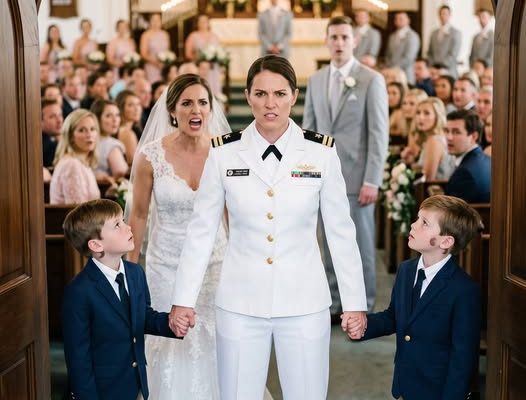
Cast out eight years ago while expecting twin boys because of a girlfriend’s deception, I walked into my ex’s wedding wearing my Navy dress blues. When his bride smirked and asked if the boys were rented ring bearers, my son answered, “We only came to find Grandpa Walter’s picture.” Then her gaze landed on the twin birthmarks behind their ears.

PART 1: THE THREAT BEFORE THE SECOND WEDDING

Eight years after my ex-husband threw me out of his family’s house in Charleston while I was eight weeks pregnant, I returned for his second wedding.
I didn’t come in a white dress. I came in my Navy Service Dress Blues, proudly wearing the Lieutenant Commander stripes I had earned after transitioning to the Navy Reserve.
My name is Jenna Reyes. I’m 34. I’m a Navy Reserve Officer and a civilian logistics contractor at Naval Station Norfolk. My black SUV stopped in front of St. Michael’s Church, and two little boys in matching navy blazers jumped out before I could open the door.
Milo and Micah. Seven years old. Twins.
“Remember what we talked about?” I whispered.
“Don’t touch anything and don’t call him Dad unless he earns it,” Milo said, fixing his little tie exactly the way his grandfather Walter taught him over FaceTime.
Three weeks earlier, Walter Whitaker — my ex-father-in-law — had called me from hospice. He could barely breathe.
“Jenna-girl, check the safety deposit box at the bank in Norfolk. I left something for the boys. And don’t let Cole get married without seeing their faces first. He needs to see his own scar.”
“What scar?”
“You’ll know.”
When Walter died last month, Cole didn’t call me. Tiffany did.
Tiffany Lang. The woman who waited for my marriage to crack. She sent me a text with a photo of her engagement ring on Cole’s family dining table — my old dining table.
Please don’t make a scene at our wedding. Cole has moved on. You should too.
I didn’t answer. I just folded two certified birth certificates, two court-admissible DNA reports, and a sworn affidavit into a sealed envelope and put it in my coat pocket.
When we walked up the church steps, Tiffany was waiting at the door in a white mermaid dress, blocking the entrance like she owned the building.
“Well,” she said loudly enough for the guests inside to hear, “I suppose the Navy doesn’t teach shame or timing.”
She looked at my boys.
“And who are these supposed to be? Ring bearers you rented?”
Micah squeezed my hand. Milo — the older by four minutes — stepped forward.
“We came to see Grandpa Walter’s picture,” he said clearly. “Mom said he would be here.”
Tiffany’s smile froze.
Because both of my sons have the same crescent-shaped birthmark behind their left ear. The exact same mark Cole has. The exact same mark Walter had. A mark that only shows up in Whitaker men.
And Tiffany knew it.
PART 2: THE TWO BOYS IN NAVY BLAZERS
Inside, 150 guests in pastel turned to stare. My dark blue uniform with gold buttons and ribbons stood out sharply. My sons’ little blazers were almost identical. In a sea of blush and sage, we looked like a military delegation that had taken a wrong turn.
Cole was at the altar in a light gray suit, holding Tiffany’s hands. When he saw me, his hands dropped.
The organ stopped.
“Jenna?”
I didn’t walk down the aisle. I stopped halfway, where Walter’s memorial photo sat on a small table — as per tradition for a family member who had just passed.
Milo placed a small Matchbox tugboat next to it. Walter had been a tugboat captain before he built the shipping company.
“He said you would know what it means,” Milo told the photo.
Cole came down the three steps, slowly, like he was approaching unexploded ordnance.
“What is this, Jenna?”
I looked at him. Eight years ago, he gave me ten minutes to defend myself. He believed Tiffany’s story that I had been with another man at a hotel in Savannah the same weekend I was actually on official active-duty military orders in Norfolk.
“You gave me ten minutes eight years ago,” I said quietly, so only he could hear. “Today I’m giving you two minutes to look at their faces.”
Cole stared at Milo, then Micah. Same blue eyes as his. Same cowlick he hates. Same birthmark.
Tiffany rushed down the aisle, her train tangling.
“Cole, don’t! She’s doing this for money. She wants a claim on the company!”
I lifted the sealed envelope from my pocket.
“No,” I said. “I came because Walter asked me to. And because my sons deserved to honor their grandfather, even if it’s just in a photograph.”
Cole’s hand was shaking when he took the envelope.
PART 3: THE ENVELOPE
He opened it right there, in front of the altar.
First page: Two certified long-form birth certificates issued by the Commonwealth of Virginia. Mother: Jenna Reyes. Father: Cole Whitaker. I had legally listed him years ago, but because I never filed a formal child-support petition through the courts back then, no official court summons had ever reached him.
Second and third pages: Two accredited, court-certified DNA reports. 99.99% probability of paternity. Swabs taken three months ago when Walter arranged for a mobile phlebotomist to meet us in Norfolk.
Cole’s breath caught.
“Twins?”
“Seven years old. You threw me out when I was eight weeks pregnant. You never asked if the baby was yours. You asked if I had been at the Hartley Hotel that Friday.”
Tiffany grabbed his arm. “It’s fake! She bought a fake lab test!”
“Be quiet,” Cole said. It was the first time I’d ever heard him tell her to be quiet.
He pulled out the next page. A sworn, notarized affidavit from the former night manager of the Hartley Hotel, obtained by Walter’s private investigator.
I, Marcus Bell, solemnly swear that on July 14th, 2017, Ms. Tiffany Lang paid me $500 cash to state that I saw Ms. Jenna Reyes enter Room 312. In truth, Ms. Reyes was never on property that night. Military duty logs prove she was at Naval Station Norfolk. Ms. Lang was the one who booked and stayed in Room 312.
Cole turned slowly toward Tiffany.
“You paid him.”
“I did it for us!” she cried out, her composure cracking. “She was always away on deployment! You needed someone who was actually here!”
“No,” I said. “You stole his chance to be a father. And you robbed my sons of a grandfather who loved them.”
The papers slipped from Cole’s hands.
He dropped to his knees right there on the white aisle runner, staring at Milo and Micah.
“My boys…” he whispered.
Milo stepped slightly in front of his brother.
“Don’t touch our mom,” he said quietly, exactly the way Walter told him to say it. “And don’t touch our grandfather’s boat.”

PART 4: THE THINGS WALTER KNEW

As the tension reached its peak, two men in business suits stepped quietly through the back doors of the church.
They weren’t interrupters sent to make a dramatic arrest at the altar — they were process servers who had been tracking Tiffany to ensure she received formal service before leaving the state for her honeymoon.
One of them approached her calmly and handed her a thick legal folder.
“Tiffany Lang. You are officially served with a civil lawsuit and a federal grand jury subpoena regarding wire fraud and embezzlement from Whitaker Shipping.”
Tiffany stared at the documents, her face draining of all color. Walter hadn’t just discovered her lies; he had quietly filed a formal audit with federal forensic accountants before he died. The wedding dress she wore was purchased with funds siphoned from company accounts.
Overwhelmed and humiliated as whispered shock spread through the pews, Tiffany turned and fled out the side exit, her long train dragging on the stone floor.
Cole remained on his knees.
I reached into my uniform coat and pulled out the last item. Not a legal document.
A bundle of Christmas cards, tied with faded blue twine. Seven of them. Each containing a savings bond receipt and a handwritten note.
For Milo & Micah — Year 1 — From Grandpa Walter — Don’t tell Cole yet. Let him see your faces first when the time is right.
Year 2 — Tell them the story about the tugboat.
Year 5 — I established two irrevocable 529 education trusts under my personal estate. Not the company. No one can touch them. Not even Tiffany.
Cole read them one by one, his shoulders shaking as tears hit the paper.
“He knew,” I said softly. “He found out three years ago when he caught Tiffany altering company ledger entries. He hired his own investigator, confirmed the DNA, and reached out to my Navy Reserve unit address. He asked me to wait until after he passed, because he wanted you to face the truth without anyone left to hide behind.”
I turned to my sons.
“Say hi to Grandpa Walter.”
Milo and Micah walked to Walter’s photo and saluted — standing straight, heels together, exactly the way I had drilled them.
“Hi, Grandpa Walter,” Micah whispered. “We brought your boat back.”
I raised my right hand and rendered a crisp, sharp military salute to Walter’s portrait.
Then I turned to leave. Cole scrambled up, taking a desperate step toward us.
“Jenna, please. Let’s sit down with lawyers… let’s fix this. I’ll settle everything, I’ll give you whatever you want — just let me be in their lives.”
I stopped at the heavy wooden church doors, holding my sons’ hands.
“You don’t become a father just because you finally recognize your own features in a mirror,” I said. “A father stays when things get difficult. A father searches for the truth instead of believing a convenient lie. My sons already had a grandfather who protected them. They don’t need you.”

PART 5: THE WORDS HE WANTED SPOKEN ALOUD

Three years later, sunlight spread across the dock behind our small home in Annapolis.
Milo and Micah were tying cleat hitches on the dock line — knots Walter had taught them over video calls before he entered hospice. Inside my home office, my Navy Service Dress Blue uniform hung neatly in the closet, complete with my Lieutenant Commander insignia.
My phone chimed with an update from my family law attorney in Charleston. The criminal case against Tiffany had concluded with a guilty plea for corporate wire fraud. Cole had spent the last three years trying to stabilize his family business while his court petitions for shared custody were repeatedly denied; the family court judge cited his eight years of abandonment, the boys’ established life in Maryland, and the strong stability of our family unit.
Cole’s last letter, forwarded through his attorney, contained no legal threats. Only two old childhood photos of himself at seven — the exact age Milo and Micah are now — and a short note:
Did they receive the birthday tugboats sent through Walter’s trust account?
I didn’t burn it. I placed it neatly inside their childhood memory box.
Marcus — a retired Marine Corps Officer who became my husband last year and who had spent countless hours teaching the boys real nautical discipline — walked out onto the deck and stood beside me.
“You built a fortress out of the truth,” he said, placing a warm hand on my shoulder.
I looked out at my sons — confident, secure, working together on the dock like seasoned young sailors.
Eight years ago, I was forced out of a Charleston estate with a single duffel bag, an eight-week ultrasound scan, and an unverified accusation.
That day at St. Michael’s, Cole thought he was walking into his new future.
Instead, two seven-year-old boys in navy blazers walked down his aisle and brought the past into the light.
And this time, I didn’t need to say a word to defend my honor.
My sons did it for me, just by standing there with his face.

Cast out eight years ago while expecting twin boys because of a girlfriend’s deception, I walked into my ex’s wedding wearing my Navy dress blues. When his bride smirked and asked if the boys were rented ring bearers, my son answered, “We only came to find Grandpa Walter’s picture.” Then her gaze landed on the twin birthmarks behind their ears. Read More

Driven away eight years ago while expecting due to a malicious rumor from his girlfriend, I attended my ex’s second wedding in full Navy uniform with our twin sons. The bride scoffed, asking if I hired them for the ceremony. My boy spoke up: “We just wanted to see Grandpa Walter’s portrait.” Seconds later, she caught sight of their matching birthmarks.

PART 1: THE THREAT BEFORE THE SECOND WEDDING

Eight years after my ex-husband threw me out of his family’s house in Charleston while I was eight weeks pregnant, I returned for his second wedding.
I didn’t come in a white dress. I came in my Navy Service Dress Blues, proudly wearing the Lieutenant Commander stripes I had earned after transitioning to the Navy Reserve.
My name is Jenna Reyes. I’m 34. I’m a Navy Reserve Officer and a civilian logistics contractor at Naval Station Norfolk. My black SUV stopped in front of St. Michael’s Church, and two little boys in matching navy blazers jumped out before I could open the door.
Milo and Micah. Seven years old. Twins.
“Remember what we talked about?” I whispered.
“Don’t touch anything and don’t call him Dad unless he earns it,” Milo said, fixing his little tie exactly the way his grandfather Walter taught him over FaceTime.
Three weeks earlier, Walter Whitaker — my ex-father-in-law — had called me from hospice. He could barely breathe.
“Jenna-girl, check the safety deposit box at the bank in Norfolk. I left something for the boys. And don’t let Cole get married without seeing their faces first. He needs to see his own scar.”
“What scar?”
“You’ll know.”
When Walter died last month, Cole didn’t call me. Tiffany did.
Tiffany Lang. The woman who waited for my marriage to crack. She sent me a text with a photo of her engagement ring on Cole’s family dining table — my old dining table.
Please don’t make a scene at our wedding. Cole has moved on. You should too.
I didn’t answer. I just folded two certified birth certificates, two court-admissible DNA reports, and a sworn affidavit into a sealed envelope and put it in my coat pocket.
When we walked up the church steps, Tiffany was waiting at the door in a white mermaid dress, blocking the entrance like she owned the building.
“Well,” she said loudly enough for the guests inside to hear, “I suppose the Navy doesn’t teach shame or timing.”
She looked at my boys.
“And who are these supposed to be? Ring bearers you rented?”
Micah squeezed my hand. Milo — the older by four minutes — stepped forward.
“We came to see Grandpa Walter’s picture,” he said clearly. “Mom said he would be here.”
Tiffany’s smile froze.
Because both of my sons have the same crescent-shaped birthmark behind their left ear. The exact same mark Cole has. The exact same mark Walter had. A mark that only shows up in Whitaker men.
And Tiffany knew it.
PART 2: THE TWO BOYS IN NAVY BLAZERS
Inside, 150 guests in pastel turned to stare. My dark blue uniform with gold buttons and ribbons stood out sharply. My sons’ little blazers were almost identical. In a sea of blush and sage, we looked like a military delegation that had taken a wrong turn.
Cole was at the altar in a light gray suit, holding Tiffany’s hands. When he saw me, his hands dropped.
The organ stopped.
“Jenna?”
I didn’t walk down the aisle. I stopped halfway, where Walter’s memorial photo sat on a small table — as per tradition for a family member who had just passed.
Milo placed a small Matchbox tugboat next to it. Walter had been a tugboat captain before he built the shipping company.
“He said you would know what it means,” Milo told the photo.
Cole came down the three steps, slowly, like he was approaching unexploded ordnance.
“What is this, Jenna?”
I looked at him. Eight years ago, he gave me ten minutes to defend myself. He believed Tiffany’s story that I had been with another man at a hotel in Savannah the same weekend I was actually on official active-duty military orders in Norfolk.
“You gave me ten minutes eight years ago,” I said quietly, so only he could hear. “Today I’m giving you two minutes to look at their faces.”
Cole stared at Milo, then Micah. Same blue eyes as his. Same cowlick he hates. Same birthmark.
Tiffany rushed down the aisle, her train tangling.
“Cole, don’t! She’s doing this for money. She wants a claim on the company!”
I lifted the sealed envelope from my pocket.
“No,” I said. “I came because Walter asked me to. And because my sons deserved to honor their grandfather, even if it’s just in a photograph.”
Cole’s hand was shaking when he took the envelope.
PART 3: THE ENVELOPE
He opened it right there, in front of the altar.
First page: Two certified long-form birth certificates issued by the Commonwealth of Virginia. Mother: Jenna Reyes. Father: Cole Whitaker. I had legally listed him years ago, but because I never filed a formal child-support petition through the courts back then, no official court summons had ever reached him.
Second and third pages: Two accredited, court-certified DNA reports. 99.99% probability of paternity. Swabs taken three months ago when Walter arranged for a mobile phlebotomist to meet us in Norfolk.
Cole’s breath caught.
“Twins?”
“Seven years old. You threw me out when I was eight weeks pregnant. You never asked if the baby was yours. You asked if I had been at the Hartley Hotel that Friday.”
Tiffany grabbed his arm. “It’s fake! She bought a fake lab test!”
“Be quiet,” Cole said. It was the first time I’d ever heard him tell her to be quiet.
He pulled out the next page. A sworn, notarized affidavit from the former night manager of the Hartley Hotel, obtained by Walter’s private investigator.
I, Marcus Bell, solemnly swear that on July 14th, 2017, Ms. Tiffany Lang paid me $500 cash to state that I saw Ms. Jenna Reyes enter Room 312. In truth, Ms. Reyes was never on property that night. Military duty logs prove she was at Naval Station Norfolk. Ms. Lang was the one who booked and stayed in Room 312.
Cole turned slowly toward Tiffany.
“You paid him.”
“I did it for us!” she cried out, her composure cracking. “She was always away on deployment! You needed someone who was actually here!”
“No,” I said. “You stole his chance to be a father. And you robbed my sons of a grandfather who loved them.”
The papers slipped from Cole’s hands.
He dropped to his knees right there on the white aisle runner, staring at Milo and Micah.
“My boys…” he whispered.
Milo stepped slightly in front of his brother.
“Don’t touch our mom,” he said quietly, exactly the way Walter told him to say it. “And don’t touch our grandfather’s boat.”

PART 4: THE THINGS WALTER KNEW

As the tension reached its peak, two men in business suits stepped quietly through the back doors of the church.
They weren’t interrupters sent to make a dramatic arrest at the altar — they were process servers who had been tracking Tiffany to ensure she received formal service before leaving the state for her honeymoon.
One of them approached her calmly and handed her a thick legal folder.
“Tiffany Lang. You are officially served with a civil lawsuit and a federal grand jury subpoena regarding wire fraud and embezzlement from Whitaker Shipping.”
Tiffany stared at the documents, her face draining of all color. Walter hadn’t just discovered her lies; he had quietly filed a formal audit with federal forensic accountants before he died. The wedding dress she wore was purchased with funds siphoned from company accounts.
Overwhelmed and humiliated as whispered shock spread through the pews, Tiffany turned and fled out the side exit, her long train dragging on the stone floor.
Cole remained on his knees.
I reached into my uniform coat and pulled out the last item. Not a legal document.
A bundle of Christmas cards, tied with faded blue twine. Seven of them. Each containing a savings bond receipt and a handwritten note.
For Milo & Micah — Year 1 — From Grandpa Walter — Don’t tell Cole yet. Let him see your faces first when the time is right.
Year 2 — Tell them the story about the tugboat.
Year 5 — I established two irrevocable 529 education trusts under my personal estate. Not the company. No one can touch them. Not even Tiffany.
Cole read them one by one, his shoulders shaking as tears hit the paper.
“He knew,” I said softly. “He found out three years ago when he caught Tiffany altering company ledger entries. He hired his own investigator, confirmed the DNA, and reached out to my Navy Reserve unit address. He asked me to wait until after he passed, because he wanted you to face the truth without anyone left to hide behind.”
I turned to my sons.
“Say hi to Grandpa Walter.”
Milo and Micah walked to Walter’s photo and saluted — standing straight, heels together, exactly the way I had drilled them.
“Hi, Grandpa Walter,” Micah whispered. “We brought your boat back.”
I raised my right hand and rendered a crisp, sharp military salute to Walter’s portrait.
Then I turned to leave. Cole scrambled up, taking a desperate step toward us.
“Jenna, please. Let’s sit down with lawyers… let’s fix this. I’ll settle everything, I’ll give you whatever you want — just let me be in their lives.”
I stopped at the heavy wooden church doors, holding my sons’ hands.
“You don’t become a father just because you finally recognize your own features in a mirror,” I said. “A father stays when things get difficult. A father searches for the truth instead of believing a convenient lie. My sons already had a grandfather who protected them. They don’t need you.”

PART 5: THE WORDS HE WANTED SPOKEN ALOUD

Three years later, sunlight spread across the dock behind our small home in Annapolis.
Milo and Micah were tying cleat hitches on the dock line — knots Walter had taught them over video calls before he entered hospice. Inside my home office, my Navy Service Dress Blue uniform hung neatly in the closet, complete with my Lieutenant Commander insignia.
My phone chimed with an update from my family law attorney in Charleston. The criminal case against Tiffany had concluded with a guilty plea for corporate wire fraud. Cole had spent the last three years trying to stabilize his family business while his court petitions for shared custody were repeatedly denied; the family court judge cited his eight years of abandonment, the boys’ established life in Maryland, and the strong stability of our family unit.
Cole’s last letter, forwarded through his attorney, contained no legal threats. Only two old childhood photos of himself at seven — the exact age Milo and Micah are now — and a short note:
Did they receive the birthday tugboats sent through Walter’s trust account?
I didn’t burn it. I placed it neatly inside their childhood memory box.
Marcus — a retired Marine Corps Officer who became my husband last year and who had spent countless hours teaching the boys real nautical discipline — walked out onto the deck and stood beside me.
“You built a fortress out of the truth,” he said, placing a warm hand on my shoulder.
I looked out at my sons — confident, secure, working together on the dock like seasoned young sailors.
Eight years ago, I was forced out of a Charleston estate with a single duffel bag, an eight-week ultrasound scan, and an unverified accusation.
That day at St. Michael’s, Cole thought he was walking into his new future.
Instead, two seven-year-old boys in navy blazers walked down his aisle and brought the past into the light.
And this time, I didn’t need to say a word to defend my honor.
My sons did it for me, just by standing there with his face.
Driven away eight years ago while expecting due to a malicious rumor from his girlfriend, I attended my ex’s second wedding in full Navy uniform with our twin sons. The bride scoffed, asking if I hired them for the ceremony. My boy spoke up: “We just wanted to see Grandpa Walter’s portrait.” Seconds later, she caught sight of their matching birthmarks. Read More

Eight years after being kicked out while expecting because of his girlfriend’s false claims, I showed up at my ex-husband’s new wedding in my Navy dress blues alongside our seven-year-old twin boys. His new bride mocked us, asking if they were hired ring bearers. My son replied, “We’re only here for Grandpa Walter’s photo.” That’s when she spotted the identical birthmarks behind their ears.

PART 1: THE THREAT BEFORE THE SECOND WEDDING

Eight years after my ex-husband threw me out of his family’s house in Charleston while I was eight weeks pregnant, I returned for his second wedding.
I didn’t come in a white dress. I came in my Navy Service Dress Blues, proudly wearing the Lieutenant Commander stripes I had earned after transitioning to the Navy Reserve.
My name is Jenna Reyes. I’m 34. I’m a Navy Reserve Officer and a civilian logistics contractor at Naval Station Norfolk. My black SUV stopped in front of St. Michael’s Church, and two little boys in matching navy blazers jumped out before I could open the door.
Milo and Micah. Seven years old. Twins.
“Remember what we talked about?” I whispered.
“Don’t touch anything and don’t call him Dad unless he earns it,” Milo said, fixing his little tie exactly the way his grandfather Walter taught him over FaceTime.
Three weeks earlier, Walter Whitaker — my ex-father-in-law — had called me from hospice. He could barely breathe.
“Jenna-girl, check the safety deposit box at the bank in Norfolk. I left something for the boys. And don’t let Cole get married without seeing their faces first. He needs to see his own scar.”
“What scar?”
“You’ll know.”
When Walter died last month, Cole didn’t call me. Tiffany did.
Tiffany Lang. The woman who waited for my marriage to crack. She sent me a text with a photo of her engagement ring on Cole’s family dining table — my old dining table.
Please don’t make a scene at our wedding. Cole has moved on. You should too.
I didn’t answer. I just folded two certified birth certificates, two court-admissible DNA reports, and a sworn affidavit into a sealed envelope and put it in my coat pocket.
When we walked up the church steps, Tiffany was waiting at the door in a white mermaid dress, blocking the entrance like she owned the building.
“Well,” she said loudly enough for the guests inside to hear, “I suppose the Navy doesn’t teach shame or timing.”
She looked at my boys.
“And who are these supposed to be? Ring bearers you rented?”
Micah squeezed my hand. Milo — the older by four minutes — stepped forward.
“We came to see Grandpa Walter’s picture,” he said clearly. “Mom said he would be here.”
Tiffany’s smile froze.
Because both of my sons have the same crescent-shaped birthmark behind their left ear. The exact same mark Cole has. The exact same mark Walter had. A mark that only shows up in Whitaker men.
And Tiffany knew it.
PART 2: THE TWO BOYS IN NAVY BLAZERS
Inside, 150 guests in pastel turned to stare. My dark blue uniform with gold buttons and ribbons stood out sharply. My sons’ little blazers were almost identical. In a sea of blush and sage, we looked like a military delegation that had taken a wrong turn.
Cole was at the altar in a light gray suit, holding Tiffany’s hands. When he saw me, his hands dropped.
The organ stopped.
“Jenna?”
I didn’t walk down the aisle. I stopped halfway, where Walter’s memorial photo sat on a small table — as per tradition for a family member who had just passed.
Milo placed a small Matchbox tugboat next to it. Walter had been a tugboat captain before he built the shipping company.
“He said you would know what it means,” Milo told the photo.
Cole came down the three steps, slowly, like he was approaching unexploded ordnance.
“What is this, Jenna?”
I looked at him. Eight years ago, he gave me ten minutes to defend myself. He believed Tiffany’s story that I had been with another man at a hotel in Savannah the same weekend I was actually on official active-duty military orders in Norfolk.
“You gave me ten minutes eight years ago,” I said quietly, so only he could hear. “Today I’m giving you two minutes to look at their faces.”
Cole stared at Milo, then Micah. Same blue eyes as his. Same cowlick he hates. Same birthmark.
Tiffany rushed down the aisle, her train tangling.
“Cole, don’t! She’s doing this for money. She wants a claim on the company!”
I lifted the sealed envelope from my pocket.
“No,” I said. “I came because Walter asked me to. And because my sons deserved to honor their grandfather, even if it’s just in a photograph.”
Cole’s hand was shaking when he took the envelope.
PART 3: THE ENVELOPE
He opened it right there, in front of the altar.
First page: Two certified long-form birth certificates issued by the Commonwealth of Virginia. Mother: Jenna Reyes. Father: Cole Whitaker. I had legally listed him years ago, but because I never filed a formal child-support petition through the courts back then, no official court summons had ever reached him.
Second and third pages: Two accredited, court-certified DNA reports. 99.99% probability of paternity. Swabs taken three months ago when Walter arranged for a mobile phlebotomist to meet us in Norfolk.
Cole’s breath caught.
“Twins?”
“Seven years old. You threw me out when I was eight weeks pregnant. You never asked if the baby was yours. You asked if I had been at the Hartley Hotel that Friday.”
Tiffany grabbed his arm. “It’s fake! She bought a fake lab test!”
“Be quiet,” Cole said. It was the first time I’d ever heard him tell her to be quiet.
He pulled out the next page. A sworn, notarized affidavit from the former night manager of the Hartley Hotel, obtained by Walter’s private investigator.
I, Marcus Bell, solemnly swear that on July 14th, 2017, Ms. Tiffany Lang paid me $500 cash to state that I saw Ms. Jenna Reyes enter Room 312. In truth, Ms. Reyes was never on property that night. Military duty logs prove she was at Naval Station Norfolk. Ms. Lang was the one who booked and stayed in Room 312.
Cole turned slowly toward Tiffany.
“You paid him.”
“I did it for us!” she cried out, her composure cracking. “She was always away on deployment! You needed someone who was actually here!”
“No,” I said. “You stole his chance to be a father. And you robbed my sons of a grandfather who loved them.”
The papers slipped from Cole’s hands.
He dropped to his knees right there on the white aisle runner, staring at Milo and Micah.
“My boys…” he whispered.
Milo stepped slightly in front of his brother.
“Don’t touch our mom,” he said quietly, exactly the way Walter told him to say it. “And don’t touch our grandfather’s boat.”

PART 4: THE THINGS WALTER KNEW

As the tension reached its peak, two men in business suits stepped quietly through the back doors of the church.
They weren’t interrupters sent to make a dramatic arrest at the altar — they were process servers who had been tracking Tiffany to ensure she received formal service before leaving the state for her honeymoon.
One of them approached her calmly and handed her a thick legal folder.
“Tiffany Lang. You are officially served with a civil lawsuit and a federal grand jury subpoena regarding wire fraud and embezzlement from Whitaker Shipping.”
Tiffany stared at the documents, her face draining of all color. Walter hadn’t just discovered her lies; he had quietly filed a formal audit with federal forensic accountants before he died. The wedding dress she wore was purchased with funds siphoned from company accounts.
Overwhelmed and humiliated as whispered shock spread through the pews, Tiffany turned and fled out the side exit, her long train dragging on the stone floor.
Cole remained on his knees.
I reached into my uniform coat and pulled out the last item. Not a legal document.
A bundle of Christmas cards, tied with faded blue twine. Seven of them. Each containing a savings bond receipt and a handwritten note.
For Milo & Micah — Year 1 — From Grandpa Walter — Don’t tell Cole yet. Let him see your faces first when the time is right.
Year 2 — Tell them the story about the tugboat.
Year 5 — I established two irrevocable 529 education trusts under my personal estate. Not the company. No one can touch them. Not even Tiffany.
Cole read them one by one, his shoulders shaking as tears hit the paper.
“He knew,” I said softly. “He found out three years ago when he caught Tiffany altering company ledger entries. He hired his own investigator, confirmed the DNA, and reached out to my Navy Reserve unit address. He asked me to wait until after he passed, because he wanted you to face the truth without anyone left to hide behind.”
I turned to my sons.
“Say hi to Grandpa Walter.”
Milo and Micah walked to Walter’s photo and saluted — standing straight, heels together, exactly the way I had drilled them.
“Hi, Grandpa Walter,” Micah whispered. “We brought your boat back.”
I raised my right hand and rendered a crisp, sharp military salute to Walter’s portrait.
Then I turned to leave. Cole scrambled up, taking a desperate step toward us.
“Jenna, please. Let’s sit down with lawyers… let’s fix this. I’ll settle everything, I’ll give you whatever you want — just let me be in their lives.”
I stopped at the heavy wooden church doors, holding my sons’ hands.
“You don’t become a father just because you finally recognize your own features in a mirror,” I said. “A father stays when things get difficult. A father searches for the truth instead of believing a convenient lie. My sons already had a grandfather who protected them. They don’t need you.”

PART 5: THE WORDS HE WANTED SPOKEN ALOUD

Three years later, sunlight spread across the dock behind our small home in Annapolis.
Milo and Micah were tying cleat hitches on the dock line — knots Walter had taught them over video calls before he entered hospice. Inside my home office, my Navy Service Dress Blue uniform hung neatly in the closet, complete with my Lieutenant Commander insignia.
My phone chimed with an update from my family law attorney in Charleston. The criminal case against Tiffany had concluded with a guilty plea for corporate wire fraud. Cole had spent the last three years trying to stabilize his family business while his court petitions for shared custody were repeatedly denied; the family court judge cited his eight years of abandonment, the boys’ established life in Maryland, and the strong stability of our family unit.
Cole’s last letter, forwarded through his attorney, contained no legal threats. Only two old childhood photos of himself at seven — the exact age Milo and Micah are now — and a short note:
Did they receive the birthday tugboats sent through Walter’s trust account?
I didn’t burn it. I placed it neatly inside their childhood memory box.
Marcus — a retired Marine Corps Officer who became my husband last year and who had spent countless hours teaching the boys real nautical discipline — walked out onto the deck and stood beside me.
“You built a fortress out of the truth,” he said, placing a warm hand on my shoulder.
I looked out at my sons — confident, secure, working together on the dock like seasoned young sailors.
Eight years ago, I was forced out of a Charleston estate with a single duffel bag, an eight-week ultrasound scan, and an unverified accusation.
That day at St. Michael’s, Cole thought he was walking into his new future.
Instead, two seven-year-old boys in navy blazers walked down his aisle and brought the past into the light.
And this time, I didn’t need to say a word to defend my honor.
My sons did it for me, just by standing there with his face.
Eight years after being kicked out while expecting because of his girlfriend’s false claims, I showed up at my ex-husband’s new wedding in my Navy dress blues alongside our seven-year-old twin boys. His new bride mocked us, asking if they were hired ring bearers. My son replied, “We’re only here for Grandpa Walter’s photo.” That’s when she spotted the identical birthmarks behind their ears. Read More

Eight years ago, my ex threw me out while expecting because his girlfriend lied that I was unfaithful. Today, I walked into his second wedding in my Navy dress blues with our seven-year-old twin sons. When his bride sneered and asked if I rented them as ring bearers, my son stepped forward: “We just came to see Grandpa Walter’s picture.” And then she noticed the matching birthmarks behind their ears.

PART 1: THE THREAT BEFORE THE SECOND WEDDING

Eight years after my ex-husband threw me out of his family’s house in Charleston while I was eight weeks pregnant, I returned for his second wedding.
I didn’t come in a white dress. I came in my Navy Service Dress Blues, proudly wearing the Lieutenant Commander stripes I had earned after transitioning to the Navy Reserve.
My name is Jenna Reyes. I’m 34. I’m a Navy Reserve Officer and a civilian logistics contractor at Naval Station Norfolk. My black SUV stopped in front of St. Michael’s Church, and two little boys in matching navy blazers jumped out before I could open the door.
Milo and Micah. Seven years old. Twins.
“Remember what we talked about?” I whispered.
“Don’t touch anything and don’t call him Dad unless he earns it,” Milo said, fixing his little tie exactly the way his grandfather Walter taught him over FaceTime.
Three weeks earlier, Walter Whitaker — my ex-father-in-law — had called me from hospice. He could barely breathe.
“Jenna-girl, check the safety deposit box at the bank in Norfolk. I left something for the boys. And don’t let Cole get married without seeing their faces first. He needs to see his own scar.”
“What scar?”
“You’ll know.”
When Walter died last month, Cole didn’t call me. Tiffany did.
Tiffany Lang. The woman who waited for my marriage to crack. She sent me a text with a photo of her engagement ring on Cole’s family dining table — my old dining table.
Please don’t make a scene at our wedding. Cole has moved on. You should too.
I didn’t answer. I just folded two certified birth certificates, two court-admissible DNA reports, and a sworn affidavit into a sealed envelope and put it in my coat pocket.
When we walked up the church steps, Tiffany was waiting at the door in a white mermaid dress, blocking the entrance like she owned the building.
“Well,” she said loudly enough for the guests inside to hear, “I suppose the Navy doesn’t teach shame or timing.”
She looked at my boys.
“And who are these supposed to be? Ring bearers you rented?”
Micah squeezed my hand. Milo — the older by four minutes — stepped forward.
“We came to see Grandpa Walter’s picture,” he said clearly. “Mom said he would be here.”
Tiffany’s smile froze.
Because both of my sons have the same crescent-shaped birthmark behind their left ear. The exact same mark Cole has. The exact same mark Walter had. A mark that only shows up in Whitaker men.
And Tiffany knew it.
PART 2: THE TWO BOYS IN NAVY BLAZERS
Inside, 150 guests in pastel turned to stare. My dark blue uniform with gold buttons and ribbons stood out sharply. My sons’ little blazers were almost identical. In a sea of blush and sage, we looked like a military delegation that had taken a wrong turn.
Cole was at the altar in a light gray suit, holding Tiffany’s hands. When he saw me, his hands dropped.
The organ stopped.
“Jenna?”
I didn’t walk down the aisle. I stopped halfway, where Walter’s memorial photo sat on a small table — as per tradition for a family member who had just passed.
Milo placed a small Matchbox tugboat next to it. Walter had been a tugboat captain before he built the shipping company.
“He said you would know what it means,” Milo told the photo.
Cole came down the three steps, slowly, like he was approaching unexploded ordnance.
“What is this, Jenna?”
I looked at him. Eight years ago, he gave me ten minutes to defend myself. He believed Tiffany’s story that I had been with another man at a hotel in Savannah the same weekend I was actually on official active-duty military orders in Norfolk.
“You gave me ten minutes eight years ago,” I said quietly, so only he could hear. “Today I’m giving you two minutes to look at their faces.”
Cole stared at Milo, then Micah. Same blue eyes as his. Same cowlick he hates. Same birthmark.
Tiffany rushed down the aisle, her train tangling.
“Cole, don’t! She’s doing this for money. She wants a claim on the company!”
I lifted the sealed envelope from my pocket.
“No,” I said. “I came because Walter asked me to. And because my sons deserved to honor their grandfather, even if it’s just in a photograph.”
Cole’s hand was shaking when he took the envelope.
PART 3: THE ENVELOPE
He opened it right there, in front of the altar.
First page: Two certified long-form birth certificates issued by the Commonwealth of Virginia. Mother: Jenna Reyes. Father: Cole Whitaker. I had legally listed him years ago, but because I never filed a formal child-support petition through the courts back then, no official court summons had ever reached him.
Second and third pages: Two accredited, court-certified DNA reports. 99.99% probability of paternity. Swabs taken three months ago when Walter arranged for a mobile phlebotomist to meet us in Norfolk.
Cole’s breath caught.
“Twins?”
“Seven years old. You threw me out when I was eight weeks pregnant. You never asked if the baby was yours. You asked if I had been at the Hartley Hotel that Friday.”
Tiffany grabbed his arm. “It’s fake! She bought a fake lab test!”
“Be quiet,” Cole said. It was the first time I’d ever heard him tell her to be quiet.
He pulled out the next page. A sworn, notarized affidavit from the former night manager of the Hartley Hotel, obtained by Walter’s private investigator.
I, Marcus Bell, solemnly swear that on July 14th, 2017, Ms. Tiffany Lang paid me $500 cash to state that I saw Ms. Jenna Reyes enter Room 312. In truth, Ms. Reyes was never on property that night. Military duty logs prove she was at Naval Station Norfolk. Ms. Lang was the one who booked and stayed in Room 312.
Cole turned slowly toward Tiffany.
“You paid him.”
“I did it for us!” she cried out, her composure cracking. “She was always away on deployment! You needed someone who was actually here!”
“No,” I said. “You stole his chance to be a father. And you robbed my sons of a grandfather who loved them.”
The papers slipped from Cole’s hands.
He dropped to his knees right there on the white aisle runner, staring at Milo and Micah.
“My boys…” he whispered.
Milo stepped slightly in front of his brother.
“Don’t touch our mom,” he said quietly, exactly the way Walter told him to say it. “And don’t touch our grandfather’s boat.”

PART 4: THE THINGS WALTER KNEW

As the tension reached its peak, two men in business suits stepped quietly through the back doors of the church.
They weren’t interrupters sent to make a dramatic arrest at the altar — they were process servers who had been tracking Tiffany to ensure she received formal service before leaving the state for her honeymoon.
One of them approached her calmly and handed her a thick legal folder.
“Tiffany Lang. You are officially served with a civil lawsuit and a federal grand jury subpoena regarding wire fraud and embezzlement from Whitaker Shipping.”
Tiffany stared at the documents, her face draining of all color. Walter hadn’t just discovered her lies; he had quietly filed a formal audit with federal forensic accountants before he died. The wedding dress she wore was purchased with funds siphoned from company accounts.
Overwhelmed and humiliated as whispered shock spread through the pews, Tiffany turned and fled out the side exit, her long train dragging on the stone floor.
Cole remained on his knees.
I reached into my uniform coat and pulled out the last item. Not a legal document.
A bundle of Christmas cards, tied with faded blue twine. Seven of them. Each containing a savings bond receipt and a handwritten note.
For Milo & Micah — Year 1 — From Grandpa Walter — Don’t tell Cole yet. Let him see your faces first when the time is right.
Year 2 — Tell them the story about the tugboat.
Year 5 — I established two irrevocable 529 education trusts under my personal estate. Not the company. No one can touch them. Not even Tiffany.
Cole read them one by one, his shoulders shaking as tears hit the paper.
“He knew,” I said softly. “He found out three years ago when he caught Tiffany altering company ledger entries. He hired his own investigator, confirmed the DNA, and reached out to my Navy Reserve unit address. He asked me to wait until after he passed, because he wanted you to face the truth without anyone left to hide behind.”
I turned to my sons.
“Say hi to Grandpa Walter.”
Milo and Micah walked to Walter’s photo and saluted — standing straight, heels together, exactly the way I had drilled them.
“Hi, Grandpa Walter,” Micah whispered. “We brought your boat back.”
I raised my right hand and rendered a crisp, sharp military salute to Walter’s portrait.
Then I turned to leave. Cole scrambled up, taking a desperate step toward us.
“Jenna, please. Let’s sit down with lawyers… let’s fix this. I’ll settle everything, I’ll give you whatever you want — just let me be in their lives.”
I stopped at the heavy wooden church doors, holding my sons’ hands.
“You don’t become a father just because you finally recognize your own features in a mirror,” I said. “A father stays when things get difficult. A father searches for the truth instead of believing a convenient lie. My sons already had a grandfather who protected them. They don’t need you.”

PART 5: THE WORDS HE WANTED SPOKEN ALOUD

Three years later, sunlight spread across the dock behind our small home in Annapolis.
Milo and Micah were tying cleat hitches on the dock line — knots Walter had taught them over video calls before he entered hospice. Inside my home office, my Navy Service Dress Blue uniform hung neatly in the closet, complete with my Lieutenant Commander insignia.
My phone chimed with an update from my family law attorney in Charleston. The criminal case against Tiffany had concluded with a guilty plea for corporate wire fraud. Cole had spent the last three years trying to stabilize his family business while his court petitions for shared custody were repeatedly denied; the family court judge cited his eight years of abandonment, the boys’ established life in Maryland, and the strong stability of our family unit.
Cole’s last letter, forwarded through his attorney, contained no legal threats. Only two old childhood photos of himself at seven — the exact age Milo and Micah are now — and a short note:
Did they receive the birthday tugboats sent through Walter’s trust account?
I didn’t burn it. I placed it neatly inside their childhood memory box.
Marcus — a retired Marine Corps Officer who became my husband last year and who had spent countless hours teaching the boys real nautical discipline — walked out onto the deck and stood beside me.
“You built a fortress out of the truth,” he said, placing a warm hand on my shoulder.
I looked out at my sons — confident, secure, working together on the dock like seasoned young sailors.
Eight years ago, I was forced out of a Charleston estate with a single duffel bag, an eight-week ultrasound scan, and an unverified accusation.
That day at St. Michael’s, Cole thought he was walking into his new future.
Instead, two seven-year-old boys in navy blazers walked down his aisle and brought the past into the light.
And this time, I didn’t need to say a word to defend my honor.
My sons did it for me, just by standing there with his face.
Eight years ago, my ex threw me out while expecting because his girlfriend lied that I was unfaithful. Today, I walked into his second wedding in my Navy dress blues with our seven-year-old twin sons. When his bride sneered and asked if I rented them as ring bearers, my son stepped forward: “We just came to see Grandpa Walter’s picture.” And then she noticed the matching birthmarks behind their ears. Read More

At my son’s lavish wedding, his bride shoved my wife into the mud while two hundred guests watched. My son saw everything and immediately called it an accident. I didn’t raise my voice; I walked up to the microphone, pulled out the final $84,000 payment, and announced that the reception was officially over.

Part 1: The Shove That Ended the Celebration

At my son Ethan’s wedding, his bride placed both hands on my wife’s shoulders and shoved her into the mud.

Two hundred guests at Briarwood Estate fell silent as Helen landed beside the ceremony lawn. A caterer dropped a tray, but Ethan only stepped toward me and whispered, “Dad, stop.”

I ignored him. Taking the microphone, I told the crowd I had planned to welcome Camille into our family and speak about love. Instead, everyone had just watched her humiliate the woman who had loved Ethan his entire life.

Camille folded her arms. “This is insane.”

I removed an envelope from my jacket. Inside was an $84,000 cashier’s check covering the reception’s remaining balance—venue, food, band, flowers, bar, photography, transportation, and guest accommodations.

Three months earlier, Camille had asked Helen to increase the flower budget. When Helen said we would consider it, Camille accused us of acting poor and said we should never have offered to host the wedding.

Ethan denied it.

“Your mother cried in the laundry room that night,” I told him. “You heard her, and you did nothing.”

His silence answered for him.

I held up the envelope. “This payment was supposed to reach the venue manager after dinner. It won’t.”

Camille’s confidence vanished. “You can’t do that.”

“I already have.”

Her father, Charles Bennett, asked whether the vendors had been paid. I explained that I had covered every deposit and would pay for services already delivered, but there would be no extended bar, extra catering, upgraded transportation, or honeymoon transfer from my family.

Ethan lowered his voice. “Dad, you’re embarrassing us.”

I looked at the son who had once cried over injured birds and wondered whether he had disappeared entirely.

“No. You embarrassed yourself when you chose laughter over your mother.”

Camille ordered Julia Marsh, the venue manager, to continue the reception. Julia refused, explaining that Mrs. Whitaker had been injured and service should pause.

Camille’s voice sharpened. “Mrs. Whitaker? That’s me now.”

From the edge of the lawn, my wife finally spoke.

“No,” Helen said, standing in her mud-stained dress. “You are not me.”

Part 2: The Truth Everyone Recorded

Ethan approached his mother and insisted Camille had only been joking. He claimed Helen had slipped after being barely touched.

A guest near the back interrupted. “I recorded it.”

Another person raised a phone. “So did I.”

Ethan stopped. Charles turned toward his daughter and demanded that she deny deliberately pushing Helen. Camille looked to Ethan for protection, but he lowered his eyes.

That was all Charles needed.

“I warned both of you,” he said. “Humiliation is not humor. Cruelty in private eventually becomes cruelty in public.”

Helen reached for my hand. Only then did Ethan truly look at her ruined dress, disheveled hair, and mud-covered arms.

“Mom…”

She raised one hand.

“Not here. Don’t apologize because people are watching, the money stopped, or Camille’s father is angry. When you can tell the truth without an audience, you know where we live.”

She turned to me. “Robert, take me home.”

Camille protested that we could not leave because it would ruin everything.

Helen looked back calmly. “No, dear. You already did.”

Guests quietly opened a path for us. Charles joined us near the exit, apologized to Helen, and offered to reimburse everything I had paid.

“Let the deposits remain the cost of a lesson,” I said.

He glanced toward Camille and Ethan arguing beside the untouched cake. “Some lessons cost more than money.”

We sat silently in the car, watching the glowing reception tent from a distance.

“Do you think we lost him?” Helen whispered.

I could not answer immediately. Our son was alive and reachable, yet he had chosen distance when his mother needed him.

“He has to decide whether he wants to be found.”

By noon the next day, videos of the shove had spread through half the guest list. By evening, Camille’s story had collapsed under the weight of too many recordings and years of private cruelty finally becoming visible.

Part 3: What an Apology Could Not Erase

Three days later, Ethan came to our house alone. Helen asked whether Camille had sent him or whether he had returned because I stopped payment.

When he answered no to both questions, she allowed him inside.

Standing among the family photographs of his childhood, Ethan finally confessed.

“I saw Camille push you. I knew exactly what happened, but I called it an accident because I didn’t want the wedding to fall apart.”

Helen studied him. “Did you think I should fall apart instead?”

Ethan covered his face. “Yes.”

It was the first completely honest word he had spoken.

Helen told him contempt would never enter our home again. He could not ask me for money while treating respect as optional, and he could not seek comfort from his mother if he remained silent when she was humiliated.

“I’m sorry, Mom.”

Her eyes filled, but she did not offer easy forgiveness.

“I hear you. Now live differently.”

The marriage was legally valid, but the reception ended early. Half the guests left before dinner, the band packed up by nine, and the cake was never cut. Charles paid the staff, while Camille spent the night alone at a hotel.

By autumn, Ethan filed for separation. Afterward, he visited every Sunday—not for money or rescue, but to repair what he could. Helen sometimes cooked with him and sometimes kept the visits brief. Trust returned slowly and unevenly.

One year after the wedding, Ethan arrived carrying a garment bag. Inside was Helen’s blue dress, professionally cleaned and restored. A faint shadow of mud remained near the hem.

“I know this doesn’t fix anything,” he said.

Helen touched the fabric.

“No,” she replied. “But it tells me you remember.”

At my son’s lavish wedding, his bride shoved my wife into the mud while two hundred guests watched. My son saw everything and immediately called it an accident. I didn’t raise my voice; I walked up to the microphone, pulled out the final $84,000 payment, and announced that the reception was officially over. Read More

At my son’s lavish wedding, his bride pushed my wife into the mud as two hundred guests watched on. My son saw everything and tried to brush it off as an accident. I didn’t argue; I just stepped up to the microphone, pulled the final $84,000 payment from my jacket, and called off the celebration.

Part 1: The Shove That Ended the Celebration

At my son Ethan’s wedding, his bride placed both hands on my wife’s shoulders and shoved her into the mud.

Two hundred guests at Briarwood Estate fell silent as Helen landed beside the ceremony lawn. A caterer dropped a tray, but Ethan only stepped toward me and whispered, “Dad, stop.”

I ignored him. Taking the microphone, I told the crowd I had planned to welcome Camille into our family and speak about love. Instead, everyone had just watched her humiliate the woman who had loved Ethan his entire life.

Camille folded her arms. “This is insane.”

I removed an envelope from my jacket. Inside was an $84,000 cashier’s check covering the reception’s remaining balance—venue, food, band, flowers, bar, photography, transportation, and guest accommodations.

Three months earlier, Camille had asked Helen to increase the flower budget. When Helen said we would consider it, Camille accused us of acting poor and said we should never have offered to host the wedding.

Ethan denied it.

“Your mother cried in the laundry room that night,” I told him. “You heard her, and you did nothing.”

His silence answered for him.

I held up the envelope. “This payment was supposed to reach the venue manager after dinner. It won’t.”

Camille’s confidence vanished. “You can’t do that.”

“I already have.”

Her father, Charles Bennett, asked whether the vendors had been paid. I explained that I had covered every deposit and would pay for services already delivered, but there would be no extended bar, extra catering, upgraded transportation, or honeymoon transfer from my family.

Ethan lowered his voice. “Dad, you’re embarrassing us.”

I looked at the son who had once cried over injured birds and wondered whether he had disappeared entirely.

“No. You embarrassed yourself when you chose laughter over your mother.”

Camille ordered Julia Marsh, the venue manager, to continue the reception. Julia refused, explaining that Mrs. Whitaker had been injured and service should pause.

Camille’s voice sharpened. “Mrs. Whitaker? That’s me now.”

From the edge of the lawn, my wife finally spoke.

“No,” Helen said, standing in her mud-stained dress. “You are not me.”

Part 2: The Truth Everyone Recorded

Ethan approached his mother and insisted Camille had only been joking. He claimed Helen had slipped after being barely touched.

A guest near the back interrupted. “I recorded it.”

Another person raised a phone. “So did I.”

Ethan stopped. Charles turned toward his daughter and demanded that she deny deliberately pushing Helen. Camille looked to Ethan for protection, but he lowered his eyes.

That was all Charles needed.

“I warned both of you,” he said. “Humiliation is not humor. Cruelty in private eventually becomes cruelty in public.”

Helen reached for my hand. Only then did Ethan truly look at her ruined dress, disheveled hair, and mud-covered arms.

“Mom…”

She raised one hand.

“Not here. Don’t apologize because people are watching, the money stopped, or Camille’s father is angry. When you can tell the truth without an audience, you know where we live.”

She turned to me. “Robert, take me home.”

Camille protested that we could not leave because it would ruin everything.

Helen looked back calmly. “No, dear. You already did.”

Guests quietly opened a path for us. Charles joined us near the exit, apologized to Helen, and offered to reimburse everything I had paid.

“Let the deposits remain the cost of a lesson,” I said.

He glanced toward Camille and Ethan arguing beside the untouched cake. “Some lessons cost more than money.”

We sat silently in the car, watching the glowing reception tent from a distance.

“Do you think we lost him?” Helen whispered.

I could not answer immediately. Our son was alive and reachable, yet he had chosen distance when his mother needed him.

“He has to decide whether he wants to be found.”

By noon the next day, videos of the shove had spread through half the guest list. By evening, Camille’s story had collapsed under the weight of too many recordings and years of private cruelty finally becoming visible.

Part 3: What an Apology Could Not Erase

Three days later, Ethan came to our house alone. Helen asked whether Camille had sent him or whether he had returned because I stopped payment.

When he answered no to both questions, she allowed him inside.

Standing among the family photographs of his childhood, Ethan finally confessed.

“I saw Camille push you. I knew exactly what happened, but I called it an accident because I didn’t want the wedding to fall apart.”

Helen studied him. “Did you think I should fall apart instead?”

Ethan covered his face. “Yes.”

It was the first completely honest word he had spoken.

Helen told him contempt would never enter our home again. He could not ask me for money while treating respect as optional, and he could not seek comfort from his mother if he remained silent when she was humiliated.

“I’m sorry, Mom.”

Her eyes filled, but she did not offer easy forgiveness.

“I hear you. Now live differently.”

The marriage was legally valid, but the reception ended early. Half the guests left before dinner, the band packed up by nine, and the cake was never cut. Charles paid the staff, while Camille spent the night alone at a hotel.

By autumn, Ethan filed for separation. Afterward, he visited every Sunday—not for money or rescue, but to repair what he could. Helen sometimes cooked with him and sometimes kept the visits brief. Trust returned slowly and unevenly.

One year after the wedding, Ethan arrived carrying a garment bag. Inside was Helen’s blue dress, professionally cleaned and restored. A faint shadow of mud remained near the hem.

“I know this doesn’t fix anything,” he said.

Helen touched the fabric.

“No,” she replied. “But it tells me you remember.”

At my son’s lavish wedding, his bride pushed my wife into the mud as two hundred guests watched on. My son saw everything and tried to brush it off as an accident. I didn’t argue; I just stepped up to the microphone, pulled the final $84,000 payment from my jacket, and called off the celebration. Read More

At my son’s lavish wedding, his bride shoved my wife into the mud in front of two hundred guests. My son witnessed it and immediately tried to claim it was an accident. I didn’t raise my voice—I simply took the microphone, produced the final $84,000 payment from my jacket, and announced that the event was over.

Part 1: The Shove That Ended the Celebration

At my son Ethan’s wedding, his bride placed both hands on my wife’s shoulders and shoved her into the mud.

Two hundred guests at Briarwood Estate fell silent as Helen landed beside the ceremony lawn. A caterer dropped a tray, but Ethan only stepped toward me and whispered, “Dad, stop.”

I ignored him. Taking the microphone, I told the crowd I had planned to welcome Camille into our family and speak about love. Instead, everyone had just watched her humiliate the woman who had loved Ethan his entire life.

Camille folded her arms. “This is insane.”

I removed an envelope from my jacket. Inside was an $84,000 cashier’s check covering the reception’s remaining balance—venue, food, band, flowers, bar, photography, transportation, and guest accommodations.

Three months earlier, Camille had asked Helen to increase the flower budget. When Helen said we would consider it, Camille accused us of acting poor and said we should never have offered to host the wedding.

Ethan denied it.

“Your mother cried in the laundry room that night,” I told him. “You heard her, and you did nothing.”

His silence answered for him.

I held up the envelope. “This payment was supposed to reach the venue manager after dinner. It won’t.”

Camille’s confidence vanished. “You can’t do that.”

“I already have.”

Her father, Charles Bennett, asked whether the vendors had been paid. I explained that I had covered every deposit and would pay for services already delivered, but there would be no extended bar, extra catering, upgraded transportation, or honeymoon transfer from my family.

Ethan lowered his voice. “Dad, you’re embarrassing us.”

I looked at the son who had once cried over injured birds and wondered whether he had disappeared entirely.

“No. You embarrassed yourself when you chose laughter over your mother.”

Camille ordered Julia Marsh, the venue manager, to continue the reception. Julia refused, explaining that Mrs. Whitaker had been injured and service should pause.

Camille’s voice sharpened. “Mrs. Whitaker? That’s me now.”

From the edge of the lawn, my wife finally spoke.

“No,” Helen said, standing in her mud-stained dress. “You are not me.”

Part 2: The Truth Everyone Recorded

Ethan approached his mother and insisted Camille had only been joking. He claimed Helen had slipped after being barely touched.

A guest near the back interrupted. “I recorded it.”

Another person raised a phone. “So did I.”

Ethan stopped. Charles turned toward his daughter and demanded that she deny deliberately pushing Helen. Camille looked to Ethan for protection, but he lowered his eyes.

That was all Charles needed.

“I warned both of you,” he said. “Humiliation is not humor. Cruelty in private eventually becomes cruelty in public.”

Helen reached for my hand. Only then did Ethan truly look at her ruined dress, disheveled hair, and mud-covered arms.

“Mom…”

She raised one hand.

“Not here. Don’t apologize because people are watching, the money stopped, or Camille’s father is angry. When you can tell the truth without an audience, you know where we live.”

She turned to me. “Robert, take me home.”

Camille protested that we could not leave because it would ruin everything.

Helen looked back calmly. “No, dear. You already did.”

Guests quietly opened a path for us. Charles joined us near the exit, apologized to Helen, and offered to reimburse everything I had paid.

“Let the deposits remain the cost of a lesson,” I said.

He glanced toward Camille and Ethan arguing beside the untouched cake. “Some lessons cost more than money.”

We sat silently in the car, watching the glowing reception tent from a distance.

“Do you think we lost him?” Helen whispered.

I could not answer immediately. Our son was alive and reachable, yet he had chosen distance when his mother needed him.

“He has to decide whether he wants to be found.”

By noon the next day, videos of the shove had spread through half the guest list. By evening, Camille’s story had collapsed under the weight of too many recordings and years of private cruelty finally becoming visible.

Part 3: What an Apology Could Not Erase

Three days later, Ethan came to our house alone. Helen asked whether Camille had sent him or whether he had returned because I stopped payment.

When he answered no to both questions, she allowed him inside.

Standing among the family photographs of his childhood, Ethan finally confessed.

“I saw Camille push you. I knew exactly what happened, but I called it an accident because I didn’t want the wedding to fall apart.”

Helen studied him. “Did you think I should fall apart instead?”

Ethan covered his face. “Yes.”

It was the first completely honest word he had spoken.

Helen told him contempt would never enter our home again. He could not ask me for money while treating respect as optional, and he could not seek comfort from his mother if he remained silent when she was humiliated.

“I’m sorry, Mom.”

Her eyes filled, but she did not offer easy forgiveness.

“I hear you. Now live differently.”

The marriage was legally valid, but the reception ended early. Half the guests left before dinner, the band packed up by nine, and the cake was never cut. Charles paid the staff, while Camille spent the night alone at a hotel.

By autumn, Ethan filed for separation. Afterward, he visited every Sunday—not for money or rescue, but to repair what he could. Helen sometimes cooked with him and sometimes kept the visits brief. Trust returned slowly and unevenly.

One year after the wedding, Ethan arrived carrying a garment bag. Inside was Helen’s blue dress, professionally cleaned and restored. A faint shadow of mud remained near the hem.

“I know this doesn’t fix anything,” he said.

Helen touched the fabric.

“No,” she replied. “But it tells me you remember.”

At my son’s lavish wedding, his bride shoved my wife into the mud in front of two hundred guests. My son witnessed it and immediately tried to claim it was an accident. I didn’t raise my voice—I simply took the microphone, produced the final $84,000 payment from my jacket, and announced that the event was over. Read More

At my son’s lavish wedding, his bride shoved my wife into the mud while two hundred guests watched. My son saw the whole thing and tried to call it an accident. I took the microphone, pulled the final $84,000 payment from my jacket, and announced that the celebration I was paying for was over.

Part 1: The Shove That Ended the Celebration

At my son Ethan’s wedding, his bride placed both hands on my wife’s shoulders and shoved her into the mud.

Two hundred guests at Briarwood Estate fell silent as Helen landed beside the ceremony lawn. A caterer dropped a tray, but Ethan only stepped toward me and whispered, “Dad, stop.”

I ignored him. Taking the microphone, I told the crowd I had planned to welcome Camille into our family and speak about love. Instead, everyone had just watched her humiliate the woman who had loved Ethan his entire life.

Camille folded her arms. “This is insane.”

I removed an envelope from my jacket. Inside was an $84,000 cashier’s check covering the reception’s remaining balance—venue, food, band, flowers, bar, photography, transportation, and guest accommodations.

Three months earlier, Camille had asked Helen to increase the flower budget. When Helen said we would consider it, Camille accused us of acting poor and said we should never have offered to host the wedding.

Ethan denied it.

“Your mother cried in the laundry room that night,” I told him. “You heard her, and you did nothing.”

His silence answered for him.

I held up the envelope. “This payment was supposed to reach the venue manager after dinner. It won’t.”

Camille’s confidence vanished. “You can’t do that.”

“I already have.”

Her father, Charles Bennett, asked whether the vendors had been paid. I explained that I had covered every deposit and would pay for services already delivered, but there would be no extended bar, extra catering, upgraded transportation, or honeymoon transfer from my family.

Ethan lowered his voice. “Dad, you’re embarrassing us.”

I looked at the son who had once cried over injured birds and wondered whether he had disappeared entirely.

“No. You embarrassed yourself when you chose laughter over your mother.”

Camille ordered Julia Marsh, the venue manager, to continue the reception. Julia refused, explaining that Mrs. Whitaker had been injured and service should pause.

Camille’s voice sharpened. “Mrs. Whitaker? That’s me now.”

From the edge of the lawn, my wife finally spoke.

“No,” Helen said, standing in her mud-stained dress. “You are not me.”

Part 2: The Truth Everyone Recorded

Ethan approached his mother and insisted Camille had only been joking. He claimed Helen had slipped after being barely touched.

A guest near the back interrupted. “I recorded it.”

Another person raised a phone. “So did I.”

Ethan stopped. Charles turned toward his daughter and demanded that she deny deliberately pushing Helen. Camille looked to Ethan for protection, but he lowered his eyes.

That was all Charles needed.

“I warned both of you,” he said. “Humiliation is not humor. Cruelty in private eventually becomes cruelty in public.”

Helen reached for my hand. Only then did Ethan truly look at her ruined dress, disheveled hair, and mud-covered arms.

“Mom…”

She raised one hand.

“Not here. Don’t apologize because people are watching, the money stopped, or Camille’s father is angry. When you can tell the truth without an audience, you know where we live.”

She turned to me. “Robert, take me home.”

Camille protested that we could not leave because it would ruin everything.

Helen looked back calmly. “No, dear. You already did.”

Guests quietly opened a path for us. Charles joined us near the exit, apologized to Helen, and offered to reimburse everything I had paid.

“Let the deposits remain the cost of a lesson,” I said.

He glanced toward Camille and Ethan arguing beside the untouched cake. “Some lessons cost more than money.”

We sat silently in the car, watching the glowing reception tent from a distance.

“Do you think we lost him?” Helen whispered.

I could not answer immediately. Our son was alive and reachable, yet he had chosen distance when his mother needed him.

“He has to decide whether he wants to be found.”

By noon the next day, videos of the shove had spread through half the guest list. By evening, Camille’s story had collapsed under the weight of too many recordings and years of private cruelty finally becoming visible.

Part 3: What an Apology Could Not Erase

Three days later, Ethan came to our house alone. Helen asked whether Camille had sent him or whether he had returned because I stopped payment.

When he answered no to both questions, she allowed him inside.

Standing among the family photographs of his childhood, Ethan finally confessed.

“I saw Camille push you. I knew exactly what happened, but I called it an accident because I didn’t want the wedding to fall apart.”

Helen studied him. “Did you think I should fall apart instead?”

Ethan covered his face. “Yes.”

It was the first completely honest word he had spoken.

Helen told him contempt would never enter our home again. He could not ask me for money while treating respect as optional, and he could not seek comfort from his mother if he remained silent when she was humiliated.

“I’m sorry, Mom.”

Her eyes filled, but she did not offer easy forgiveness.

“I hear you. Now live differently.”

The marriage was legally valid, but the reception ended early. Half the guests left before dinner, the band packed up by nine, and the cake was never cut. Charles paid the staff, while Camille spent the night alone at a hotel.

By autumn, Ethan filed for separation. Afterward, he visited every Sunday—not for money or rescue, but to repair what he could. Helen sometimes cooked with him and sometimes kept the visits brief. Trust returned slowly and unevenly.

One year after the wedding, Ethan arrived carrying a garment bag. Inside was Helen’s blue dress, professionally cleaned and restored. A faint shadow of mud remained near the hem.

“I know this doesn’t fix anything,” he said.

Helen touched the fabric.

“No,” she replied. “But it tells me you remember.”

At my son’s lavish wedding, his bride shoved my wife into the mud while two hundred guests watched. My son saw the whole thing and tried to call it an accident. I took the microphone, pulled the final $84,000 payment from my jacket, and announced that the celebration I was paying for was over. Read More

During my son’s lavish wedding, his bride pushed my wife into the mud as two hundred guests watched. My son saw everything and immediately called it an accident. I didn’t argue or raise my voice—I took the microphone, pulled the final $84,000 payment from my coat, and ended the party right there.

Part 1: The Shove That Ended the Celebration

At my son Ethan’s wedding, his bride placed both hands on my wife’s shoulders and shoved her into the mud.

Two hundred guests at Briarwood Estate fell silent as Helen landed beside the ceremony lawn. A caterer dropped a tray, but Ethan only stepped toward me and whispered, “Dad, stop.”

I ignored him. Taking the microphone, I told the crowd I had planned to welcome Camille into our family and speak about love. Instead, everyone had just watched her humiliate the woman who had loved Ethan his entire life.

Camille folded her arms. “This is insane.”

I removed an envelope from my jacket. Inside was an $84,000 cashier’s check covering the reception’s remaining balance—venue, food, band, flowers, bar, photography, transportation, and guest accommodations.

Three months earlier, Camille had asked Helen to increase the flower budget. When Helen said we would consider it, Camille accused us of acting poor and said we should never have offered to host the wedding.

Ethan denied it.

“Your mother cried in the laundry room that night,” I told him. “You heard her, and you did nothing.”

His silence answered for him.

I held up the envelope. “This payment was supposed to reach the venue manager after dinner. It won’t.”

Camille’s confidence vanished. “You can’t do that.”

“I already have.”

Her father, Charles Bennett, asked whether the vendors had been paid. I explained that I had covered every deposit and would pay for services already delivered, but there would be no extended bar, extra catering, upgraded transportation, or honeymoon transfer from my family.

Ethan lowered his voice. “Dad, you’re embarrassing us.”

I looked at the son who had once cried over injured birds and wondered whether he had disappeared entirely.

“No. You embarrassed yourself when you chose laughter over your mother.”

Camille ordered Julia Marsh, the venue manager, to continue the reception. Julia refused, explaining that Mrs. Whitaker had been injured and service should pause.

Camille’s voice sharpened. “Mrs. Whitaker? That’s me now.”

From the edge of the lawn, my wife finally spoke.

“No,” Helen said, standing in her mud-stained dress. “You are not me.”

Part 2: The Truth Everyone Recorded

Ethan approached his mother and insisted Camille had only been joking. He claimed Helen had slipped after being barely touched.

A guest near the back interrupted. “I recorded it.”

Another person raised a phone. “So did I.”

Ethan stopped. Charles turned toward his daughter and demanded that she deny deliberately pushing Helen. Camille looked to Ethan for protection, but he lowered his eyes.

That was all Charles needed.

“I warned both of you,” he said. “Humiliation is not humor. Cruelty in private eventually becomes cruelty in public.”

Helen reached for my hand. Only then did Ethan truly look at her ruined dress, disheveled hair, and mud-covered arms.

“Mom…”

She raised one hand.

“Not here. Don’t apologize because people are watching, the money stopped, or Camille’s father is angry. When you can tell the truth without an audience, you know where we live.”

She turned to me. “Robert, take me home.”

Camille protested that we could not leave because it would ruin everything.

Helen looked back calmly. “No, dear. You already did.”

Guests quietly opened a path for us. Charles joined us near the exit, apologized to Helen, and offered to reimburse everything I had paid.

“Let the deposits remain the cost of a lesson,” I said.

He glanced toward Camille and Ethan arguing beside the untouched cake. “Some lessons cost more than money.”

We sat silently in the car, watching the glowing reception tent from a distance.

“Do you think we lost him?” Helen whispered.

I could not answer immediately. Our son was alive and reachable, yet he had chosen distance when his mother needed him.

“He has to decide whether he wants to be found.”

By noon the next day, videos of the shove had spread through half the guest list. By evening, Camille’s story had collapsed under the weight of too many recordings and years of private cruelty finally becoming visible.

Part 3: What an Apology Could Not Erase

Three days later, Ethan came to our house alone. Helen asked whether Camille had sent him or whether he had returned because I stopped payment.

When he answered no to both questions, she allowed him inside.

Standing among the family photographs of his childhood, Ethan finally confessed.

“I saw Camille push you. I knew exactly what happened, but I called it an accident because I didn’t want the wedding to fall apart.”

Helen studied him. “Did you think I should fall apart instead?”

Ethan covered his face. “Yes.”

It was the first completely honest word he had spoken.

Helen told him contempt would never enter our home again. He could not ask me for money while treating respect as optional, and he could not seek comfort from his mother if he remained silent when she was humiliated.

“I’m sorry, Mom.”

Her eyes filled, but she did not offer easy forgiveness.

“I hear you. Now live differently.”

The marriage was legally valid, but the reception ended early. Half the guests left before dinner, the band packed up by nine, and the cake was never cut. Charles paid the staff, while Camille spent the night alone at a hotel.

By autumn, Ethan filed for separation. Afterward, he visited every Sunday—not for money or rescue, but to repair what he could. Helen sometimes cooked with him and sometimes kept the visits brief. Trust returned slowly and unevenly.

One year after the wedding, Ethan arrived carrying a garment bag. Inside was Helen’s blue dress, professionally cleaned and restored. A faint shadow of mud remained near the hem.

“I know this doesn’t fix anything,” he said.

Helen touched the fabric.

“No,” she replied. “But it tells me you remember.”

During my son’s lavish wedding, his bride pushed my wife into the mud as two hundred guests watched. My son saw everything and immediately called it an accident. I didn’t argue or raise my voice—I took the microphone, pulled the final $84,000 payment from my coat, and ended the party right there. Read More

At my son’s lavish wedding, his bride shoved my wife into the mud in full view of two hundred guests. My son saw it and tried to dismiss it as an accident. I remained calm, took the microphone, pulled the final $84,000 payment from my jacket, and announced that the funded celebration was canceled.

Part 1: The Shove That Ended the Celebration

At my son Ethan’s wedding, his bride placed both hands on my wife’s shoulders and shoved her into the mud.

Two hundred guests at Briarwood Estate fell silent as Helen landed beside the ceremony lawn. A caterer dropped a tray, but Ethan only stepped toward me and whispered, “Dad, stop.”

I ignored him. Taking the microphone, I told the crowd I had planned to welcome Camille into our family and speak about love. Instead, everyone had just watched her humiliate the woman who had loved Ethan his entire life.

Camille folded her arms. “This is insane.”

I removed an envelope from my jacket. Inside was an $84,000 cashier’s check covering the reception’s remaining balance—venue, food, band, flowers, bar, photography, transportation, and guest accommodations.

Three months earlier, Camille had asked Helen to increase the flower budget. When Helen said we would consider it, Camille accused us of acting poor and said we should never have offered to host the wedding.

Ethan denied it.

“Your mother cried in the laundry room that night,” I told him. “You heard her, and you did nothing.”

His silence answered for him.

I held up the envelope. “This payment was supposed to reach the venue manager after dinner. It won’t.”

Camille’s confidence vanished. “You can’t do that.”

“I already have.”

Her father, Charles Bennett, asked whether the vendors had been paid. I explained that I had covered every deposit and would pay for services already delivered, but there would be no extended bar, extra catering, upgraded transportation, or honeymoon transfer from my family.

Ethan lowered his voice. “Dad, you’re embarrassing us.”

I looked at the son who had once cried over injured birds and wondered whether he had disappeared entirely.

“No. You embarrassed yourself when you chose laughter over your mother.”

Camille ordered Julia Marsh, the venue manager, to continue the reception. Julia refused, explaining that Mrs. Whitaker had been injured and service should pause.

Camille’s voice sharpened. “Mrs. Whitaker? That’s me now.”

From the edge of the lawn, my wife finally spoke.

“No,” Helen said, standing in her mud-stained dress. “You are not me.”

Part 2: The Truth Everyone Recorded

Ethan approached his mother and insisted Camille had only been joking. He claimed Helen had slipped after being barely touched.

A guest near the back interrupted. “I recorded it.”

Another person raised a phone. “So did I.”

Ethan stopped. Charles turned toward his daughter and demanded that she deny deliberately pushing Helen. Camille looked to Ethan for protection, but he lowered his eyes.

That was all Charles needed.

“I warned both of you,” he said. “Humiliation is not humor. Cruelty in private eventually becomes cruelty in public.”

Helen reached for my hand. Only then did Ethan truly look at her ruined dress, disheveled hair, and mud-covered arms.

“Mom…”

She raised one hand.

“Not here. Don’t apologize because people are watching, the money stopped, or Camille’s father is angry. When you can tell the truth without an audience, you know where we live.”

She turned to me. “Robert, take me home.”

Camille protested that we could not leave because it would ruin everything.

Helen looked back calmly. “No, dear. You already did.”

Guests quietly opened a path for us. Charles joined us near the exit, apologized to Helen, and offered to reimburse everything I had paid.

“Let the deposits remain the cost of a lesson,” I said.

He glanced toward Camille and Ethan arguing beside the untouched cake. “Some lessons cost more than money.”

We sat silently in the car, watching the glowing reception tent from a distance.

“Do you think we lost him?” Helen whispered.

I could not answer immediately. Our son was alive and reachable, yet he had chosen distance when his mother needed him.

“He has to decide whether he wants to be found.”

By noon the next day, videos of the shove had spread through half the guest list. By evening, Camille’s story had collapsed under the weight of too many recordings and years of private cruelty finally becoming visible.

Part 3: What an Apology Could Not Erase

Three days later, Ethan came to our house alone. Helen asked whether Camille had sent him or whether he had returned because I stopped payment.

When he answered no to both questions, she allowed him inside.

Standing among the family photographs of his childhood, Ethan finally confessed.

“I saw Camille push you. I knew exactly what happened, but I called it an accident because I didn’t want the wedding to fall apart.”

Helen studied him. “Did you think I should fall apart instead?”

Ethan covered his face. “Yes.”

It was the first completely honest word he had spoken.

Helen told him contempt would never enter our home again. He could not ask me for money while treating respect as optional, and he could not seek comfort from his mother if he remained silent when she was humiliated.

“I’m sorry, Mom.”

Her eyes filled, but she did not offer easy forgiveness.

“I hear you. Now live differently.”

The marriage was legally valid, but the reception ended early. Half the guests left before dinner, the band packed up by nine, and the cake was never cut. Charles paid the staff, while Camille spent the night alone at a hotel.

By autumn, Ethan filed for separation. Afterward, he visited every Sunday—not for money or rescue, but to repair what he could. Helen sometimes cooked with him and sometimes kept the visits brief. Trust returned slowly and unevenly.

One year after the wedding, Ethan arrived carrying a garment bag. Inside was Helen’s blue dress, professionally cleaned and restored. A faint shadow of mud remained near the hem.

“I know this doesn’t fix anything,” he said.

Helen touched the fabric.

“No,” she replied. “But it tells me you remember.”

At my son’s lavish wedding, his bride shoved my wife into the mud in full view of two hundred guests. My son saw it and tried to dismiss it as an accident. I remained calm, took the microphone, pulled the final $84,000 payment from my jacket, and announced that the funded celebration was canceled. Read More