
Two days before our wedding, my fiancé forgot to end our call, allowing me to hear his mother ask if I had signed the property agreement.

Two days before my wedding, my fiancé forgot to end our call. I heard his mother ask, “Did she sign the property agreement?” Grant laughed and said, “Not yet. Once she does, the house and savings are ours.” I didn’t confront him. I didn’t cancel the venue. On Saturday morning, I put on my wedding dress, let my twelve-year-old son walk me down the aisle, and stood in front of nearly one hundred guests while Grant smiled at me like I still knew nothing.
Two Days Before My Wedding, I Heard My Fiancé Say, “Once She Signs, the House and Savings Are Ours.” I Let Him Meet Me at the Altar Anyway.

Two days before my wedding, my fiancé forgot to end our phone call.

I was standing in my laundry room folding one of my son’s white dress shirts when I heard Grant’s mother ask him a question that made my hands stop moving.

“Did she sign the property agreement?”

There was a short pause.

Then Grant laughed.

“Not yet. Once she does, the house and savings are ours.”

For several seconds, I honestly believed I had misunderstood him.

The washing machine hummed beside me.

One of my nieces was upstairs practicing the same three piano measures she had been playing badly for a week.

My twelve-year-old son, Caleb, was in the backyard trying to repair the chain on his bicycle.

It was Thursday afternoon.

Our wedding was Saturday.

My wedding dress was hanging in the guest room.

There were place cards spread across my dining room table.

The refrigerator was full of food my mother had brought because she was convinced nobody fed a bride properly during wedding week.

And through the speaker of my phone, the man I was supposed to marry in forty-eight hours was discussing my house as if I had already disappeared from it.

I sat down on the laundry-room bench.

Grant still thought the call had ended.

His mother, Colleen, lowered her voice.

“Why did she bring Rebecca into it?”

Rebecca was my attorney.

I had asked her to review the agreement because I do not sign legal or financial documents without understanding them.

That habit had helped me build a successful architecture firm.

Apparently, Grant found it inconvenient.

“She’s cautious,” he said. “That’s all.”

“Cautious women don’t build companies.”

“You know what I mean.”

“No, I know exactly what I mean. She didn’t get where she is by signing things because someone smiles at her.”

Grant laughed again.

“Don’t worry. She wants the family more than she wants to argue about paperwork.”

My stomach tightened.

The shirt in my lap belonged to Caleb.

I looked down at the little button I had been fastening before Grant’s voice changed the shape of everything.

“She’ll sign,” he continued. “She doesn’t want to start the marriage with some huge fight.”

Colleen said, “And after?”

“After what?”

“After she signs.”

“Then we restructure things.”

My breathing slowed.

Not because I was calm.

Because when fear becomes large enough, the body sometimes gets very quiet.

Colleen asked, “The house first?”

“Probably.”

The house.

My house.

A five-bedroom brick home on three acres outside Charlotte.

I bought it before I met Grant.

The mortgage was almost paid off.

The latest appraisal put its value just under nine hundred thousand dollars.

More important to me, it was the house where Caleb had learned to ride a bicycle without training wheels.

It was where my sister Lily had sat at the kitchen table drinking coffee on the last Christmas before she died.

It was where her daughters, Maisie and June, had moved after the accident that took both Lily and her husband.

The house was not simply real estate.

It was the one place my three children had never had to question whether they belonged.

Caleb was mine by birth.

Maisie and June were mine by choice, law and every ordinary act of parenting that came after grief.

They were nine when Grant and I got engaged.

He knew exactly what that house meant.

Colleen said, “And the debt?”

Grant sighed.

“I can handle it once we have more flexibility.”

“You said you need access sooner rather than later.”

“I know.”

“How much are we talking?”

“Enough.”

“Grant.”

“Mom.”

“I’m asking because if she doesn’t sign, you’re going into this marriage with the same problem.”

“I know what my problem is.”

I stared at the laundry-room wall.

Grant had told me his business debt was manageable.

He owned a small commercial development company.

Over the three years we had been together, he described himself as cautious.

Conservative.

Not interested in leverage.

He had occasionally mentioned slow-paying clients and a difficult project.

Nothing more.

Now Colleen said, “A line against the house would clean most of it up.”

My hand closed around Caleb’s shirt.

Grant answered, “Exactly.”

I felt something inside me separate.

Not break.

Separate.

There was the life I thought I was entering on Saturday.

And there was apparently another version Grant had been planning with his mother.

Colleen continued.

“What about the investment accounts?”

“Eventually some of that can move joint.”

“Eventually?”

“I’m not going to ask her to move everything the week after the wedding.”

“You should have handled this months ago.”

“I’m handling it.”

“How?”

Grant gave a small laugh.

“She’s sentimental.”

I stopped breathing.

“Sentimental people are easy once you know which promise they need to hear.”

I closed my eyes.

The money hurt.

The house hurt.

The plan to make my separate property available for his debt hurt.

But none of that was the moment our relationship truly ended.

That came next.

Colleen asked, “And the kids?”

There was a brief silence.

“Which part?”

“The twins’ trust.”

My grandparents had left investments to me years earlier.

After Lily died, I worked with Rebecca and a separate estate-planning attorney to make sure Maisie and June’s inherited assets and future protections stayed clearly structured for them.

Grant knew about that.

He also knew I considered those funds untouchable.

Colleen said, “You told me Rebecca kept all of that separate.”

“She did.”

“So?”

“I’ll work on Mara.”

“How?”

“Slowly.”

I had to put the shirt down because my fingers had gone numb.

Grant continued.

“She’s protective about the girls because of what happened to Lily. If I push hard, she’ll shut down.”

“So you won’t push.”

“No. I’ll make it about simplifying the family finances.”

Colleen sounded satisfied.

“You always were good at knowing which door to use.”

Then she asked the question I would remember longer than anything else from that call.

“You’re sure you can tolerate living there?”

Grant sighed.

Not playfully.

Not reluctantly.

The kind of tired sigh people make when they finally say what they actually think.

“Honestly? I’m tired of pretending I enjoy that noisy little household.”

I stared through the laundry-room doorway toward the hall.

On the wall were school pictures.

Caleb at eleven, trying not to smile because he had recently decided smiling in photographs was childish.

Maisie with crooked bangs she had cut herself.

June wearing the glasses she initially hated and later refused to remove even for swimming.

Grant had helped me hang those pictures.

He had stood on a ladder while I argued about spacing.

He had looked at them and said, “This is what I want. A real family.”

Now he told his mother:

“I just need to get through Saturday.”

I stopped folding.

For three years, Grant had sat at our dinner table.

He had helped Caleb build a model bridge for science class.

He attended Maisie’s dance recital and brought her grocery-store flowers because she had only been onstage for four minutes but insisted four minutes deserved flowers.

He spent two hours helping June make a poster about sea turtles.

He drove them to school when I had early meetings.

He hugged them.

Photographed them.

Told friends he loved “our chaotic little crew.”

I had believed him because the children believed him.

That was the part I could not forgive.

Money can be replaced.

Trust between an adult and a child should not be treated as part of a financial strategy.

The conversation continued for another few minutes.

Colleen asked about the wedding schedule.

Grant complained that my family had too many opinions about seating.

They laughed about the cost of the barn.

Then finally the line went dead.

I checked the screen.

Nine minutes, twenty-seven seconds.

My phone recorded calls automatically because of the amount of business I conducted while driving.

I had forgotten the setting was even on.

I opened the file.

Pressed play.

Colleen’s voice filled the laundry room again.

“Did she sign the property agreement?”

I stopped it.

Then I copied the recording.

Once to my laptop.

Once to a cloud folder.

Once to a thumb drive.

I emailed the file to Rebecca with five words.

Call me as soon as possible.

Then I walked outside.

Caleb was sitting on the driveway beside his bicycle.

The chain had blackened his fingers.

“Mom?”

I forced my face into something close to normal.

“Yeah?”

“You okay?”

“Why?”

“You look weird.”

“Thanks.”

“You know what I mean.”

I looked at my son.

He had his father’s nose.

His father had been out of our life long enough that Caleb rarely mentioned him anymore.

For years, I had worried about bringing another man into his world.

Grant had understood that.

Or I thought he had.

“You need help with the chain?” I asked.

“I got it.”

He stood and spun the wheel.

The chain moved.

“See?”

“Nice.”

“Grant said I was putting it on backward.”

My throat tightened.

“Did he?”

“Yeah. He was wrong.”

I almost laughed.

“Apparently.”

Caleb wiped his fingers on an old towel.

“Are you scared about Saturday?”

I looked at him.

“Maybe.”

He shrugged.

“Seems reasonable.”

That was my son.

Twelve years old and often more emotionally sensible than half the adults I knew.

I went back inside before he could ask another question.

Rebecca called twelve minutes later.

“Mara.”

“Did you listen?”

“Yes.”

“What is that agreement actually going to do?”

“Where is Grant?”

“Not here.”

“Children?”

“Home.”

“Can you go somewhere private?”

I went into my home office and closed the door.

Rebecca said, “First, do not sign anything.”

“I wasn’t planning to.”

“Good.”

“Second?”

“The agreement he gave you is not a magic document that transfers your house to him. I want you to hear that clearly.”

I closed my eyes.

That helped.

“But?”

“But it creates obligations and language I already disliked before hearing this recording. Now I dislike them much more.”

Rebecca had warned me two weeks earlier that Grant’s proposed agreement was oddly concerned with “marital financial integration” for something he kept describing as simple property planning.

She had revised several sections.

Grant objected.

I thought it was ordinary legal negotiation.

Rebecca continued.

“There are provisions that would make it easier for the two of you to treat certain future financial decisions jointly. There is language encouraging consolidation of accounts after marriage. None of that automatically gives Grant your house, and the twins’ trust is not his to raid because he marries you.”

“So he’s exaggerating to his mother?”

“Possibly. Or he has a sequence of steps in mind after the wedding.”

“The home-equity line.”

“Yes.”

“Could he do that without me?”

“Not against property he doesn’t own or control.”

“So he needs me.”

“He needs your cooperation.”

I stared at the family photo on my desk.

Grant stood behind me in it with both hands on my shoulders.

Caleb held one twin under each arm.

All five of us were laughing.

“Rebecca.”

“Yes?”

“Find out how much debt he has.”

“I can review what we lawfully have access to and what he has disclosed. If the marriage is not happening, your immediate priority is protecting your own accounts, devices, business and records.”

“The wedding.”

“Mara.”

“I’m not asking whether I should marry him.”

“Good.”

“I’m asking what happens if I don’t cancel the event.”

Silence.

Rebecca knew me well enough to understand what I meant.

“What are you thinking?”

“I don’t know yet.”

“That sentence worries me.”

“I am not going to hurt him.”

“That was not my concern.”

“I’m not going to destroy property or lock him in a barn.”

“Thank you for setting the standard so high.”

Despite everything, I laughed.

Then I started crying.

Rebecca waited.

When I could breathe again, I said, “He used the kids.”

“I heard.”

“He called them a noisy little household.”

“I heard that too.”

“I could forgive him for wanting my money before I can forgive that.”

“You don’t have to decide which betrayal wins.”

I wiped my face.

“What should I do tonight?”

“Change financial passwords. Make sure business accounts require your authorization. Do not make unusual transfers just because you are angry. Preserve the recording. Preserve the agreement and all drafts. And do not sign anything.”

“What about the house?”

“Same advice. Do nothing rash. Grant has no automatic right to it because you were planning to marry him.”

“The children’s accounts?”

“We review everything.”

“What do I tell him?”

“That is your decision.”

I looked at the wedding schedule pinned beside my desk.

Rehearsal Friday.

Wedding Saturday at four.

Dinner at six.

Cake at seven.

Nearly one hundred people were already traveling.

My mother had bought a dress she complained cost more than her first car.

Maisie and June had been practicing walking slowly with flower baskets because they kept racing each other down the hallway.

Caleb had asked if he could walk me down the aisle.

I had said yes.

I thought about calling the venue.

Canceling everything.

Sending a group message.

Explaining.

Then I imagined Grant telling people I had panicked over a legal misunderstanding.

I imagined Colleen saying she had only been concerned about family finances.

I imagined my children hearing pieces of the story for years and wondering which adult was telling the truth.

I did not want revenge.

I wanted clarity.

“Rebecca.”

“Yes?”

“I think I’m still going to the wedding.”

“Oh, God.”

“There won’t be a marriage.”

“That part comforts me slightly.”

“I need him to hear himself.”

“Mara.”

“I’m serious.”

She exhaled.

“If you do anything public, do not misrepresent the recording. Do not edit it deceptively. And remember your children will be there.”

That stopped me.

The children.

Of course.

Whatever I did had to protect them first.

“I know.”

“Do they know anything?”

“No.”

“Keep it that way until you know exactly how you want to handle it.”

I spent Thursday night securing my life.

Not dramatically.

No suitcases.

No secret cash.

No frantic bank transfers.

I changed passwords on my personal investment accounts.

I changed the administrative credentials for my architecture firm.

I reviewed who had access to my home security system.

I checked every shared subscription and financial permission I could think of.

Grant had no ownership interest in my company.

No title interest in my house.

No authority over the twins’ trust.

No access to Caleb’s education account.

Rebecca confirmed all of that.

The danger had not been that Grant already owned my life.

The danger was that I had been preparing to legally join it with his while trusting intentions he had deliberately hidden.

Around midnight, I opened our wedding website.

There was a photograph of Grant and me standing beneath a maple tree.

The caption said:

We can’t wait to celebrate the beginning of our forever with the people we love most.

I stared at the word forever.

Then I closed the browser.

Grant came home shortly after one.

I was in bed pretending to read.

He loosened his tie.

“You’re awake.”

“Wedding week.”

He smiled.

“You nervous?”

“Yes.”

He leaned down and kissed my forehead.

“Don’t be.”

I looked at him.

For a second, I almost asked.

Did you mean it?

Was the whole thing a performance?

Did you ever love my children?

Did you ever love me without calculating what came with me?

Instead I said, “Long day?”

“Awful.”

He disappeared into the bathroom.

I stared at the doorway.

He had no idea I knew.

That was one of the strangest feelings of my life.

People think discovering betrayal creates instant confrontation.

Sometimes information creates silence first.

You watch the person brush his teeth.

Take off his watch.

Complain about traffic.

And everything ordinary becomes surreal because you now know there was another conversation happening underneath your entire relationship.

Grant came to bed.

He slept easily.

I did not.

Friday morning, Maisie and June burst into the bedroom before seven.

“Aunt Mara!”

“Mom!”

They used both names depending on mood.

June climbed onto the bed.

“Mom says flower girls have to sleep tonight.”

I looked at her.

“I am Mom.”

She frowned.

“Grandma says.”

“That makes more sense.”

Maisie held up her green dress in a garment bag.

“Can I wear it today?”

“No.”

“What if I don’t get dirty?”

“You will.”

“That’s rude.”

“It is experience.”

Grant laughed from the bathroom doorway.

“Listen to your mother.”

Both girls ran to him.

He hugged them.

“Ready for tomorrow?”

“Yes!”

Maisie jumped.

June asked, “Are you going to cry?”

“Absolutely not.”

“You cried at Caleb’s band concert.”

“That was dust.”

“There was no dust.”

Grant looked at me over their heads.

He smiled.

I felt sick.

Was this fake too?

I still did not know.

That uncertainty hurt more than if I could simply declare every good moment a lie.

People who deceive you are not necessarily pretending every second.

That is what makes betrayal difficult to organize in your head.

Grant could have loved the girls and resented living with them.

He could have enjoyed helping Caleb and still seen my devotion to him as leverage.

He could have loved me and still wanted access to my wealth.

Human beings are fully capable of carrying contradictions that would make a fictional villain seem badly written.

Friday afternoon, I met Rebecca.

She had reviewed everything we had.

Grant had more debt than he had disclosed to me, though the full picture was still unclear.

Several business obligations appeared personally guaranteed.

There were no signs he had accessed my accounts.

No evidence he had taken money from me already.

That distinction mattered.

“He has not stolen from you,” Rebecca said.

“He was planning to use me to solve his debt.”

“That recording strongly suggests he hoped you would cooperate in financial restructuring after marriage.”

“Say it in normal English.”

“He expected being your husband to make you easier to persuade.”

I nodded.

“That sounds like Grant.”

Rebecca looked at me.

“You still planning tomorrow?”

“Yes.”

“How?”

I showed her.

Not the entire recording.

A carefully selected continuous portion that began with Colleen asking about the property agreement and continued through Grant discussing the house, my financial cooperation, the twins and his comment about our household.

I had not altered individual statements.

I had only chosen a segment short enough that one hundred wedding guests would not spend nine minutes listening to wedding logistics afterward.

Rebecca listened.

“You understand this will end every relationship in that room.”

“It already ended the important one.”

“What about his parents?”

“Colleen was in the conversation.”

“Fair.”

“I’m not playing it in front of the kids.”

She looked surprised.

“I have a plan for that too.”

The wedding barn had two connected spaces.

The ceremony area opened into a reception room.

There was also a smaller side room used for children’s activities during events.

My cousin Leah had already volunteered to supervise the younger children during cocktail hour.

I asked her to take Caleb, Maisie, June and the other kids there immediately after my announcement.

“What am I telling them?”

“That there is an adult problem.”

“Mara, you’re scaring me.”

“I’m not going to create a scene with children in the room.”

Leah studied my face.

“You’re not marrying Grant.”

“No.”

She opened her mouth.

I lifted one hand.

“Please do not ask yet.”

She closed it.

Then she hugged me.

Saturday morning was beautiful.

That almost offended me.

Clear sky.

Cool spring air.

The kind of weather brides are told they have been blessed with.

At nine, the house filled with women carrying garment bags, makeup cases, hair tools and enough food to feed a construction crew.

My mother arrived with coffee.

She took one look at me.

“You’re pale.”

“I’m wearing makeup in an hour.”

“That is not what I mean.”

“Mama.”

She lowered her voice.

“What happened?”

I had planned to wait.

Then I looked at her.

My mother had known every version of me.

Child.

Teenager.

Widow of my first marriage in everything but law after Caleb’s father disappeared into addiction and instability.

Sister grieving Lily.

Woman rebuilding a household.

Business owner.

Mother of three children through two different kinds of loss.

I handed her my phone.

“Listen.”

She did.

By the time Grant said, “I just need to get through Saturday,” my mother had stopped breathing normally.

She removed one earbud.

“Mara.”

“I’m not marrying him.”

“No.”

“I’m still going.”

She stared at me.

“You are your father’s daughter.”

“I’m choosing to take that as support.”

“It was not entirely support.”

Then she hugged me.

“I’ll do whatever you need.”

“Keep the children calm.”

“That I can do.”

“Especially Caleb.”

Her face softened.

“He loves Grant.”

“I know.”

That was the wound I dreaded most.

The twins were young enough that their attachment to Grant was mostly built out of ordinary routines.

Caleb was different.

He had chosen Grant carefully.

He had spent years watching men come and go from his biological father’s life.

He did not trust easily.

Grant had earned his trust.

Or seemed to.

I wanted to protect Caleb from hearing the worst sentence in front of strangers.

But I could not protect him from the fact that the wedding was not happening.

By noon, I was dressed.

My gown was ivory with a fitted bodice and a simple skirt.

No huge train.

No sparkling princess costume.

I had chosen it because I felt like myself in it.

When I looked in the mirror, I did not see a woman being humiliated.

I saw a woman who had almost signed something because she thought love required proving she was not suspicious.

That frightened me.

Then there was a knock.

Caleb.

He wore a navy suit.

His hair was combed too neatly, which meant my mother had gotten to him.

“You look weird,” I said.

He rolled his eyes.

“You look expensive.”

“Correct answer.”

He stood in the doorway.

Then his face softened.

“You look really pretty, Mom.”

“Thank you.”

He looked at the floor.

“Can I ask something?”

“Anything.”

“Are you scared?”

“Yes.”

He nodded.

“Good.”

I laughed despite myself.

“Good?”

He shrugged.

“You always tell me courage isn’t not being scared.”

The sentence nearly took my knees out.

He had heard me say that after his first day at middle school.

Before his first band solo.

When Maisie had to get stitches.

Now he gave it back to me.

I held out my arm.

“Ready?”

He looked offended.

“I’m walking you.”

“Right.”

He offered his.

I took it.

Outside, Maisie and June waited in green dresses with flower baskets.

They looked so proud.

Grant stood beneath the wooden arch at the front of the barn.

Nearly one hundred guests turned as the music began.

For one insane second, my old instincts came back.

Walk down the aisle.

Smile.

Do not embarrass anyone.

Handle it privately.

You have already spent the money.

Everyone is here.

Maybe he can explain.

Maybe Colleen pressured him.

Maybe the debt is temporary.

Maybe he loves the kids more than he sounded like he did.

That is how people get trapped.

Not because they cannot see the exit.

Because staying temporarily seems easier than making ninety people uncomfortable.

Caleb tightened his arm against mine.

“You okay?”

“Yes.”

We walked.

Grant smiled.

“You look incredible,” he whispered when I reached him.

I looked at his face.

He seemed genuinely happy.

That was almost the cruelest part.

The minister welcomed everyone.

He knew.

I had told him that morning.

Not every detail.

Enough.

He spoke briefly about marriage requiring truth.

Responsibility.

The joining of lives and families.

Grant nodded solemnly.

I nearly laughed.

Then the minister closed his book.

Grant frowned.

“You skipped the vows.”

The minister looked at me.

“Mara has something she needs to say first.”

A ripple moved through the room.

Grant turned.

“What?”

I looked toward Leah.

She understood.

She gathered the children.

“Kids, come with me for a minute.”

Caleb resisted.

“Why?”

“Adult stuff.”

His eyes came to mine.

“Mom?”

“I’m okay.”

He knew I wasn’t telling him everything.

But he followed.

Once the side door closed, I stepped toward the microphone.

My hands were shaking.

Nearly one hundred faces stared back.

My relatives.

Grant’s relatives.

Friends.

Employees.

Neighbors.

People who had traveled.

People holding wedding programs with our names printed together.

“There will still be dinner,” I said.

A few nervous laughs.

“There will definitely still be cake.”

More laughter, thinner this time.

“But there will not be a wedding.”

The room went completely silent.

Grant’s face changed.

“Mara.”

I looked at him.

“We are not getting married today.”

He reached toward my elbow.

“Can we talk privately?”

“No.”

His mother stood from the front row.

Colleen looked furious before she looked confused.

“Mara, what is this?”

I glanced at her.

“You know.”

Her face drained slightly.

Grant leaned closer.

“Whatever you think happened, we can discuss it.”

“I know what happened.”

“No, clearly you don’t.”

Interesting.

His first instinct was not apology.

It was control of the interpretation.

I stepped away from him.

“I heard your phone call Thursday.”

Silence.

Grant’s eyes widened.

Colleen went still.

“What call?” Grant asked.

“The one you forgot to end.”

The room changed.

Not loudly.

People simply became more attentive.

Grant looked toward his mother.

That glance was enough for several guests to understand she was involved.

“Mara,” Colleen said, “this is not appropriate.”

I almost admired the consistency.

Of course the problem was my timing.

I said, “Neither was planning to use my marriage to restructure my property.”

Grant’s father stood.

“Let’s all calm down.”

I looked at him.

“I am calm.”

Grant stepped forward.

“You misunderstood a private financial conversation.”

“Then you’ll have no problem hearing it.”

His face changed completely.

“Mara.”

The ceremony lights dimmed slightly.

The speakers came on.

Colleen’s recorded voice filled the barn.

“Did she sign the property agreement?”

Nobody moved.

Grant looked across the room at me.

The color left his face.

Then his own voice followed.

“Not yet. Once she does, the house and savings are ours.”

A woman somewhere behind me gasped.

Grant said, “Turn that off.”

I did not.

The recording continued.

Colleen asking about Rebecca.

Grant saying:

“She wants the family more than she wants to argue about paperwork.”

Then the house.

The plan to restructure.

The debt.

The joint accounts.

I watched Grant’s father sit down slowly.

Colleen remained standing.

Then came the part about the twins’ trust.

“I’ll work on her.”

My mother made a sound behind me.

Grant took one step toward the sound system.

My brother moved into his path.

Not aggressively.

Just enough.

“Don’t.”

Grant stopped.

The recording continued.

Then Colleen’s question.

“You’re sure you can tolerate living there?”

Grant’s recorded sigh filled the room.

“Honestly? I’m tired of pretending I enjoy that noisy little household. I just need to get through Saturday.”

I stopped the audio.

The silence afterward was worse than shouting.

Grant looked at me.

“Mara.”

I held up one hand.

“No.”

“That was taken out of context.”

“Which part?”

He looked around.

“This is insane.”

“Which part, Grant?”

“Private conversations sound different when you pull them out and play them to an audience.”

“You were talking about my children.”

“I was venting.”

“You were talking about my house.”

“We were talking about our future.”

“My investments.”

“I never touched your investments.”

“That is true.”

I wanted everyone to hear that too.

“You have not stolen from me.”

His expression loosened slightly.

Then I continued.

“You were planning to marry me while telling your mother that my love for you would make me easier to pressure into financial decisions.”

“That is not what I meant.”

“You called me sentimental.”

He rubbed both hands over his face.

“Because you are.”

“And easy.”

“I said easier.”

A few people actually made sounds at that.

Grant realized the mistake too late.

He closed his eyes.

I looked at Colleen.

She had recovered enough to become angry.

“This is a disgusting way to handle a private family disagreement.”

“No, Colleen. This is where the disagreement ends.”

“You humiliated my son in front of everyone.”

I almost laughed.

“Your son told you he was tired of pretending to like my children.”

“He was frustrated.”

“About living with three children he has spent three years telling he loves.”

Grant said, “I do love them.”

I turned.

“Then why did you say that?”

“I was stressed.”

“That answer does not protect you as much as you think.”

He looked at me desperately.

“Mara, please. Let’s go somewhere private.”

I thought about it.

For one second, I almost agreed.

Then I remembered his recorded laugh.

Sentimental people are easy once you know which promise they need to hear.

“No.”

He stared.

“I’m done having private conversations that become different stories later.”

My voice shook.

I did not care.

“I needed the people who brought their children here, who bought gifts, who traveled, who believed they were celebrating a marriage, to understand why there is no marriage.”

Colleen said, “So this is revenge.”

“No.”

“Then what is it?”

“Accuracy.”

That word seemed to bother her more.

I looked toward the guests.

“I’m sorry you came expecting a wedding.”

My mother started crying.

Several of my friends already were.

“The food is paid for. The cake is paid for. The band is here. If you want to stay, please stay.”

A few people laughed uncertainly.

“I’m going to change clothes.”

Then I looked back at Grant.

“You should leave.”

His face hardened.

“This is my wedding too.”

“No. It was going to be.”

“Mara.”

“I am not signing the agreement. I am not marrying you. You will not borrow against my house. You will not have access to my business or the children’s money.”

“I never said I wanted their money.”

“You said you’d work on me about the twins’ trust.”

“That was not about taking it.”

“What was it about?”

He had no answer that sounded safe.

I nodded.

“That’s what I thought.”

Grant’s father stood and quietly put one hand on his son’s shoulder.

“Come on.”

Grant shook him off.

“No.”

His father lowered his voice.

“This is over.”

That seemed to reach him.

Not my words.

His father’s.

For a moment I hated that.

Then I realized I no longer needed Grant to understand me perfectly.

I only needed him to leave.

He looked at Colleen.

She picked up her purse.

Her face was rigid.

As she passed me, she said quietly, “You think you’ve won something.”

I looked at her.

“No.”

That was the truth.

My wedding was gone.

A relationship I had trusted was gone.

Three children were sitting in another room waiting to learn why.

There was nothing about that that felt like winning.

Colleen walked away.

Grant stayed another few seconds.

Then he looked at me.

“Did you ever love me?”

The question shocked me.

“Yes.”

He looked almost relieved.

“That’s why this hurts.”

Then he left.

The barn doors closed behind him.

The first person who reached me was my mother.

She held my face.

“Breathe.”

“I am breathing.”

“Not correctly.”

That made me laugh and cry at the same time.

Then I remembered Caleb.

I went to the side room.

All the younger children were playing a game Leah had invented to keep them busy.

Caleb was not.

He sat alone near the window.

He knew.

Maybe not the details.

Enough.

I sat beside him.

“Grant left?”

“Yes.”

“So you’re not getting married.”

“No.”

He stared at his shoes.

“Did he cheat?”

The question surprised me.

“Not that I know of.”

“Then what?”

I had promised myself I would not make the children listen to the recording.

I kept that promise.

“Grant said some things and made some plans that showed me he wasn’t someone I could safely build a marriage with.”

“What things?”

“Adult financial things.”

Caleb frowned.

“That sounds boring.”

“Parts of betrayal are extremely boring.”

He almost smiled.

Then his face became serious.

“Did it have anything to do with us?”

There it was.

The question I feared.

I could have lied.

Not exactly.

Mostly money.

He loves you.

I had spent too much of my childhood watching adults hide truths from children in ways children could feel anyway.

“Yes,” I said carefully. “Some of it did.”

His jaw tightened.

“Did he say he doesn’t want us?”

I reached for his hand.

“He said something unkind about living in our house.”

“What?”

“I am not repeating it to you.”

“Why?”

“Because you do not need to carry every ugly sentence an adult says when he’s showing bad judgment.”

Caleb pulled his hand away.

“He lied to me.”

My heart broke.

“I think Grant cared about you.”

“That’s not what I said.”

No.

It wasn’t.

I looked at my son.

“He presented himself to you as more committed to our family than he was actually prepared to be.”

Caleb’s eyes filled.

“That’s just a fancy way to say he lied.”

“Yes.”

He started crying.

At twelve, boys sometimes turn their faces away as though tears become less real if nobody sees them.

I pulled him toward me.

He resisted for half a second.

Then gave up.

“I’m sorry.”

“Why are you sorry?”

“Because I brought him into your life.”

Caleb pushed away enough to look at me.

“You didn’t know.”

There was that child again.

Somehow comforting me.

“No. I didn’t.”

Maisie and June came over.

June asked, “Are we still flower girls?”

I laughed through tears.

“No.”

Her face fell.

“But we have the dresses.”

“You can wear them to dinner.”

That satisfied her immediately.

Maisie asked, “Where’s Grant?”

“He went home.”

“To our house?”

“No.”

“Are you mad at him?”

“Yes.”

She considered that.

“Can we still have cake?”

“Yes.”

Children are miraculous in their ability to locate the practical center of disaster.

So we had cake.

I changed out of my wedding gown and into a navy dress.

Maisie and June refused to change.

They ate barbecue and macaroni in their green flower-girl dresses.

Caleb removed his tie and sat with my brother.

The band played.

At first nobody knew what to do.

Then my mother stood.

She walked onto the empty dance floor.

She held out her hand to me.

“What are you doing?”

“You paid for a band.”

“Mama.”

“Do not waste money.”

I laughed.

Then I danced with my mother at the reception for the wedding that never happened.

My brother joined us.

Then Leah.

Then friends.

Eventually even Caleb.

It was not joyful in the way a wedding reception should be.

But it was alive.

That mattered.

Rebecca came briefly.

She had not been invited originally because the guest list had been limited.

After Thursday, she became essential.

“You okay?” she asked.

“No.”

“Good answer.”

“Grant says I humiliated him.”

“You did play his private conversation to ninety-something people.”

“Thank you for the legal precision.”

“I told you I was not here as emotional support.”

“You brought flowers.”

“That was my assistant.”

I smiled.

Then she became serious.

“He has contacted me.”

“Already?”

“Yes.”

“What does he want?”

“To know whether you intend to return the engagement ring and how the canceled wedding expenses will be handled.”

Of course.

Money again.

“I’ll return the ring.”

Rebecca nodded.

“Good.”

“What about the venue?”

“You paid most of it.”

“And we used it.”

“Yes.”

“Then there’s nothing to argue about from me.”

“We’ll sort everything carefully.”

That was how the aftermath began.

Not with police.

Not lawsuits.

Not dramatic revenge.

Invoices.

Receipts.

Possessions.

The small logistical wreckage of a marriage that stopped before it legally began.

Grant had clothing at my house.

Tools in the garage.

A coffee maker he loved.

Golf clubs.

Several pieces of furniture he had purchased.

We arranged pickups through a third party because I did not want him entering while the children were home.

The engagement ring went back in its original box.

I did not throw it into a lake.

I did not sell it.

I handed it to Rebecca.

That felt cleaner.

The property agreement was never signed.

My house stayed mine.

My company stayed mine.

The twins’ trust remained exactly as Rebecca and I had structured it before Grant proposed.

My investments did not magically become untouchable because I had escaped a villain at the altar.

They were protected because I had already done careful planning and then refused to sign something I did not fully understand.

That difference mattered to me.

A few days after the wedding, Grant sent a long email.

I almost deleted it.

Then I read it.

He apologized first.

Then explained.

Then apologized again.

Then explained more.

He said the debt situation had gotten worse faster than he expected.

A development project had stalled.

Two investors had pulled back.

He had guaranteed obligations he thought the company could handle.

He had been ashamed.

He told Colleen because she had loaned him money before.

She began pushing him to think about the financial security that marriage to me would provide.

He claimed he never intended to “take my house.”

He imagined we would borrow against it together.

Together.

That word had apparently been doing a lot of work inside his conscience.

He wrote:

I thought once we were married, you would understand that solving my problem would protect our family too.

I read that sentence several times.

That was probably true.

And that was precisely the problem.

Grant had already decided his debt would become our family responsibility before telling me the real size of it.

He had not been preparing to rob me in the night.

He was doing something more ordinary.

He expected marriage to make my resources available to problems he had hidden until I was emotionally committed enough to solve them.

Then came the paragraph about the children.

That was harder.

I was venting to Mom. I did not mean that I hate the kids. You know I love Caleb and the girls. The house can be chaotic and I was overwhelmed. I said something cruel because I was frustrated.

I believed parts of that too.

That made it worse in a way.

If the entire relationship had been a con, I could have thrown all three years away.

Instead, I had to accept that Grant may have genuinely loved us and still been willing to manipulate us.

Love does not automatically produce honorable behavior.

That lesson took me longer to accept.

I did not answer his email.

Two weeks later, Colleen came to my office.

She did not make it past reception.

My assistant called.

“There is a woman here who says she’s your almost-mother-in-law.”

I closed my eyes.

“That sounds like Colleen.”

“She says she won’t leave without speaking to you.”

“Tell her she can leave with security.”

A minute later, my assistant called back.

“She says five minutes.”

I should have refused.

Instead I said, “Conference room. Door open.”

Colleen entered carrying herself the way she had at every holiday dinner.

Perfect posture.

Controlled expression.

Expensive handbag.

She sat across from me.

“I’m not here to fight.”

“That’s new.”

Her mouth tightened.

“I deserved that.”

I waited.

She folded her hands.

“Grant is not doing well.”

“I’m sorry to hear that.”

“You were cruel.”

I almost laughed.

“There it is.”

“I said I wasn’t here to fight.”

“You lasted seventeen seconds.”

“You played a private conversation to an entire wedding.”

“Yes.”

“Do you feel good about that?”

“No.”

That seemed to surprise her.

“You don’t?”

“My wedding ended. My son was hurt. My nieces were confused. A man I loved turned out not to be who I thought he was. No, Colleen, I do not feel good.”

She looked away.

“Then why do it?”

“Because if I canceled privately, you and Grant would have spent the next six months telling people I overreacted to a property agreement.”

She opened her mouth.

I raised a hand.

“You were already building that story on Thursday.”

“What story?”

“That Rebecca was making me suspicious.”

Colleen went quiet.

I leaned forward.

“You were not discussing whether Grant should disclose his debt honestly. You were discussing how to get me to cooperate after marriage.”

Her face hardened.

“I was trying to protect my son.”

“From consequences.”

“He built that business himself.”

“So did I.”

“He had one bad year.”

“Then he could have told me.”

“He was embarrassed.”

“Embarrassment is not permission to plan around another person’s assets.”

She looked down at her hands.

For the first time, some of the polish left.

“My husband hid debt from me once.”

That surprised me.

“Grant’s father?”

“Yes.”

“What happened?”

“We almost lost our first house.”

I sat back.

“Then why would you help Grant do something similar?”

Her eyes filled.

“Because I thought if we could solve it quickly, nobody would ever have to know.”

There it was.

Human logic.

Bad logic.

But human.

Colleen had spent years treating secrecy as protection.

She had handed that lesson to her son.

“I am not forgiving you because your motive makes sense to you.”

“I didn’t ask.”

“Good.”

She looked toward the open door.

Then she said, “The thing about the children was wrong.”

“Yes.”

“Grant does care for them.”

“I think he does.”

She looked surprised.

“You do?”

“Yes. People can care about children and still say things that damage those children.”

“Did you play it for them?”

“No.”

Relief crossed her face.

“I wouldn’t.”

She nodded.

Then she stood.

At the door, she turned.

“I am sorry.”

“For what?”

She understood the question.

“For treating your love for my son like something we could use.”

That was better than I expected.

I nodded.

“Thank you.”

I never became friends with Colleen.

I didn’t need to.

Grant and I spoke once in person about three months later.

We met at a coffee shop.

Neutral place.

Daylight.

No lawyers.

He had lost weight.

His business was still operating, though smaller.

He sat across from me.

“I keep thinking about Saturday.”

“So do I.”

“I hate you for that sometimes.”

“I understand.”

He looked surprised.

“You do?”

“Yes.”

“I also understand why you did it.”

“That must be confusing.”

“It is.”

He rubbed his coffee cup between both hands.

“I really did love you.”

“I know.”

“I loved the kids too.”

“I think you did.”

“Then why does everyone act like those three years were fake?”

“I don’t.”

He looked at me.

“I act like the future you were promising was dishonest.”

He sat quietly.

Then asked, “Would you have helped me with the debt if I had told you?”

That question hurt.

Because I knew the answer.

“Probably.”

His face changed.

“Really?”

“Yes.”

I would not have mortgaged the house blindly.

I would not have touched the twins’ money.

But I would have sat with Rebecca.

Reviewed his business.

Talked about options.

Maybe invested something carefully if the numbers made sense.

Maybe helped him restructure.

Maybe not.

But I would have listened.

Grant looked down.

“So I destroyed us because I was afraid to ask.”

“Not exactly.”

“What then?”

“You destroyed trust because you decided persuasion was safer than honesty.”

He nodded slowly.

“That’s fair.”

There was no dramatic reconciliation.

He did not ask me to take him back.

I did not humiliate him again.

We sat for an hour talking about a relationship that had been real and a marriage that never became one.

Before we left, Grant said, “Tell Caleb I’m sorry.”

“No.”

His face fell.

“You tell him yourself if he ever wants to hear it.”

“Will he?”

“I don’t know.”

Caleb did not want to see Grant for nearly a year.

I never pushed.

Grant sent a birthday card.

Caleb put it in his desk drawer.

He did not respond.

The twins were different.

Maisie missed Grant immediately.

June became angry.

“He lied,” she would say whenever his name came up.

I never told them the details.

They knew the wedding stopped because Grant had been dishonest about money and had said hurtful things about our family.

That was enough.

Children should not carry adult financial betrayal simply because they are part of the emotional fallout.

A year later, Caleb asked to hear the recording.

He was thirteen.

“No.”

“Why?”

“Because there are words you don’t need inside your head.”

“They’re about me.”

“Some are.”

“Then I should know.”

I thought for a long time.

Finally I told him the sentence.

Not the audio.

“Grant said he was tired of pretending he enjoyed our noisy household.”

Caleb stared at the floor.

Then he said, “We are noisy.”

I laughed unexpectedly.

“Yes.”

“The twins especially.”

“Absolutely.”

“He still sucks.”

“Yes.”

That was enough.

Over time, life filled the space Grant left.

Not quickly.

There were practical adjustments.

Caleb no longer had someone waiting to help him with certain projects.

I learned enough about bicycles to become dangerous.

My brother took him fishing.

Maisie found a new audience for dance recitals in my mother.

June discovered robotics and decided everyone should care about gears.

My architecture firm kept growing.

The house remained noisy.

Very noisy.

There were backpacks in the hallway.

Music upstairs.

Arguments over bathroom time.

Burned toast.

Lost shoes.

Homework emergencies at 9:30 p.m.

For a while, Grant’s sentence haunted me.

I’m tired of pretending I enjoy that noisy little household.

Then one Friday evening, nearly two years after the wedding-that-wasn’t, I came home late.

I opened the door.

Caleb and two friends were in the kitchen.

Maisie and June were making cupcakes with more frosting on the counter than the cakes.

My mother was yelling from the living room that somebody had left a soccer cleat on her chair.

The dog was barking.

Someone had music playing upstairs.

It was chaos.

I stood in the doorway.

Caleb looked at me.

“Why are you smiling?”

“No reason.”

He frowned.

“That’s creepy.”

I laughed.

Then June shouted, “Mom, Maisie got frosting in my hair!”

“I did not!”

“She did!”

I put down my bag.

Home.

That was all.

Noisy.

Imperfect.

Mine.

The house never became collateral for Grant’s debt.

Not because I won some clever legal battle.

Because I never gave consent.

That distinction matters.

My savings remained separate because I chose to keep them separate.

The children’s protections stayed intact because they had been structured carefully before Grant arrived.

The greatest protection I had was not wealth.

It was the habit of asking questions before signing.

Grant had counted on emotion making me stop doing that.

He was almost right.

Two days before I heard that phone call, I had been considering signing his version of the property agreement simply because I was exhausted by the arguments.

Rebecca kept pushing back.

“Do not sign a document to prove trust.”

I had rolled my eyes.

“We’re getting married.”

“Then he should be comfortable with you understanding exactly what you’re signing.”

She was right.

Years later, I kept one thing from the wedding.

Not the engagement ring.

Not the dress.

The dress went to a nonprofit that repurposed bridal gowns.

I kept the printed program Caleb had carried in his jacket pocket.

On the front were my name and Grant’s.

Inside was a line the minister had chosen.

Marriage is built not merely on love, but on truth freely offered and trust freely given.

I used to think that sentence was painfully sentimental.

Now I keep it in my desk.

Grant had called me sentimental as though it made me weak.

Maybe I was.

I still am.

I cry at school concerts.

I keep birthday cards.

I save voicemails from my mother.

I have one of Lily’s old sweaters in the back of my closet even though I will never wear it.

I believe family dinners matter.

I believe children should know someone will come when they call.

I believe promises mean something.

None of that makes a person easy.

Sentiment without judgment can make us vulnerable.

But sentiment with boundaries is something else.

It gives you something worth protecting.

That Saturday morning, Grant thought my desire for family would keep me walking toward him no matter what I knew.

He was right about one part.

I did walk down the aisle.

My twelve-year-old son held my arm.

My nieces scattered flower petals.

Nearly one hundred people watched.

Grant smiled because he thought the ceremony meant I had chosen him.

What he misunderstood was what I was walking toward.

Not Grant.

My family.

My house.

My children.

My own judgment.

And when I reached the front, I finally chose all of them without him.

Two days before our wedding, my fiancé forgot to end our call, allowing me to hear his mother ask if I had signed the property agreement. Read More
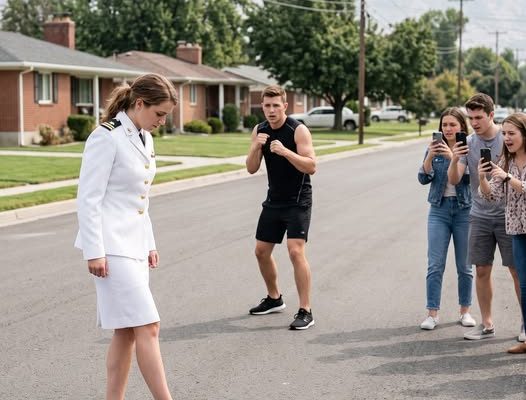

A neighbor tried to record himself fighting me at a neighborhood BBQ, setting off a salute that ruined his viral stunt.

Part 1: The Gloves at My Feet

The gloves landed near my sneakers, and the whole street went silent. Blake Harrington stood ten feet away in a sleeveless black training shirt, smiling like he had already decided how the video would end. “Come on, Colonel,” he said. “Show everybody what you’ve got.”

His father, Victor Harrington, was filming. Half the neighborhood was watching.

My name is Maya Lawson. I was forty-two, a single mother, and a colonel in the United States Army. I had spent more than twenty years training soldiers, commanding Ranger operations, and making decisions in places where one careless move could cost more than pride.

But no one on Juniper Hollow Drive knew that.

To them, I was just the quiet woman in the blue house at the end of the cul-de-sac. I cut my own grass, drank coffee before sunrise, and drove an old pickup with a dented tailgate.

I had moved to Silver Creek, Colorado, after my fifteen-year-old son, Ethan, finished ninth grade. The listing promised mountain views, good schools, and peaceful streets.

Peace was all I wanted.

After years of radios, engines, boots, and voices carrying news no one wanted to hear, silence had become sacred.

The house next door belonged to Victor, a wealthy developer with a perfect lawn, a polished white SUV, and a habit of turning every conversation toward money. His twenty-two-year-old son had recently come home after leaving college.

According to Victor, Blake was “pursuing professional fighting.” According to everyone else, he spent afternoons blasting music from the garage and recording himself hitting pads held by smaller men.

I noticed Blake before he noticed me.

People like him were usually too busy being watched to watch anyone else.

For three mornings, he started his motorcycle at six and let the engine roar beneath my bedroom window. He parked across two mailbox spaces. Once, he shoved past a delivery driver because the man’s cart blocked the sidewalk.

No one confronted him.

Silver Creek was the kind of neighborhood where people smiled at the mailbox and complained behind closed doors.

Then, one morning, Blake finally noticed me.

Part 2: The Salute

At the summer barbecue, Blake tossed the gloves at my feet while phones rose around us. Ethan stiffened beside me, but I kept one hand on his shoulder.

Before I could answer Blake, an elderly man across the street raised a trembling salute.

“Ma’am,” he said. “I served under your command in the 75th.”

Blake’s smile faded.

I studied the man’s face. Time had changed him—silver hair, deeper lines, a scar along his jaw—but then I remembered.

“Sergeant First Class Samuel Price.”

His eyes filled.

“Yes, ma’am.”

I returned the salute, and the whole street changed. People who had treated the moment like entertainment lowered their phones.

Blake looked between us. “You actually know her?”

Samuel’s voice hardened. “Son, people are alive today because Colonel Lawson knew what she was doing when everyone else was losing their heads.”

“Samuel,” I warned quietly.

He understood. Some memories deserved more respect than becoming barbecue entertainment.

Blake tried to laugh it off. “Cool. She was in the Army.”

“Not just in the Army,” Samuel said.

Victor finally stepped forward. “Blake, that’s enough.”

“You were filming thirty seconds ago,” Blake snapped.

Humiliation had started doing what it often does to insecure men.

It made him reckless.

He picked up one glove. “Being some military officer doesn’t make someone a fighter.”

I looked at him calmly. “You challenged me because you wanted to prove something. To whom?”

That question landed harder than a threat.

Blake’s face reddened. “You scared?”

“No.”

“Then fight me.”

“No.”

Children were watching. Ethan was watching.

“I’d rather my son learn that strength includes knowing when not to use it.”

For one second, I thought that might end it.

Then Blake stepped too close and shoved my shoulder.

Not hard.

Just enough.

I caught Ethan before he lunged forward.

“Stay behind me.”

Blake spread his arms. “What happened to discipline, Colonel?”

I looked at him.

“You get one mistake.”

He smiled. “You threatening me?”

“No. I’m giving you a chance to walk away.”

“And if I don’t?”

“Then you’ll learn something today.”

Part 3: The Demonstration

Blake pulled on the gloves.

I sighed. “No gloves.”

He frowned. “What?”

“You want a demonstration? No punches. No kicks.”

Neighbors leaned closer.

“You try to touch my shoulder,” I said. “I stop you.”

Blake laughed because it sounded easy.

That was his first problem.

He came casually at first, reaching for my shoulder. I shifted half a step. His fingers touched air.

The second attempt was faster.

I moved again.

The third time, he feinted left and reached right. I redirected his wrist with two fingers and stepped away.

His smile disappeared.

Now the performance ended.

He lowered his stance. There was real training there—decent footwork, good timing, better coaching than his arrogance suggested.

That made the lesson more important.

He rushed. I pivoted, caught his wrist, guided his momentum, and let him stumble past me.

“Again,” he snapped.

This time, anger made him faster.

It also made him obvious.

He tried to trap me between two lawn chairs, but I rotated around him. Twenty seconds passed. Thirty. Forty.

His breathing changed.

Mine didn’t.

“You’re running,” he said.

“I’m standing three feet away.”

People laughed, and he heard it.

Then he broke the rules. Instead of touching my shoulder, he tried to clinch around my body.

I trapped one arm, turned my hips, stepped behind his balance point, and lowered him onto the grass.

Not slammed.

Not thrown.

Lowered.

Controlled.

He landed on his back, staring at the sky.

The neighborhood went silent.

Samuel cleared his throat. “Colonel Lawson once taught two hundred Rangers the same principle. Momentum is useful until someone else owns it.”

I shot him a look.

“Sorry, ma’am.”

Ethan was trying not to grin.

“Don’t,” I told him.

“Yes, ma’am.”

That almost made me laugh.

Then Blake stood, humiliation and common sense fighting across his face.

Common sense almost won.

Then someone’s phone chimed.

Too many people had recorded him falling.

And Blake chose anger.

Part 4: The House Next Door

“That wasn’t a fight,” Blake snapped.

“No,” I agreed.

“I wasn’t ready.”

“You said you were.”

“You tricked me.”

“No.”

He stepped toward me again, but Victor grabbed his arm.

“Stop.”

Blake ripped free. “You’re embarrassing me.”

Victor stared at him. “You’re doing that yourself.”

Something cracked between them.

Blake laughed bitterly. “You only like filming when I win.”

No one spoke.

There it was.

His arrogance had been fed, rewarded, and monetized. Every fight clip, every sparring video, every loud prediction about Blake becoming a professional fighter—Victor had helped build the audience.

And now the investment had landed on a lawn in front of forty neighbors.

“Go ahead,” Blake said. “Post that too.”

He stormed into the house and slammed the door.

The barbecue slowly pretended to continue.

Then a scream came from inside Victor’s house.

Not anger.

Pain.

Victor ran. I followed.

We found Blake on the garage floor beside a collapsed weight rack, his arm trapped beneath part of the equipment.

His face was gray.

“I can’t feel my hand.”

The old part of me returned instantly.

“Samuel, call emergency services. Tell them possible crush injury, right upper extremity.”

“Yes, ma’am.”

“Victor, towels.”

Victor froze.

“Victor!”

He snapped awake.

I crouched beside Blake. “Look at me. Don’t try to move.”

His voice broke. “This hurts.”

“I know.”

For the first time, he looked twenty-two.

Not undefeated.

Not a black belt.

Just someone’s frightened son.

Victor knelt where Blake could see him.

“I’m sorry,” he said.

“For what?”

“For making everything a competition. I should have told you I was proud when no one was watching. I should have told you losing doesn’t make you less mine.”

Blake turned away, but I saw the tear slide toward his ear.

When paramedics arrived, they stabilized his arm and prepared him for transport.

Before they wheeled him out, Blake caught my wrist.

“Claire—”

“Maya is fine.”

He swallowed. “Why are you helping me?”

“Because you need help.”

“After everything?”

“That doesn’t change anything.”

He stared at me.

“Why?”

“Because character matters most when nobody has earned kindness from you.”

Part 5: Operation Nightglass

After the ambulance left, Samuel approached me quietly.

“There’s something you need to see.”

He handed me a black challenge coin. One side bore the Ranger crest. The other held a mountain, three stars, and the number seventeen.

I had not seen that symbol in eleven years.

“Where did you get this?”

“Someone left it at my sister’s door two nights ago.”

There had been twelve coins, issued to a command group tied to an operation I had spent years trying not to remember.

Operation Nightglass.

Ten coins were accounted for. One had been buried with Thomas Reed. The last belonged to Captain Adrian Voss, an officer who disappeared before investigators could question him.

Samuel also had a note.

Tell Lawson that Operation Nightglass never ended.

Below it were coordinates less than sixty miles away.

Then my phone rang.

Unknown number.

I answered. “Lawson.”

A slow, steady breath came through.

“Still giving orders, Colonel?”

Every muscle in my body went still.

“Voss.”

He laughed softly. “You always were quick.”

He claimed Nightglass had not failed the way the reports said. He claimed the route change that doomed us had been forged through command.

“Why call now?” I asked.

“Because the man who authorized it finally made one mistake.”

“What mistake?”

“He came to Colorado.”

The line disconnected.

Then I saw a black SUV at the end of Juniper Hollow Drive. I had seen it before—near the mailbox, outside the grocery store, always close enough to be coincidence.

Not anymore.

I ran home for Ethan.

He was not in his room.

His backpack lay near the stairs. His phone was on the kitchen counter. The back door was open.

Then I saw an envelope on his desk.

COLONEL LAWSON.

Inside were three sentences:

If you want your son safe, come alone. Bring the Nightglass coin. Do not call anyone.

My vision narrowed.

Then Ethan appeared in the doorway holding a sandwich.

“What?”

For one second, I could breathe again.

But then another message arrived.

Photos.

Ethan outside school.

Ethan riding his bike.

Me on my porch.

Then one word:

TONIGHT.

Part 6: The Wrong Man Buried

Victor arrived from the hospital with a second challenge coin found in Blake’s jacket.

This one carried the number twelve.

Thomas Reed’s number.

The man we thought had been buried eleven years ago.

Then another note appeared:

Lawson brought the wrong man home.

Samuel went pale.

“Reed wasn’t the one we buried.”

Thunder rolled over the mountains.

A new call came in.

The voice was older and weak, but I knew it.

“Reed?”

“Colonel.”

Thomas Reed was alive.

He told me Adrian Voss was not the one hunting me.

The real name was General Elias Warren, the respected officer who had overseen the Nightglass investigation and later congratulated me for surviving it.

Warren had not retired from what mattered.

“Nightglass wasn’t an operation that failed,” Thomas said. “It was designed to fail.”

“Why?”

“Because of you.”

I stopped breathing.

I had documented route inconsistencies and questioned intelligence packages. Warren needed my signature on a mission that would collapse. If I died, I became a hero. If I survived, I became responsible.

Voss had discovered the forged order.

Thomas helped him.

The body identified as Thomas had belonged to a contractor working for Warren. Thomas and Voss had disappeared to stay alive.

He gave me one warning before the line died.

“Do not trust the first uniform you see.”

Minutes later, government vehicles pulled into my driveway.

Special Agent Martin Cross from Defense Criminal Investigative Service stood on my porch.

“We need to speak with you about classified material connected to Operation Nightglass.”

Then he looked at Ethan.

Something shifted in his eyes.

“Colonel,” he said quietly, “you need to get your son out of this house.”

“Why?”

“Because the people watching you are closer than you think.”

“How close?”

He glanced next door.

“Next door.”

Part 7: The Secret in the Harrington House

I was across the lawn before Cross finished speaking.

Victor’s house glowed under the storm. The garage door was open. His SUV was gone.

Ethan followed me despite my order to stay back.

“Why are you here?”

“Because Victor texted me.”

The message read:

Don’t come over. Take your mom and leave.

Then Cross revealed the truth.

Victor Harrington’s real name was Victor Warren.

Elias Warren’s son.

His mother had left Elias when Victor was fourteen and changed their surname to Harrington. Victor had spent his life trying to become someone with nothing to do with his father.

But Warren had followed him anyway.

For years, money tied to shell corporations had quietly helped build Victor’s company. His own chief operating officer was an alias for Adrian Voss.

Victor had discovered pieces of the truth but had been too afraid to report everything.

Then his house went dark.

Three intrusions appeared on the security system. Side door. Garage. Rear window.

No immediate attack followed.

Then I smelled smoke.

“They’re flushing us out,” Samuel said.

Victor led us into a reinforced basement safe room. On the monitors, masked men entered the property and placed cameras near the exits.

Then the black SUV arrived.

Adrian Voss stepped out, older, thinner, alive.

He looked directly into the camera.

“Claire.”

I pressed the intercom. “What do you want?”

“Five minutes.”

“You burned the garage?”

“No.”

“Then whose people are inside?”

He glanced toward the street.

“Cross’s.”

Every face turned toward Agent Cross.

Voss continued, “Ask him what agency employed him before DCIS.”

Cross said nothing.

“Answer,” I ordered.

“Defense Intelligence Agency,” he said.

“What directorate?”

“Special Activities.”

Nightglass.

Voss’s voice sharpened.

“Cross was Warren’s liaison.”

Cross moved fast, reaching inside his jacket.

Samuel intercepted him.

I caught Cross’s wrist, kicked away his weapon, and helped pin him to the concrete.

“You trust Voss?” Cross hissed.

“No,” I said. “But you lied.”

Part 8: The Notebook

Voss said the men upstairs were not there for us.

They were there for Victor’s evidence.

Victor had copied files to cloud storage, but Cross laughed.

“They were corrupted twelve minutes ago.”

Voss held up a silver drive.

“I have the original.”

Then he revealed what Nightglass had really protected: evidence that Elias Warren stole twelve billion dollars through classified defense programs over seventeen years.

Shell contractors.

False logistics companies.

Compromised officials.

I had noticed a route discrepancy that exposed one of the fake contractors. Warren needed Nightglass to collapse so the records would disappear.

“Why target me now?” I asked.

“Because you still have what he never recovered.”

“I have nothing.”

“Yes, you do,” Voss said. “The original Nightglass operations notebook.”

I almost laughed. “That was destroyed.”

“No. You gave it to your son.”

My heart stopped.

Years earlier, when Ethan was six, he found a small black field notebook in a storage box. Most pages looked blank after declassification, so I let him use it for drawings.

Dinosaurs.

Spaceships.

A terrible portrait of me with giant ears.

Voss said the binding contained a micro-storage strip Thomas had hidden before disappearing.

The notebook was in Ethan’s room across the street.

Before we could move, men crossed toward my house.

Voss ran to intercept them.

Minutes later, a bedroom window shattered. A man climbed out. Voss followed and recovered the notebook.

Then the black SUV returned.

A shot cracked.

Voss fell on the wet grass.

I reached him as rain hammered the lawn.

“The strip,” he gasped.

“I have the notebook.”

“No. Not the notebook. The drawing.”

Ethan remembered a spaceship on the inside cover.

Beneath it was the encryption key.

Then Voss whispered one more truth.

“Elias Warren didn’t die in January. He attended his own memorial.”

Part 9: The General Who Refused to Die

At 1:12 a.m., I sat inside a secure conference room at Peterson Space Force Base with Samuel, General Rebecca Stone, Victor, Blake, and Ethan.

Voss survived surgery under federal protection. Cross was in custody. The micro-storage strip had been removed from the notebook, and the encryption key was exactly where Voss said it would be—behind Ethan’s old rocket drawing.

A technician decrypted the files.

Financial records.

Personnel lists.

Contractor networks.

One of the largest diversion schemes anyone in that room had ever seen.

Elias Warren’s signature was everywhere.

Then we found a folder labeled SUCCESSION.

Victor’s photo appeared.

The file contained his company, properties, employees, marriage records, and Blake’s birth certificate. Warren had tracked his estranged son for decades and secretly funded his rise through a private equity firm called North Peak.

Victor lowered himself into a chair.

“My whole life was his.”

I sat beside him. “What you did with the opportunity was still yours.”

“You don’t know that.”

“Yes, I do. Your father couldn’t make you run into a burning house for your son. He couldn’t make you apologize to Blake. He could move money, but he could not decide who you became.”

Then another file appeared.

LAWSON.

My assignments. Evaluations. medical records. promotions. Ethan’s school records. My divorce. My house purchase.

Everything.

Warren had profiled me years before Nightglass as an officer likely to expose him.

Nightglass had been my erasure.

A live financial node appeared at the coordinates Thomas sent. Stone warned me not to go.

I went anyway.

Not alone.

At dawn, I entered an abandoned lodge with federal teams beyond visual range. Inside, Elias Warren sat by a fire, older than his photographs, but alive.

“You looked convincing at your funeral,” I said.

He smiled. “People stop investigating dead men.”

He wanted the notebook.

I brought a duplicate.

He knew.

Then movement sounded upstairs.

Thomas Reed appeared on the balcony, restrained.

Warren smiled.

“Now give me the real drive.”

Part 10: The Friend Who Knew Too Much

Thomas looked at me and asked calmly, “You still count backward from five?”

Old Ranger signal.

Five.

Four.

Three.

The lights went out.

Thomas dropped. I moved. Federal teams entered from three sides.

Warren tried to escape. I intercepted him.

He swung his cane. I caught it, twisted, and made him stumble. For one moment, the man who had shaped fourteen years of my life stood directly in front of me.

“Hit me,” he whispered.

“No.”

“Coward.”

“No,” I said. “I’m done letting you choose my behavior.”

Agents restrained him.

Then Warren smiled.

“You think this ends with me? Ask Thomas who really created Nightglass.”

For the first time since hearing his voice again, Thomas Reed looked afraid.

At the secure facility, he finally told me the truth.

Nightglass had begun as an internal investigation into senior officials. Three years earlier, my routine reports about duplicate billing and logistics anomalies became markers for investigators.

Without knowing it, I had helped build the map that exposed Warren’s network.

Then Thomas admitted the leak came through his family.

He had confided enough fear to his wife for her to mention it to her brother, Philip Kane, a banker tied to Warren’s financial network. Kane warned Warren, and Warren changed the route.

Thomas had stayed “dead” to protect his daughters.

Voss had stayed hidden because Warren had penetrated the investigation.

I did not forgive them.

Not yet.

But I understood.

Then Stone entered.

“Warren escaped.”

During transfer, a vehicle collision freed him. Soon after, a succession account moved nine million dollars into a company registered under Blake’s name.

Warren had shifted from his son to his grandson.

Blake received a video of Victor sitting in a car beside Elias Warren.

The message read:

Family inheritance belongs to the son strong enough to claim it.

I told Blake not to move.

For once, he listened.

That single decision saved him, because security caught a man with false credentials outside his hospital room minutes later.

Part 11: The Daughter of Nightglass

Warren led us to an abandoned commercial development owned by one of Victor’s companies. We found Victor alive, tied in an unfinished office.

Warren appeared on a video screen.

Victor finally laughed at him.

“You can keep the money,” he said. “The company. The name. Your definition of strength.”

The call ended.

Then every monitor lit up with one message:

You still don’t know who I am.

Thomas went white.

“I know who it is.”

“Who?”

“My daughter.”

Her name was Emily Reed. She was twenty-three, a cybersecurity specialist, and had discovered her father was alive after mourning him for eleven years.

A video feed opened.

“Hello, Dad,” she said.

Thomas broke.

Emily had orchestrated the coins, coordinates, photographs, and warnings to force everyone connected to Nightglass into the open. She had intercepted Warren’s surveillance feed and sent me the images of Ethan to prove my son was already being watched.

She had even redirected Warren’s transport route, hoping to expose everyone who helped him run.

Her plan worked—twenty-seven names activated after his escape.

But Warren had been tracking her too.

He used her access to move the twelve billion dollars, then trapped her inside a private data center.

We reached her alive, with Warren standing behind her.

He had transferred the stolen money into trusts tied to Victor and Blake, intending to frame his own son as the beneficiary.

Then Blake and Ethan appeared in the doorway.

They had followed us.

Before I could yell, Warren moved for a weapon.

Three adults reacted.

But Blake did something none of us expected.

He stepped backward, grabbed Ethan, and pulled him behind a server cabinet.

He did not fight.

That decision saved both boys.

Warren was restrained seconds later.

Then a technician shouted from the server room.

The money had not gone to Victor.

It had gone to one account.

Mine.

Part 12: The Last Order

By sunrise, according to international banking records, I was one of the richest women in America.

Twelve billion stolen dollars had been routed through shell companies and placed under my identity.

It would have been funny if it had not been catastrophic.

General Stone said the funds were already being frozen, but proving the authorization records were forged would take months.

Reporters would come.

Politics would follow.

Nightglass had never been simple.

The investigation consumed months. Warren’s network collapsed slowly: twenty-seven conspirators became thirty-four, then forty-one. Retired officials, civilian executives, subcontractors, and intermediaries were exposed.

Cross accepted a plea agreement for helping Warren manipulate the original investigation.

Warren refused every deal.

He insisted he was a patriot.

He believed control justified ownership.

That belief had shaped his network, his son, his grandson, and every officer he tried to destroy.

The twelve billion was recovered, mostly. Ethan remained disappointed that I could not legally keep enough to fix my truck.

Three months after the barbecue, the government publicly cleared me of financial involvement.

The official phrase was sterile:

Unwitting target.

It covered fourteen years of manipulation.

I hated it.

Samuel framed the article under a handwritten label:

Unwitting Target Who Still Throws Men on Lawns.

I threatened to remove it.

He used stronger screws.

Part 13: The Hollow Project

Blake’s arm healed, but something else changed first.

He stopped posting fight videos.

Weeks later, his motorcycle started at six in the morning outside my window—then immediately shut off.

A knock came downstairs.

Blake stood on my porch with two coffees.

“Peace offering.”

“You remembered.”

“Six a.m. Motorcycles are obnoxious.”

“Yes.”

“I was obnoxious.”

“Yes.”

He smiled. “You ever answer with more than one word?”

“Sometimes.”

He had quit his gym, not because his coach did anything wrong, but because he did not like who he had become there.

“I need to figure out whether I love fighting,” he said, “or just love winning.”

“That is a good question.”

“I hate good questions.”

“Most people do.”

Victor sold properties tied to Warren’s money and stepped away from the company. Then he brought me a proposal for a nonprofit training center for veterans, at-risk teenagers, and young athletes.

No heroic title.

No family name.

We eventually called it The Hollow Project.

Its purpose was simple: teach young people that discipline without character is only performance.

Blake became one of its first assistant coaches.

He was surprisingly good.

When one angry teenager lost control during sparring, Blake did not humiliate him. He sat beside him, waited, and said, “You’re allowed to be angry. You’re not allowed to let anger drive.”

I heard it from across the gym.

He saw my face.

“Don’t say it.”

“I wasn’t going to.”

“You have the face.”

“What face?”

“The one Samuel warned me about.”

I smiled.

“Good lesson.”

“Go away.”

Part 14: Coming Back

Thomas Reed’s reunion with his daughters was harder.

Emily eventually told her younger sister, Sarah. Sarah refused to see him for four months.

Thomas accepted it. Every Sunday, he wrote her a letter with no excuses and no requests.

One December afternoon, Sarah appeared at The Hollow Project. She stood outside for fifteen minutes.

Thomas saw her through the window.

He did not run to her.

He waited.

She came in, walked to him, slapped him lightly, then hugged him.

Thomas cried into her shoulder.

Some moments deserve silence.

Voss accepted responsibility for hiding evidence after Nightglass. Because of his cooperation and the circumstances, he avoided prison but lost rank recognition tied to the years he lived under an alias.

He became an emergency-planning instructor at a community college.

The third time he invited me to speak, he bribed Ethan with pizza.

I attended.

A student asked the most important thing I had learned commanding Rangers.

I thought about risk, operations, training, trust.

Then I remembered Blake’s gloves, Victor’s apology, Thomas waiting for Emily to choose, and Ethan telling me to stop living inside Nightglass.

“Control is not leadership,” I said. “People confuse them because both can produce obedience. But control makes people smaller. Leadership should help them become capable of choosing well without you.”

Part 15: What Strength Really Was

One year after the barbecue, Juniper Hollow Drive held another summer gathering.

Same street.

Same grills.

Same sprinklers.

Someone joked that Blake should bring his MMA gloves.

He pointed at me. “Absolutely not.”

The neighbors laughed.

Victor raised lemonade. “To personal growth.”

Samuel raised his. “To gravity.”

Blake groaned.

Ethan produced the framed photo of Blake lying on the lawn.

“For history,” he said.

Blake stared. “You people are terrible.”

“We adapt,” I said.

Later, Blake held out his hand.

No gloves.

No cameras.

No performance.

“Truce?”

I shook it. “Truce.”

Then he surprised me.

He saluted.

Quietly.

Respectfully.

Samuel followed.

Then Voss.

Then Thomas.

Victor looked around. “I was never military.”

Ethan shrugged. “Neither am I.”

They saluted anyway.

A year earlier, a salute had exposed my past in front of the neighborhood.

Now it meant something different.

Not rank.

Not reputation.

Belonging.

I returned it.

Then Samuel ruined the moment.

“So, Colonel, think you could still take Blake?”

Blake shouted, “No.”

Everyone laughed.

The sun lowered behind the Colorado mountains. Music played. Children ran through sprinklers. Victor burned burgers. Samuel insulted his grilling. Emily helped Thomas hang lights between the trees.

I stood in the middle of the cul-de-sac and finally understood.

Warren thought strength was control.

Blake thought it meant never losing.

Victor thought it meant proving he did not need his father.

Thomas thought it meant suffering alone.

I thought it meant carrying responsibility without showing its weight.

We had all been wrong.

Strength was not domination, pride, or isolation.

Sometimes it was stepping away.

Sometimes it was coming home.

Sometimes it was admitting fear.

Sometimes it was giving someone the freedom to choose whether they forgave you.

And sometimes it was refusing to pick up the gloves someone threw at your feet.

When thunder rolled beyond the mountains that night, I did not think of Nightglass.

I thought only of rain.

A neighbor tried to record himself fighting me at a neighborhood BBQ, setting off a salute that ruined his viral stunt. Read More

A neighbor tried to record himself fighting me at a neighborhood BBQ, setting off a salute that ruined his viral stunt.

Part 1: The Gloves at My Feet

The gloves landed near my sneakers, and the whole street went silent. Blake Harrington stood ten feet away in a sleeveless black training shirt, smiling like he had already decided how the video would end. “Come on, Colonel,” he said. “Show everybody what you’ve got.”

His father, Victor Harrington, was filming. Half the neighborhood was watching.

My name is Maya Lawson. I was forty-two, a single mother, and a colonel in the United States Army. I had spent more than twenty years training soldiers, commanding Ranger operations, and making decisions in places where one careless move could cost more than pride.

But no one on Juniper Hollow Drive knew that.

To them, I was just the quiet woman in the blue house at the end of the cul-de-sac. I cut my own grass, drank coffee before sunrise, and drove an old pickup with a dented tailgate.

I had moved to Silver Creek, Colorado, after my fifteen-year-old son, Ethan, finished ninth grade. The listing promised mountain views, good schools, and peaceful streets.

Peace was all I wanted.

After years of radios, engines, boots, and voices carrying news no one wanted to hear, silence had become sacred.

The house next door belonged to Victor, a wealthy developer with a perfect lawn, a polished white SUV, and a habit of turning every conversation toward money. His twenty-two-year-old son had recently come home after leaving college.

According to Victor, Blake was “pursuing professional fighting.” According to everyone else, he spent afternoons blasting music from the garage and recording himself hitting pads held by smaller men.

I noticed Blake before he noticed me.

People like him were usually too busy being watched to watch anyone else.

For three mornings, he started his motorcycle at six and let the engine roar beneath my bedroom window. He parked across two mailbox spaces. Once, he shoved past a delivery driver because the man’s cart blocked the sidewalk.

No one confronted him.

Silver Creek was the kind of neighborhood where people smiled at the mailbox and complained behind closed doors.

Then, one morning, Blake finally noticed me.

Part 2: The Salute

At the summer barbecue, Blake tossed the gloves at my feet while phones rose around us. Ethan stiffened beside me, but I kept one hand on his shoulder.

Before I could answer Blake, an elderly man across the street raised a trembling salute.

“Ma’am,” he said. “I served under your command in the 75th.”

Blake’s smile faded.

I studied the man’s face. Time had changed him—silver hair, deeper lines, a scar along his jaw—but then I remembered.

“Sergeant First Class Samuel Price.”

His eyes filled.

“Yes, ma’am.”

I returned the salute, and the whole street changed. People who had treated the moment like entertainment lowered their phones.

Blake looked between us. “You actually know her?”

Samuel’s voice hardened. “Son, people are alive today because Colonel Lawson knew what she was doing when everyone else was losing their heads.”

“Samuel,” I warned quietly.

He understood. Some memories deserved more respect than becoming barbecue entertainment.

Blake tried to laugh it off. “Cool. She was in the Army.”

“Not just in the Army,” Samuel said.

Victor finally stepped forward. “Blake, that’s enough.”

“You were filming thirty seconds ago,” Blake snapped.

Humiliation had started doing what it often does to insecure men.

It made him reckless.

He picked up one glove. “Being some military officer doesn’t make someone a fighter.”

I looked at him calmly. “You challenged me because you wanted to prove something. To whom?”

That question landed harder than a threat.

Blake’s face reddened. “You scared?”

“No.”

“Then fight me.”

“No.”

Children were watching. Ethan was watching.

“I’d rather my son learn that strength includes knowing when not to use it.”

For one second, I thought that might end it.

Then Blake stepped too close and shoved my shoulder.

Not hard.

Just enough.

I caught Ethan before he lunged forward.

“Stay behind me.”

Blake spread his arms. “What happened to discipline, Colonel?”

I looked at him.

“You get one mistake.”

He smiled. “You threatening me?”

“No. I’m giving you a chance to walk away.”

“And if I don’t?”

“Then you’ll learn something today.”

Part 3: The Demonstration

Blake pulled on the gloves.

I sighed. “No gloves.”

He frowned. “What?”

“You want a demonstration? No punches. No kicks.”

Neighbors leaned closer.

“You try to touch my shoulder,” I said. “I stop you.”

Blake laughed because it sounded easy.

That was his first problem.

He came casually at first, reaching for my shoulder. I shifted half a step. His fingers touched air.

The second attempt was faster.

I moved again.

The third time, he feinted left and reached right. I redirected his wrist with two fingers and stepped away.

His smile disappeared.

Now the performance ended.

He lowered his stance. There was real training there—decent footwork, good timing, better coaching than his arrogance suggested.

That made the lesson more important.

He rushed. I pivoted, caught his wrist, guided his momentum, and let him stumble past me.

“Again,” he snapped.

This time, anger made him faster.

It also made him obvious.

He tried to trap me between two lawn chairs, but I rotated around him. Twenty seconds passed. Thirty. Forty.

His breathing changed.

Mine didn’t.

“You’re running,” he said.

“I’m standing three feet away.”

People laughed, and he heard it.

Then he broke the rules. Instead of touching my shoulder, he tried to clinch around my body.

I trapped one arm, turned my hips, stepped behind his balance point, and lowered him onto the grass.

Not slammed.

Not thrown.

Lowered.

Controlled.

He landed on his back, staring at the sky.

The neighborhood went silent.

Samuel cleared his throat. “Colonel Lawson once taught two hundred Rangers the same principle. Momentum is useful until someone else owns it.”

I shot him a look.

“Sorry, ma’am.”

Ethan was trying not to grin.

“Don’t,” I told him.

“Yes, ma’am.”

That almost made me laugh.

Then Blake stood, humiliation and common sense fighting across his face.

Common sense almost won.

Then someone’s phone chimed.

Too many people had recorded him falling.

And Blake chose anger.

Part 4: The House Next Door

“That wasn’t a fight,” Blake snapped.

“No,” I agreed.

“I wasn’t ready.”

“You said you were.”

“You tricked me.”

“No.”

He stepped toward me again, but Victor grabbed his arm.

“Stop.”

Blake ripped free. “You’re embarrassing me.”

Victor stared at him. “You’re doing that yourself.”

Something cracked between them.

Blake laughed bitterly. “You only like filming when I win.”

No one spoke.

There it was.

His arrogance had been fed, rewarded, and monetized. Every fight clip, every sparring video, every loud prediction about Blake becoming a professional fighter—Victor had helped build the audience.

And now the investment had landed on a lawn in front of forty neighbors.

“Go ahead,” Blake said. “Post that too.”

He stormed into the house and slammed the door.

The barbecue slowly pretended to continue.

Then a scream came from inside Victor’s house.

Not anger.

Pain.

Victor ran. I followed.

We found Blake on the garage floor beside a collapsed weight rack, his arm trapped beneath part of the equipment.

His face was gray.

“I can’t feel my hand.”

The old part of me returned instantly.

“Samuel, call emergency services. Tell them possible crush injury, right upper extremity.”

“Yes, ma’am.”

“Victor, towels.”

Victor froze.

“Victor!”

He snapped awake.

I crouched beside Blake. “Look at me. Don’t try to move.”

His voice broke. “This hurts.”

“I know.”

For the first time, he looked twenty-two.

Not undefeated.

Not a black belt.

Just someone’s frightened son.

Victor knelt where Blake could see him.

“I’m sorry,” he said.

“For what?”

“For making everything a competition. I should have told you I was proud when no one was watching. I should have told you losing doesn’t make you less mine.”

Blake turned away, but I saw the tear slide toward his ear.

When paramedics arrived, they stabilized his arm and prepared him for transport.

Before they wheeled him out, Blake caught my wrist.

“Claire—”

“Maya is fine.”

He swallowed. “Why are you helping me?”

“Because you need help.”

“After everything?”

“That doesn’t change anything.”

He stared at me.

“Why?”

“Because character matters most when nobody has earned kindness from you.”

Part 5: Operation Nightglass

After the ambulance left, Samuel approached me quietly.

“There’s something you need to see.”

He handed me a black challenge coin. One side bore the Ranger crest. The other held a mountain, three stars, and the number seventeen.

I had not seen that symbol in eleven years.

“Where did you get this?”

“Someone left it at my sister’s door two nights ago.”

There had been twelve coins, issued to a command group tied to an operation I had spent years trying not to remember.

Operation Nightglass.

Ten coins were accounted for. One had been buried with Thomas Reed. The last belonged to Captain Adrian Voss, an officer who disappeared before investigators could question him.

Samuel also had a note.

Tell Lawson that Operation Nightglass never ended.

Below it were coordinates less than sixty miles away.

Then my phone rang.

Unknown number.

I answered. “Lawson.”

A slow, steady breath came through.

“Still giving orders, Colonel?”

Every muscle in my body went still.

“Voss.”

He laughed softly. “You always were quick.”

He claimed Nightglass had not failed the way the reports said. He claimed the route change that doomed us had been forged through command.

“Why call now?” I asked.

“Because the man who authorized it finally made one mistake.”

“What mistake?”

“He came to Colorado.”

The line disconnected.

Then I saw a black SUV at the end of Juniper Hollow Drive. I had seen it before—near the mailbox, outside the grocery store, always close enough to be coincidence.

Not anymore.

I ran home for Ethan.

He was not in his room.

His backpack lay near the stairs. His phone was on the kitchen counter. The back door was open.

Then I saw an envelope on his desk.

COLONEL LAWSON.

Inside were three sentences:

If you want your son safe, come alone. Bring the Nightglass coin. Do not call anyone.

My vision narrowed.

Then Ethan appeared in the doorway holding a sandwich.

“What?”

For one second, I could breathe again.

But then another message arrived.

Photos.

Ethan outside school.

Ethan riding his bike.

Me on my porch.

Then one word:

TONIGHT.

Part 6: The Wrong Man Buried

Victor arrived from the hospital with a second challenge coin found in Blake’s jacket.

This one carried the number twelve.

Thomas Reed’s number.

The man we thought had been buried eleven years ago.

Then another note appeared:

Lawson brought the wrong man home.

Samuel went pale.

“Reed wasn’t the one we buried.”

Thunder rolled over the mountains.

A new call came in.

The voice was older and weak, but I knew it.

“Reed?”

“Colonel.”

Thomas Reed was alive.

He told me Adrian Voss was not the one hunting me.

The real name was General Elias Warren, the respected officer who had overseen the Nightglass investigation and later congratulated me for surviving it.

Warren had not retired from what mattered.

“Nightglass wasn’t an operation that failed,” Thomas said. “It was designed to fail.”

“Why?”

“Because of you.”

I stopped breathing.

I had documented route inconsistencies and questioned intelligence packages. Warren needed my signature on a mission that would collapse. If I died, I became a hero. If I survived, I became responsible.

Voss had discovered the forged order.

Thomas helped him.

The body identified as Thomas had belonged to a contractor working for Warren. Thomas and Voss had disappeared to stay alive.

He gave me one warning before the line died.

“Do not trust the first uniform you see.”

Minutes later, government vehicles pulled into my driveway.

Special Agent Martin Cross from Defense Criminal Investigative Service stood on my porch.

“We need to speak with you about classified material connected to Operation Nightglass.”

Then he looked at Ethan.

Something shifted in his eyes.

“Colonel,” he said quietly, “you need to get your son out of this house.”

“Why?”

“Because the people watching you are closer than you think.”

“How close?”

He glanced next door.

“Next door.”

Part 7: The Secret in the Harrington House

I was across the lawn before Cross finished speaking.

Victor’s house glowed under the storm. The garage door was open. His SUV was gone.

Ethan followed me despite my order to stay back.

“Why are you here?”

“Because Victor texted me.”

The message read:

Don’t come over. Take your mom and leave.

Then Cross revealed the truth.

Victor Harrington’s real name was Victor Warren.

Elias Warren’s son.

His mother had left Elias when Victor was fourteen and changed their surname to Harrington. Victor had spent his life trying to become someone with nothing to do with his father.

But Warren had followed him anyway.

For years, money tied to shell corporations had quietly helped build Victor’s company. His own chief operating officer was an alias for Adrian Voss.

Victor had discovered pieces of the truth but had been too afraid to report everything.

Then his house went dark.

Three intrusions appeared on the security system. Side door. Garage. Rear window.

No immediate attack followed.

Then I smelled smoke.

“They’re flushing us out,” Samuel said.

Victor led us into a reinforced basement safe room. On the monitors, masked men entered the property and placed cameras near the exits.

Then the black SUV arrived.

Adrian Voss stepped out, older, thinner, alive.

He looked directly into the camera.

“Claire.”

I pressed the intercom. “What do you want?”

“Five minutes.”

“You burned the garage?”

“No.”

“Then whose people are inside?”

He glanced toward the street.

“Cross’s.”

Every face turned toward Agent Cross.

Voss continued, “Ask him what agency employed him before DCIS.”

Cross said nothing.

“Answer,” I ordered.

“Defense Intelligence Agency,” he said.

“What directorate?”

“Special Activities.”

Nightglass.

Voss’s voice sharpened.

“Cross was Warren’s liaison.”

Cross moved fast, reaching inside his jacket.

Samuel intercepted him.

I caught Cross’s wrist, kicked away his weapon, and helped pin him to the concrete.

“You trust Voss?” Cross hissed.

“No,” I said. “But you lied.”

Part 8: The Notebook

Voss said the men upstairs were not there for us.

They were there for Victor’s evidence.

Victor had copied files to cloud storage, but Cross laughed.

“They were corrupted twelve minutes ago.”

Voss held up a silver drive.

“I have the original.”

Then he revealed what Nightglass had really protected: evidence that Elias Warren stole twelve billion dollars through classified defense programs over seventeen years.

Shell contractors.

False logistics companies.

Compromised officials.

I had noticed a route discrepancy that exposed one of the fake contractors. Warren needed Nightglass to collapse so the records would disappear.

“Why target me now?” I asked.

“Because you still have what he never recovered.”

“I have nothing.”

“Yes, you do,” Voss said. “The original Nightglass operations notebook.”

I almost laughed. “That was destroyed.”

“No. You gave it to your son.”

My heart stopped.

Years earlier, when Ethan was six, he found a small black field notebook in a storage box. Most pages looked blank after declassification, so I let him use it for drawings.

Dinosaurs.

Spaceships.

A terrible portrait of me with giant ears.

Voss said the binding contained a micro-storage strip Thomas had hidden before disappearing.

The notebook was in Ethan’s room across the street.

Before we could move, men crossed toward my house.

Voss ran to intercept them.

Minutes later, a bedroom window shattered. A man climbed out. Voss followed and recovered the notebook.

Then the black SUV returned.

A shot cracked.

Voss fell on the wet grass.

I reached him as rain hammered the lawn.

“The strip,” he gasped.

“I have the notebook.”

“No. Not the notebook. The drawing.”

Ethan remembered a spaceship on the inside cover.

Beneath it was the encryption key.

Then Voss whispered one more truth.

“Elias Warren didn’t die in January. He attended his own memorial.”

Part 9: The General Who Refused to Die

At 1:12 a.m., I sat inside a secure conference room at Peterson Space Force Base with Samuel, General Rebecca Stone, Victor, Blake, and Ethan.

Voss survived surgery under federal protection. Cross was in custody. The micro-storage strip had been removed from the notebook, and the encryption key was exactly where Voss said it would be—behind Ethan’s old rocket drawing.

A technician decrypted the files.

Financial records.

Personnel lists.

Contractor networks.

One of the largest diversion schemes anyone in that room had ever seen.

Elias Warren’s signature was everywhere.

Then we found a folder labeled SUCCESSION.

Victor’s photo appeared.

The file contained his company, properties, employees, marriage records, and Blake’s birth certificate. Warren had tracked his estranged son for decades and secretly funded his rise through a private equity firm called North Peak.

Victor lowered himself into a chair.

“My whole life was his.”

I sat beside him. “What you did with the opportunity was still yours.”

“You don’t know that.”

“Yes, I do. Your father couldn’t make you run into a burning house for your son. He couldn’t make you apologize to Blake. He could move money, but he could not decide who you became.”

Then another file appeared.

LAWSON.

My assignments. Evaluations. medical records. promotions. Ethan’s school records. My divorce. My house purchase.

Everything.

Warren had profiled me years before Nightglass as an officer likely to expose him.

Nightglass had been my erasure.

A live financial node appeared at the coordinates Thomas sent. Stone warned me not to go.

I went anyway.

Not alone.

At dawn, I entered an abandoned lodge with federal teams beyond visual range. Inside, Elias Warren sat by a fire, older than his photographs, but alive.

“You looked convincing at your funeral,” I said.

He smiled. “People stop investigating dead men.”

He wanted the notebook.

I brought a duplicate.

He knew.

Then movement sounded upstairs.

Thomas Reed appeared on the balcony, restrained.

Warren smiled.

“Now give me the real drive.”

Part 10: The Friend Who Knew Too Much

Thomas looked at me and asked calmly, “You still count backward from five?”

Old Ranger signal.

Five.

Four.

Three.

The lights went out.

Thomas dropped. I moved. Federal teams entered from three sides.

Warren tried to escape. I intercepted him.

He swung his cane. I caught it, twisted, and made him stumble. For one moment, the man who had shaped fourteen years of my life stood directly in front of me.

“Hit me,” he whispered.

“No.”

“Coward.”

“No,” I said. “I’m done letting you choose my behavior.”

Agents restrained him.

Then Warren smiled.

“You think this ends with me? Ask Thomas who really created Nightglass.”

For the first time since hearing his voice again, Thomas Reed looked afraid.

At the secure facility, he finally told me the truth.

Nightglass had begun as an internal investigation into senior officials. Three years earlier, my routine reports about duplicate billing and logistics anomalies became markers for investigators.

Without knowing it, I had helped build the map that exposed Warren’s network.

Then Thomas admitted the leak came through his family.

He had confided enough fear to his wife for her to mention it to her brother, Philip Kane, a banker tied to Warren’s financial network. Kane warned Warren, and Warren changed the route.

Thomas had stayed “dead” to protect his daughters.

Voss had stayed hidden because Warren had penetrated the investigation.

I did not forgive them.

Not yet.

But I understood.

Then Stone entered.

“Warren escaped.”

During transfer, a vehicle collision freed him. Soon after, a succession account moved nine million dollars into a company registered under Blake’s name.

Warren had shifted from his son to his grandson.

Blake received a video of Victor sitting in a car beside Elias Warren.

The message read:

Family inheritance belongs to the son strong enough to claim it.

I told Blake not to move.

For once, he listened.

That single decision saved him, because security caught a man with false credentials outside his hospital room minutes later.

Part 11: The Daughter of Nightglass

Warren led us to an abandoned commercial development owned by one of Victor’s companies. We found Victor alive, tied in an unfinished office.

Warren appeared on a video screen.

Victor finally laughed at him.

“You can keep the money,” he said. “The company. The name. Your definition of strength.”

The call ended.

Then every monitor lit up with one message:

You still don’t know who I am.

Thomas went white.

“I know who it is.”

“Who?”

“My daughter.”

Her name was Emily Reed. She was twenty-three, a cybersecurity specialist, and had discovered her father was alive after mourning him for eleven years.

A video feed opened.

“Hello, Dad,” she said.

Thomas broke.

Emily had orchestrated the coins, coordinates, photographs, and warnings to force everyone connected to Nightglass into the open. She had intercepted Warren’s surveillance feed and sent me the images of Ethan to prove my son was already being watched.

She had even redirected Warren’s transport route, hoping to expose everyone who helped him run.

Her plan worked—twenty-seven names activated after his escape.

But Warren had been tracking her too.

He used her access to move the twelve billion dollars, then trapped her inside a private data center.

We reached her alive, with Warren standing behind her.

He had transferred the stolen money into trusts tied to Victor and Blake, intending to frame his own son as the beneficiary.

Then Blake and Ethan appeared in the doorway.

They had followed us.

Before I could yell, Warren moved for a weapon.

Three adults reacted.

But Blake did something none of us expected.

He stepped backward, grabbed Ethan, and pulled him behind a server cabinet.

He did not fight.

That decision saved both boys.

Warren was restrained seconds later.

Then a technician shouted from the server room.

The money had not gone to Victor.

It had gone to one account.

Mine.

Part 12: The Last Order

By sunrise, according to international banking records, I was one of the richest women in America.

Twelve billion stolen dollars had been routed through shell companies and placed under my identity.

It would have been funny if it had not been catastrophic.

General Stone said the funds were already being frozen, but proving the authorization records were forged would take months.

Reporters would come.

Politics would follow.

Nightglass had never been simple.

The investigation consumed months. Warren’s network collapsed slowly: twenty-seven conspirators became thirty-four, then forty-one. Retired officials, civilian executives, subcontractors, and intermediaries were exposed.

Cross accepted a plea agreement for helping Warren manipulate the original investigation.

Warren refused every deal.

He insisted he was a patriot.

He believed control justified ownership.

That belief had shaped his network, his son, his grandson, and every officer he tried to destroy.

The twelve billion was recovered, mostly. Ethan remained disappointed that I could not legally keep enough to fix my truck.

Three months after the barbecue, the government publicly cleared me of financial involvement.

The official phrase was sterile:

Unwitting target.

It covered fourteen years of manipulation.

I hated it.

Samuel framed the article under a handwritten label:

Unwitting Target Who Still Throws Men on Lawns.

I threatened to remove it.

He used stronger screws.

Part 13: The Hollow Project

Blake’s arm healed, but something else changed first.

He stopped posting fight videos.

Weeks later, his motorcycle started at six in the morning outside my window—then immediately shut off.

A knock came downstairs.

Blake stood on my porch with two coffees.

“Peace offering.”

“You remembered.”

“Six a.m. Motorcycles are obnoxious.”

“Yes.”

“I was obnoxious.”

“Yes.”

He smiled. “You ever answer with more than one word?”

“Sometimes.”

He had quit his gym, not because his coach did anything wrong, but because he did not like who he had become there.

“I need to figure out whether I love fighting,” he said, “or just love winning.”

“That is a good question.”

“I hate good questions.”

“Most people do.”

Victor sold properties tied to Warren’s money and stepped away from the company. Then he brought me a proposal for a nonprofit training center for veterans, at-risk teenagers, and young athletes.

No heroic title.

No family name.

We eventually called it The Hollow Project.

Its purpose was simple: teach young people that discipline without character is only performance.

Blake became one of its first assistant coaches.

He was surprisingly good.

When one angry teenager lost control during sparring, Blake did not humiliate him. He sat beside him, waited, and said, “You’re allowed to be angry. You’re not allowed to let anger drive.”

I heard it from across the gym.

He saw my face.

“Don’t say it.”

“I wasn’t going to.”

“You have the face.”

“What face?”

“The one Samuel warned me about.”

I smiled.

“Good lesson.”

“Go away.”

Part 14: Coming Back

Thomas Reed’s reunion with his daughters was harder.

Emily eventually told her younger sister, Sarah. Sarah refused to see him for four months.

Thomas accepted it. Every Sunday, he wrote her a letter with no excuses and no requests.

One December afternoon, Sarah appeared at The Hollow Project. She stood outside for fifteen minutes.

Thomas saw her through the window.

He did not run to her.

He waited.

She came in, walked to him, slapped him lightly, then hugged him.

Thomas cried into her shoulder.

Some moments deserve silence.

Voss accepted responsibility for hiding evidence after Nightglass. Because of his cooperation and the circumstances, he avoided prison but lost rank recognition tied to the years he lived under an alias.

He became an emergency-planning instructor at a community college.

The third time he invited me to speak, he bribed Ethan with pizza.

I attended.

A student asked the most important thing I had learned commanding Rangers.

I thought about risk, operations, training, trust.

Then I remembered Blake’s gloves, Victor’s apology, Thomas waiting for Emily to choose, and Ethan telling me to stop living inside Nightglass.

“Control is not leadership,” I said. “People confuse them because both can produce obedience. But control makes people smaller. Leadership should help them become capable of choosing well without you.”

Part 15: What Strength Really Was

One year after the barbecue, Juniper Hollow Drive held another summer gathering.

Same street.

Same grills.

Same sprinklers.

Someone joked that Blake should bring his MMA gloves.

He pointed at me. “Absolutely not.”

The neighbors laughed.

Victor raised lemonade. “To personal growth.”

Samuel raised his. “To gravity.”

Blake groaned.

Ethan produced the framed photo of Blake lying on the lawn.

“For history,” he said.

Blake stared. “You people are terrible.”

“We adapt,” I said.

Later, Blake held out his hand.

No gloves.

No cameras.

No performance.

“Truce?”

I shook it. “Truce.”

Then he surprised me.

He saluted.

Quietly.

Respectfully.

Samuel followed.

Then Voss.

Then Thomas.

Victor looked around. “I was never military.”

Ethan shrugged. “Neither am I.”

They saluted anyway.

A year earlier, a salute had exposed my past in front of the neighborhood.

Now it meant something different.

Not rank.

Not reputation.

Belonging.

I returned it.

Then Samuel ruined the moment.

“So, Colonel, think you could still take Blake?”

Blake shouted, “No.”

Everyone laughed.

The sun lowered behind the Colorado mountains. Music played. Children ran through sprinklers. Victor burned burgers. Samuel insulted his grilling. Emily helped Thomas hang lights between the trees.

I stood in the middle of the cul-de-sac and finally understood.

Warren thought strength was control.

Blake thought it meant never losing.

Victor thought it meant proving he did not need his father.

Thomas thought it meant suffering alone.

I thought it meant carrying responsibility without showing its weight.

We had all been wrong.

Strength was not domination, pride, or isolation.

Sometimes it was stepping away.

Sometimes it was coming home.

Sometimes it was admitting fear.

Sometimes it was giving someone the freedom to choose whether they forgave you.

And sometimes it was refusing to pick up the gloves someone threw at your feet.

When thunder rolled beyond the mountains that night, I did not think of Nightglass.

I thought only of rain.

A neighbor tried to record himself fighting me at a neighborhood BBQ, setting off a salute that ruined his viral stunt. Read More

A neighbor tried to record himself fighting me at a neighborhood BBQ, setting off a salute that ruined his viral stunt.

Part 1: The Gloves at My Feet

The gloves landed near my sneakers, and the whole street went silent. Blake Harrington stood ten feet away in a sleeveless black training shirt, smiling like he had already decided how the video would end. “Come on, Colonel,” he said. “Show everybody what you’ve got.”

His father, Victor Harrington, was filming. Half the neighborhood was watching.

My name is Maya Lawson. I was forty-two, a single mother, and a colonel in the United States Army. I had spent more than twenty years training soldiers, commanding Ranger operations, and making decisions in places where one careless move could cost more than pride.

But no one on Juniper Hollow Drive knew that.

To them, I was just the quiet woman in the blue house at the end of the cul-de-sac. I cut my own grass, drank coffee before sunrise, and drove an old pickup with a dented tailgate.

I had moved to Silver Creek, Colorado, after my fifteen-year-old son, Ethan, finished ninth grade. The listing promised mountain views, good schools, and peaceful streets.

Peace was all I wanted.

After years of radios, engines, boots, and voices carrying news no one wanted to hear, silence had become sacred.

The house next door belonged to Victor, a wealthy developer with a perfect lawn, a polished white SUV, and a habit of turning every conversation toward money. His twenty-two-year-old son had recently come home after leaving college.

According to Victor, Blake was “pursuing professional fighting.” According to everyone else, he spent afternoons blasting music from the garage and recording himself hitting pads held by smaller men.

I noticed Blake before he noticed me.

People like him were usually too busy being watched to watch anyone else.

For three mornings, he started his motorcycle at six and let the engine roar beneath my bedroom window. He parked across two mailbox spaces. Once, he shoved past a delivery driver because the man’s cart blocked the sidewalk.

No one confronted him.

Silver Creek was the kind of neighborhood where people smiled at the mailbox and complained behind closed doors.

Then, one morning, Blake finally noticed me.

Part 2: The Salute

At the summer barbecue, Blake tossed the gloves at my feet while phones rose around us. Ethan stiffened beside me, but I kept one hand on his shoulder.

Before I could answer Blake, an elderly man across the street raised a trembling salute.

“Ma’am,” he said. “I served under your command in the 75th.”

Blake’s smile faded.

I studied the man’s face. Time had changed him—silver hair, deeper lines, a scar along his jaw—but then I remembered.

“Sergeant First Class Samuel Price.”

His eyes filled.

“Yes, ma’am.”

I returned the salute, and the whole street changed. People who had treated the moment like entertainment lowered their phones.

Blake looked between us. “You actually know her?”

Samuel’s voice hardened. “Son, people are alive today because Colonel Lawson knew what she was doing when everyone else was losing their heads.”

“Samuel,” I warned quietly.

He understood. Some memories deserved more respect than becoming barbecue entertainment.

Blake tried to laugh it off. “Cool. She was in the Army.”

“Not just in the Army,” Samuel said.

Victor finally stepped forward. “Blake, that’s enough.”

“You were filming thirty seconds ago,” Blake snapped.

Humiliation had started doing what it often does to insecure men.

It made him reckless.

He picked up one glove. “Being some military officer doesn’t make someone a fighter.”

I looked at him calmly. “You challenged me because you wanted to prove something. To whom?”

That question landed harder than a threat.

Blake’s face reddened. “You scared?”

“No.”

“Then fight me.”

“No.”

Children were watching. Ethan was watching.

“I’d rather my son learn that strength includes knowing when not to use it.”

For one second, I thought that might end it.

Then Blake stepped too close and shoved my shoulder.

Not hard.

Just enough.

I caught Ethan before he lunged forward.

“Stay behind me.”

Blake spread his arms. “What happened to discipline, Colonel?”

I looked at him.

“You get one mistake.”

He smiled. “You threatening me?”

“No. I’m giving you a chance to walk away.”

“And if I don’t?”

“Then you’ll learn something today.”

Part 3: The Demonstration

Blake pulled on the gloves.

I sighed. “No gloves.”

He frowned. “What?”

“You want a demonstration? No punches. No kicks.”

Neighbors leaned closer.

“You try to touch my shoulder,” I said. “I stop you.”

Blake laughed because it sounded easy.

That was his first problem.

He came casually at first, reaching for my shoulder. I shifted half a step. His fingers touched air.

The second attempt was faster.

I moved again.

The third time, he feinted left and reached right. I redirected his wrist with two fingers and stepped away.

His smile disappeared.

Now the performance ended.

He lowered his stance. There was real training there—decent footwork, good timing, better coaching than his arrogance suggested.

That made the lesson more important.

He rushed. I pivoted, caught his wrist, guided his momentum, and let him stumble past me.

“Again,” he snapped.

This time, anger made him faster.

It also made him obvious.

He tried to trap me between two lawn chairs, but I rotated around him. Twenty seconds passed. Thirty. Forty.

His breathing changed.

Mine didn’t.

“You’re running,” he said.

“I’m standing three feet away.”

People laughed, and he heard it.

Then he broke the rules. Instead of touching my shoulder, he tried to clinch around my body.

I trapped one arm, turned my hips, stepped behind his balance point, and lowered him onto the grass.

Not slammed.

Not thrown.

Lowered.

Controlled.

He landed on his back, staring at the sky.

The neighborhood went silent.

Samuel cleared his throat. “Colonel Lawson once taught two hundred Rangers the same principle. Momentum is useful until someone else owns it.”

I shot him a look.

“Sorry, ma’am.”

Ethan was trying not to grin.

“Don’t,” I told him.

“Yes, ma’am.”

That almost made me laugh.

Then Blake stood, humiliation and common sense fighting across his face.

Common sense almost won.

Then someone’s phone chimed.

Too many people had recorded him falling.

And Blake chose anger.

Part 4: The House Next Door

“That wasn’t a fight,” Blake snapped.

“No,” I agreed.

“I wasn’t ready.”

“You said you were.”

“You tricked me.”

“No.”

He stepped toward me again, but Victor grabbed his arm.

“Stop.”

Blake ripped free. “You’re embarrassing me.”

Victor stared at him. “You’re doing that yourself.”

Something cracked between them.

Blake laughed bitterly. “You only like filming when I win.”

No one spoke.

There it was.

His arrogance had been fed, rewarded, and monetized. Every fight clip, every sparring video, every loud prediction about Blake becoming a professional fighter—Victor had helped build the audience.

And now the investment had landed on a lawn in front of forty neighbors.

“Go ahead,” Blake said. “Post that too.”

He stormed into the house and slammed the door.

The barbecue slowly pretended to continue.

Then a scream came from inside Victor’s house.

Not anger.

Pain.

Victor ran. I followed.

We found Blake on the garage floor beside a collapsed weight rack, his arm trapped beneath part of the equipment.

His face was gray.

“I can’t feel my hand.”

The old part of me returned instantly.

“Samuel, call emergency services. Tell them possible crush injury, right upper extremity.”

“Yes, ma’am.”

“Victor, towels.”

Victor froze.

“Victor!”

He snapped awake.

I crouched beside Blake. “Look at me. Don’t try to move.”

His voice broke. “This hurts.”

“I know.”

For the first time, he looked twenty-two.

Not undefeated.

Not a black belt.

Just someone’s frightened son.

Victor knelt where Blake could see him.

“I’m sorry,” he said.

“For what?”

“For making everything a competition. I should have told you I was proud when no one was watching. I should have told you losing doesn’t make you less mine.”

Blake turned away, but I saw the tear slide toward his ear.

When paramedics arrived, they stabilized his arm and prepared him for transport.

Before they wheeled him out, Blake caught my wrist.

“Claire—”

“Maya is fine.”

He swallowed. “Why are you helping me?”

“Because you need help.”

“After everything?”

“That doesn’t change anything.”

He stared at me.

“Why?”

“Because character matters most when nobody has earned kindness from you.”

Part 5: Operation Nightglass

After the ambulance left, Samuel approached me quietly.

“There’s something you need to see.”

He handed me a black challenge coin. One side bore the Ranger crest. The other held a mountain, three stars, and the number seventeen.

I had not seen that symbol in eleven years.

“Where did you get this?”

“Someone left it at my sister’s door two nights ago.”

There had been twelve coins, issued to a command group tied to an operation I had spent years trying not to remember.

Operation Nightglass.

Ten coins were accounted for. One had been buried with Thomas Reed. The last belonged to Captain Adrian Voss, an officer who disappeared before investigators could question him.

Samuel also had a note.

Tell Lawson that Operation Nightglass never ended.

Below it were coordinates less than sixty miles away.

Then my phone rang.

Unknown number.

I answered. “Lawson.”

A slow, steady breath came through.

“Still giving orders, Colonel?”

Every muscle in my body went still.

“Voss.”

He laughed softly. “You always were quick.”

He claimed Nightglass had not failed the way the reports said. He claimed the route change that doomed us had been forged through command.

“Why call now?” I asked.

“Because the man who authorized it finally made one mistake.”

“What mistake?”

“He came to Colorado.”

The line disconnected.

Then I saw a black SUV at the end of Juniper Hollow Drive. I had seen it before—near the mailbox, outside the grocery store, always close enough to be coincidence.

Not anymore.

I ran home for Ethan.

He was not in his room.

His backpack lay near the stairs. His phone was on the kitchen counter. The back door was open.

Then I saw an envelope on his desk.

COLONEL LAWSON.

Inside were three sentences:

If you want your son safe, come alone. Bring the Nightglass coin. Do not call anyone.

My vision narrowed.

Then Ethan appeared in the doorway holding a sandwich.

“What?”

For one second, I could breathe again.

But then another message arrived.

Photos.

Ethan outside school.

Ethan riding his bike.

Me on my porch.

Then one word:

TONIGHT.

Part 6: The Wrong Man Buried

Victor arrived from the hospital with a second challenge coin found in Blake’s jacket.

This one carried the number twelve.

Thomas Reed’s number.

The man we thought had been buried eleven years ago.

Then another note appeared:

Lawson brought the wrong man home.

Samuel went pale.

“Reed wasn’t the one we buried.”

Thunder rolled over the mountains.

A new call came in.

The voice was older and weak, but I knew it.

“Reed?”

“Colonel.”

Thomas Reed was alive.

He told me Adrian Voss was not the one hunting me.

The real name was General Elias Warren, the respected officer who had overseen the Nightglass investigation and later congratulated me for surviving it.

Warren had not retired from what mattered.

“Nightglass wasn’t an operation that failed,” Thomas said. “It was designed to fail.”

“Why?”

“Because of you.”

I stopped breathing.

I had documented route inconsistencies and questioned intelligence packages. Warren needed my signature on a mission that would collapse. If I died, I became a hero. If I survived, I became responsible.

Voss had discovered the forged order.

Thomas helped him.

The body identified as Thomas had belonged to a contractor working for Warren. Thomas and Voss had disappeared to stay alive.

He gave me one warning before the line died.

“Do not trust the first uniform you see.”

Minutes later, government vehicles pulled into my driveway.

Special Agent Martin Cross from Defense Criminal Investigative Service stood on my porch.

“We need to speak with you about classified material connected to Operation Nightglass.”

Then he looked at Ethan.

Something shifted in his eyes.

“Colonel,” he said quietly, “you need to get your son out of this house.”

“Why?”

“Because the people watching you are closer than you think.”

“How close?”

He glanced next door.

“Next door.”

Part 7: The Secret in the Harrington House

I was across the lawn before Cross finished speaking.

Victor’s house glowed under the storm. The garage door was open. His SUV was gone.

Ethan followed me despite my order to stay back.

“Why are you here?”

“Because Victor texted me.”

The message read:

Don’t come over. Take your mom and leave.

Then Cross revealed the truth.

Victor Harrington’s real name was Victor Warren.

Elias Warren’s son.

His mother had left Elias when Victor was fourteen and changed their surname to Harrington. Victor had spent his life trying to become someone with nothing to do with his father.

But Warren had followed him anyway.

For years, money tied to shell corporations had quietly helped build Victor’s company. His own chief operating officer was an alias for Adrian Voss.

Victor had discovered pieces of the truth but had been too afraid to report everything.

Then his house went dark.

Three intrusions appeared on the security system. Side door. Garage. Rear window.

No immediate attack followed.

Then I smelled smoke.

“They’re flushing us out,” Samuel said.

Victor led us into a reinforced basement safe room. On the monitors, masked men entered the property and placed cameras near the exits.

Then the black SUV arrived.

Adrian Voss stepped out, older, thinner, alive.

He looked directly into the camera.

“Claire.”

I pressed the intercom. “What do you want?”

“Five minutes.”

“You burned the garage?”

“No.”

“Then whose people are inside?”

He glanced toward the street.

“Cross’s.”

Every face turned toward Agent Cross.

Voss continued, “Ask him what agency employed him before DCIS.”

Cross said nothing.

“Answer,” I ordered.

“Defense Intelligence Agency,” he said.

“What directorate?”

“Special Activities.”

Nightglass.

Voss’s voice sharpened.

“Cross was Warren’s liaison.”

Cross moved fast, reaching inside his jacket.

Samuel intercepted him.

I caught Cross’s wrist, kicked away his weapon, and helped pin him to the concrete.

“You trust Voss?” Cross hissed.

“No,” I said. “But you lied.”

Part 8: The Notebook

Voss said the men upstairs were not there for us.

They were there for Victor’s evidence.

Victor had copied files to cloud storage, but Cross laughed.

“They were corrupted twelve minutes ago.”

Voss held up a silver drive.

“I have the original.”

Then he revealed what Nightglass had really protected: evidence that Elias Warren stole twelve billion dollars through classified defense programs over seventeen years.

Shell contractors.

False logistics companies.

Compromised officials.

I had noticed a route discrepancy that exposed one of the fake contractors. Warren needed Nightglass to collapse so the records would disappear.

“Why target me now?” I asked.

“Because you still have what he never recovered.”

“I have nothing.”

“Yes, you do,” Voss said. “The original Nightglass operations notebook.”

I almost laughed. “That was destroyed.”

“No. You gave it to your son.”

My heart stopped.

Years earlier, when Ethan was six, he found a small black field notebook in a storage box. Most pages looked blank after declassification, so I let him use it for drawings.

Dinosaurs.

Spaceships.

A terrible portrait of me with giant ears.

Voss said the binding contained a micro-storage strip Thomas had hidden before disappearing.

The notebook was in Ethan’s room across the street.

Before we could move, men crossed toward my house.

Voss ran to intercept them.

Minutes later, a bedroom window shattered. A man climbed out. Voss followed and recovered the notebook.

Then the black SUV returned.

A shot cracked.

Voss fell on the wet grass.

I reached him as rain hammered the lawn.

“The strip,” he gasped.

“I have the notebook.”

“No. Not the notebook. The drawing.”

Ethan remembered a spaceship on the inside cover.

Beneath it was the encryption key.

Then Voss whispered one more truth.

“Elias Warren didn’t die in January. He attended his own memorial.”

Part 9: The General Who Refused to Die

At 1:12 a.m., I sat inside a secure conference room at Peterson Space Force Base with Samuel, General Rebecca Stone, Victor, Blake, and Ethan.

Voss survived surgery under federal protection. Cross was in custody. The micro-storage strip had been removed from the notebook, and the encryption key was exactly where Voss said it would be—behind Ethan’s old rocket drawing.

A technician decrypted the files.

Financial records.

Personnel lists.

Contractor networks.

One of the largest diversion schemes anyone in that room had ever seen.

Elias Warren’s signature was everywhere.

Then we found a folder labeled SUCCESSION.

Victor’s photo appeared.

The file contained his company, properties, employees, marriage records, and Blake’s birth certificate. Warren had tracked his estranged son for decades and secretly funded his rise through a private equity firm called North Peak.

Victor lowered himself into a chair.

“My whole life was his.”

I sat beside him. “What you did with the opportunity was still yours.”

“You don’t know that.”

“Yes, I do. Your father couldn’t make you run into a burning house for your son. He couldn’t make you apologize to Blake. He could move money, but he could not decide who you became.”

Then another file appeared.

LAWSON.

My assignments. Evaluations. medical records. promotions. Ethan’s school records. My divorce. My house purchase.

Everything.

Warren had profiled me years before Nightglass as an officer likely to expose him.

Nightglass had been my erasure.

A live financial node appeared at the coordinates Thomas sent. Stone warned me not to go.

I went anyway.

Not alone.

At dawn, I entered an abandoned lodge with federal teams beyond visual range. Inside, Elias Warren sat by a fire, older than his photographs, but alive.

“You looked convincing at your funeral,” I said.

He smiled. “People stop investigating dead men.”

He wanted the notebook.

I brought a duplicate.

He knew.

Then movement sounded upstairs.

Thomas Reed appeared on the balcony, restrained.

Warren smiled.

“Now give me the real drive.”

Part 10: The Friend Who Knew Too Much

Thomas looked at me and asked calmly, “You still count backward from five?”

Old Ranger signal.

Five.

Four.

Three.

The lights went out.

Thomas dropped. I moved. Federal teams entered from three sides.

Warren tried to escape. I intercepted him.

He swung his cane. I caught it, twisted, and made him stumble. For one moment, the man who had shaped fourteen years of my life stood directly in front of me.

“Hit me,” he whispered.

“No.”

“Coward.”

“No,” I said. “I’m done letting you choose my behavior.”

Agents restrained him.

Then Warren smiled.

“You think this ends with me? Ask Thomas who really created Nightglass.”

For the first time since hearing his voice again, Thomas Reed looked afraid.

At the secure facility, he finally told me the truth.

Nightglass had begun as an internal investigation into senior officials. Three years earlier, my routine reports about duplicate billing and logistics anomalies became markers for investigators.

Without knowing it, I had helped build the map that exposed Warren’s network.

Then Thomas admitted the leak came through his family.

He had confided enough fear to his wife for her to mention it to her brother, Philip Kane, a banker tied to Warren’s financial network. Kane warned Warren, and Warren changed the route.

Thomas had stayed “dead” to protect his daughters.

Voss had stayed hidden because Warren had penetrated the investigation.

I did not forgive them.

Not yet.

But I understood.

Then Stone entered.

“Warren escaped.”

During transfer, a vehicle collision freed him. Soon after, a succession account moved nine million dollars into a company registered under Blake’s name.

Warren had shifted from his son to his grandson.

Blake received a video of Victor sitting in a car beside Elias Warren.

The message read:

Family inheritance belongs to the son strong enough to claim it.

I told Blake not to move.

For once, he listened.

That single decision saved him, because security caught a man with false credentials outside his hospital room minutes later.

Part 11: The Daughter of Nightglass

Warren led us to an abandoned commercial development owned by one of Victor’s companies. We found Victor alive, tied in an unfinished office.

Warren appeared on a video screen.

Victor finally laughed at him.

“You can keep the money,” he said. “The company. The name. Your definition of strength.”

The call ended.

Then every monitor lit up with one message:

You still don’t know who I am.

Thomas went white.

“I know who it is.”

“Who?”

“My daughter.”

Her name was Emily Reed. She was twenty-three, a cybersecurity specialist, and had discovered her father was alive after mourning him for eleven years.

A video feed opened.

“Hello, Dad,” she said.

Thomas broke.

Emily had orchestrated the coins, coordinates, photographs, and warnings to force everyone connected to Nightglass into the open. She had intercepted Warren’s surveillance feed and sent me the images of Ethan to prove my son was already being watched.

She had even redirected Warren’s transport route, hoping to expose everyone who helped him run.

Her plan worked—twenty-seven names activated after his escape.

But Warren had been tracking her too.

He used her access to move the twelve billion dollars, then trapped her inside a private data center.

We reached her alive, with Warren standing behind her.

He had transferred the stolen money into trusts tied to Victor and Blake, intending to frame his own son as the beneficiary.

Then Blake and Ethan appeared in the doorway.

They had followed us.

Before I could yell, Warren moved for a weapon.

Three adults reacted.

But Blake did something none of us expected.

He stepped backward, grabbed Ethan, and pulled him behind a server cabinet.

He did not fight.

That decision saved both boys.

Warren was restrained seconds later.

Then a technician shouted from the server room.

The money had not gone to Victor.

It had gone to one account.

Mine.

Part 12: The Last Order

By sunrise, according to international banking records, I was one of the richest women in America.

Twelve billion stolen dollars had been routed through shell companies and placed under my identity.

It would have been funny if it had not been catastrophic.

General Stone said the funds were already being frozen, but proving the authorization records were forged would take months.

Reporters would come.

Politics would follow.

Nightglass had never been simple.

The investigation consumed months. Warren’s network collapsed slowly: twenty-seven conspirators became thirty-four, then forty-one. Retired officials, civilian executives, subcontractors, and intermediaries were exposed.

Cross accepted a plea agreement for helping Warren manipulate the original investigation.

Warren refused every deal.

He insisted he was a patriot.

He believed control justified ownership.

That belief had shaped his network, his son, his grandson, and every officer he tried to destroy.

The twelve billion was recovered, mostly. Ethan remained disappointed that I could not legally keep enough to fix my truck.

Three months after the barbecue, the government publicly cleared me of financial involvement.

The official phrase was sterile:

Unwitting target.

It covered fourteen years of manipulation.

I hated it.

Samuel framed the article under a handwritten label:

Unwitting Target Who Still Throws Men on Lawns.

I threatened to remove it.

He used stronger screws.

Part 13: The Hollow Project

Blake’s arm healed, but something else changed first.

He stopped posting fight videos.

Weeks later, his motorcycle started at six in the morning outside my window—then immediately shut off.

A knock came downstairs.

Blake stood on my porch with two coffees.

“Peace offering.”

“You remembered.”

“Six a.m. Motorcycles are obnoxious.”

“Yes.”

“I was obnoxious.”

“Yes.”

He smiled. “You ever answer with more than one word?”

“Sometimes.”

He had quit his gym, not because his coach did anything wrong, but because he did not like who he had become there.

“I need to figure out whether I love fighting,” he said, “or just love winning.”

“That is a good question.”

“I hate good questions.”

“Most people do.”

Victor sold properties tied to Warren’s money and stepped away from the company. Then he brought me a proposal for a nonprofit training center for veterans, at-risk teenagers, and young athletes.

No heroic title.

No family name.

We eventually called it The Hollow Project.

Its purpose was simple: teach young people that discipline without character is only performance.

Blake became one of its first assistant coaches.

He was surprisingly good.

When one angry teenager lost control during sparring, Blake did not humiliate him. He sat beside him, waited, and said, “You’re allowed to be angry. You’re not allowed to let anger drive.”

I heard it from across the gym.

He saw my face.

“Don’t say it.”

“I wasn’t going to.”

“You have the face.”

“What face?”

“The one Samuel warned me about.”

I smiled.

“Good lesson.”

“Go away.”

Part 14: Coming Back

Thomas Reed’s reunion with his daughters was harder.

Emily eventually told her younger sister, Sarah. Sarah refused to see him for four months.

Thomas accepted it. Every Sunday, he wrote her a letter with no excuses and no requests.

One December afternoon, Sarah appeared at The Hollow Project. She stood outside for fifteen minutes.

Thomas saw her through the window.

He did not run to her.

He waited.

She came in, walked to him, slapped him lightly, then hugged him.

Thomas cried into her shoulder.

Some moments deserve silence.

Voss accepted responsibility for hiding evidence after Nightglass. Because of his cooperation and the circumstances, he avoided prison but lost rank recognition tied to the years he lived under an alias.

He became an emergency-planning instructor at a community college.

The third time he invited me to speak, he bribed Ethan with pizza.

I attended.

A student asked the most important thing I had learned commanding Rangers.

I thought about risk, operations, training, trust.

Then I remembered Blake’s gloves, Victor’s apology, Thomas waiting for Emily to choose, and Ethan telling me to stop living inside Nightglass.

“Control is not leadership,” I said. “People confuse them because both can produce obedience. But control makes people smaller. Leadership should help them become capable of choosing well without you.”

Part 15: What Strength Really Was

One year after the barbecue, Juniper Hollow Drive held another summer gathering.

Same street.

Same grills.

Same sprinklers.

Someone joked that Blake should bring his MMA gloves.

He pointed at me. “Absolutely not.”

The neighbors laughed.

Victor raised lemonade. “To personal growth.”

Samuel raised his. “To gravity.”

Blake groaned.

Ethan produced the framed photo of Blake lying on the lawn.

“For history,” he said.

Blake stared. “You people are terrible.”

“We adapt,” I said.

Later, Blake held out his hand.

No gloves.

No cameras.

No performance.

“Truce?”

I shook it. “Truce.”

Then he surprised me.

He saluted.

Quietly.

Respectfully.

Samuel followed.

Then Voss.

Then Thomas.

Victor looked around. “I was never military.”

Ethan shrugged. “Neither am I.”

They saluted anyway.

A year earlier, a salute had exposed my past in front of the neighborhood.

Now it meant something different.

Not rank.

Not reputation.

Belonging.

I returned it.

Then Samuel ruined the moment.

“So, Colonel, think you could still take Blake?”

Blake shouted, “No.”

Everyone laughed.

The sun lowered behind the Colorado mountains. Music played. Children ran through sprinklers. Victor burned burgers. Samuel insulted his grilling. Emily helped Thomas hang lights between the trees.

I stood in the middle of the cul-de-sac and finally understood.

Warren thought strength was control.

Blake thought it meant never losing.

Victor thought it meant proving he did not need his father.

Thomas thought it meant suffering alone.

I thought it meant carrying responsibility without showing its weight.

We had all been wrong.

Strength was not domination, pride, or isolation.

Sometimes it was stepping away.

Sometimes it was coming home.

Sometimes it was admitting fear.

Sometimes it was giving someone the freedom to choose whether they forgave you.

And sometimes it was refusing to pick up the gloves someone threw at your feet.

When thunder rolled beyond the mountains that night, I did not think of Nightglass.

I thought only of rain.

A neighbor tried to record himself fighting me at a neighborhood BBQ, setting off a salute that ruined his viral stunt. Read More

A neighbor tried to record himself fighting me at a neighborhood BBQ, setting off a salute that ruined his viral stunt.

Part 1: The Gloves at My Feet

The gloves landed near my sneakers, and the whole street went silent. Blake Harrington stood ten feet away in a sleeveless black training shirt, smiling like he had already decided how the video would end. “Come on, Colonel,” he said. “Show everybody what you’ve got.”

His father, Victor Harrington, was filming. Half the neighborhood was watching.

My name is Maya Lawson. I was forty-two, a single mother, and a colonel in the United States Army. I had spent more than twenty years training soldiers, commanding Ranger operations, and making decisions in places where one careless move could cost more than pride.

But no one on Juniper Hollow Drive knew that.

To them, I was just the quiet woman in the blue house at the end of the cul-de-sac. I cut my own grass, drank coffee before sunrise, and drove an old pickup with a dented tailgate.

I had moved to Silver Creek, Colorado, after my fifteen-year-old son, Ethan, finished ninth grade. The listing promised mountain views, good schools, and peaceful streets.

Peace was all I wanted.

After years of radios, engines, boots, and voices carrying news no one wanted to hear, silence had become sacred.

The house next door belonged to Victor, a wealthy developer with a perfect lawn, a polished white SUV, and a habit of turning every conversation toward money. His twenty-two-year-old son had recently come home after leaving college.

According to Victor, Blake was “pursuing professional fighting.” According to everyone else, he spent afternoons blasting music from the garage and recording himself hitting pads held by smaller men.

I noticed Blake before he noticed me.

People like him were usually too busy being watched to watch anyone else.

For three mornings, he started his motorcycle at six and let the engine roar beneath my bedroom window. He parked across two mailbox spaces. Once, he shoved past a delivery driver because the man’s cart blocked the sidewalk.

No one confronted him.

Silver Creek was the kind of neighborhood where people smiled at the mailbox and complained behind closed doors.

Then, one morning, Blake finally noticed me.

Part 2: The Salute

At the summer barbecue, Blake tossed the gloves at my feet while phones rose around us. Ethan stiffened beside me, but I kept one hand on his shoulder.

Before I could answer Blake, an elderly man across the street raised a trembling salute.

“Ma’am,” he said. “I served under your command in the 75th.”

Blake’s smile faded.

I studied the man’s face. Time had changed him—silver hair, deeper lines, a scar along his jaw—but then I remembered.

“Sergeant First Class Samuel Price.”

His eyes filled.

“Yes, ma’am.”

I returned the salute, and the whole street changed. People who had treated the moment like entertainment lowered their phones.

Blake looked between us. “You actually know her?”

Samuel’s voice hardened. “Son, people are alive today because Colonel Lawson knew what she was doing when everyone else was losing their heads.”

“Samuel,” I warned quietly.

He understood. Some memories deserved more respect than becoming barbecue entertainment.

Blake tried to laugh it off. “Cool. She was in the Army.”

“Not just in the Army,” Samuel said.

Victor finally stepped forward. “Blake, that’s enough.”

“You were filming thirty seconds ago,” Blake snapped.

Humiliation had started doing what it often does to insecure men.

It made him reckless.

He picked up one glove. “Being some military officer doesn’t make someone a fighter.”

I looked at him calmly. “You challenged me because you wanted to prove something. To whom?”

That question landed harder than a threat.

Blake’s face reddened. “You scared?”

“No.”

“Then fight me.”

“No.”

Children were watching. Ethan was watching.

“I’d rather my son learn that strength includes knowing when not to use it.”

For one second, I thought that might end it.

Then Blake stepped too close and shoved my shoulder.

Not hard.

Just enough.

I caught Ethan before he lunged forward.

“Stay behind me.”

Blake spread his arms. “What happened to discipline, Colonel?”

I looked at him.

“You get one mistake.”

He smiled. “You threatening me?”

“No. I’m giving you a chance to walk away.”

“And if I don’t?”

“Then you’ll learn something today.”

Part 3: The Demonstration

Blake pulled on the gloves.

I sighed. “No gloves.”

He frowned. “What?”

“You want a demonstration? No punches. No kicks.”

Neighbors leaned closer.

“You try to touch my shoulder,” I said. “I stop you.”

Blake laughed because it sounded easy.

That was his first problem.

He came casually at first, reaching for my shoulder. I shifted half a step. His fingers touched air.

The second attempt was faster.

I moved again.

The third time, he feinted left and reached right. I redirected his wrist with two fingers and stepped away.

His smile disappeared.

Now the performance ended.

He lowered his stance. There was real training there—decent footwork, good timing, better coaching than his arrogance suggested.

That made the lesson more important.

He rushed. I pivoted, caught his wrist, guided his momentum, and let him stumble past me.

“Again,” he snapped.

This time, anger made him faster.

It also made him obvious.

He tried to trap me between two lawn chairs, but I rotated around him. Twenty seconds passed. Thirty. Forty.

His breathing changed.

Mine didn’t.

“You’re running,” he said.

“I’m standing three feet away.”

People laughed, and he heard it.

Then he broke the rules. Instead of touching my shoulder, he tried to clinch around my body.

I trapped one arm, turned my hips, stepped behind his balance point, and lowered him onto the grass.

Not slammed.

Not thrown.

Lowered.

Controlled.

He landed on his back, staring at the sky.

The neighborhood went silent.

Samuel cleared his throat. “Colonel Lawson once taught two hundred Rangers the same principle. Momentum is useful until someone else owns it.”

I shot him a look.

“Sorry, ma’am.”

Ethan was trying not to grin.

“Don’t,” I told him.

“Yes, ma’am.”

That almost made me laugh.

Then Blake stood, humiliation and common sense fighting across his face.

Common sense almost won.

Then someone’s phone chimed.

Too many people had recorded him falling.

And Blake chose anger.

Part 4: The House Next Door

“That wasn’t a fight,” Blake snapped.

“No,” I agreed.

“I wasn’t ready.”

“You said you were.”

“You tricked me.”

“No.”

He stepped toward me again, but Victor grabbed his arm.

“Stop.”

Blake ripped free. “You’re embarrassing me.”

Victor stared at him. “You’re doing that yourself.”

Something cracked between them.

Blake laughed bitterly. “You only like filming when I win.”

No one spoke.

There it was.

His arrogance had been fed, rewarded, and monetized. Every fight clip, every sparring video, every loud prediction about Blake becoming a professional fighter—Victor had helped build the audience.

And now the investment had landed on a lawn in front of forty neighbors.

“Go ahead,” Blake said. “Post that too.”

He stormed into the house and slammed the door.

The barbecue slowly pretended to continue.

Then a scream came from inside Victor’s house.

Not anger.

Pain.

Victor ran. I followed.

We found Blake on the garage floor beside a collapsed weight rack, his arm trapped beneath part of the equipment.

His face was gray.

“I can’t feel my hand.”

The old part of me returned instantly.

“Samuel, call emergency services. Tell them possible crush injury, right upper extremity.”

“Yes, ma’am.”

“Victor, towels.”

Victor froze.

“Victor!”

He snapped awake.

I crouched beside Blake. “Look at me. Don’t try to move.”

His voice broke. “This hurts.”

“I know.”

For the first time, he looked twenty-two.

Not undefeated.

Not a black belt.

Just someone’s frightened son.

Victor knelt where Blake could see him.

“I’m sorry,” he said.

“For what?”

“For making everything a competition. I should have told you I was proud when no one was watching. I should have told you losing doesn’t make you less mine.”

Blake turned away, but I saw the tear slide toward his ear.

When paramedics arrived, they stabilized his arm and prepared him for transport.

Before they wheeled him out, Blake caught my wrist.

“Claire—”

“Maya is fine.”

He swallowed. “Why are you helping me?”

“Because you need help.”

“After everything?”

“That doesn’t change anything.”

He stared at me.

“Why?”

“Because character matters most when nobody has earned kindness from you.”

Part 5: Operation Nightglass

After the ambulance left, Samuel approached me quietly.

“There’s something you need to see.”

He handed me a black challenge coin. One side bore the Ranger crest. The other held a mountain, three stars, and the number seventeen.

I had not seen that symbol in eleven years.

“Where did you get this?”

“Someone left it at my sister’s door two nights ago.”

There had been twelve coins, issued to a command group tied to an operation I had spent years trying not to remember.

Operation Nightglass.

Ten coins were accounted for. One had been buried with Thomas Reed. The last belonged to Captain Adrian Voss, an officer who disappeared before investigators could question him.

Samuel also had a note.

Tell Lawson that Operation Nightglass never ended.

Below it were coordinates less than sixty miles away.

Then my phone rang.

Unknown number.

I answered. “Lawson.”

A slow, steady breath came through.

“Still giving orders, Colonel?”

Every muscle in my body went still.

“Voss.”

He laughed softly. “You always were quick.”

He claimed Nightglass had not failed the way the reports said. He claimed the route change that doomed us had been forged through command.

“Why call now?” I asked.

“Because the man who authorized it finally made one mistake.”

“What mistake?”

“He came to Colorado.”

The line disconnected.

Then I saw a black SUV at the end of Juniper Hollow Drive. I had seen it before—near the mailbox, outside the grocery store, always close enough to be coincidence.

Not anymore.

I ran home for Ethan.

He was not in his room.

His backpack lay near the stairs. His phone was on the kitchen counter. The back door was open.

Then I saw an envelope on his desk.

COLONEL LAWSON.

Inside were three sentences:

If you want your son safe, come alone. Bring the Nightglass coin. Do not call anyone.

My vision narrowed.

Then Ethan appeared in the doorway holding a sandwich.

“What?”

For one second, I could breathe again.

But then another message arrived.

Photos.

Ethan outside school.

Ethan riding his bike.

Me on my porch.

Then one word:

TONIGHT.

Part 6: The Wrong Man Buried

Victor arrived from the hospital with a second challenge coin found in Blake’s jacket.

This one carried the number twelve.

Thomas Reed’s number.

The man we thought had been buried eleven years ago.

Then another note appeared:

Lawson brought the wrong man home.

Samuel went pale.

“Reed wasn’t the one we buried.”

Thunder rolled over the mountains.

A new call came in.

The voice was older and weak, but I knew it.

“Reed?”

“Colonel.”

Thomas Reed was alive.

He told me Adrian Voss was not the one hunting me.

The real name was General Elias Warren, the respected officer who had overseen the Nightglass investigation and later congratulated me for surviving it.

Warren had not retired from what mattered.

“Nightglass wasn’t an operation that failed,” Thomas said. “It was designed to fail.”

“Why?”

“Because of you.”

I stopped breathing.

I had documented route inconsistencies and questioned intelligence packages. Warren needed my signature on a mission that would collapse. If I died, I became a hero. If I survived, I became responsible.

Voss had discovered the forged order.

Thomas helped him.

The body identified as Thomas had belonged to a contractor working for Warren. Thomas and Voss had disappeared to stay alive.

He gave me one warning before the line died.

“Do not trust the first uniform you see.”

Minutes later, government vehicles pulled into my driveway.

Special Agent Martin Cross from Defense Criminal Investigative Service stood on my porch.

“We need to speak with you about classified material connected to Operation Nightglass.”

Then he looked at Ethan.

Something shifted in his eyes.

“Colonel,” he said quietly, “you need to get your son out of this house.”

“Why?”

“Because the people watching you are closer than you think.”

“How close?”

He glanced next door.

“Next door.”

Part 7: The Secret in the Harrington House

I was across the lawn before Cross finished speaking.

Victor’s house glowed under the storm. The garage door was open. His SUV was gone.

Ethan followed me despite my order to stay back.

“Why are you here?”

“Because Victor texted me.”

The message read:

Don’t come over. Take your mom and leave.

Then Cross revealed the truth.

Victor Harrington’s real name was Victor Warren.

Elias Warren’s son.

His mother had left Elias when Victor was fourteen and changed their surname to Harrington. Victor had spent his life trying to become someone with nothing to do with his father.

But Warren had followed him anyway.

For years, money tied to shell corporations had quietly helped build Victor’s company. His own chief operating officer was an alias for Adrian Voss.

Victor had discovered pieces of the truth but had been too afraid to report everything.

Then his house went dark.

Three intrusions appeared on the security system. Side door. Garage. Rear window.

No immediate attack followed.

Then I smelled smoke.

“They’re flushing us out,” Samuel said.

Victor led us into a reinforced basement safe room. On the monitors, masked men entered the property and placed cameras near the exits.

Then the black SUV arrived.

Adrian Voss stepped out, older, thinner, alive.

He looked directly into the camera.

“Claire.”

I pressed the intercom. “What do you want?”

“Five minutes.”

“You burned the garage?”

“No.”

“Then whose people are inside?”

He glanced toward the street.

“Cross’s.”

Every face turned toward Agent Cross.

Voss continued, “Ask him what agency employed him before DCIS.”

Cross said nothing.

“Answer,” I ordered.

“Defense Intelligence Agency,” he said.

“What directorate?”

“Special Activities.”

Nightglass.

Voss’s voice sharpened.

“Cross was Warren’s liaison.”

Cross moved fast, reaching inside his jacket.

Samuel intercepted him.

I caught Cross’s wrist, kicked away his weapon, and helped pin him to the concrete.

“You trust Voss?” Cross hissed.

“No,” I said. “But you lied.”

Part 8: The Notebook

Voss said the men upstairs were not there for us.

They were there for Victor’s evidence.

Victor had copied files to cloud storage, but Cross laughed.

“They were corrupted twelve minutes ago.”

Voss held up a silver drive.

“I have the original.”

Then he revealed what Nightglass had really protected: evidence that Elias Warren stole twelve billion dollars through classified defense programs over seventeen years.

Shell contractors.

False logistics companies.

Compromised officials.

I had noticed a route discrepancy that exposed one of the fake contractors. Warren needed Nightglass to collapse so the records would disappear.

“Why target me now?” I asked.

“Because you still have what he never recovered.”

“I have nothing.”

“Yes, you do,” Voss said. “The original Nightglass operations notebook.”

I almost laughed. “That was destroyed.”

“No. You gave it to your son.”

My heart stopped.

Years earlier, when Ethan was six, he found a small black field notebook in a storage box. Most pages looked blank after declassification, so I let him use it for drawings.

Dinosaurs.

Spaceships.

A terrible portrait of me with giant ears.

Voss said the binding contained a micro-storage strip Thomas had hidden before disappearing.

The notebook was in Ethan’s room across the street.

Before we could move, men crossed toward my house.

Voss ran to intercept them.

Minutes later, a bedroom window shattered. A man climbed out. Voss followed and recovered the notebook.

Then the black SUV returned.

A shot cracked.

Voss fell on the wet grass.

I reached him as rain hammered the lawn.

“The strip,” he gasped.

“I have the notebook.”

“No. Not the notebook. The drawing.”

Ethan remembered a spaceship on the inside cover.

Beneath it was the encryption key.

Then Voss whispered one more truth.

“Elias Warren didn’t die in January. He attended his own memorial.”

Part 9: The General Who Refused to Die

At 1:12 a.m., I sat inside a secure conference room at Peterson Space Force Base with Samuel, General Rebecca Stone, Victor, Blake, and Ethan.

Voss survived surgery under federal protection. Cross was in custody. The micro-storage strip had been removed from the notebook, and the encryption key was exactly where Voss said it would be—behind Ethan’s old rocket drawing.

A technician decrypted the files.

Financial records.

Personnel lists.

Contractor networks.

One of the largest diversion schemes anyone in that room had ever seen.

Elias Warren’s signature was everywhere.

Then we found a folder labeled SUCCESSION.

Victor’s photo appeared.

The file contained his company, properties, employees, marriage records, and Blake’s birth certificate. Warren had tracked his estranged son for decades and secretly funded his rise through a private equity firm called North Peak.

Victor lowered himself into a chair.

“My whole life was his.”

I sat beside him. “What you did with the opportunity was still yours.”

“You don’t know that.”

“Yes, I do. Your father couldn’t make you run into a burning house for your son. He couldn’t make you apologize to Blake. He could move money, but he could not decide who you became.”

Then another file appeared.

LAWSON.

My assignments. Evaluations. medical records. promotions. Ethan’s school records. My divorce. My house purchase.

Everything.

Warren had profiled me years before Nightglass as an officer likely to expose him.

Nightglass had been my erasure.

A live financial node appeared at the coordinates Thomas sent. Stone warned me not to go.

I went anyway.

Not alone.

At dawn, I entered an abandoned lodge with federal teams beyond visual range. Inside, Elias Warren sat by a fire, older than his photographs, but alive.

“You looked convincing at your funeral,” I said.

He smiled. “People stop investigating dead men.”

He wanted the notebook.

I brought a duplicate.

He knew.

Then movement sounded upstairs.

Thomas Reed appeared on the balcony, restrained.

Warren smiled.

“Now give me the real drive.”

Part 10: The Friend Who Knew Too Much

Thomas looked at me and asked calmly, “You still count backward from five?”

Old Ranger signal.

Five.

Four.

Three.

The lights went out.

Thomas dropped. I moved. Federal teams entered from three sides.

Warren tried to escape. I intercepted him.

He swung his cane. I caught it, twisted, and made him stumble. For one moment, the man who had shaped fourteen years of my life stood directly in front of me.

“Hit me,” he whispered.

“No.”

“Coward.”

“No,” I said. “I’m done letting you choose my behavior.”

Agents restrained him.

Then Warren smiled.

“You think this ends with me? Ask Thomas who really created Nightglass.”

For the first time since hearing his voice again, Thomas Reed looked afraid.

At the secure facility, he finally told me the truth.

Nightglass had begun as an internal investigation into senior officials. Three years earlier, my routine reports about duplicate billing and logistics anomalies became markers for investigators.

Without knowing it, I had helped build the map that exposed Warren’s network.

Then Thomas admitted the leak came through his family.

He had confided enough fear to his wife for her to mention it to her brother, Philip Kane, a banker tied to Warren’s financial network. Kane warned Warren, and Warren changed the route.

Thomas had stayed “dead” to protect his daughters.

Voss had stayed hidden because Warren had penetrated the investigation.

I did not forgive them.

Not yet.

But I understood.

Then Stone entered.

“Warren escaped.”

During transfer, a vehicle collision freed him. Soon after, a succession account moved nine million dollars into a company registered under Blake’s name.

Warren had shifted from his son to his grandson.

Blake received a video of Victor sitting in a car beside Elias Warren.

The message read:

Family inheritance belongs to the son strong enough to claim it.

I told Blake not to move.

For once, he listened.

That single decision saved him, because security caught a man with false credentials outside his hospital room minutes later.

Part 11: The Daughter of Nightglass

Warren led us to an abandoned commercial development owned by one of Victor’s companies. We found Victor alive, tied in an unfinished office.

Warren appeared on a video screen.

Victor finally laughed at him.

“You can keep the money,” he said. “The company. The name. Your definition of strength.”

The call ended.

Then every monitor lit up with one message:

You still don’t know who I am.

Thomas went white.

“I know who it is.”

“Who?”

“My daughter.”

Her name was Emily Reed. She was twenty-three, a cybersecurity specialist, and had discovered her father was alive after mourning him for eleven years.

A video feed opened.

“Hello, Dad,” she said.

Thomas broke.

Emily had orchestrated the coins, coordinates, photographs, and warnings to force everyone connected to Nightglass into the open. She had intercepted Warren’s surveillance feed and sent me the images of Ethan to prove my son was already being watched.

She had even redirected Warren’s transport route, hoping to expose everyone who helped him run.

Her plan worked—twenty-seven names activated after his escape.

But Warren had been tracking her too.

He used her access to move the twelve billion dollars, then trapped her inside a private data center.

We reached her alive, with Warren standing behind her.

He had transferred the stolen money into trusts tied to Victor and Blake, intending to frame his own son as the beneficiary.

Then Blake and Ethan appeared in the doorway.

They had followed us.

Before I could yell, Warren moved for a weapon.

Three adults reacted.

But Blake did something none of us expected.

He stepped backward, grabbed Ethan, and pulled him behind a server cabinet.

He did not fight.

That decision saved both boys.

Warren was restrained seconds later.

Then a technician shouted from the server room.

The money had not gone to Victor.

It had gone to one account.

Mine.

Part 12: The Last Order

By sunrise, according to international banking records, I was one of the richest women in America.

Twelve billion stolen dollars had been routed through shell companies and placed under my identity.

It would have been funny if it had not been catastrophic.

General Stone said the funds were already being frozen, but proving the authorization records were forged would take months.

Reporters would come.

Politics would follow.

Nightglass had never been simple.

The investigation consumed months. Warren’s network collapsed slowly: twenty-seven conspirators became thirty-four, then forty-one. Retired officials, civilian executives, subcontractors, and intermediaries were exposed.

Cross accepted a plea agreement for helping Warren manipulate the original investigation.

Warren refused every deal.

He insisted he was a patriot.

He believed control justified ownership.

That belief had shaped his network, his son, his grandson, and every officer he tried to destroy.

The twelve billion was recovered, mostly. Ethan remained disappointed that I could not legally keep enough to fix my truck.

Three months after the barbecue, the government publicly cleared me of financial involvement.

The official phrase was sterile:

Unwitting target.

It covered fourteen years of manipulation.

I hated it.

Samuel framed the article under a handwritten label:

Unwitting Target Who Still Throws Men on Lawns.

I threatened to remove it.

He used stronger screws.

Part 13: The Hollow Project

Blake’s arm healed, but something else changed first.

He stopped posting fight videos.

Weeks later, his motorcycle started at six in the morning outside my window—then immediately shut off.

A knock came downstairs.

Blake stood on my porch with two coffees.

“Peace offering.”

“You remembered.”

“Six a.m. Motorcycles are obnoxious.”

“Yes.”

“I was obnoxious.”

“Yes.”

He smiled. “You ever answer with more than one word?”

“Sometimes.”

He had quit his gym, not because his coach did anything wrong, but because he did not like who he had become there.

“I need to figure out whether I love fighting,” he said, “or just love winning.”

“That is a good question.”

“I hate good questions.”

“Most people do.”

Victor sold properties tied to Warren’s money and stepped away from the company. Then he brought me a proposal for a nonprofit training center for veterans, at-risk teenagers, and young athletes.

No heroic title.

No family name.

We eventually called it The Hollow Project.

Its purpose was simple: teach young people that discipline without character is only performance.

Blake became one of its first assistant coaches.

He was surprisingly good.

When one angry teenager lost control during sparring, Blake did not humiliate him. He sat beside him, waited, and said, “You’re allowed to be angry. You’re not allowed to let anger drive.”

I heard it from across the gym.

He saw my face.

“Don’t say it.”

“I wasn’t going to.”

“You have the face.”

“What face?”

“The one Samuel warned me about.”

I smiled.

“Good lesson.”

“Go away.”

Part 14: Coming Back

Thomas Reed’s reunion with his daughters was harder.

Emily eventually told her younger sister, Sarah. Sarah refused to see him for four months.

Thomas accepted it. Every Sunday, he wrote her a letter with no excuses and no requests.

One December afternoon, Sarah appeared at The Hollow Project. She stood outside for fifteen minutes.

Thomas saw her through the window.

He did not run to her.

He waited.

She came in, walked to him, slapped him lightly, then hugged him.

Thomas cried into her shoulder.

Some moments deserve silence.

Voss accepted responsibility for hiding evidence after Nightglass. Because of his cooperation and the circumstances, he avoided prison but lost rank recognition tied to the years he lived under an alias.

He became an emergency-planning instructor at a community college.

The third time he invited me to speak, he bribed Ethan with pizza.

I attended.

A student asked the most important thing I had learned commanding Rangers.

I thought about risk, operations, training, trust.

Then I remembered Blake’s gloves, Victor’s apology, Thomas waiting for Emily to choose, and Ethan telling me to stop living inside Nightglass.

“Control is not leadership,” I said. “People confuse them because both can produce obedience. But control makes people smaller. Leadership should help them become capable of choosing well without you.”

Part 15: What Strength Really Was

One year after the barbecue, Juniper Hollow Drive held another summer gathering.

Same street.

Same grills.

Same sprinklers.

Someone joked that Blake should bring his MMA gloves.

He pointed at me. “Absolutely not.”

The neighbors laughed.

Victor raised lemonade. “To personal growth.”

Samuel raised his. “To gravity.”

Blake groaned.

Ethan produced the framed photo of Blake lying on the lawn.

“For history,” he said.

Blake stared. “You people are terrible.”

“We adapt,” I said.

Later, Blake held out his hand.

No gloves.

No cameras.

No performance.

“Truce?”

I shook it. “Truce.”

Then he surprised me.

He saluted.

Quietly.

Respectfully.

Samuel followed.

Then Voss.

Then Thomas.

Victor looked around. “I was never military.”

Ethan shrugged. “Neither am I.”

They saluted anyway.

A year earlier, a salute had exposed my past in front of the neighborhood.

Now it meant something different.

Not rank.

Not reputation.

Belonging.

I returned it.

Then Samuel ruined the moment.

“So, Colonel, think you could still take Blake?”

Blake shouted, “No.”

Everyone laughed.

The sun lowered behind the Colorado mountains. Music played. Children ran through sprinklers. Victor burned burgers. Samuel insulted his grilling. Emily helped Thomas hang lights between the trees.

I stood in the middle of the cul-de-sac and finally understood.

Warren thought strength was control.

Blake thought it meant never losing.

Victor thought it meant proving he did not need his father.

Thomas thought it meant suffering alone.

I thought it meant carrying responsibility without showing its weight.

We had all been wrong.

Strength was not domination, pride, or isolation.

Sometimes it was stepping away.

Sometimes it was coming home.

Sometimes it was admitting fear.

Sometimes it was giving someone the freedom to choose whether they forgave you.

And sometimes it was refusing to pick up the gloves someone threw at your feet.

When thunder rolled beyond the mountains that night, I did not think of Nightglass.

I thought only of rain.

A neighbor tried to record himself fighting me at a neighborhood BBQ, setting off a salute that ruined his viral stunt. Read More

A neighbor tried to record himself fighting me at a neighborhood BBQ, setting off a salute that ruined his viral stunt.

Part 1: The Gloves at My Feet

The gloves landed near my sneakers, and the whole street went silent. Blake Harrington stood ten feet away in a sleeveless black training shirt, smiling like he had already decided how the video would end. “Come on, Colonel,” he said. “Show everybody what you’ve got.”

His father, Victor Harrington, was filming. Half the neighborhood was watching.

My name is Maya Lawson. I was forty-two, a single mother, and a colonel in the United States Army. I had spent more than twenty years training soldiers, commanding Ranger operations, and making decisions in places where one careless move could cost more than pride.

But no one on Juniper Hollow Drive knew that.

To them, I was just the quiet woman in the blue house at the end of the cul-de-sac. I cut my own grass, drank coffee before sunrise, and drove an old pickup with a dented tailgate.

I had moved to Silver Creek, Colorado, after my fifteen-year-old son, Ethan, finished ninth grade. The listing promised mountain views, good schools, and peaceful streets.

Peace was all I wanted.

After years of radios, engines, boots, and voices carrying news no one wanted to hear, silence had become sacred.

The house next door belonged to Victor, a wealthy developer with a perfect lawn, a polished white SUV, and a habit of turning every conversation toward money. His twenty-two-year-old son had recently come home after leaving college.

According to Victor, Blake was “pursuing professional fighting.” According to everyone else, he spent afternoons blasting music from the garage and recording himself hitting pads held by smaller men.

I noticed Blake before he noticed me.

People like him were usually too busy being watched to watch anyone else.

For three mornings, he started his motorcycle at six and let the engine roar beneath my bedroom window. He parked across two mailbox spaces. Once, he shoved past a delivery driver because the man’s cart blocked the sidewalk.

No one confronted him.

Silver Creek was the kind of neighborhood where people smiled at the mailbox and complained behind closed doors.

Then, one morning, Blake finally noticed me.

Part 2: The Salute

At the summer barbecue, Blake tossed the gloves at my feet while phones rose around us. Ethan stiffened beside me, but I kept one hand on his shoulder.

Before I could answer Blake, an elderly man across the street raised a trembling salute.

“Ma’am,” he said. “I served under your command in the 75th.”

Blake’s smile faded.

I studied the man’s face. Time had changed him—silver hair, deeper lines, a scar along his jaw—but then I remembered.

“Sergeant First Class Samuel Price.”

His eyes filled.

“Yes, ma’am.”

I returned the salute, and the whole street changed. People who had treated the moment like entertainment lowered their phones.

Blake looked between us. “You actually know her?”

Samuel’s voice hardened. “Son, people are alive today because Colonel Lawson knew what she was doing when everyone else was losing their heads.”

“Samuel,” I warned quietly.

He understood. Some memories deserved more respect than becoming barbecue entertainment.

Blake tried to laugh it off. “Cool. She was in the Army.”

“Not just in the Army,” Samuel said.

Victor finally stepped forward. “Blake, that’s enough.”

“You were filming thirty seconds ago,” Blake snapped.

Humiliation had started doing what it often does to insecure men.

It made him reckless.

He picked up one glove. “Being some military officer doesn’t make someone a fighter.”

I looked at him calmly. “You challenged me because you wanted to prove something. To whom?”

That question landed harder than a threat.

Blake’s face reddened. “You scared?”

“No.”

“Then fight me.”

“No.”

Children were watching. Ethan was watching.

“I’d rather my son learn that strength includes knowing when not to use it.”

For one second, I thought that might end it.

Then Blake stepped too close and shoved my shoulder.

Not hard.

Just enough.

I caught Ethan before he lunged forward.

“Stay behind me.”

Blake spread his arms. “What happened to discipline, Colonel?”

I looked at him.

“You get one mistake.”

He smiled. “You threatening me?”

“No. I’m giving you a chance to walk away.”

“And if I don’t?”

“Then you’ll learn something today.”

Part 3: The Demonstration

Blake pulled on the gloves.

I sighed. “No gloves.”

He frowned. “What?”

“You want a demonstration? No punches. No kicks.”

Neighbors leaned closer.

“You try to touch my shoulder,” I said. “I stop you.”

Blake laughed because it sounded easy.

That was his first problem.

He came casually at first, reaching for my shoulder. I shifted half a step. His fingers touched air.

The second attempt was faster.

I moved again.

The third time, he feinted left and reached right. I redirected his wrist with two fingers and stepped away.

His smile disappeared.

Now the performance ended.

He lowered his stance. There was real training there—decent footwork, good timing, better coaching than his arrogance suggested.

That made the lesson more important.

He rushed. I pivoted, caught his wrist, guided his momentum, and let him stumble past me.

“Again,” he snapped.

This time, anger made him faster.

It also made him obvious.

He tried to trap me between two lawn chairs, but I rotated around him. Twenty seconds passed. Thirty. Forty.

His breathing changed.

Mine didn’t.

“You’re running,” he said.

“I’m standing three feet away.”

People laughed, and he heard it.

Then he broke the rules. Instead of touching my shoulder, he tried to clinch around my body.

I trapped one arm, turned my hips, stepped behind his balance point, and lowered him onto the grass.

Not slammed.

Not thrown.

Lowered.

Controlled.

He landed on his back, staring at the sky.

The neighborhood went silent.

Samuel cleared his throat. “Colonel Lawson once taught two hundred Rangers the same principle. Momentum is useful until someone else owns it.”

I shot him a look.

“Sorry, ma’am.”

Ethan was trying not to grin.

“Don’t,” I told him.

“Yes, ma’am.”

That almost made me laugh.

Then Blake stood, humiliation and common sense fighting across his face.

Common sense almost won.

Then someone’s phone chimed.

Too many people had recorded him falling.

And Blake chose anger.

Part 4: The House Next Door

“That wasn’t a fight,” Blake snapped.

“No,” I agreed.

“I wasn’t ready.”

“You said you were.”

“You tricked me.”

“No.”

He stepped toward me again, but Victor grabbed his arm.

“Stop.”

Blake ripped free. “You’re embarrassing me.”

Victor stared at him. “You’re doing that yourself.”

Something cracked between them.

Blake laughed bitterly. “You only like filming when I win.”

No one spoke.

There it was.

His arrogance had been fed, rewarded, and monetized. Every fight clip, every sparring video, every loud prediction about Blake becoming a professional fighter—Victor had helped build the audience.

And now the investment had landed on a lawn in front of forty neighbors.

“Go ahead,” Blake said. “Post that too.”

He stormed into the house and slammed the door.

The barbecue slowly pretended to continue.

Then a scream came from inside Victor’s house.

Not anger.

Pain.

Victor ran. I followed.

We found Blake on the garage floor beside a collapsed weight rack, his arm trapped beneath part of the equipment.

His face was gray.

“I can’t feel my hand.”

The old part of me returned instantly.

“Samuel, call emergency services. Tell them possible crush injury, right upper extremity.”

“Yes, ma’am.”

“Victor, towels.”

Victor froze.

“Victor!”

He snapped awake.

I crouched beside Blake. “Look at me. Don’t try to move.”

His voice broke. “This hurts.”

“I know.”

For the first time, he looked twenty-two.

Not undefeated.

Not a black belt.

Just someone’s frightened son.

Victor knelt where Blake could see him.

“I’m sorry,” he said.

“For what?”

“For making everything a competition. I should have told you I was proud when no one was watching. I should have told you losing doesn’t make you less mine.”

Blake turned away, but I saw the tear slide toward his ear.

When paramedics arrived, they stabilized his arm and prepared him for transport.

Before they wheeled him out, Blake caught my wrist.

“Claire—”

“Maya is fine.”

He swallowed. “Why are you helping me?”

“Because you need help.”

“After everything?”

“That doesn’t change anything.”

He stared at me.

“Why?”

“Because character matters most when nobody has earned kindness from you.”

Part 5: Operation Nightglass

After the ambulance left, Samuel approached me quietly.

“There’s something you need to see.”

He handed me a black challenge coin. One side bore the Ranger crest. The other held a mountain, three stars, and the number seventeen.

I had not seen that symbol in eleven years.

“Where did you get this?”

“Someone left it at my sister’s door two nights ago.”

There had been twelve coins, issued to a command group tied to an operation I had spent years trying not to remember.

Operation Nightglass.

Ten coins were accounted for. One had been buried with Thomas Reed. The last belonged to Captain Adrian Voss, an officer who disappeared before investigators could question him.

Samuel also had a note.

Tell Lawson that Operation Nightglass never ended.

Below it were coordinates less than sixty miles away.

Then my phone rang.

Unknown number.

I answered. “Lawson.”

A slow, steady breath came through.

“Still giving orders, Colonel?”

Every muscle in my body went still.

“Voss.”

He laughed softly. “You always were quick.”

He claimed Nightglass had not failed the way the reports said. He claimed the route change that doomed us had been forged through command.

“Why call now?” I asked.

“Because the man who authorized it finally made one mistake.”

“What mistake?”

“He came to Colorado.”

The line disconnected.

Then I saw a black SUV at the end of Juniper Hollow Drive. I had seen it before—near the mailbox, outside the grocery store, always close enough to be coincidence.

Not anymore.

I ran home for Ethan.

He was not in his room.

His backpack lay near the stairs. His phone was on the kitchen counter. The back door was open.

Then I saw an envelope on his desk.

COLONEL LAWSON.

Inside were three sentences:

If you want your son safe, come alone. Bring the Nightglass coin. Do not call anyone.

My vision narrowed.

Then Ethan appeared in the doorway holding a sandwich.

“What?”

For one second, I could breathe again.

But then another message arrived.

Photos.

Ethan outside school.

Ethan riding his bike.

Me on my porch.

Then one word:

TONIGHT.

Part 6: The Wrong Man Buried

Victor arrived from the hospital with a second challenge coin found in Blake’s jacket.

This one carried the number twelve.

Thomas Reed’s number.

The man we thought had been buried eleven years ago.

Then another note appeared:

Lawson brought the wrong man home.

Samuel went pale.

“Reed wasn’t the one we buried.”

Thunder rolled over the mountains.

A new call came in.

The voice was older and weak, but I knew it.

“Reed?”

“Colonel.”

Thomas Reed was alive.

He told me Adrian Voss was not the one hunting me.

The real name was General Elias Warren, the respected officer who had overseen the Nightglass investigation and later congratulated me for surviving it.

Warren had not retired from what mattered.

“Nightglass wasn’t an operation that failed,” Thomas said. “It was designed to fail.”

“Why?”

“Because of you.”

I stopped breathing.

I had documented route inconsistencies and questioned intelligence packages. Warren needed my signature on a mission that would collapse. If I died, I became a hero. If I survived, I became responsible.

Voss had discovered the forged order.

Thomas helped him.

The body identified as Thomas had belonged to a contractor working for Warren. Thomas and Voss had disappeared to stay alive.

He gave me one warning before the line died.

“Do not trust the first uniform you see.”

Minutes later, government vehicles pulled into my driveway.

Special Agent Martin Cross from Defense Criminal Investigative Service stood on my porch.

“We need to speak with you about classified material connected to Operation Nightglass.”

Then he looked at Ethan.

Something shifted in his eyes.

“Colonel,” he said quietly, “you need to get your son out of this house.”

“Why?”

“Because the people watching you are closer than you think.”

“How close?”

He glanced next door.

“Next door.”

Part 7: The Secret in the Harrington House

I was across the lawn before Cross finished speaking.

Victor’s house glowed under the storm. The garage door was open. His SUV was gone.

Ethan followed me despite my order to stay back.

“Why are you here?”

“Because Victor texted me.”

The message read:

Don’t come over. Take your mom and leave.

Then Cross revealed the truth.

Victor Harrington’s real name was Victor Warren.

Elias Warren’s son.

His mother had left Elias when Victor was fourteen and changed their surname to Harrington. Victor had spent his life trying to become someone with nothing to do with his father.

But Warren had followed him anyway.

For years, money tied to shell corporations had quietly helped build Victor’s company. His own chief operating officer was an alias for Adrian Voss.

Victor had discovered pieces of the truth but had been too afraid to report everything.

Then his house went dark.

Three intrusions appeared on the security system. Side door. Garage. Rear window.

No immediate attack followed.

Then I smelled smoke.

“They’re flushing us out,” Samuel said.

Victor led us into a reinforced basement safe room. On the monitors, masked men entered the property and placed cameras near the exits.

Then the black SUV arrived.

Adrian Voss stepped out, older, thinner, alive.

He looked directly into the camera.

“Claire.”

I pressed the intercom. “What do you want?”

“Five minutes.”

“You burned the garage?”

“No.”

“Then whose people are inside?”

He glanced toward the street.

“Cross’s.”

Every face turned toward Agent Cross.

Voss continued, “Ask him what agency employed him before DCIS.”

Cross said nothing.

“Answer,” I ordered.

“Defense Intelligence Agency,” he said.

“What directorate?”

“Special Activities.”

Nightglass.

Voss’s voice sharpened.

“Cross was Warren’s liaison.”

Cross moved fast, reaching inside his jacket.

Samuel intercepted him.

I caught Cross’s wrist, kicked away his weapon, and helped pin him to the concrete.

“You trust Voss?” Cross hissed.

“No,” I said. “But you lied.”

Part 8: The Notebook

Voss said the men upstairs were not there for us.

They were there for Victor’s evidence.

Victor had copied files to cloud storage, but Cross laughed.

“They were corrupted twelve minutes ago.”

Voss held up a silver drive.

“I have the original.”

Then he revealed what Nightglass had really protected: evidence that Elias Warren stole twelve billion dollars through classified defense programs over seventeen years.

Shell contractors.

False logistics companies.

Compromised officials.

I had noticed a route discrepancy that exposed one of the fake contractors. Warren needed Nightglass to collapse so the records would disappear.

“Why target me now?” I asked.

“Because you still have what he never recovered.”

“I have nothing.”

“Yes, you do,” Voss said. “The original Nightglass operations notebook.”

I almost laughed. “That was destroyed.”

“No. You gave it to your son.”

My heart stopped.

Years earlier, when Ethan was six, he found a small black field notebook in a storage box. Most pages looked blank after declassification, so I let him use it for drawings.

Dinosaurs.

Spaceships.

A terrible portrait of me with giant ears.

Voss said the binding contained a micro-storage strip Thomas had hidden before disappearing.

The notebook was in Ethan’s room across the street.

Before we could move, men crossed toward my house.

Voss ran to intercept them.

Minutes later, a bedroom window shattered. A man climbed out. Voss followed and recovered the notebook.

Then the black SUV returned.

A shot cracked.

Voss fell on the wet grass.

I reached him as rain hammered the lawn.

“The strip,” he gasped.

“I have the notebook.”

“No. Not the notebook. The drawing.”

Ethan remembered a spaceship on the inside cover.

Beneath it was the encryption key.

Then Voss whispered one more truth.

“Elias Warren didn’t die in January. He attended his own memorial.”

Part 9: The General Who Refused to Die

At 1:12 a.m., I sat inside a secure conference room at Peterson Space Force Base with Samuel, General Rebecca Stone, Victor, Blake, and Ethan.

Voss survived surgery under federal protection. Cross was in custody. The micro-storage strip had been removed from the notebook, and the encryption key was exactly where Voss said it would be—behind Ethan’s old rocket drawing.

A technician decrypted the files.

Financial records.

Personnel lists.

Contractor networks.

One of the largest diversion schemes anyone in that room had ever seen.

Elias Warren’s signature was everywhere.

Then we found a folder labeled SUCCESSION.

Victor’s photo appeared.

The file contained his company, properties, employees, marriage records, and Blake’s birth certificate. Warren had tracked his estranged son for decades and secretly funded his rise through a private equity firm called North Peak.

Victor lowered himself into a chair.

“My whole life was his.”

I sat beside him. “What you did with the opportunity was still yours.”

“You don’t know that.”

“Yes, I do. Your father couldn’t make you run into a burning house for your son. He couldn’t make you apologize to Blake. He could move money, but he could not decide who you became.”

Then another file appeared.

LAWSON.

My assignments. Evaluations. medical records. promotions. Ethan’s school records. My divorce. My house purchase.

Everything.

Warren had profiled me years before Nightglass as an officer likely to expose him.

Nightglass had been my erasure.

A live financial node appeared at the coordinates Thomas sent. Stone warned me not to go.

I went anyway.

Not alone.

At dawn, I entered an abandoned lodge with federal teams beyond visual range. Inside, Elias Warren sat by a fire, older than his photographs, but alive.

“You looked convincing at your funeral,” I said.

He smiled. “People stop investigating dead men.”

He wanted the notebook.

I brought a duplicate.

He knew.

Then movement sounded upstairs.

Thomas Reed appeared on the balcony, restrained.

Warren smiled.

“Now give me the real drive.”

Part 10: The Friend Who Knew Too Much

Thomas looked at me and asked calmly, “You still count backward from five?”

Old Ranger signal.

Five.

Four.

Three.

The lights went out.

Thomas dropped. I moved. Federal teams entered from three sides.

Warren tried to escape. I intercepted him.

He swung his cane. I caught it, twisted, and made him stumble. For one moment, the man who had shaped fourteen years of my life stood directly in front of me.

“Hit me,” he whispered.

“No.”

“Coward.”

“No,” I said. “I’m done letting you choose my behavior.”

Agents restrained him.

Then Warren smiled.

“You think this ends with me? Ask Thomas who really created Nightglass.”

For the first time since hearing his voice again, Thomas Reed looked afraid.

At the secure facility, he finally told me the truth.

Nightglass had begun as an internal investigation into senior officials. Three years earlier, my routine reports about duplicate billing and logistics anomalies became markers for investigators.

Without knowing it, I had helped build the map that exposed Warren’s network.

Then Thomas admitted the leak came through his family.

He had confided enough fear to his wife for her to mention it to her brother, Philip Kane, a banker tied to Warren’s financial network. Kane warned Warren, and Warren changed the route.

Thomas had stayed “dead” to protect his daughters.

Voss had stayed hidden because Warren had penetrated the investigation.

I did not forgive them.

Not yet.

But I understood.

Then Stone entered.

“Warren escaped.”

During transfer, a vehicle collision freed him. Soon after, a succession account moved nine million dollars into a company registered under Blake’s name.

Warren had shifted from his son to his grandson.

Blake received a video of Victor sitting in a car beside Elias Warren.

The message read:

Family inheritance belongs to the son strong enough to claim it.

I told Blake not to move.

For once, he listened.

That single decision saved him, because security caught a man with false credentials outside his hospital room minutes later.

Part 11: The Daughter of Nightglass

Warren led us to an abandoned commercial development owned by one of Victor’s companies. We found Victor alive, tied in an unfinished office.

Warren appeared on a video screen.

Victor finally laughed at him.

“You can keep the money,” he said. “The company. The name. Your definition of strength.”

The call ended.

Then every monitor lit up with one message:

You still don’t know who I am.

Thomas went white.

“I know who it is.”

“Who?”

“My daughter.”

Her name was Emily Reed. She was twenty-three, a cybersecurity specialist, and had discovered her father was alive after mourning him for eleven years.

A video feed opened.

“Hello, Dad,” she said.

Thomas broke.

Emily had orchestrated the coins, coordinates, photographs, and warnings to force everyone connected to Nightglass into the open. She had intercepted Warren’s surveillance feed and sent me the images of Ethan to prove my son was already being watched.

She had even redirected Warren’s transport route, hoping to expose everyone who helped him run.

Her plan worked—twenty-seven names activated after his escape.

But Warren had been tracking her too.

He used her access to move the twelve billion dollars, then trapped her inside a private data center.

We reached her alive, with Warren standing behind her.

He had transferred the stolen money into trusts tied to Victor and Blake, intending to frame his own son as the beneficiary.

Then Blake and Ethan appeared in the doorway.

They had followed us.

Before I could yell, Warren moved for a weapon.

Three adults reacted.

But Blake did something none of us expected.

He stepped backward, grabbed Ethan, and pulled him behind a server cabinet.

He did not fight.

That decision saved both boys.

Warren was restrained seconds later.

Then a technician shouted from the server room.

The money had not gone to Victor.

It had gone to one account.

Mine.

Part 12: The Last Order

By sunrise, according to international banking records, I was one of the richest women in America.

Twelve billion stolen dollars had been routed through shell companies and placed under my identity.

It would have been funny if it had not been catastrophic.

General Stone said the funds were already being frozen, but proving the authorization records were forged would take months.

Reporters would come.

Politics would follow.

Nightglass had never been simple.

The investigation consumed months. Warren’s network collapsed slowly: twenty-seven conspirators became thirty-four, then forty-one. Retired officials, civilian executives, subcontractors, and intermediaries were exposed.

Cross accepted a plea agreement for helping Warren manipulate the original investigation.

Warren refused every deal.

He insisted he was a patriot.

He believed control justified ownership.

That belief had shaped his network, his son, his grandson, and every officer he tried to destroy.

The twelve billion was recovered, mostly. Ethan remained disappointed that I could not legally keep enough to fix my truck.

Three months after the barbecue, the government publicly cleared me of financial involvement.

The official phrase was sterile:

Unwitting target.

It covered fourteen years of manipulation.

I hated it.

Samuel framed the article under a handwritten label:

Unwitting Target Who Still Throws Men on Lawns.

I threatened to remove it.

He used stronger screws.

Part 13: The Hollow Project

Blake’s arm healed, but something else changed first.

He stopped posting fight videos.

Weeks later, his motorcycle started at six in the morning outside my window—then immediately shut off.

A knock came downstairs.

Blake stood on my porch with two coffees.

“Peace offering.”

“You remembered.”

“Six a.m. Motorcycles are obnoxious.”

“Yes.”

“I was obnoxious.”

“Yes.”

He smiled. “You ever answer with more than one word?”

“Sometimes.”

He had quit his gym, not because his coach did anything wrong, but because he did not like who he had become there.

“I need to figure out whether I love fighting,” he said, “or just love winning.”

“That is a good question.”

“I hate good questions.”

“Most people do.”

Victor sold properties tied to Warren’s money and stepped away from the company. Then he brought me a proposal for a nonprofit training center for veterans, at-risk teenagers, and young athletes.

No heroic title.

No family name.

We eventually called it The Hollow Project.

Its purpose was simple: teach young people that discipline without character is only performance.

Blake became one of its first assistant coaches.

He was surprisingly good.

When one angry teenager lost control during sparring, Blake did not humiliate him. He sat beside him, waited, and said, “You’re allowed to be angry. You’re not allowed to let anger drive.”

I heard it from across the gym.

He saw my face.

“Don’t say it.”

“I wasn’t going to.”

“You have the face.”

“What face?”

“The one Samuel warned me about.”

I smiled.

“Good lesson.”

“Go away.”

Part 14: Coming Back

Thomas Reed’s reunion with his daughters was harder.

Emily eventually told her younger sister, Sarah. Sarah refused to see him for four months.

Thomas accepted it. Every Sunday, he wrote her a letter with no excuses and no requests.

One December afternoon, Sarah appeared at The Hollow Project. She stood outside for fifteen minutes.

Thomas saw her through the window.

He did not run to her.

He waited.

She came in, walked to him, slapped him lightly, then hugged him.

Thomas cried into her shoulder.

Some moments deserve silence.

Voss accepted responsibility for hiding evidence after Nightglass. Because of his cooperation and the circumstances, he avoided prison but lost rank recognition tied to the years he lived under an alias.

He became an emergency-planning instructor at a community college.

The third time he invited me to speak, he bribed Ethan with pizza.

I attended.

A student asked the most important thing I had learned commanding Rangers.

I thought about risk, operations, training, trust.

Then I remembered Blake’s gloves, Victor’s apology, Thomas waiting for Emily to choose, and Ethan telling me to stop living inside Nightglass.

“Control is not leadership,” I said. “People confuse them because both can produce obedience. But control makes people smaller. Leadership should help them become capable of choosing well without you.”

Part 15: What Strength Really Was

One year after the barbecue, Juniper Hollow Drive held another summer gathering.

Same street.

Same grills.

Same sprinklers.

Someone joked that Blake should bring his MMA gloves.

He pointed at me. “Absolutely not.”

The neighbors laughed.

Victor raised lemonade. “To personal growth.”

Samuel raised his. “To gravity.”

Blake groaned.

Ethan produced the framed photo of Blake lying on the lawn.

“For history,” he said.

Blake stared. “You people are terrible.”

“We adapt,” I said.

Later, Blake held out his hand.

No gloves.

No cameras.

No performance.

“Truce?”

I shook it. “Truce.”

Then he surprised me.

He saluted.

Quietly.

Respectfully.

Samuel followed.

Then Voss.

Then Thomas.

Victor looked around. “I was never military.”

Ethan shrugged. “Neither am I.”

They saluted anyway.

A year earlier, a salute had exposed my past in front of the neighborhood.

Now it meant something different.

Not rank.

Not reputation.

Belonging.

I returned it.

Then Samuel ruined the moment.

“So, Colonel, think you could still take Blake?”

Blake shouted, “No.”

Everyone laughed.

The sun lowered behind the Colorado mountains. Music played. Children ran through sprinklers. Victor burned burgers. Samuel insulted his grilling. Emily helped Thomas hang lights between the trees.

I stood in the middle of the cul-de-sac and finally understood.

Warren thought strength was control.

Blake thought it meant never losing.

Victor thought it meant proving he did not need his father.

Thomas thought it meant suffering alone.

I thought it meant carrying responsibility without showing its weight.

We had all been wrong.

Strength was not domination, pride, or isolation.

Sometimes it was stepping away.

Sometimes it was coming home.

Sometimes it was admitting fear.

Sometimes it was giving someone the freedom to choose whether they forgave you.

And sometimes it was refusing to pick up the gloves someone threw at your feet.

When thunder rolled beyond the mountains that night, I did not think of Nightglass.

I thought only of rain.

A neighbor tried to record himself fighting me at a neighborhood BBQ, setting off a salute that ruined his viral stunt. Read More

My father tried to hurt my son while telling him I wasn’t coming, setting off a quiet payback that ruined his whole life.

Part 1 – My Eight-Year-Old Son Was in the Hospital, but His Mother Stayed With the Men Who Hurt Him

My eight-year-old son was lying in a hospital bed with a serious concussion after three grown men from his own family restrained him while his grandfather attacked him. When Jake squeezed my hand and whispered, “Daddy… Grandpa said you weren’t coming,” I realized they had done more than hurt my child—they had tried to convince him that his father had abandoned him.

An elderly neighbor had found Jake stumbling down the sidewalk alone with blood near his ear and one sneaker missing. Christine had called me eight times, but my wife had not followed the ambulance or come to the hospital; she was still at her father’s house with the same people Jake had escaped from.

The doctor explained that Jake had suffered a serious concussion and needed additional scans to watch for swelling. That morning, my biggest concern had been getting him to soccer practice on time, but now one side of his face was swollen and bruised while I waited to learn whether his injuries were even worse than they appeared.

When the doctor finally allowed me inside, I forced myself to control my anger because Jake did not need another furious adult around him. He needed his father, so I sat beside him and carefully took his hand.

“Dad…”

“I’m here, buddy. I’ve got you.”

His fingers tightened around mine as he told me he had tried to escape after his grandfather became angry.

“Grandpa said you think you’re better than everybody.”

I kept my voice steady.

“What happened next?”

“Uncle Brian grabbed my arms…and Uncle Scott held my legs.”

Hearing that two grown men had restrained my eight-year-old son was difficult enough, but Jake had more to tell me. His eyes dropped toward the blanket before he explained what happened while he could not get away.

“Grandpa slammed my head on the driveway. Then he said, ‘Your daddy isn’t here to protect you.’”

I leaned down and kissed the uninjured side of his forehead.

“I’ll always come for you.”

Jake looked at me for several seconds before saying the words that changed everything I thought I understood about that night.

“Mom didn’t stop them.”

Christine had remained inside that house even after Jake escaped and was taken away for emergency treatment. I did not know what explanation she would eventually give me, but I knew my injured son had arrived at the hospital without either parent because his mother had chosen to stay behind.

I stepped into the hallway but kept watching Jake through the glass because he was staring toward the doorway, checking whether I was still there. My phone vibrated again with Christine’s name, yet I did not answer because confronting her in anger would not make Jake safer or tell me what had actually happened.

Instead, I opened an encrypted application I had not touched in years. Inside was a contact without a name, connected to a life I had deliberately abandoned when I chose marriage, fatherhood, soccer practices, and an ordinary suburban existence.

Christine’s family knew me only as that ordinary father, and somewhere along the way they had apparently mistaken ordinary for powerless. What they did not know was that my old life had taught me to control anger, separate facts from assumptions, and find out exactly what was happening before making my next move.

I pressed the call button.

“I was wondering if I’d ever hear from you again.”

I looked through the glass at Jake.

“I need your help.”

The familiar voice became serious.

“Who are we dealing with?”

“My father-in-law and his sons, Brian and Scott.”

There was a pause before he asked about Jake and then Christine. When I explained that she had stayed at her father’s house, the silence on the other end lasted several seconds.

Then he told me something I had not expected.

He already recognized two of those names.

I looked back at my injured son as the meaning of that sank in. Until that moment, I thought Jake had been caught in one terrible family outburst, but now someone from the life I had buried years ago was telling me his attackers were not strangers to my past.

And I was about to discover that what happened on that driveway might have started long before Jake ever stepped outside.

Part 2 – My Wife’s First Explanation Made Me Question What Really Happened Before Jake Was Hurt

The person on the encrypted call told me not to leave the hospital, no matter how badly I wanted to confront Christine’s family. Jake had woken up looking for me, and before I investigated why two names from my past had suddenly resurfaced, my son needed to know that this time his father would stay exactly where he could see him.

I returned to Jake’s bedside and found him watching the doorway again. He looked exhausted, but the fear in his eyes had not disappeared.

“Dad, are they going to come back?”

I pulled my chair closer.

“No one is taking you anywhere tonight. I’m staying right here.”

His shoulders relaxed slightly, and I stayed beside him while the nurses continued checking his condition. The doctors were still monitoring the concussion carefully, so I wrote down everything they told me and focused on the facts instead of allowing my anger to fill the gaps.

My phone vibrated again.

Christine.

This time, I answered.

“Where is Jake?” she asked immediately.

“At the hospital. Where you should be.”

Christine went quiet before asking how badly he was hurt. When I told her about the concussion and the additional scans, she finally said something that made me stop thinking of her absence as simple panic.

“My dad didn’t mean for this to happen.”

I stared through the glass toward Jake.

“What exactly did he mean to happen?”

She hesitated before explaining that everyone had become angry after Jake said something disrespectful. According to her, Brian and Scott were only trying to control the situation when her father lost his temper.

“Jake says Brian held his arms while Scott held his legs.”

“That isn’t how they described it.”

“I didn’t ask how they described it.”

Christine immediately asked me not to turn the situation into something bigger before I heard everyone’s version. She said her father was shaken and her brothers were worried about what might happen next, but every person she mentioned was an adult who had remained safely inside that house while our injured son escaped alone.

“Why didn’t you come with Jake?”

“I’m trying to keep everyone calm.”

“Our son needed his mother.”

“You don’t understand everything that happened.”

“Then explain it.”

She refused to discuss the details over the phone and told me we should talk once everyone had settled down. Then, just before I ended the call, she made a request that changed how I viewed everything she had said.

“Please don’t tell the police anything until I get there.”

I lowered my voice.

“Why?”

“I don’t want you making accusations before you hear the whole story.”

“I’m not making accusations, Christine. Jake told me what happened.”

“He’s eight.”

The words escaped before she could take them back.

“Yes,” I replied. “He’s eight. That’s exactly the problem.”

I ended the call and immediately wrote down the conversation while I could still remember every detail. Christine had not denied that her father hurt Jake or that Brian and Scott restrained him; instead, she had defended their intentions and asked me to delay speaking with the police.

When I returned to Jake’s room, he asked whether his mother was coming. I told him honestly that I did not know when she would arrive, and after a moment he looked down at the blanket as if deciding whether he should tell me something else.

“Mom knew Grandpa was mad before we went outside.”

I leaned closer.

“What was he mad about?”

Jake swallowed.

“They were talking about you.”

“What did they say?”

“I couldn’t hear everything, but Grandpa said you needed to remember who you used to work for.”

That sentence changed the entire direction of my thoughts. Christine knew I had a life before our marriage, but I had never explained enough for her father to know the details, and I certainly had never told him about the people connected to that encrypted phone.

I sent one message to my old contact.

Jake says his grandfather mentioned my old work before they hurt him.

The reply appeared almost immediately.

Then we have a bigger problem. I just confirmed why I recognized his name.

I stared at those words while Jake slowly closed his eyes beside me. His grandfather had not simply lost his temper with an eight-year-old child—he apparently knew something about a past I had spent years making sure would never reach my family.

Then another message appeared.

Before I tell you what I found, you need to know something about Christine.

And for the first time that night, I wondered whether my wife had stayed behind because she was afraid of her family—or because she had known far more than she ever told me.

Part 3 – What My Old Contact Found Made Christine’s Silence Even Harder to Explain

I stared at the message telling me there was something I needed to know about Christine before my old contact explained why he recognized her father’s name. Until then, I had been trying not to judge my wife before hearing her side, but her decision to remain with the adults who hurt Jake—and her request that I delay speaking to police—was becoming harder to explain as simple fear or confusion.

I stepped farther from Jake’s room and called the number again. The man on the other end reminded me not to assume anything he could not verify, then explained that my father-in-law’s name had appeared years earlier around people connected to the work I had deliberately left behind.

“Are you telling me he knew who I was before Christine married me?”

“I’m telling you there’s enough overlap that I don’t believe his comment to Jake was random.”

I looked through the glass at my sleeping son.

“And Christine?”

“That’s the part I’m checking.”

He asked me to think carefully about the previous year, especially occasions when Christine had taken Jake to her father’s house without me. Once I stopped treating those visits as ordinary family routines, I remembered how often work conflicts had suddenly appeared before dinners, how Christine insisted she could handle certain weekends alone, and how rarely her father visited our home instead.

None of those details proved anything by themselves. Together, however, they raised a question I had never thought to ask: had Christine been keeping me away from her family because they disliked me, or because there were conversations they did not want me to hear?

My phone buzzed with another call from her.

“I’m coming to the hospital,” Christine said.

“When?”

“Soon, but you need to promise me something first.”

I waited.

“Don’t mention your old work to anyone.”

That request removed any remaining doubt that Jake had misunderstood the conversation.

“How do you know Jake told me about that?”

Christine stopped speaking.

I had never told her what Jake said.

I had never mentioned her father’s words.

Yet she already knew exactly what subject I was asking about.

“Christine, what does your father know about me?”

“It isn’t what you think.”

“Then tell me what it is.”

She lowered her voice.

“My dad found out some things years ago. I didn’t tell you because I knew you wanted that part of your life buried.”

I struggled to keep my voice controlled.

“And tonight he discussed it in front of our son?”

“He was angry.”

“That doesn’t answer my question.”

Christine began crying and insisted she had never expected anyone to hurt Jake. She said the argument had originally been about me, and Jake had interrupted after hearing his grandfather insult his father.

“What did Jake say?”

“He told Dad to stop talking about you.”

That was apparently all it had taken.

An eight-year-old had defended his father, three grown men had responded by restraining him, and Christine had remained there afterward trying to keep the adults calm.

Then she said something even more disturbing.

“My father wanted you to understand that some things should stay buried.”

I looked toward Jake’s hospital bed.

“By hurting our son?”

“No! That wasn’t supposed to happen.”

The wording caught my attention immediately.

“What was supposed to happen, Christine?”

She went silent.

I asked again, but she refused to answer and said she would explain everything when she reached the hospital. Before ending the call, she begged me once more not to contact anyone from my former life.

I immediately called my old contact back and repeated her exact words. This time, he did not need long to respond.

“Now we know Jake wasn’t the reason this started.”

I already understood.

My son had simply walked into an argument that had begun before he ever spoke.

Then the man told me he had confirmed something else. My father-in-law had been asking questions about my former work for months, and at least one of those inquiries had been made through someone who knew enough about my history to understand why I had disappeared from that world.

I felt the anger returning, but this time I did not let it control me. Jake needed the truth handled carefully, because whatever Christine was about to confess could determine whether I could ever trust her around our son again.

Twenty minutes later, the elevator doors opened at the end of the hospital corridor.

Christine stepped out alone.

She saw me standing outside Jake’s room and immediately stopped, but what caught my attention was not the fear on her face. It was the envelope she was clutching tightly against her chest.

She walked toward me and lowered her voice.

“My father gave me this before Jake got hurt.”

I looked at the envelope.

“What is it?”

Christine glanced toward our son’s room before answering.

“The reason he wanted you back in your old life.”

And when she finally handed it to me, I realized Jake’s grandfather had not attacked him simply because he hated me.

He had been trying to force me to do something—and Christine had known about the plan before our son ever reached that driveway.

Part 4 – Christine Finally Admitted Her Father Had Been Using Jake to Send Me a Message

Christine held the envelope between us while Jake slept only a few feet away. She admitted her father had given it to her before the confrontation, but instead of warning me or taking our son home, she had stayed because she believed she could keep the situation under control.

I opened the envelope carefully and found documents connected to people and operations from the life I had abandoned years earlier. None of it justified what happened to Jake, but it explained why my father-in-law had suddenly become interested in a past I had deliberately kept separate from my marriage.

“You knew he was looking into me?”

Christine lowered her eyes.

“I knew he had questions.”

“For how long?”

“A few months.”

That answer hurt differently because this was no longer about one terrible night. Christine had known her father was digging into my history, yet she had continued bringing Jake to his house while keeping me away from conversations that apparently involved my former life.

“Why didn’t you tell me?”

“Because you never wanted to talk about that part of yourself. Dad said if I brought it up, you might disappear again.”

I stared at her.

“And you believed him?”

“I was scared.”

Christine explained that her father had convinced himself my former connections could solve a problem he had created. He wanted access to people he could no longer reach on his own, and when I refused for years to discuss my past, he began pressuring Christine to make me cooperate.

That afternoon, Jake had overheard his grandfather insulting me and telling Christine that I needed to remember who I used to work for. My son had defended me, and according to Christine, that was when the argument shifted toward him.

“He told Dad to stop talking about you.”

I struggled to keep my voice controlled.

“And then?”

“Dad told him to stay out of adult business. Jake yelled that you would make him stop.”

Christine began crying.

“Brian grabbed him when he tried to leave. Scott tried to keep his legs still, and everything happened so fast.”

I looked directly at her.

“What did you do?”

Her silence answered first.

“I told them to stop.”

“But you didn’t take Jake and leave.”

“I froze.”

“And after he escaped?”

Christine looked toward the hospital room.

“Dad kept saying we had to decide what everyone was going to say before the police got involved.”

That explained why she had stayed behind and why she later asked me not to speak with investigators. She had chosen to help manage the consequences for three adults instead of following her injured child to the hospital.

“I was terrified,” she whispered.

“So was Jake.”

She started to apologize, but I stopped her because apologies were not what I needed at that moment. Jake’s safety came first, and whether Christine remained part of his immediate life would have to depend on what professionals determined after hearing everything that happened.

I photographed every page inside the envelope and sent the images through the encrypted connection. My old contact called almost immediately after reviewing them.

“This is what he wanted from you?”

“Apparently.”

“Then don’t contact him. Preserve the originals and give everything relevant to the investigators.”

His advice was exactly what I needed because the old version of me would have wanted to confront the people responsible personally. The father I had become understood that Jake needed evidence preserved, doctors listened to, and adults held accountable through a process that would not put him in the middle again.

Christine eventually asked whether she could see him.

I looked through the glass.

“That isn’t my decision alone anymore.”

Her face fell.

“I’m his mother.”

“And tonight he asked me whether the people from your father’s house were coming back.”

She had no response.

A nurse approached a few minutes later and told us Jake was awake again. Christine instinctively moved toward the door, but when Jake saw her through the glass, his entire body tightened beneath the blanket.

“Dad.”

I entered immediately and sat beside him.

“I’m here.”

He looked past me toward his mother.

“Is Grandpa with her?”

“No.”

Jake squeezed my hand.

“Don’t let her take me back.”

Christine heard him from the hallway, and whatever explanation she had prepared disappeared from her face. For the first time that night, she was hearing directly what her choices had done to the person who mattered most.

I promised Jake he was staying with me while the adults figured everything out properly. Only after his breathing settled did I look back toward Christine, who was standing outside the room crying silently.

Then my encrypted phone vibrated.

My old contact had finished checking the documents.

Your father-in-law didn’t discover your past by accident. Someone gave it to him.

A second message arrived before I could respond.

And the person who gave him your name knew exactly where you were living.

I stared at the screen as another realization replaced the one I had just processed. I had spent years believing I had successfully left my old life behind, but someone from that world had known about Christine, Jake, and our home long before my father-in-law ever began asking questions.

Then the final message appeared.

I know who it was. Call me when Jake is safe.

For the first time, I understood that exposing Christine’s father would not be the end of this story. Someone from my own past had opened the door that eventually led all the way to my eight-year-old son.

Part 5 – I Finally Learned Who Had Brought My Past to My Family’s Door

I waited until Jake had fallen asleep before returning the call. Christine remained outside his room with the envelope on her lap, but after hearing our son beg me not to let her take him back, she finally seemed to understand that protecting her father’s version of events had cost her something no explanation could immediately repair.

My old contact answered immediately and explained what he had verified. Someone connected to my former life had deliberately passed information about me to my father-in-law, including enough details for him to realize that the ordinary suburban father he had spent years looking down on once had access to people and networks he desperately wanted to reach.

“So who gave him my name?”

He told me, and I recognized it immediately. It belonged to someone I had worked beside years earlier, someone who knew why I walked away and had apparently kept track of where I built my new life afterward.

That discovery angered me, but I refused to let it change my priority. I told my contact to preserve everything he could verify and send nothing that could not be documented, because I was not going to answer what happened to Jake by returning to the kind of life I had promised myself I would leave behind.

The following morning, I gave investigators Jake’s account, Christine’s statements, and the documents she had brought to the hospital. I also made sure the doctors preserved their findings, while the neighbor who discovered Jake provided her own account of finding an injured eight-year-old wandering alone after escaping his grandfather’s property.

Christine eventually gave investigators her statement as well. She admitted Brian restrained Jake’s arms, Scott held his legs, and her father hurt him after Jake tried to defend me, while also acknowledging that she remained behind afterward because her father insisted everyone needed to agree on what they would say.

That admission changed everything.

Her father could no longer portray the incident as a misunderstanding between an adult and a disrespectful child, while Brian and Scott could not explain their involvement as an attempt to calm Jake down. The medical evidence, Jake’s account, the neighbor’s testimony, and Christine’s eventual statement created a version of events that did not depend on anyone accepting my anger as proof.

Over the following weeks, the legal process moved forward while I focused on Jake. The people responsible faced investigation and consequences through the proper authorities, and I resisted every temptation to use my former connections to create punishment outside that process.

That was the promise I ultimately refused to break.

I had once lived in a world where problems could be handled through influence, pressure, and people who knew how to make things happen quietly. Calling that old contact had reopened the door, but Jake reminded me why I had closed it in the first place.

My son did not need the man I used to be.

He needed his dad.

Christine and I separated while the family court determined what contact was appropriate for Jake. I never told him to hate his mother, but I also refused to pressure him into forgiving her before he was ready, because rebuilding trust had to happen according to his needs rather than the adults’ desire to feel better.

One evening several months later, Jake and I were sitting on the living-room floor rebuilding one of his Lego sets. His injuries had healed, he had returned to school and soccer, and the missing sneaker from that night had long since been replaced.

He suddenly stopped working.

“Dad?”

“Yeah, buddy?”

“Grandpa said you weren’t coming because you were scared of him.”

I placed the Lego piece in my hand on the floor.

“What do you think now?”

Jake considered the question.

“You came.”

I smiled.

“I did.”

He looked down at the half-finished model.

“Were you scared?”

I could have told him no.

Instead, I gave him the truth.

“Yes.”

His eyes widened.

“Really?”

“I was scared when I saw you in that hospital bed. Being scared doesn’t mean you leave someone behind.”

Jake thought about that before returning to his Lego pieces. I realized then that this was the lesson I wanted him to carry from everything that happened, rather than some story about his father becoming dangerous enough to frighten the people who had hurt him.

I had spent years believing leaving my old life meant never touching it again. In reality, the hardest test came when I had every reason to return to it and still chose to use what it had taught me without becoming the person I had deliberately left behind.

The people who hurt Jake thought I was powerless because I lived an ordinary life.

They were wrong, but not for the reason they would have expected.

My strength was not that I could call people from my past.

It was that I could make that call, uncover the truth, and still walk away from everything that might have turned my son’s suffering into an excuse for revenge.

A few weeks later, my old contact sent one final message confirming that the person who exposed my identity had been dealt with through channels that required no involvement from me. I deleted the encrypted application afterward, put my phone aside, and returned to the living room where Jake was waiting with a soccer ball under his arm.

“Ready, Dad?”

I grabbed my jacket.

“Always.”

Jake ran toward the front door, and I followed him into the ordinary suburban afternoon I had once worried was too simple. After everything that happened, I finally understood that ordinary was never the weakness Christine’s family believed it was.

It was the life I had fought hardest to build.

And this time, nobody from my past—or theirs—was going to decide what it meant for my son.

My father tried to hurt my son while telling him I wasn’t coming, setting off a quiet payback that ruined his whole life. Read More

My father tried to hurt my son while telling him I wasn’t coming, setting off a quiet payback that ruined his whole life.

Part 1 – My Eight-Year-Old Son Was in the Hospital, but His Mother Stayed With the Men Who Hurt Him

My eight-year-old son was lying in a hospital bed with a serious concussion after three grown men from his own family restrained him while his grandfather attacked him. When Jake squeezed my hand and whispered, “Daddy… Grandpa said you weren’t coming,” I realized they had done more than hurt my child—they had tried to convince him that his father had abandoned him.

An elderly neighbor had found Jake stumbling down the sidewalk alone with blood near his ear and one sneaker missing. Christine had called me eight times, but my wife had not followed the ambulance or come to the hospital; she was still at her father’s house with the same people Jake had escaped from.

The doctor explained that Jake had suffered a serious concussion and needed additional scans to watch for swelling. That morning, my biggest concern had been getting him to soccer practice on time, but now one side of his face was swollen and bruised while I waited to learn whether his injuries were even worse than they appeared.

When the doctor finally allowed me inside, I forced myself to control my anger because Jake did not need another furious adult around him. He needed his father, so I sat beside him and carefully took his hand.

“Dad…”

“I’m here, buddy. I’ve got you.”

His fingers tightened around mine as he told me he had tried to escape after his grandfather became angry.

“Grandpa said you think you’re better than everybody.”

I kept my voice steady.

“What happened next?”

“Uncle Brian grabbed my arms…and Uncle Scott held my legs.”

Hearing that two grown men had restrained my eight-year-old son was difficult enough, but Jake had more to tell me. His eyes dropped toward the blanket before he explained what happened while he could not get away.

“Grandpa slammed my head on the driveway. Then he said, ‘Your daddy isn’t here to protect you.’”

I leaned down and kissed the uninjured side of his forehead.

“I’ll always come for you.”

Jake looked at me for several seconds before saying the words that changed everything I thought I understood about that night.

“Mom didn’t stop them.”

Christine had remained inside that house even after Jake escaped and was taken away for emergency treatment. I did not know what explanation she would eventually give me, but I knew my injured son had arrived at the hospital without either parent because his mother had chosen to stay behind.

I stepped into the hallway but kept watching Jake through the glass because he was staring toward the doorway, checking whether I was still there. My phone vibrated again with Christine’s name, yet I did not answer because confronting her in anger would not make Jake safer or tell me what had actually happened.

Instead, I opened an encrypted application I had not touched in years. Inside was a contact without a name, connected to a life I had deliberately abandoned when I chose marriage, fatherhood, soccer practices, and an ordinary suburban existence.

Christine’s family knew me only as that ordinary father, and somewhere along the way they had apparently mistaken ordinary for powerless. What they did not know was that my old life had taught me to control anger, separate facts from assumptions, and find out exactly what was happening before making my next move.

I pressed the call button.

“I was wondering if I’d ever hear from you again.”

I looked through the glass at Jake.

“I need your help.”

The familiar voice became serious.

“Who are we dealing with?”

“My father-in-law and his sons, Brian and Scott.”

There was a pause before he asked about Jake and then Christine. When I explained that she had stayed at her father’s house, the silence on the other end lasted several seconds.

Then he told me something I had not expected.

He already recognized two of those names.

I looked back at my injured son as the meaning of that sank in. Until that moment, I thought Jake had been caught in one terrible family outburst, but now someone from the life I had buried years ago was telling me his attackers were not strangers to my past.

And I was about to discover that what happened on that driveway might have started long before Jake ever stepped outside.

Part 2 – My Wife’s First Explanation Made Me Question What Really Happened Before Jake Was Hurt

The person on the encrypted call told me not to leave the hospital, no matter how badly I wanted to confront Christine’s family. Jake had woken up looking for me, and before I investigated why two names from my past had suddenly resurfaced, my son needed to know that this time his father would stay exactly where he could see him.

I returned to Jake’s bedside and found him watching the doorway again. He looked exhausted, but the fear in his eyes had not disappeared.

“Dad, are they going to come back?”

I pulled my chair closer.

“No one is taking you anywhere tonight. I’m staying right here.”

His shoulders relaxed slightly, and I stayed beside him while the nurses continued checking his condition. The doctors were still monitoring the concussion carefully, so I wrote down everything they told me and focused on the facts instead of allowing my anger to fill the gaps.

My phone vibrated again.

Christine.

This time, I answered.

“Where is Jake?” she asked immediately.

“At the hospital. Where you should be.”

Christine went quiet before asking how badly he was hurt. When I told her about the concussion and the additional scans, she finally said something that made me stop thinking of her absence as simple panic.

“My dad didn’t mean for this to happen.”

I stared through the glass toward Jake.

“What exactly did he mean to happen?”

She hesitated before explaining that everyone had become angry after Jake said something disrespectful. According to her, Brian and Scott were only trying to control the situation when her father lost his temper.

“Jake says Brian held his arms while Scott held his legs.”

“That isn’t how they described it.”

“I didn’t ask how they described it.”

Christine immediately asked me not to turn the situation into something bigger before I heard everyone’s version. She said her father was shaken and her brothers were worried about what might happen next, but every person she mentioned was an adult who had remained safely inside that house while our injured son escaped alone.

“Why didn’t you come with Jake?”

“I’m trying to keep everyone calm.”

“Our son needed his mother.”

“You don’t understand everything that happened.”

“Then explain it.”

She refused to discuss the details over the phone and told me we should talk once everyone had settled down. Then, just before I ended the call, she made a request that changed how I viewed everything she had said.

“Please don’t tell the police anything until I get there.”

I lowered my voice.

“Why?”

“I don’t want you making accusations before you hear the whole story.”

“I’m not making accusations, Christine. Jake told me what happened.”

“He’s eight.”

The words escaped before she could take them back.

“Yes,” I replied. “He’s eight. That’s exactly the problem.”

I ended the call and immediately wrote down the conversation while I could still remember every detail. Christine had not denied that her father hurt Jake or that Brian and Scott restrained him; instead, she had defended their intentions and asked me to delay speaking with the police.

When I returned to Jake’s room, he asked whether his mother was coming. I told him honestly that I did not know when she would arrive, and after a moment he looked down at the blanket as if deciding whether he should tell me something else.

“Mom knew Grandpa was mad before we went outside.”

I leaned closer.

“What was he mad about?”

Jake swallowed.

“They were talking about you.”

“What did they say?”

“I couldn’t hear everything, but Grandpa said you needed to remember who you used to work for.”

That sentence changed the entire direction of my thoughts. Christine knew I had a life before our marriage, but I had never explained enough for her father to know the details, and I certainly had never told him about the people connected to that encrypted phone.

I sent one message to my old contact.

Jake says his grandfather mentioned my old work before they hurt him.

The reply appeared almost immediately.

Then we have a bigger problem. I just confirmed why I recognized his name.

I stared at those words while Jake slowly closed his eyes beside me. His grandfather had not simply lost his temper with an eight-year-old child—he apparently knew something about a past I had spent years making sure would never reach my family.

Then another message appeared.

Before I tell you what I found, you need to know something about Christine.

And for the first time that night, I wondered whether my wife had stayed behind because she was afraid of her family—or because she had known far more than she ever told me.

Part 3 – What My Old Contact Found Made Christine’s Silence Even Harder to Explain

I stared at the message telling me there was something I needed to know about Christine before my old contact explained why he recognized her father’s name. Until then, I had been trying not to judge my wife before hearing her side, but her decision to remain with the adults who hurt Jake—and her request that I delay speaking to police—was becoming harder to explain as simple fear or confusion.

I stepped farther from Jake’s room and called the number again. The man on the other end reminded me not to assume anything he could not verify, then explained that my father-in-law’s name had appeared years earlier around people connected to the work I had deliberately left behind.

“Are you telling me he knew who I was before Christine married me?”

“I’m telling you there’s enough overlap that I don’t believe his comment to Jake was random.”

I looked through the glass at my sleeping son.

“And Christine?”

“That’s the part I’m checking.”

He asked me to think carefully about the previous year, especially occasions when Christine had taken Jake to her father’s house without me. Once I stopped treating those visits as ordinary family routines, I remembered how often work conflicts had suddenly appeared before dinners, how Christine insisted she could handle certain weekends alone, and how rarely her father visited our home instead.

None of those details proved anything by themselves. Together, however, they raised a question I had never thought to ask: had Christine been keeping me away from her family because they disliked me, or because there were conversations they did not want me to hear?

My phone buzzed with another call from her.

“I’m coming to the hospital,” Christine said.

“When?”

“Soon, but you need to promise me something first.”

I waited.

“Don’t mention your old work to anyone.”

That request removed any remaining doubt that Jake had misunderstood the conversation.

“How do you know Jake told me about that?”

Christine stopped speaking.

I had never told her what Jake said.

I had never mentioned her father’s words.

Yet she already knew exactly what subject I was asking about.

“Christine, what does your father know about me?”

“It isn’t what you think.”

“Then tell me what it is.”

She lowered her voice.

“My dad found out some things years ago. I didn’t tell you because I knew you wanted that part of your life buried.”

I struggled to keep my voice controlled.

“And tonight he discussed it in front of our son?”

“He was angry.”

“That doesn’t answer my question.”

Christine began crying and insisted she had never expected anyone to hurt Jake. She said the argument had originally been about me, and Jake had interrupted after hearing his grandfather insult his father.

“What did Jake say?”

“He told Dad to stop talking about you.”

That was apparently all it had taken.

An eight-year-old had defended his father, three grown men had responded by restraining him, and Christine had remained there afterward trying to keep the adults calm.

Then she said something even more disturbing.

“My father wanted you to understand that some things should stay buried.”

I looked toward Jake’s hospital bed.

“By hurting our son?”

“No! That wasn’t supposed to happen.”

The wording caught my attention immediately.

“What was supposed to happen, Christine?”

She went silent.

I asked again, but she refused to answer and said she would explain everything when she reached the hospital. Before ending the call, she begged me once more not to contact anyone from my former life.

I immediately called my old contact back and repeated her exact words. This time, he did not need long to respond.

“Now we know Jake wasn’t the reason this started.”

I already understood.

My son had simply walked into an argument that had begun before he ever spoke.

Then the man told me he had confirmed something else. My father-in-law had been asking questions about my former work for months, and at least one of those inquiries had been made through someone who knew enough about my history to understand why I had disappeared from that world.

I felt the anger returning, but this time I did not let it control me. Jake needed the truth handled carefully, because whatever Christine was about to confess could determine whether I could ever trust her around our son again.

Twenty minutes later, the elevator doors opened at the end of the hospital corridor.

Christine stepped out alone.

She saw me standing outside Jake’s room and immediately stopped, but what caught my attention was not the fear on her face. It was the envelope she was clutching tightly against her chest.

She walked toward me and lowered her voice.

“My father gave me this before Jake got hurt.”

I looked at the envelope.

“What is it?”

Christine glanced toward our son’s room before answering.

“The reason he wanted you back in your old life.”

And when she finally handed it to me, I realized Jake’s grandfather had not attacked him simply because he hated me.

He had been trying to force me to do something—and Christine had known about the plan before our son ever reached that driveway.

Part 4 – Christine Finally Admitted Her Father Had Been Using Jake to Send Me a Message

Christine held the envelope between us while Jake slept only a few feet away. She admitted her father had given it to her before the confrontation, but instead of warning me or taking our son home, she had stayed because she believed she could keep the situation under control.

I opened the envelope carefully and found documents connected to people and operations from the life I had abandoned years earlier. None of it justified what happened to Jake, but it explained why my father-in-law had suddenly become interested in a past I had deliberately kept separate from my marriage.

“You knew he was looking into me?”

Christine lowered her eyes.

“I knew he had questions.”

“For how long?”

“A few months.”

That answer hurt differently because this was no longer about one terrible night. Christine had known her father was digging into my history, yet she had continued bringing Jake to his house while keeping me away from conversations that apparently involved my former life.

“Why didn’t you tell me?”

“Because you never wanted to talk about that part of yourself. Dad said if I brought it up, you might disappear again.”

I stared at her.

“And you believed him?”

“I was scared.”

Christine explained that her father had convinced himself my former connections could solve a problem he had created. He wanted access to people he could no longer reach on his own, and when I refused for years to discuss my past, he began pressuring Christine to make me cooperate.

That afternoon, Jake had overheard his grandfather insulting me and telling Christine that I needed to remember who I used to work for. My son had defended me, and according to Christine, that was when the argument shifted toward him.

“He told Dad to stop talking about you.”

I struggled to keep my voice controlled.

“And then?”

“Dad told him to stay out of adult business. Jake yelled that you would make him stop.”

Christine began crying.

“Brian grabbed him when he tried to leave. Scott tried to keep his legs still, and everything happened so fast.”

I looked directly at her.

“What did you do?”

Her silence answered first.

“I told them to stop.”

“But you didn’t take Jake and leave.”

“I froze.”

“And after he escaped?”

Christine looked toward the hospital room.

“Dad kept saying we had to decide what everyone was going to say before the police got involved.”

That explained why she had stayed behind and why she later asked me not to speak with investigators. She had chosen to help manage the consequences for three adults instead of following her injured child to the hospital.

“I was terrified,” she whispered.

“So was Jake.”

She started to apologize, but I stopped her because apologies were not what I needed at that moment. Jake’s safety came first, and whether Christine remained part of his immediate life would have to depend on what professionals determined after hearing everything that happened.

I photographed every page inside the envelope and sent the images through the encrypted connection. My old contact called almost immediately after reviewing them.

“This is what he wanted from you?”

“Apparently.”

“Then don’t contact him. Preserve the originals and give everything relevant to the investigators.”

His advice was exactly what I needed because the old version of me would have wanted to confront the people responsible personally. The father I had become understood that Jake needed evidence preserved, doctors listened to, and adults held accountable through a process that would not put him in the middle again.

Christine eventually asked whether she could see him.

I looked through the glass.

“That isn’t my decision alone anymore.”

Her face fell.

“I’m his mother.”

“And tonight he asked me whether the people from your father’s house were coming back.”

She had no response.

A nurse approached a few minutes later and told us Jake was awake again. Christine instinctively moved toward the door, but when Jake saw her through the glass, his entire body tightened beneath the blanket.

“Dad.”

I entered immediately and sat beside him.

“I’m here.”

He looked past me toward his mother.

“Is Grandpa with her?”

“No.”

Jake squeezed my hand.

“Don’t let her take me back.”

Christine heard him from the hallway, and whatever explanation she had prepared disappeared from her face. For the first time that night, she was hearing directly what her choices had done to the person who mattered most.

I promised Jake he was staying with me while the adults figured everything out properly. Only after his breathing settled did I look back toward Christine, who was standing outside the room crying silently.

Then my encrypted phone vibrated.

My old contact had finished checking the documents.

Your father-in-law didn’t discover your past by accident. Someone gave it to him.

A second message arrived before I could respond.

And the person who gave him your name knew exactly where you were living.

I stared at the screen as another realization replaced the one I had just processed. I had spent years believing I had successfully left my old life behind, but someone from that world had known about Christine, Jake, and our home long before my father-in-law ever began asking questions.

Then the final message appeared.

I know who it was. Call me when Jake is safe.

For the first time, I understood that exposing Christine’s father would not be the end of this story. Someone from my own past had opened the door that eventually led all the way to my eight-year-old son.

Part 5 – I Finally Learned Who Had Brought My Past to My Family’s Door

I waited until Jake had fallen asleep before returning the call. Christine remained outside his room with the envelope on her lap, but after hearing our son beg me not to let her take him back, she finally seemed to understand that protecting her father’s version of events had cost her something no explanation could immediately repair.

My old contact answered immediately and explained what he had verified. Someone connected to my former life had deliberately passed information about me to my father-in-law, including enough details for him to realize that the ordinary suburban father he had spent years looking down on once had access to people and networks he desperately wanted to reach.

“So who gave him my name?”

He told me, and I recognized it immediately. It belonged to someone I had worked beside years earlier, someone who knew why I walked away and had apparently kept track of where I built my new life afterward.

That discovery angered me, but I refused to let it change my priority. I told my contact to preserve everything he could verify and send nothing that could not be documented, because I was not going to answer what happened to Jake by returning to the kind of life I had promised myself I would leave behind.

The following morning, I gave investigators Jake’s account, Christine’s statements, and the documents she had brought to the hospital. I also made sure the doctors preserved their findings, while the neighbor who discovered Jake provided her own account of finding an injured eight-year-old wandering alone after escaping his grandfather’s property.

Christine eventually gave investigators her statement as well. She admitted Brian restrained Jake’s arms, Scott held his legs, and her father hurt him after Jake tried to defend me, while also acknowledging that she remained behind afterward because her father insisted everyone needed to agree on what they would say.

That admission changed everything.

Her father could no longer portray the incident as a misunderstanding between an adult and a disrespectful child, while Brian and Scott could not explain their involvement as an attempt to calm Jake down. The medical evidence, Jake’s account, the neighbor’s testimony, and Christine’s eventual statement created a version of events that did not depend on anyone accepting my anger as proof.

Over the following weeks, the legal process moved forward while I focused on Jake. The people responsible faced investigation and consequences through the proper authorities, and I resisted every temptation to use my former connections to create punishment outside that process.

That was the promise I ultimately refused to break.

I had once lived in a world where problems could be handled through influence, pressure, and people who knew how to make things happen quietly. Calling that old contact had reopened the door, but Jake reminded me why I had closed it in the first place.

My son did not need the man I used to be.

He needed his dad.

Christine and I separated while the family court determined what contact was appropriate for Jake. I never told him to hate his mother, but I also refused to pressure him into forgiving her before he was ready, because rebuilding trust had to happen according to his needs rather than the adults’ desire to feel better.

One evening several months later, Jake and I were sitting on the living-room floor rebuilding one of his Lego sets. His injuries had healed, he had returned to school and soccer, and the missing sneaker from that night had long since been replaced.

He suddenly stopped working.

“Dad?”

“Yeah, buddy?”

“Grandpa said you weren’t coming because you were scared of him.”

I placed the Lego piece in my hand on the floor.

“What do you think now?”

Jake considered the question.

“You came.”

I smiled.

“I did.”

He looked down at the half-finished model.

“Were you scared?”

I could have told him no.

Instead, I gave him the truth.

“Yes.”

His eyes widened.

“Really?”

“I was scared when I saw you in that hospital bed. Being scared doesn’t mean you leave someone behind.”

Jake thought about that before returning to his Lego pieces. I realized then that this was the lesson I wanted him to carry from everything that happened, rather than some story about his father becoming dangerous enough to frighten the people who had hurt him.

I had spent years believing leaving my old life meant never touching it again. In reality, the hardest test came when I had every reason to return to it and still chose to use what it had taught me without becoming the person I had deliberately left behind.

The people who hurt Jake thought I was powerless because I lived an ordinary life.

They were wrong, but not for the reason they would have expected.

My strength was not that I could call people from my past.

It was that I could make that call, uncover the truth, and still walk away from everything that might have turned my son’s suffering into an excuse for revenge.

A few weeks later, my old contact sent one final message confirming that the person who exposed my identity had been dealt with through channels that required no involvement from me. I deleted the encrypted application afterward, put my phone aside, and returned to the living room where Jake was waiting with a soccer ball under his arm.

“Ready, Dad?”

I grabbed my jacket.

“Always.”

Jake ran toward the front door, and I followed him into the ordinary suburban afternoon I had once worried was too simple. After everything that happened, I finally understood that ordinary was never the weakness Christine’s family believed it was.

It was the life I had fought hardest to build.

And this time, nobody from my past—or theirs—was going to decide what it meant for my son.

My father tried to hurt my son while telling him I wasn’t coming, setting off a quiet payback that ruined his whole life. Read More

My father tried to hurt my son while telling him I wasn’t coming, setting off a quiet payback that ruined his whole life.

Part 1 – My Eight-Year-Old Son Was in the Hospital, but His Mother Stayed With the Men Who Hurt Him

My eight-year-old son was lying in a hospital bed with a serious concussion after three grown men from his own family restrained him while his grandfather attacked him. When Jake squeezed my hand and whispered, “Daddy… Grandpa said you weren’t coming,” I realized they had done more than hurt my child—they had tried to convince him that his father had abandoned him.

An elderly neighbor had found Jake stumbling down the sidewalk alone with blood near his ear and one sneaker missing. Christine had called me eight times, but my wife had not followed the ambulance or come to the hospital; she was still at her father’s house with the same people Jake had escaped from.

The doctor explained that Jake had suffered a serious concussion and needed additional scans to watch for swelling. That morning, my biggest concern had been getting him to soccer practice on time, but now one side of his face was swollen and bruised while I waited to learn whether his injuries were even worse than they appeared.

When the doctor finally allowed me inside, I forced myself to control my anger because Jake did not need another furious adult around him. He needed his father, so I sat beside him and carefully took his hand.

“Dad…”

“I’m here, buddy. I’ve got you.”

His fingers tightened around mine as he told me he had tried to escape after his grandfather became angry.

“Grandpa said you think you’re better than everybody.”

I kept my voice steady.

“What happened next?”

“Uncle Brian grabbed my arms…and Uncle Scott held my legs.”

Hearing that two grown men had restrained my eight-year-old son was difficult enough, but Jake had more to tell me. His eyes dropped toward the blanket before he explained what happened while he could not get away.

“Grandpa slammed my head on the driveway. Then he said, ‘Your daddy isn’t here to protect you.’”

I leaned down and kissed the uninjured side of his forehead.

“I’ll always come for you.”

Jake looked at me for several seconds before saying the words that changed everything I thought I understood about that night.

“Mom didn’t stop them.”

Christine had remained inside that house even after Jake escaped and was taken away for emergency treatment. I did not know what explanation she would eventually give me, but I knew my injured son had arrived at the hospital without either parent because his mother had chosen to stay behind.

I stepped into the hallway but kept watching Jake through the glass because he was staring toward the doorway, checking whether I was still there. My phone vibrated again with Christine’s name, yet I did not answer because confronting her in anger would not make Jake safer or tell me what had actually happened.

Instead, I opened an encrypted application I had not touched in years. Inside was a contact without a name, connected to a life I had deliberately abandoned when I chose marriage, fatherhood, soccer practices, and an ordinary suburban existence.

Christine’s family knew me only as that ordinary father, and somewhere along the way they had apparently mistaken ordinary for powerless. What they did not know was that my old life had taught me to control anger, separate facts from assumptions, and find out exactly what was happening before making my next move.

I pressed the call button.

“I was wondering if I’d ever hear from you again.”

I looked through the glass at Jake.

“I need your help.”

The familiar voice became serious.

“Who are we dealing with?”

“My father-in-law and his sons, Brian and Scott.”

There was a pause before he asked about Jake and then Christine. When I explained that she had stayed at her father’s house, the silence on the other end lasted several seconds.

Then he told me something I had not expected.

He already recognized two of those names.

I looked back at my injured son as the meaning of that sank in. Until that moment, I thought Jake had been caught in one terrible family outburst, but now someone from the life I had buried years ago was telling me his attackers were not strangers to my past.

And I was about to discover that what happened on that driveway might have started long before Jake ever stepped outside.

Part 2 – My Wife’s First Explanation Made Me Question What Really Happened Before Jake Was Hurt

The person on the encrypted call told me not to leave the hospital, no matter how badly I wanted to confront Christine’s family. Jake had woken up looking for me, and before I investigated why two names from my past had suddenly resurfaced, my son needed to know that this time his father would stay exactly where he could see him.

I returned to Jake’s bedside and found him watching the doorway again. He looked exhausted, but the fear in his eyes had not disappeared.

“Dad, are they going to come back?”

I pulled my chair closer.

“No one is taking you anywhere tonight. I’m staying right here.”

His shoulders relaxed slightly, and I stayed beside him while the nurses continued checking his condition. The doctors were still monitoring the concussion carefully, so I wrote down everything they told me and focused on the facts instead of allowing my anger to fill the gaps.

My phone vibrated again.

Christine.

This time, I answered.

“Where is Jake?” she asked immediately.

“At the hospital. Where you should be.”

Christine went quiet before asking how badly he was hurt. When I told her about the concussion and the additional scans, she finally said something that made me stop thinking of her absence as simple panic.

“My dad didn’t mean for this to happen.”

I stared through the glass toward Jake.

“What exactly did he mean to happen?”

She hesitated before explaining that everyone had become angry after Jake said something disrespectful. According to her, Brian and Scott were only trying to control the situation when her father lost his temper.

“Jake says Brian held his arms while Scott held his legs.”

“That isn’t how they described it.”

“I didn’t ask how they described it.”

Christine immediately asked me not to turn the situation into something bigger before I heard everyone’s version. She said her father was shaken and her brothers were worried about what might happen next, but every person she mentioned was an adult who had remained safely inside that house while our injured son escaped alone.

“Why didn’t you come with Jake?”

“I’m trying to keep everyone calm.”

“Our son needed his mother.”

“You don’t understand everything that happened.”

“Then explain it.”

She refused to discuss the details over the phone and told me we should talk once everyone had settled down. Then, just before I ended the call, she made a request that changed how I viewed everything she had said.

“Please don’t tell the police anything until I get there.”

I lowered my voice.

“Why?”

“I don’t want you making accusations before you hear the whole story.”

“I’m not making accusations, Christine. Jake told me what happened.”

“He’s eight.”

The words escaped before she could take them back.

“Yes,” I replied. “He’s eight. That’s exactly the problem.”

I ended the call and immediately wrote down the conversation while I could still remember every detail. Christine had not denied that her father hurt Jake or that Brian and Scott restrained him; instead, she had defended their intentions and asked me to delay speaking with the police.

When I returned to Jake’s room, he asked whether his mother was coming. I told him honestly that I did not know when she would arrive, and after a moment he looked down at the blanket as if deciding whether he should tell me something else.

“Mom knew Grandpa was mad before we went outside.”

I leaned closer.

“What was he mad about?”

Jake swallowed.

“They were talking about you.”

“What did they say?”

“I couldn’t hear everything, but Grandpa said you needed to remember who you used to work for.”

That sentence changed the entire direction of my thoughts. Christine knew I had a life before our marriage, but I had never explained enough for her father to know the details, and I certainly had never told him about the people connected to that encrypted phone.

I sent one message to my old contact.

Jake says his grandfather mentioned my old work before they hurt him.

The reply appeared almost immediately.

Then we have a bigger problem. I just confirmed why I recognized his name.

I stared at those words while Jake slowly closed his eyes beside me. His grandfather had not simply lost his temper with an eight-year-old child—he apparently knew something about a past I had spent years making sure would never reach my family.

Then another message appeared.

Before I tell you what I found, you need to know something about Christine.

And for the first time that night, I wondered whether my wife had stayed behind because she was afraid of her family—or because she had known far more than she ever told me.

Part 3 – What My Old Contact Found Made Christine’s Silence Even Harder to Explain

I stared at the message telling me there was something I needed to know about Christine before my old contact explained why he recognized her father’s name. Until then, I had been trying not to judge my wife before hearing her side, but her decision to remain with the adults who hurt Jake—and her request that I delay speaking to police—was becoming harder to explain as simple fear or confusion.

I stepped farther from Jake’s room and called the number again. The man on the other end reminded me not to assume anything he could not verify, then explained that my father-in-law’s name had appeared years earlier around people connected to the work I had deliberately left behind.

“Are you telling me he knew who I was before Christine married me?”

“I’m telling you there’s enough overlap that I don’t believe his comment to Jake was random.”

I looked through the glass at my sleeping son.

“And Christine?”

“That’s the part I’m checking.”

He asked me to think carefully about the previous year, especially occasions when Christine had taken Jake to her father’s house without me. Once I stopped treating those visits as ordinary family routines, I remembered how often work conflicts had suddenly appeared before dinners, how Christine insisted she could handle certain weekends alone, and how rarely her father visited our home instead.

None of those details proved anything by themselves. Together, however, they raised a question I had never thought to ask: had Christine been keeping me away from her family because they disliked me, or because there were conversations they did not want me to hear?

My phone buzzed with another call from her.

“I’m coming to the hospital,” Christine said.

“When?”

“Soon, but you need to promise me something first.”

I waited.

“Don’t mention your old work to anyone.”

That request removed any remaining doubt that Jake had misunderstood the conversation.

“How do you know Jake told me about that?”

Christine stopped speaking.

I had never told her what Jake said.

I had never mentioned her father’s words.

Yet she already knew exactly what subject I was asking about.

“Christine, what does your father know about me?”

“It isn’t what you think.”

“Then tell me what it is.”

She lowered her voice.

“My dad found out some things years ago. I didn’t tell you because I knew you wanted that part of your life buried.”

I struggled to keep my voice controlled.

“And tonight he discussed it in front of our son?”

“He was angry.”

“That doesn’t answer my question.”

Christine began crying and insisted she had never expected anyone to hurt Jake. She said the argument had originally been about me, and Jake had interrupted after hearing his grandfather insult his father.

“What did Jake say?”

“He told Dad to stop talking about you.”

That was apparently all it had taken.

An eight-year-old had defended his father, three grown men had responded by restraining him, and Christine had remained there afterward trying to keep the adults calm.

Then she said something even more disturbing.

“My father wanted you to understand that some things should stay buried.”

I looked toward Jake’s hospital bed.

“By hurting our son?”

“No! That wasn’t supposed to happen.”

The wording caught my attention immediately.

“What was supposed to happen, Christine?”

She went silent.

I asked again, but she refused to answer and said she would explain everything when she reached the hospital. Before ending the call, she begged me once more not to contact anyone from my former life.

I immediately called my old contact back and repeated her exact words. This time, he did not need long to respond.

“Now we know Jake wasn’t the reason this started.”

I already understood.

My son had simply walked into an argument that had begun before he ever spoke.

Then the man told me he had confirmed something else. My father-in-law had been asking questions about my former work for months, and at least one of those inquiries had been made through someone who knew enough about my history to understand why I had disappeared from that world.

I felt the anger returning, but this time I did not let it control me. Jake needed the truth handled carefully, because whatever Christine was about to confess could determine whether I could ever trust her around our son again.

Twenty minutes later, the elevator doors opened at the end of the hospital corridor.

Christine stepped out alone.

She saw me standing outside Jake’s room and immediately stopped, but what caught my attention was not the fear on her face. It was the envelope she was clutching tightly against her chest.

She walked toward me and lowered her voice.

“My father gave me this before Jake got hurt.”

I looked at the envelope.

“What is it?”

Christine glanced toward our son’s room before answering.

“The reason he wanted you back in your old life.”

And when she finally handed it to me, I realized Jake’s grandfather had not attacked him simply because he hated me.

He had been trying to force me to do something—and Christine had known about the plan before our son ever reached that driveway.

Part 4 – Christine Finally Admitted Her Father Had Been Using Jake to Send Me a Message

Christine held the envelope between us while Jake slept only a few feet away. She admitted her father had given it to her before the confrontation, but instead of warning me or taking our son home, she had stayed because she believed she could keep the situation under control.

I opened the envelope carefully and found documents connected to people and operations from the life I had abandoned years earlier. None of it justified what happened to Jake, but it explained why my father-in-law had suddenly become interested in a past I had deliberately kept separate from my marriage.

“You knew he was looking into me?”

Christine lowered her eyes.

“I knew he had questions.”

“For how long?”

“A few months.”

That answer hurt differently because this was no longer about one terrible night. Christine had known her father was digging into my history, yet she had continued bringing Jake to his house while keeping me away from conversations that apparently involved my former life.

“Why didn’t you tell me?”

“Because you never wanted to talk about that part of yourself. Dad said if I brought it up, you might disappear again.”

I stared at her.

“And you believed him?”

“I was scared.”

Christine explained that her father had convinced himself my former connections could solve a problem he had created. He wanted access to people he could no longer reach on his own, and when I refused for years to discuss my past, he began pressuring Christine to make me cooperate.

That afternoon, Jake had overheard his grandfather insulting me and telling Christine that I needed to remember who I used to work for. My son had defended me, and according to Christine, that was when the argument shifted toward him.

“He told Dad to stop talking about you.”

I struggled to keep my voice controlled.

“And then?”

“Dad told him to stay out of adult business. Jake yelled that you would make him stop.”

Christine began crying.

“Brian grabbed him when he tried to leave. Scott tried to keep his legs still, and everything happened so fast.”

I looked directly at her.

“What did you do?”

Her silence answered first.

“I told them to stop.”

“But you didn’t take Jake and leave.”

“I froze.”

“And after he escaped?”

Christine looked toward the hospital room.

“Dad kept saying we had to decide what everyone was going to say before the police got involved.”

That explained why she had stayed behind and why she later asked me not to speak with investigators. She had chosen to help manage the consequences for three adults instead of following her injured child to the hospital.

“I was terrified,” she whispered.

“So was Jake.”

She started to apologize, but I stopped her because apologies were not what I needed at that moment. Jake’s safety came first, and whether Christine remained part of his immediate life would have to depend on what professionals determined after hearing everything that happened.

I photographed every page inside the envelope and sent the images through the encrypted connection. My old contact called almost immediately after reviewing them.

“This is what he wanted from you?”

“Apparently.”

“Then don’t contact him. Preserve the originals and give everything relevant to the investigators.”

His advice was exactly what I needed because the old version of me would have wanted to confront the people responsible personally. The father I had become understood that Jake needed evidence preserved, doctors listened to, and adults held accountable through a process that would not put him in the middle again.

Christine eventually asked whether she could see him.

I looked through the glass.

“That isn’t my decision alone anymore.”

Her face fell.

“I’m his mother.”

“And tonight he asked me whether the people from your father’s house were coming back.”

She had no response.

A nurse approached a few minutes later and told us Jake was awake again. Christine instinctively moved toward the door, but when Jake saw her through the glass, his entire body tightened beneath the blanket.

“Dad.”

I entered immediately and sat beside him.

“I’m here.”

He looked past me toward his mother.

“Is Grandpa with her?”

“No.”

Jake squeezed my hand.

“Don’t let her take me back.”

Christine heard him from the hallway, and whatever explanation she had prepared disappeared from her face. For the first time that night, she was hearing directly what her choices had done to the person who mattered most.

I promised Jake he was staying with me while the adults figured everything out properly. Only after his breathing settled did I look back toward Christine, who was standing outside the room crying silently.

Then my encrypted phone vibrated.

My old contact had finished checking the documents.

Your father-in-law didn’t discover your past by accident. Someone gave it to him.

A second message arrived before I could respond.

And the person who gave him your name knew exactly where you were living.

I stared at the screen as another realization replaced the one I had just processed. I had spent years believing I had successfully left my old life behind, but someone from that world had known about Christine, Jake, and our home long before my father-in-law ever began asking questions.

Then the final message appeared.

I know who it was. Call me when Jake is safe.

For the first time, I understood that exposing Christine’s father would not be the end of this story. Someone from my own past had opened the door that eventually led all the way to my eight-year-old son.

Part 5 – I Finally Learned Who Had Brought My Past to My Family’s Door

I waited until Jake had fallen asleep before returning the call. Christine remained outside his room with the envelope on her lap, but after hearing our son beg me not to let her take him back, she finally seemed to understand that protecting her father’s version of events had cost her something no explanation could immediately repair.

My old contact answered immediately and explained what he had verified. Someone connected to my former life had deliberately passed information about me to my father-in-law, including enough details for him to realize that the ordinary suburban father he had spent years looking down on once had access to people and networks he desperately wanted to reach.

“So who gave him my name?”

He told me, and I recognized it immediately. It belonged to someone I had worked beside years earlier, someone who knew why I walked away and had apparently kept track of where I built my new life afterward.

That discovery angered me, but I refused to let it change my priority. I told my contact to preserve everything he could verify and send nothing that could not be documented, because I was not going to answer what happened to Jake by returning to the kind of life I had promised myself I would leave behind.

The following morning, I gave investigators Jake’s account, Christine’s statements, and the documents she had brought to the hospital. I also made sure the doctors preserved their findings, while the neighbor who discovered Jake provided her own account of finding an injured eight-year-old wandering alone after escaping his grandfather’s property.

Christine eventually gave investigators her statement as well. She admitted Brian restrained Jake’s arms, Scott held his legs, and her father hurt him after Jake tried to defend me, while also acknowledging that she remained behind afterward because her father insisted everyone needed to agree on what they would say.

That admission changed everything.

Her father could no longer portray the incident as a misunderstanding between an adult and a disrespectful child, while Brian and Scott could not explain their involvement as an attempt to calm Jake down. The medical evidence, Jake’s account, the neighbor’s testimony, and Christine’s eventual statement created a version of events that did not depend on anyone accepting my anger as proof.

Over the following weeks, the legal process moved forward while I focused on Jake. The people responsible faced investigation and consequences through the proper authorities, and I resisted every temptation to use my former connections to create punishment outside that process.

That was the promise I ultimately refused to break.

I had once lived in a world where problems could be handled through influence, pressure, and people who knew how to make things happen quietly. Calling that old contact had reopened the door, but Jake reminded me why I had closed it in the first place.

My son did not need the man I used to be.

He needed his dad.

Christine and I separated while the family court determined what contact was appropriate for Jake. I never told him to hate his mother, but I also refused to pressure him into forgiving her before he was ready, because rebuilding trust had to happen according to his needs rather than the adults’ desire to feel better.

One evening several months later, Jake and I were sitting on the living-room floor rebuilding one of his Lego sets. His injuries had healed, he had returned to school and soccer, and the missing sneaker from that night had long since been replaced.

He suddenly stopped working.

“Dad?”

“Yeah, buddy?”

“Grandpa said you weren’t coming because you were scared of him.”

I placed the Lego piece in my hand on the floor.

“What do you think now?”

Jake considered the question.

“You came.”

I smiled.

“I did.”

He looked down at the half-finished model.

“Were you scared?”

I could have told him no.

Instead, I gave him the truth.

“Yes.”

His eyes widened.

“Really?”

“I was scared when I saw you in that hospital bed. Being scared doesn’t mean you leave someone behind.”

Jake thought about that before returning to his Lego pieces. I realized then that this was the lesson I wanted him to carry from everything that happened, rather than some story about his father becoming dangerous enough to frighten the people who had hurt him.

I had spent years believing leaving my old life meant never touching it again. In reality, the hardest test came when I had every reason to return to it and still chose to use what it had taught me without becoming the person I had deliberately left behind.

The people who hurt Jake thought I was powerless because I lived an ordinary life.

They were wrong, but not for the reason they would have expected.

My strength was not that I could call people from my past.

It was that I could make that call, uncover the truth, and still walk away from everything that might have turned my son’s suffering into an excuse for revenge.

A few weeks later, my old contact sent one final message confirming that the person who exposed my identity had been dealt with through channels that required no involvement from me. I deleted the encrypted application afterward, put my phone aside, and returned to the living room where Jake was waiting with a soccer ball under his arm.

“Ready, Dad?”

I grabbed my jacket.

“Always.”

Jake ran toward the front door, and I followed him into the ordinary suburban afternoon I had once worried was too simple. After everything that happened, I finally understood that ordinary was never the weakness Christine’s family believed it was.

It was the life I had fought hardest to build.

And this time, nobody from my past—or theirs—was going to decide what it meant for my son.

My father tried to hurt my son while telling him I wasn’t coming, setting off a quiet payback that ruined his whole life. Read More

My father tried to hurt my son while telling him I wasn’t coming, setting off a quiet payback that ruined his whole life.

Part 1 – My Eight-Year-Old Son Was in the Hospital, but His Mother Stayed With the Men Who Hurt Him

My eight-year-old son was lying in a hospital bed with a serious concussion after three grown men from his own family restrained him while his grandfather attacked him. When Jake squeezed my hand and whispered, “Daddy… Grandpa said you weren’t coming,” I realized they had done more than hurt my child—they had tried to convince him that his father had abandoned him.

An elderly neighbor had found Jake stumbling down the sidewalk alone with blood near his ear and one sneaker missing. Christine had called me eight times, but my wife had not followed the ambulance or come to the hospital; she was still at her father’s house with the same people Jake had escaped from.

The doctor explained that Jake had suffered a serious concussion and needed additional scans to watch for swelling. That morning, my biggest concern had been getting him to soccer practice on time, but now one side of his face was swollen and bruised while I waited to learn whether his injuries were even worse than they appeared.

When the doctor finally allowed me inside, I forced myself to control my anger because Jake did not need another furious adult around him. He needed his father, so I sat beside him and carefully took his hand.

“Dad…”

“I’m here, buddy. I’ve got you.”

His fingers tightened around mine as he told me he had tried to escape after his grandfather became angry.

“Grandpa said you think you’re better than everybody.”

I kept my voice steady.

“What happened next?”

“Uncle Brian grabbed my arms…and Uncle Scott held my legs.”

Hearing that two grown men had restrained my eight-year-old son was difficult enough, but Jake had more to tell me. His eyes dropped toward the blanket before he explained what happened while he could not get away.

“Grandpa slammed my head on the driveway. Then he said, ‘Your daddy isn’t here to protect you.’”

I leaned down and kissed the uninjured side of his forehead.

“I’ll always come for you.”

Jake looked at me for several seconds before saying the words that changed everything I thought I understood about that night.

“Mom didn’t stop them.”

Christine had remained inside that house even after Jake escaped and was taken away for emergency treatment. I did not know what explanation she would eventually give me, but I knew my injured son had arrived at the hospital without either parent because his mother had chosen to stay behind.

I stepped into the hallway but kept watching Jake through the glass because he was staring toward the doorway, checking whether I was still there. My phone vibrated again with Christine’s name, yet I did not answer because confronting her in anger would not make Jake safer or tell me what had actually happened.

Instead, I opened an encrypted application I had not touched in years. Inside was a contact without a name, connected to a life I had deliberately abandoned when I chose marriage, fatherhood, soccer practices, and an ordinary suburban existence.

Christine’s family knew me only as that ordinary father, and somewhere along the way they had apparently mistaken ordinary for powerless. What they did not know was that my old life had taught me to control anger, separate facts from assumptions, and find out exactly what was happening before making my next move.

I pressed the call button.

“I was wondering if I’d ever hear from you again.”

I looked through the glass at Jake.

“I need your help.”

The familiar voice became serious.

“Who are we dealing with?”

“My father-in-law and his sons, Brian and Scott.”

There was a pause before he asked about Jake and then Christine. When I explained that she had stayed at her father’s house, the silence on the other end lasted several seconds.

Then he told me something I had not expected.

He already recognized two of those names.

I looked back at my injured son as the meaning of that sank in. Until that moment, I thought Jake had been caught in one terrible family outburst, but now someone from the life I had buried years ago was telling me his attackers were not strangers to my past.

And I was about to discover that what happened on that driveway might have started long before Jake ever stepped outside.

Part 2 – My Wife’s First Explanation Made Me Question What Really Happened Before Jake Was Hurt

The person on the encrypted call told me not to leave the hospital, no matter how badly I wanted to confront Christine’s family. Jake had woken up looking for me, and before I investigated why two names from my past had suddenly resurfaced, my son needed to know that this time his father would stay exactly where he could see him.

I returned to Jake’s bedside and found him watching the doorway again. He looked exhausted, but the fear in his eyes had not disappeared.

“Dad, are they going to come back?”

I pulled my chair closer.

“No one is taking you anywhere tonight. I’m staying right here.”

His shoulders relaxed slightly, and I stayed beside him while the nurses continued checking his condition. The doctors were still monitoring the concussion carefully, so I wrote down everything they told me and focused on the facts instead of allowing my anger to fill the gaps.

My phone vibrated again.

Christine.

This time, I answered.

“Where is Jake?” she asked immediately.

“At the hospital. Where you should be.”

Christine went quiet before asking how badly he was hurt. When I told her about the concussion and the additional scans, she finally said something that made me stop thinking of her absence as simple panic.

“My dad didn’t mean for this to happen.”

I stared through the glass toward Jake.

“What exactly did he mean to happen?”

She hesitated before explaining that everyone had become angry after Jake said something disrespectful. According to her, Brian and Scott were only trying to control the situation when her father lost his temper.

“Jake says Brian held his arms while Scott held his legs.”

“That isn’t how they described it.”

“I didn’t ask how they described it.”

Christine immediately asked me not to turn the situation into something bigger before I heard everyone’s version. She said her father was shaken and her brothers were worried about what might happen next, but every person she mentioned was an adult who had remained safely inside that house while our injured son escaped alone.

“Why didn’t you come with Jake?”

“I’m trying to keep everyone calm.”

“Our son needed his mother.”

“You don’t understand everything that happened.”

“Then explain it.”

She refused to discuss the details over the phone and told me we should talk once everyone had settled down. Then, just before I ended the call, she made a request that changed how I viewed everything she had said.

“Please don’t tell the police anything until I get there.”

I lowered my voice.

“Why?”

“I don’t want you making accusations before you hear the whole story.”

“I’m not making accusations, Christine. Jake told me what happened.”

“He’s eight.”

The words escaped before she could take them back.

“Yes,” I replied. “He’s eight. That’s exactly the problem.”

I ended the call and immediately wrote down the conversation while I could still remember every detail. Christine had not denied that her father hurt Jake or that Brian and Scott restrained him; instead, she had defended their intentions and asked me to delay speaking with the police.

When I returned to Jake’s room, he asked whether his mother was coming. I told him honestly that I did not know when she would arrive, and after a moment he looked down at the blanket as if deciding whether he should tell me something else.

“Mom knew Grandpa was mad before we went outside.”

I leaned closer.

“What was he mad about?”

Jake swallowed.

“They were talking about you.”

“What did they say?”

“I couldn’t hear everything, but Grandpa said you needed to remember who you used to work for.”

That sentence changed the entire direction of my thoughts. Christine knew I had a life before our marriage, but I had never explained enough for her father to know the details, and I certainly had never told him about the people connected to that encrypted phone.

I sent one message to my old contact.

Jake says his grandfather mentioned my old work before they hurt him.

The reply appeared almost immediately.

Then we have a bigger problem. I just confirmed why I recognized his name.

I stared at those words while Jake slowly closed his eyes beside me. His grandfather had not simply lost his temper with an eight-year-old child—he apparently knew something about a past I had spent years making sure would never reach my family.

Then another message appeared.

Before I tell you what I found, you need to know something about Christine.

And for the first time that night, I wondered whether my wife had stayed behind because she was afraid of her family—or because she had known far more than she ever told me.

Part 3 – What My Old Contact Found Made Christine’s Silence Even Harder to Explain

I stared at the message telling me there was something I needed to know about Christine before my old contact explained why he recognized her father’s name. Until then, I had been trying not to judge my wife before hearing her side, but her decision to remain with the adults who hurt Jake—and her request that I delay speaking to police—was becoming harder to explain as simple fear or confusion.

I stepped farther from Jake’s room and called the number again. The man on the other end reminded me not to assume anything he could not verify, then explained that my father-in-law’s name had appeared years earlier around people connected to the work I had deliberately left behind.

“Are you telling me he knew who I was before Christine married me?”

“I’m telling you there’s enough overlap that I don’t believe his comment to Jake was random.”

I looked through the glass at my sleeping son.

“And Christine?”

“That’s the part I’m checking.”

He asked me to think carefully about the previous year, especially occasions when Christine had taken Jake to her father’s house without me. Once I stopped treating those visits as ordinary family routines, I remembered how often work conflicts had suddenly appeared before dinners, how Christine insisted she could handle certain weekends alone, and how rarely her father visited our home instead.

None of those details proved anything by themselves. Together, however, they raised a question I had never thought to ask: had Christine been keeping me away from her family because they disliked me, or because there were conversations they did not want me to hear?

My phone buzzed with another call from her.

“I’m coming to the hospital,” Christine said.

“When?”

“Soon, but you need to promise me something first.”

I waited.

“Don’t mention your old work to anyone.”

That request removed any remaining doubt that Jake had misunderstood the conversation.

“How do you know Jake told me about that?”

Christine stopped speaking.

I had never told her what Jake said.

I had never mentioned her father’s words.

Yet she already knew exactly what subject I was asking about.

“Christine, what does your father know about me?”

“It isn’t what you think.”

“Then tell me what it is.”

She lowered her voice.

“My dad found out some things years ago. I didn’t tell you because I knew you wanted that part of your life buried.”

I struggled to keep my voice controlled.

“And tonight he discussed it in front of our son?”

“He was angry.”

“That doesn’t answer my question.”

Christine began crying and insisted she had never expected anyone to hurt Jake. She said the argument had originally been about me, and Jake had interrupted after hearing his grandfather insult his father.

“What did Jake say?”

“He told Dad to stop talking about you.”

That was apparently all it had taken.

An eight-year-old had defended his father, three grown men had responded by restraining him, and Christine had remained there afterward trying to keep the adults calm.

Then she said something even more disturbing.

“My father wanted you to understand that some things should stay buried.”

I looked toward Jake’s hospital bed.

“By hurting our son?”

“No! That wasn’t supposed to happen.”

The wording caught my attention immediately.

“What was supposed to happen, Christine?”

She went silent.

I asked again, but she refused to answer and said she would explain everything when she reached the hospital. Before ending the call, she begged me once more not to contact anyone from my former life.

I immediately called my old contact back and repeated her exact words. This time, he did not need long to respond.

“Now we know Jake wasn’t the reason this started.”

I already understood.

My son had simply walked into an argument that had begun before he ever spoke.

Then the man told me he had confirmed something else. My father-in-law had been asking questions about my former work for months, and at least one of those inquiries had been made through someone who knew enough about my history to understand why I had disappeared from that world.

I felt the anger returning, but this time I did not let it control me. Jake needed the truth handled carefully, because whatever Christine was about to confess could determine whether I could ever trust her around our son again.

Twenty minutes later, the elevator doors opened at the end of the hospital corridor.

Christine stepped out alone.

She saw me standing outside Jake’s room and immediately stopped, but what caught my attention was not the fear on her face. It was the envelope she was clutching tightly against her chest.

She walked toward me and lowered her voice.

“My father gave me this before Jake got hurt.”

I looked at the envelope.

“What is it?”

Christine glanced toward our son’s room before answering.

“The reason he wanted you back in your old life.”

And when she finally handed it to me, I realized Jake’s grandfather had not attacked him simply because he hated me.

He had been trying to force me to do something—and Christine had known about the plan before our son ever reached that driveway.

Part 4 – Christine Finally Admitted Her Father Had Been Using Jake to Send Me a Message

Christine held the envelope between us while Jake slept only a few feet away. She admitted her father had given it to her before the confrontation, but instead of warning me or taking our son home, she had stayed because she believed she could keep the situation under control.

I opened the envelope carefully and found documents connected to people and operations from the life I had abandoned years earlier. None of it justified what happened to Jake, but it explained why my father-in-law had suddenly become interested in a past I had deliberately kept separate from my marriage.

“You knew he was looking into me?”

Christine lowered her eyes.

“I knew he had questions.”

“For how long?”

“A few months.”

That answer hurt differently because this was no longer about one terrible night. Christine had known her father was digging into my history, yet she had continued bringing Jake to his house while keeping me away from conversations that apparently involved my former life.

“Why didn’t you tell me?”

“Because you never wanted to talk about that part of yourself. Dad said if I brought it up, you might disappear again.”

I stared at her.

“And you believed him?”

“I was scared.”

Christine explained that her father had convinced himself my former connections could solve a problem he had created. He wanted access to people he could no longer reach on his own, and when I refused for years to discuss my past, he began pressuring Christine to make me cooperate.

That afternoon, Jake had overheard his grandfather insulting me and telling Christine that I needed to remember who I used to work for. My son had defended me, and according to Christine, that was when the argument shifted toward him.

“He told Dad to stop talking about you.”

I struggled to keep my voice controlled.

“And then?”

“Dad told him to stay out of adult business. Jake yelled that you would make him stop.”

Christine began crying.

“Brian grabbed him when he tried to leave. Scott tried to keep his legs still, and everything happened so fast.”

I looked directly at her.

“What did you do?”

Her silence answered first.

“I told them to stop.”

“But you didn’t take Jake and leave.”

“I froze.”

“And after he escaped?”

Christine looked toward the hospital room.

“Dad kept saying we had to decide what everyone was going to say before the police got involved.”

That explained why she had stayed behind and why she later asked me not to speak with investigators. She had chosen to help manage the consequences for three adults instead of following her injured child to the hospital.

“I was terrified,” she whispered.

“So was Jake.”

She started to apologize, but I stopped her because apologies were not what I needed at that moment. Jake’s safety came first, and whether Christine remained part of his immediate life would have to depend on what professionals determined after hearing everything that happened.

I photographed every page inside the envelope and sent the images through the encrypted connection. My old contact called almost immediately after reviewing them.

“This is what he wanted from you?”

“Apparently.”

“Then don’t contact him. Preserve the originals and give everything relevant to the investigators.”

His advice was exactly what I needed because the old version of me would have wanted to confront the people responsible personally. The father I had become understood that Jake needed evidence preserved, doctors listened to, and adults held accountable through a process that would not put him in the middle again.

Christine eventually asked whether she could see him.

I looked through the glass.

“That isn’t my decision alone anymore.”

Her face fell.

“I’m his mother.”

“And tonight he asked me whether the people from your father’s house were coming back.”

She had no response.

A nurse approached a few minutes later and told us Jake was awake again. Christine instinctively moved toward the door, but when Jake saw her through the glass, his entire body tightened beneath the blanket.

“Dad.”

I entered immediately and sat beside him.

“I’m here.”

He looked past me toward his mother.

“Is Grandpa with her?”

“No.”

Jake squeezed my hand.

“Don’t let her take me back.”

Christine heard him from the hallway, and whatever explanation she had prepared disappeared from her face. For the first time that night, she was hearing directly what her choices had done to the person who mattered most.

I promised Jake he was staying with me while the adults figured everything out properly. Only after his breathing settled did I look back toward Christine, who was standing outside the room crying silently.

Then my encrypted phone vibrated.

My old contact had finished checking the documents.

Your father-in-law didn’t discover your past by accident. Someone gave it to him.

A second message arrived before I could respond.

And the person who gave him your name knew exactly where you were living.

I stared at the screen as another realization replaced the one I had just processed. I had spent years believing I had successfully left my old life behind, but someone from that world had known about Christine, Jake, and our home long before my father-in-law ever began asking questions.

Then the final message appeared.

I know who it was. Call me when Jake is safe.

For the first time, I understood that exposing Christine’s father would not be the end of this story. Someone from my own past had opened the door that eventually led all the way to my eight-year-old son.

Part 5 – I Finally Learned Who Had Brought My Past to My Family’s Door

I waited until Jake had fallen asleep before returning the call. Christine remained outside his room with the envelope on her lap, but after hearing our son beg me not to let her take him back, she finally seemed to understand that protecting her father’s version of events had cost her something no explanation could immediately repair.

My old contact answered immediately and explained what he had verified. Someone connected to my former life had deliberately passed information about me to my father-in-law, including enough details for him to realize that the ordinary suburban father he had spent years looking down on once had access to people and networks he desperately wanted to reach.

“So who gave him my name?”

He told me, and I recognized it immediately. It belonged to someone I had worked beside years earlier, someone who knew why I walked away and had apparently kept track of where I built my new life afterward.

That discovery angered me, but I refused to let it change my priority. I told my contact to preserve everything he could verify and send nothing that could not be documented, because I was not going to answer what happened to Jake by returning to the kind of life I had promised myself I would leave behind.

The following morning, I gave investigators Jake’s account, Christine’s statements, and the documents she had brought to the hospital. I also made sure the doctors preserved their findings, while the neighbor who discovered Jake provided her own account of finding an injured eight-year-old wandering alone after escaping his grandfather’s property.

Christine eventually gave investigators her statement as well. She admitted Brian restrained Jake’s arms, Scott held his legs, and her father hurt him after Jake tried to defend me, while also acknowledging that she remained behind afterward because her father insisted everyone needed to agree on what they would say.

That admission changed everything.

Her father could no longer portray the incident as a misunderstanding between an adult and a disrespectful child, while Brian and Scott could not explain their involvement as an attempt to calm Jake down. The medical evidence, Jake’s account, the neighbor’s testimony, and Christine’s eventual statement created a version of events that did not depend on anyone accepting my anger as proof.

Over the following weeks, the legal process moved forward while I focused on Jake. The people responsible faced investigation and consequences through the proper authorities, and I resisted every temptation to use my former connections to create punishment outside that process.

That was the promise I ultimately refused to break.

I had once lived in a world where problems could be handled through influence, pressure, and people who knew how to make things happen quietly. Calling that old contact had reopened the door, but Jake reminded me why I had closed it in the first place.

My son did not need the man I used to be.

He needed his dad.

Christine and I separated while the family court determined what contact was appropriate for Jake. I never told him to hate his mother, but I also refused to pressure him into forgiving her before he was ready, because rebuilding trust had to happen according to his needs rather than the adults’ desire to feel better.

One evening several months later, Jake and I were sitting on the living-room floor rebuilding one of his Lego sets. His injuries had healed, he had returned to school and soccer, and the missing sneaker from that night had long since been replaced.

He suddenly stopped working.

“Dad?”

“Yeah, buddy?”

“Grandpa said you weren’t coming because you were scared of him.”

I placed the Lego piece in my hand on the floor.

“What do you think now?”

Jake considered the question.

“You came.”

I smiled.

“I did.”

He looked down at the half-finished model.

“Were you scared?”

I could have told him no.

Instead, I gave him the truth.

“Yes.”

His eyes widened.

“Really?”

“I was scared when I saw you in that hospital bed. Being scared doesn’t mean you leave someone behind.”

Jake thought about that before returning to his Lego pieces. I realized then that this was the lesson I wanted him to carry from everything that happened, rather than some story about his father becoming dangerous enough to frighten the people who had hurt him.

I had spent years believing leaving my old life meant never touching it again. In reality, the hardest test came when I had every reason to return to it and still chose to use what it had taught me without becoming the person I had deliberately left behind.

The people who hurt Jake thought I was powerless because I lived an ordinary life.

They were wrong, but not for the reason they would have expected.

My strength was not that I could call people from my past.

It was that I could make that call, uncover the truth, and still walk away from everything that might have turned my son’s suffering into an excuse for revenge.

A few weeks later, my old contact sent one final message confirming that the person who exposed my identity had been dealt with through channels that required no involvement from me. I deleted the encrypted application afterward, put my phone aside, and returned to the living room where Jake was waiting with a soccer ball under his arm.

“Ready, Dad?”

I grabbed my jacket.

“Always.”

Jake ran toward the front door, and I followed him into the ordinary suburban afternoon I had once worried was too simple. After everything that happened, I finally understood that ordinary was never the weakness Christine’s family believed it was.

It was the life I had fought hardest to build.

And this time, nobody from my past—or theirs—was going to decide what it meant for my son.

My father tried to hurt my son while telling him I wasn’t coming, setting off a quiet payback that ruined his whole life. Read More