Inheriting my grandparents’ $1.2 million property, I settled every debt and secured the deed. Soon after, my brother arrived with Mom and a phony lawyer. Two days later, movers arrived only to find my attorney and the police waiting.

Have you ever felt like you were the only normal person in a family full of people convinced they deserved starring roles in a drama no one else agreed to be part of?

That’s basically my life.

My name is Evan.

I’m thirty-three, single, and painfully ordinary.

I work from home often enough that I’ll wear the same hoodie for three days straight. I know the name of my barista’s dog, and I’ve never posted a single thing on Instagram.

Yet somehow, I ended up trapped in a real-life family disaster involving police officers, lawyers, fake legal papers, a lawsuit, and a betrayal I still sometimes struggle to believe actually happened.

I never asked for any of it.

All I did was inherit my grandparents’ house and try to respect what they wanted.

Apparently, once money enters the picture, blood doesn’t always mean much.

Let me start from the beginning.

My grandparents, Henry and Margaret, were old-school in the best possible way.

They were married for fifty-seven years, raised three children, worked hard their entire lives, and almost never missed Sunday church.

For more than forty years, they lived in the same two-story colonial house.

Even after I became an adult, stepping through the front door still brought back the same smells—cinnamon rolls, old wood, furniture polish, and whatever Grandma happened to be cooking.

The house was never just property to me.

It was memory.

Tradition.

Safety.

It was where I spent almost every Christmas morning until I was twenty-five.

It was where Grandpa taught me how to change a flat tire.

It was where Grandma taught me how to make lasagna from scratch.

More importantly, it was the one place where I could escape the chaos that seemed to follow the rest of my family.

Because my mother and brother did not exactly inherit my grandparents’ sense of loyalty.

My mother, Diane, has always been complicated.

She had a talent for making you feel responsible for almost anything, even when logic said otherwise.

She wasn’t physically cruel.

Emotionally, though?

She could play guilt like a concert violinist.

My father left when I was ten, and somehow she managed to make me feel as though I had played a role in destroying the marriage.

Then there was my older brother, Caleb.

The golden child.

Caleb could do almost anything wrong and somehow emerge as the victim.

When he dropped out of college after two semesters, Mom insisted it was because conventional education couldn’t handle someone as intelligent as him.

When he wrecked her car after a night of drinking, she replaced it.

Meanwhile, I once got grounded because I forgot to put the cap back on the toothpaste.

I learned young that I wasn’t really part of their little alliance.

Oddly enough, I never cared that much.

Because I had my grandparents.

They saw me.

When they died within six months of each other, it wrecked me.

Grandma passed first, quietly in her sleep.

Grandpa followed not long afterward.

People said he simply didn’t know how to keep living without her.

At the funerals, Mom and Caleb performed grief like they were competing for an award.

Crying.

Clinging to each other.

Telling anyone who would listen how devastating the loss was.

I watched from a few rows back and tried not to say anything.

Because when Grandma was sick, I had been the one taking her to appointments.

I picked up prescriptions.

I sat with her.

I helped Grandpa understand bills when things became overwhelming.

Mom and Caleb sent flowers.

I showed up.

That had always been the difference.

A few weeks after Grandpa’s funeral, his attorney called me to discuss the will.

I expected something sentimental.

Maybe Grandpa’s watch.

An old photograph.

A small keepsake.

I definitely wasn’t expecting the house.

But that was exactly what he had left me.

Not divided between family members.

Not placed in some complicated trust.

The entire property, worth around $1.2 million once the land and location were taken into account, had been left solely to me.

There was only one complication.

Grandpa had an old line of credit tied to the property from home repairs and medical expenses.

Otherwise, the transfer was clear.

At first, I was stunned.

Then guilt arrived almost immediately.

I could already hear Mom in my head.

“How can you keep the whole thing? What about Caleb? What about the rest of the family?”

Grandpa’s attorney must have seen the hesitation on my face.

He leaned forward and told me something I would never forget.

“Your grandfather said you were the only one who consistently showed up. He believed you would protect the house and respect what it meant.”

That settled something inside me.

So I did exactly that.

I didn’t sell.

I didn’t brag.

I quietly transferred the deed into my name.

I paid off the remaining debt using my savings and money Grandpa had left in another account.

I kept the taxes current.

Paid the insurance.

Repainted the fence.

Resealed the driveway.

Handled every boring responsibility that came with owning an old house.

About a month later, I moved in.

Not because I wanted to show anyone that I had “won.”

It simply felt right.

Keeping the house alive felt like another way of keeping part of my grandparents alive.

I didn’t immediately tell my family what the will said.

It wasn’t the kind of conversation I wanted to casually drop over Sunday dinner.

For a while, they didn’t ask.

Caleb apparently assumed the estate was still in probate and that the house would eventually be divided among us.

I never corrected him.

I thought eventually we would sit down like adults and discuss what Grandpa had actually decided.

Legally, everything was already settled.

Emotionally, though, I knew it would be a disaster.

I just underestimated how bad.

Because Mom and Caleb did not wait for facts.

They created their own.

It began with small comments.

One afternoon I mentioned repainting the upstairs bedroom.

Mom frowned and said,

“Don’t spend too much. We’ll probably redo everything properly when we sell.”

I stared at her.

“Sell?”

She looked at me as though I was slow.

“The house. Obviously we’ll all need to agree on a buyer, but it’s worth a fortune. Don’t get too attached.”

I almost told her the truth right then.

Instead, I changed the subject.

Part of me hoped she would eventually ask what Grandpa had actually written in the will.

She never did.

Neither did Caleb.

They simply assumed.

Then they started coming around more frequently.

Caleb began visiting once or twice a week.

At first, he pretended he was just checking on me.

Soon he was walking through the house criticizing everything.

“That paint color will hurt resale.”

“You shouldn’t replace those cabinets yet.”

“You need to think about the investment value.”

One day he brought his girlfriend.

I caught her taking selfies in the living room.

She laughed and said,

“This light is going to look amazing once we open up this wall. I already made a Pinterest board for the renovation.”

They spoke as though I were temporarily occupying their future property.

Mom did the same thing in her own way.

She started bringing boxes of junk from her apartment and leaving them in my basement.

“These belong here,” she said.

“It’s the family house.”

Then one afternoon, I found Caleb in the garage with a tape measure.

He was taking measurements and typing notes into his phone.

“What are you doing?”

He barely looked up.

“Thinking about converting this into a studio. Maybe a guest house. Grandpa had good bones here, but the place needs to be modernized.”

Then he smiled.

“Don’t worry. You can keep your room for now.”

My room.

In the house I legally owned.

I didn’t answer him.

I walked inside and locked the door after he left.

My hands were shaking.

That was the moment I realized this wasn’t simply about confusion over the estate.

They didn’t see me as the owner.

They didn’t see me as the grandson who had cared for Grandma and Grandpa.

They saw me as an inconvenience.

A temporary obstacle between them and money.

I knew I would eventually have to explain the truth.

What I didn’t know was that I would also have to defend it.

A few days later, Mom sent me a strange text.

Don’t be surprised if things move quickly now. Just cooperate. It’ll be easier for everyone.

I replied with a question mark.

She never answered.

The message bothered me all night.

The next morning, I walked through the house looking at old family photographs.

One showed me at seven years old, missing a front tooth and sitting on Grandpa’s lap while Grandma fixed my crooked bow tie.

Caleb stood in the corner looking bored.

Even back then, we were different.

At exactly 11:42 the following morning, the doorbell rang.

Caleb stood outside.

Mom was behind him.

And beside them was a man in a cheap suit carrying a manila folder.

He looked more like someone playing an attorney on television than an actual lawyer.

Caleb smiled.

“Morning.”

I stared at them.

“What is this?”

Mom stepped forward.

“We didn’t want it to come to this, Evan, but you left us no choice.”

The man cleared his throat.

“Mr. Thatcher, I’m here representing the Thatcher family estate and facilitating a transfer of possession.”

He handed me the folder.

Inside were a few loosely stapled pages full of generic legal language.

One page said NOTICE TO VACATE.

Another was called a provisional asset agreement.

Caleb’s name had been handwritten into a section labeled new tenant.

I looked at the papers.

Then at them.

“What is this?”

Mom clicked her tongue.

“Don’t make this difficult. The house is being returned to the family like it should have been. The will was unfair. We consulted someone and discovered we have more rights than we realized.”

She nodded proudly toward the fake attorney.

Caleb grinned.

“You’ll be out by the weekend.”

For a second, the entire thing felt surreal.

They had apparently convinced themselves that showing up with fake-looking paperwork would frighten me out of my own property.

I didn’t yell.

I didn’t argue.

I simply handed the folder back to Caleb.

“You might want to check whose name is actually on the title.”

He laughed.

“What title?”

I walked into Grandpa’s old office and returned with the certified deed.

County stamp.

Transfer date.

My legal name printed clearly across the document.

I handed it to their so-called attorney.

His face changed almost immediately.

He flipped through the pages.

“This is…”

He looked at Mom.

She snatched it out of his hands.

“This isn’t final.”

“Yes, it is.”

“You can’t just—”

“It’s legally binding.”

My hands were trembling now, but I kept my voice even.

“If you want to challenge Grandpa’s will, go ahead. But you are not evicting me from my own house.”

Silence filled the porch.

Eventually Caleb muttered,

“You always were a selfish little freak.”

Then they left.

No apology.

No attempt to discuss it.

Just anger.

I hoped that would be the end.

It wasn’t.

Two days later, I came home from the grocery store and found a moving truck in my driveway.

Two workers were unloading boxes labeled CALEB—STUDIO EQUIPMENT.

I honestly thought they had the wrong address.

Then I saw Caleb sitting on my porch swing, wearing sunglasses and drinking iced coffee like he owned the place.

“What are you doing?”

He barely looked up.

“Taking what’s mine.”

One of the movers looked at me.

“You’re the property owner?”

“Yes.”

I pointed toward the truck.

“Put everything back. He doesn’t live here.”

The mover looked uncomfortable.

“We already unloaded half of it.”

“I don’t care. He’s trespassing.”

Caleb stood.

“You think having your name on a piece of paper makes you king? Mom and I were part of this family long before you started sniffing around Grandpa.”

I stared at him.

“You barely visited them in the hospital.”

“That’s not the point.”

It absolutely was.

I walked into the house, locked the door, and called police.

They arrived within twenty minutes.

The movers were told to stop.

Caleb proudly produced the same ridiculous paperwork from before.

The officer glanced at it and said,

“Sir, this appears to have been downloaded from a free template website. It isn’t enforceable.”

Caleb started arguing.

The officer warned him.

Finally, Caleb left with the movers.

Before getting into his car, he shouted,

“You just made a big mistake, Evan.”

I stood in the driveway long after they disappeared.

My chest felt tight.

My heart wouldn’t slow down.

Inside, I sat on the floor beneath my grandparents’ old clock and finally understood what was happening.

They didn’t merely want the house.

They wanted to erase me from the story of it.

They wanted to rewrite history so they were the loving heirs and I was some opportunist standing in the way.

Worst of all, Mom seemed to believe her own version.

The woman who had raised me no longer looked at me like her son.

She looked at me like an obstacle.

The next day, I called an actual lawyer.

His name was Jared Lancing.

Tall.

Sharp suit.

Quiet voice.

He spoke with the precision of a surgeon.

Jared reviewed everything.

The will.

The deed.

The fake eviction attempt.

The moving truck.

Then he looked at me.

“You’re legally secure. They’re bluffing, and they’re doing it badly. But if you want this to stop, we should create a paper trail now.”

He recommended filing a protective order related to property harassment and notifying the county recorder’s office that there might be fraudulent claims involving the house.

“What happens if they keep escalating?” I asked.

Jared didn’t hesitate.

“Then we’ll have evidence showing a pattern.”

I followed his advice.

Within days, local police were aware of the dispute and had begun occasionally checking the property.

I didn’t tell Mom or Caleb.

Let them believe I was still the quiet younger brother who would eventually cave.

I had had enough.

Four days later, they returned.

Again.

This time, they brought backup.

I was eating leftover Thai food and watching an old episode of Frasier when I heard tires on the gravel.

I looked through the window.

Another moving truck.

Caleb’s Mustang.

A silver sedan.

Mom stepped out wearing sunglasses even though the sky was cloudy.

Beside her was Uncle Frank.

I hadn’t seen him in years.

Frank was Grandpa’s younger brother.

When I was a kid, he was the “fun uncle.”

He gave me a Game Boy.

Let me watch movies I wasn’t supposed to see.

But as I got older, I learned the charm hid something else.

He had burned bridges all over the family.

Shady loans.

Questionable business schemes.

Once, he even tried selling one of Grandma’s antique jewelry boxes and claimed she had given him permission.

After that, he practically vanished.

Now he was standing on my porch.

I didn’t open the door.

Caleb rang twice.

Then pounded on it.

My phone buzzed.

Mom had texted.

Come outside. Let’s make this easy.

Easy.

As though this mess were somehow mine to fix.

I called Jared.

“They’re back.”

“Who?”

“Mom. Caleb. Uncle Frank. Another truck.”

There was a short pause.

“Call police. I’m coming over. Do not open that door.”

So I stayed inside.

Through the glass, I heard Caleb shouting.

“You’re squatting in a family asset! You’re going to lose everything if you keep this up!”

Mom joined in.

“We’ll tell the court how you manipulated Grandpa. We’ll tell them you isolated him.”

That almost made me laugh.

I had spent countless nights in the hospital with Grandpa.

Mom had spent some of those same weeks posting inspirational quotes from wellness retreats.

Then Frank tried a softer approach.

“Come on, kid. You don’t want a war with family. Walk away and we’ll let you keep part of the inheritance.”

Let me.

Keep part of my own inheritance.

The whole thing felt like a terrible play.

The police arrived about twelve minutes later.

Officer Reigns had already dealt with Caleb once.

He stepped out of his cruiser and said,

“I need everyone off the property.”

Mom immediately changed tone.

“This is a family matter, officer. We have legal papers.”

He sighed.

“Ma’am, I’ve seen those papers. The deed is in Evan’s name. You are currently trespassing. Please leave.”

Frank backed down first.

Caleb muttered something.

Mom turned toward the front door.

“You’ll regret this, Evan! Families don’t forget betrayal!”

Then they finally left.

That one broke something in me.

I thanked the officer.

Waited until everyone disappeared.

Locked the door.

Then I collapsed emotionally.

I sat on the kitchen floor and cried harder than I had in years.

Not because of the house.

Because I finally understood I had lost the family I kept hoping existed.

Somewhere inside me, I had always believed Mom might eventually care more about me than the money.

That Caleb might calm down.

That if I explained enough, they would understand.

That illusion died on my kitchen floor.

For two days, I barely left the house.

I ignored messages.

Ignored work.

Barely slept.

The house suddenly felt enormous.

Every family photograph seemed to remind me that the people outside wanted the building more than they wanted me.

Around three in the morning on the third night, I wandered into Grandpa’s study.

I sat in his old leather chair and opened a photo album.

Fishing trips.

Birthdays.

Christmas mornings.

Grandma smiling.

Grandpa holding a giant fish.

Me sitting beside them.

Inside the front cover, Grandpa had written:

To Evan, may this house always be a home.

I cried again.

But this time, the feeling was different.

It wasn’t despair.

It was clarity.

I remembered why my grandparents had trusted me.

Not because I was smarter.

Not because I was somehow morally superior.

Because I had shown up.

I sat beside Grandma even on days she forgot who I was.

I helped Grandpa walk through his garden when his body was failing.

I was present.

They hadn’t left me the house as a prize.

They had left it to the person they trusted to care for it.

The next morning, I started rebuilding my life.

First, I changed every lock.

Then I upgraded the alarm.

Installed cameras.

Motion lights.

A smart doorbell.

Nothing dramatic.

Just practical steps.

Then I focused on work.

I had been freelancing in digital marketing for years, but I’d gotten comfortable.

I contacted old clients.

Pitched new ones.

Within a week, I landed two new contracts.

One nearly doubled my monthly income.

Money meant choices.

And after weeks of feeling powerless, choices felt important.

Jared drafted a cease-and-desist letter making it clear that further harassment could lead to litigation.

Then I started doing something even more important.

Living.

I joined a gym.

Signed up for a cooking class.

Reconnected with my college friend Marcus.

He dragged me to trivia nights and weekend hikes.

I started saying yes to invitations.

Especially when part of me wanted to hide at home.

Slowly, the house changed too.

I painted the living room a soft gray Grandma would have liked.

Planted herbs outside.

Basil.

Mint.

Rosemary.

I adopted a three-legged mutt named Tucker.

Tucker barked like a security alarm every time anyone came near the property.

He slept at the foot of my bed and snored like an old tractor.

For the first time since the inheritance drama started, I felt peaceful.

Then a certified envelope arrived.

Inside was a letter from a real law firm.

Caleb and Mom were challenging the will.

They claimed Grandpa had been manipulated.

They claimed I had isolated him.

They demanded the house, its contents, and even back rent for the time I had supposedly denied them access to “family property.”

Now it was official.

They were suing me.

I called Jared.

“They filed.”

“I figured they might.”

“What now?”

His answer was simple.

“Now we respond.”

I barely slept that night.

But fear wasn’t the main reason.

Something had finally become crystal clear.

They had chosen court.

That meant facts would matter.

Documents would matter.

Dates would matter.

Evidence would matter.

No more emotional arguments.

No more Mom rewriting history at the dinner table.

No more Caleb shouting louder and assuming that made him right.

I turned Grandpa’s old oak desk into an evidence station.

The will.

The deed.

Tax receipts.

Insurance records.

Medical paperwork.

Hospital visits.

Text messages.

Emails.

Voicemails.

Everything went into folders.

Then Jared and I met.

He reviewed the case for hours.

Finally, he leaned back.

“They don’t have much.”

“That’s good.”

“It’s better than good. Their claims create opportunities for us.”

He wanted Caleb’s financial records.

If Caleb truly believed he owned part of the property, had he ever declared it as an asset?

Paid taxes?

Paid insurance?

Contributed to maintenance?

Of course not.

Then Jared pulled out Grandpa’s hospital records.

I had been listed as the primary emergency contact.

I had signed treatment paperwork.

Mom and Caleb had barely appeared during his final weeks.

“We can get witnesses,” Jared said.

The hospice nurse remembered me.

So did staff at the hospital.

Then Jared mentioned something I had never heard about.

“A video.”

“What video?”

He almost smiled.

“The attorney who prepared your grandfather’s will called me. Apparently Henry recorded a statement when he signed the final version.”

My throat went dry.

We went to the estate attorney’s office that afternoon.

David Goldstein was in his late sixties with wire-rimmed glasses and an office that looked untouched since the 1980s.

He removed an old USB drive from a drawer.

“Henry told me that if anyone ever challenged his decision, this should explain things.”

He plugged it in.

Grandpa appeared on the screen.

He looked frail.

But his eyes were completely clear.

“If you’re watching this,” he began, “then something has probably gone wrong.”

He explained that he was mentally competent.

That he understood the will.

That no one had pressured him.

Then he said the words I will never forget.

“I’m leaving the house to Evan. Only Evan.”

He paused.

“Not because he asked for it. He never did. Because he was the person who kept showing up.”

Then he addressed Mom.

And Caleb.

He said they had chosen not to be present when Grandma and Grandpa needed them.

He said Caleb needed to find his own path.

And that the house belonged to the person he trusted.

When the screen went dark, I realized I was crying.

“Can that be used in court?”

Goldstein looked at Jared.

Jared nodded.

“Absolutely.”

From that point on, I stopped feeling like I was defending myself.

I was documenting the truth.

We created a timeline of everything.

The fake legal papers.

The first moving truck.

The police report.

The second confrontation.

Mom’s texts.

Caleb’s threats.

Even an incident at a grocery store where he told me I was “squatting in his inheritance.”

Then I contacted people who had known my grandparents.

Neighbors.

Church friends.

Their gardener.

The hospice nurse.

Stories poured in.

One neighbor still had a note from Grandma mentioning that I had brought her tulips.

Their gardener remembered Grandpa talking about me.

Little things.

Nothing dramatic.

But together they painted a picture.

A life.

A relationship.

Meanwhile, Mom’s new attorney offered a settlement.

Equal distribution of the estate if I moved out within thirty days.

Jared responded with one sentence:

My client declines.

Two days later, Mom left me a voicemail.

Her voice was cold.

“You think you’re better than us. You aren’t. You’re just hiding behind paperwork. Enjoy that empty house because no one will visit you when you’re old.”

I didn’t call back.

I forwarded the message to Jared.

Another piece of evidence.

The court hearing was scheduled three weeks later.

I wore Grandpa’s navy suit.

The same suit he wore in the video.

It had to be tailored slightly, but I kept his little silver eagle pin on the lapel.

Jared met me on the courthouse steps.

“You ready?”

I nodded.

“Yes.”

Inside, Mom and Caleb sat beside their attorney, Gregory Shaw.

He looked extremely confident.

The judge was Judge Kayla Stinson.

Short gray hair.

Direct manner.

The kind of person who looked like she had heard every bad excuse imaginable.

Mom’s attorney spoke first.

He argued that Grandpa had been emotionally manipulated.

That I had isolated my grandparents.

That Mom and Caleb had been unfairly excluded from the estate.

Then Jared stood.

He didn’t raise his voice.

He simply said we would provide medical records, financial records, witness testimony, and a direct statement from Grandpa explaining exactly why the property had been left to me.

The case unfolded over several hours.

First came the paperwork.

The will.

The notarized deed.

The debt payoff.

The tax records.

Every document matched.

Then Caleb testified.

He described himself as a devoted grandson who had unfortunately been unable to visit often because of work and personal struggles.

He claimed I had intentionally damaged his relationship with Grandpa.

Jared let him talk.

Then cross-examination began.

“What was the final medication prescribed to your grandfather?”

Caleb blinked.

“I don’t remember.”

“What was the name of his primary physician?”

“I don’t know.”

“Who was his hospice nurse?”

Silence.

Jared remained calm.

“You testified that you had an extremely close relationship with him. Yet you cannot identify any of the people responsible for his care during his final months?”

Caleb looked toward his lawyer.

Then came Anna.

Grandpa’s hospice nurse.

She spoke quietly.

“Evan was there constantly. He took notes. Asked questions. Brought his grandfather coffee. Brought his grandmother crossword books.”

Jared asked,

“How often did you see the rest of the family?”

She paused.

“I don’t remember seeing them during that period.”

Then the video played.

Grandpa’s face appeared on the courtroom monitor.

The room became completely silent.

He explained everything.

His mental state.

His decision.

Why he trusted me.

Why he was leaving me the house.

When the video finished, even the judge remained silent for several seconds.

Then she said,

“That is highly relevant evidence.”

But Jared wasn’t finished.

He presented Mom’s messages.

The fake notices.

The police reports.

Photographs of damage from Caleb’s attempted move.

The invoices.

The threatening messages.

Then Jared filed a counterclaim based on harassment, property interference, legal expenses, and related damages.

Mom’s attorney objected.

The judge called a recess.

Mom stormed into the hallway.

Caleb followed her.

I stayed in my seat.

Ten minutes later, everyone returned.

Judge Stinson reviewed her notes.

Then she spoke.

There was no persuasive evidence Grandpa had been pressured.

The will was valid.

The deed was valid.

The house legally belonged to me.

Mom’s attorney tried one last request.

“Would the court consider some form of shared asset compromise?”

The judge cut him off.

“No.”

Then she addressed Mom and Caleb.

Their repeated attempts to interfere with the property, misrepresent ownership, and harass me had created unnecessary legal costs.

The court awarded damages of $41,500.

Slightly less than Jared had requested.

Far more than I ever expected.

Then the judge closed the case.

It was over.

Caleb later tried delaying payment.

Jared began the process of wage garnishment.

Mom sent one final message.

You turned your back on your family. Enjoy the house. Alone.

I never answered.

Not because I hated her.

Because I was finally tired of explaining myself.

And she had been wrong about one thing.

I wasn’t alone.

I had Marcus.

I had neighbors who had quietly supported me through everything.

I had Anna.

I had Tucker snoring under my desk.

And I had peace.

That weekend, I invited a few people over for dinner.

Nothing fancy.

Six people.

Marcus brought wine.

Anna came with her husband.

Jared stopped by with his wife and child.

We grilled in the backyard beneath string lights I had finally installed.

At one point, I looked around.

People laughing.

Food on the table.

Tucker begging for scraps.

Warm light across the yard.

And I realized something.

The house finally felt like a home again.

Not because everything had returned to the way it was when Grandma and Grandpa were alive.

It never could.

This was different.

A new home built on old memories and new relationships.

Later that night, after everyone left, I locked the doors and turned off the lights.

As I passed Grandpa’s study, I stopped.

His photograph sat on the shelf.

I looked at it and smiled.

“You were right,” I whispered.

“They didn’t win.”

Then I went upstairs.

For the first time in a very long time, the hallway felt quiet instead of threatening.

The house was peaceful.

The future felt like mine.

And that night, I slept without checking the windows.

Inheriting my grandparents’ $1.2 million property, I settled every debt and secured the deed. Soon after, my brother arrived with Mom and a phony lawyer. Two days later, movers arrived only to find my attorney and the police waiting. Read More

I inherited my grandparents’ $1.2 million estate, paid every debt, and locked down the deed. But then my brother showed up with Mom and a fake lawyer. Two days later, movers pulled up—only to be greeted by the police and my attorney.

Have you ever felt like you were the only normal person in a family full of people convinced they deserved starring roles in a drama no one else agreed to be part of?

That’s basically my life.

My name is Evan.

I’m thirty-three, single, and painfully ordinary.

I work from home often enough that I’ll wear the same hoodie for three days straight. I know the name of my barista’s dog, and I’ve never posted a single thing on Instagram.

Yet somehow, I ended up trapped in a real-life family disaster involving police officers, lawyers, fake legal papers, a lawsuit, and a betrayal I still sometimes struggle to believe actually happened.

I never asked for any of it.

All I did was inherit my grandparents’ house and try to respect what they wanted.

Apparently, once money enters the picture, blood doesn’t always mean much.

Let me start from the beginning.

My grandparents, Henry and Margaret, were old-school in the best possible way.

They were married for fifty-seven years, raised three children, worked hard their entire lives, and almost never missed Sunday church.

For more than forty years, they lived in the same two-story colonial house.

Even after I became an adult, stepping through the front door still brought back the same smells—cinnamon rolls, old wood, furniture polish, and whatever Grandma happened to be cooking.

The house was never just property to me.

It was memory.

Tradition.

Safety.

It was where I spent almost every Christmas morning until I was twenty-five.

It was where Grandpa taught me how to change a flat tire.

It was where Grandma taught me how to make lasagna from scratch.

More importantly, it was the one place where I could escape the chaos that seemed to follow the rest of my family.

Because my mother and brother did not exactly inherit my grandparents’ sense of loyalty.

My mother, Diane, has always been complicated.

She had a talent for making you feel responsible for almost anything, even when logic said otherwise.

She wasn’t physically cruel.

Emotionally, though?

She could play guilt like a concert violinist.

My father left when I was ten, and somehow she managed to make me feel as though I had played a role in destroying the marriage.

Then there was my older brother, Caleb.

The golden child.

Caleb could do almost anything wrong and somehow emerge as the victim.

When he dropped out of college after two semesters, Mom insisted it was because conventional education couldn’t handle someone as intelligent as him.

When he wrecked her car after a night of drinking, she replaced it.

Meanwhile, I once got grounded because I forgot to put the cap back on the toothpaste.

I learned young that I wasn’t really part of their little alliance.

Oddly enough, I never cared that much.

Because I had my grandparents.

They saw me.

When they died within six months of each other, it wrecked me.

Grandma passed first, quietly in her sleep.

Grandpa followed not long afterward.

People said he simply didn’t know how to keep living without her.

At the funerals, Mom and Caleb performed grief like they were competing for an award.

Crying.

Clinging to each other.

Telling anyone who would listen how devastating the loss was.

I watched from a few rows back and tried not to say anything.

Because when Grandma was sick, I had been the one taking her to appointments.

I picked up prescriptions.

I sat with her.

I helped Grandpa understand bills when things became overwhelming.

Mom and Caleb sent flowers.

I showed up.

That had always been the difference.

A few weeks after Grandpa’s funeral, his attorney called me to discuss the will.

I expected something sentimental.

Maybe Grandpa’s watch.

An old photograph.

A small keepsake.

I definitely wasn’t expecting the house.

But that was exactly what he had left me.

Not divided between family members.

Not placed in some complicated trust.

The entire property, worth around $1.2 million once the land and location were taken into account, had been left solely to me.

There was only one complication.

Grandpa had an old line of credit tied to the property from home repairs and medical expenses.

Otherwise, the transfer was clear.

At first, I was stunned.

Then guilt arrived almost immediately.

I could already hear Mom in my head.

“How can you keep the whole thing? What about Caleb? What about the rest of the family?”

Grandpa’s attorney must have seen the hesitation on my face.

He leaned forward and told me something I would never forget.

“Your grandfather said you were the only one who consistently showed up. He believed you would protect the house and respect what it meant.”

That settled something inside me.

So I did exactly that.

I didn’t sell.

I didn’t brag.

I quietly transferred the deed into my name.

I paid off the remaining debt using my savings and money Grandpa had left in another account.

I kept the taxes current.

Paid the insurance.

Repainted the fence.

Resealed the driveway.

Handled every boring responsibility that came with owning an old house.

About a month later, I moved in.

Not because I wanted to show anyone that I had “won.”

It simply felt right.

Keeping the house alive felt like another way of keeping part of my grandparents alive.

I didn’t immediately tell my family what the will said.

It wasn’t the kind of conversation I wanted to casually drop over Sunday dinner.

For a while, they didn’t ask.

Caleb apparently assumed the estate was still in probate and that the house would eventually be divided among us.

I never corrected him.

I thought eventually we would sit down like adults and discuss what Grandpa had actually decided.

Legally, everything was already settled.

Emotionally, though, I knew it would be a disaster.

I just underestimated how bad.

Because Mom and Caleb did not wait for facts.

They created their own.

It began with small comments.

One afternoon I mentioned repainting the upstairs bedroom.

Mom frowned and said,

“Don’t spend too much. We’ll probably redo everything properly when we sell.”

I stared at her.

“Sell?”

She looked at me as though I was slow.

“The house. Obviously we’ll all need to agree on a buyer, but it’s worth a fortune. Don’t get too attached.”

I almost told her the truth right then.

Instead, I changed the subject.

Part of me hoped she would eventually ask what Grandpa had actually written in the will.

She never did.

Neither did Caleb.

They simply assumed.

Then they started coming around more frequently.

Caleb began visiting once or twice a week.

At first, he pretended he was just checking on me.

Soon he was walking through the house criticizing everything.

“That paint color will hurt resale.”

“You shouldn’t replace those cabinets yet.”

“You need to think about the investment value.”

One day he brought his girlfriend.

I caught her taking selfies in the living room.

She laughed and said,

“This light is going to look amazing once we open up this wall. I already made a Pinterest board for the renovation.”

They spoke as though I were temporarily occupying their future property.

Mom did the same thing in her own way.

She started bringing boxes of junk from her apartment and leaving them in my basement.

“These belong here,” she said.

“It’s the family house.”

Then one afternoon, I found Caleb in the garage with a tape measure.

He was taking measurements and typing notes into his phone.

“What are you doing?”

He barely looked up.

“Thinking about converting this into a studio. Maybe a guest house. Grandpa had good bones here, but the place needs to be modernized.”

Then he smiled.

“Don’t worry. You can keep your room for now.”

My room.

In the house I legally owned.

I didn’t answer him.

I walked inside and locked the door after he left.

My hands were shaking.

That was the moment I realized this wasn’t simply about confusion over the estate.

They didn’t see me as the owner.

They didn’t see me as the grandson who had cared for Grandma and Grandpa.

They saw me as an inconvenience.

A temporary obstacle between them and money.

I knew I would eventually have to explain the truth.

What I didn’t know was that I would also have to defend it.

A few days later, Mom sent me a strange text.

Don’t be surprised if things move quickly now. Just cooperate. It’ll be easier for everyone.

I replied with a question mark.

She never answered.

The message bothered me all night.

The next morning, I walked through the house looking at old family photographs.

One showed me at seven years old, missing a front tooth and sitting on Grandpa’s lap while Grandma fixed my crooked bow tie.

Caleb stood in the corner looking bored.

Even back then, we were different.

At exactly 11:42 the following morning, the doorbell rang.

Caleb stood outside.

Mom was behind him.

And beside them was a man in a cheap suit carrying a manila folder.

He looked more like someone playing an attorney on television than an actual lawyer.

Caleb smiled.

“Morning.”

I stared at them.

“What is this?”

Mom stepped forward.

“We didn’t want it to come to this, Evan, but you left us no choice.”

The man cleared his throat.

“Mr. Thatcher, I’m here representing the Thatcher family estate and facilitating a transfer of possession.”

He handed me the folder.

Inside were a few loosely stapled pages full of generic legal language.

One page said NOTICE TO VACATE.

Another was called a provisional asset agreement.

Caleb’s name had been handwritten into a section labeled new tenant.

I looked at the papers.

Then at them.

“What is this?”

Mom clicked her tongue.

“Don’t make this difficult. The house is being returned to the family like it should have been. The will was unfair. We consulted someone and discovered we have more rights than we realized.”

She nodded proudly toward the fake attorney.

Caleb grinned.

“You’ll be out by the weekend.”

For a second, the entire thing felt surreal.

They had apparently convinced themselves that showing up with fake-looking paperwork would frighten me out of my own property.

I didn’t yell.

I didn’t argue.

I simply handed the folder back to Caleb.

“You might want to check whose name is actually on the title.”

He laughed.

“What title?”

I walked into Grandpa’s old office and returned with the certified deed.

County stamp.

Transfer date.

My legal name printed clearly across the document.

I handed it to their so-called attorney.

His face changed almost immediately.

He flipped through the pages.

“This is…”

He looked at Mom.

She snatched it out of his hands.

“This isn’t final.”

“Yes, it is.”

“You can’t just—”

“It’s legally binding.”

My hands were trembling now, but I kept my voice even.

“If you want to challenge Grandpa’s will, go ahead. But you are not evicting me from my own house.”

Silence filled the porch.

Eventually Caleb muttered,

“You always were a selfish little freak.”

Then they left.

No apology.

No attempt to discuss it.

Just anger.

I hoped that would be the end.

It wasn’t.

Two days later, I came home from the grocery store and found a moving truck in my driveway.

Two workers were unloading boxes labeled CALEB—STUDIO EQUIPMENT.

I honestly thought they had the wrong address.

Then I saw Caleb sitting on my porch swing, wearing sunglasses and drinking iced coffee like he owned the place.

“What are you doing?”

He barely looked up.

“Taking what’s mine.”

One of the movers looked at me.

“You’re the property owner?”

“Yes.”

I pointed toward the truck.

“Put everything back. He doesn’t live here.”

The mover looked uncomfortable.

“We already unloaded half of it.”

“I don’t care. He’s trespassing.”

Caleb stood.

“You think having your name on a piece of paper makes you king? Mom and I were part of this family long before you started sniffing around Grandpa.”

I stared at him.

“You barely visited them in the hospital.”

“That’s not the point.”

It absolutely was.

I walked into the house, locked the door, and called police.

They arrived within twenty minutes.

The movers were told to stop.

Caleb proudly produced the same ridiculous paperwork from before.

The officer glanced at it and said,

“Sir, this appears to have been downloaded from a free template website. It isn’t enforceable.”

Caleb started arguing.

The officer warned him.

Finally, Caleb left with the movers.

Before getting into his car, he shouted,

“You just made a big mistake, Evan.”

I stood in the driveway long after they disappeared.

My chest felt tight.

My heart wouldn’t slow down.

Inside, I sat on the floor beneath my grandparents’ old clock and finally understood what was happening.

They didn’t merely want the house.

They wanted to erase me from the story of it.

They wanted to rewrite history so they were the loving heirs and I was some opportunist standing in the way.

Worst of all, Mom seemed to believe her own version.

The woman who had raised me no longer looked at me like her son.

She looked at me like an obstacle.

The next day, I called an actual lawyer.

His name was Jared Lancing.

Tall.

Sharp suit.

Quiet voice.

He spoke with the precision of a surgeon.

Jared reviewed everything.

The will.

The deed.

The fake eviction attempt.

The moving truck.

Then he looked at me.

“You’re legally secure. They’re bluffing, and they’re doing it badly. But if you want this to stop, we should create a paper trail now.”

He recommended filing a protective order related to property harassment and notifying the county recorder’s office that there might be fraudulent claims involving the house.

“What happens if they keep escalating?” I asked.

Jared didn’t hesitate.

“Then we’ll have evidence showing a pattern.”

I followed his advice.

Within days, local police were aware of the dispute and had begun occasionally checking the property.

I didn’t tell Mom or Caleb.

Let them believe I was still the quiet younger brother who would eventually cave.

I had had enough.

Four days later, they returned.

Again.

This time, they brought backup.

I was eating leftover Thai food and watching an old episode of Frasier when I heard tires on the gravel.

I looked through the window.

Another moving truck.

Caleb’s Mustang.

A silver sedan.

Mom stepped out wearing sunglasses even though the sky was cloudy.

Beside her was Uncle Frank.

I hadn’t seen him in years.

Frank was Grandpa’s younger brother.

When I was a kid, he was the “fun uncle.”

He gave me a Game Boy.

Let me watch movies I wasn’t supposed to see.

But as I got older, I learned the charm hid something else.

He had burned bridges all over the family.

Shady loans.

Questionable business schemes.

Once, he even tried selling one of Grandma’s antique jewelry boxes and claimed she had given him permission.

After that, he practically vanished.

Now he was standing on my porch.

I didn’t open the door.

Caleb rang twice.

Then pounded on it.

My phone buzzed.

Mom had texted.

Come outside. Let’s make this easy.

Easy.

As though this mess were somehow mine to fix.

I called Jared.

“They’re back.”

“Who?”

“Mom. Caleb. Uncle Frank. Another truck.”

There was a short pause.

“Call police. I’m coming over. Do not open that door.”

So I stayed inside.

Through the glass, I heard Caleb shouting.

“You’re squatting in a family asset! You’re going to lose everything if you keep this up!”

Mom joined in.

“We’ll tell the court how you manipulated Grandpa. We’ll tell them you isolated him.”

That almost made me laugh.

I had spent countless nights in the hospital with Grandpa.

Mom had spent some of those same weeks posting inspirational quotes from wellness retreats.

Then Frank tried a softer approach.

“Come on, kid. You don’t want a war with family. Walk away and we’ll let you keep part of the inheritance.”

Let me.

Keep part of my own inheritance.

The whole thing felt like a terrible play.

The police arrived about twelve minutes later.

Officer Reigns had already dealt with Caleb once.

He stepped out of his cruiser and said,

“I need everyone off the property.”

Mom immediately changed tone.

“This is a family matter, officer. We have legal papers.”

He sighed.

“Ma’am, I’ve seen those papers. The deed is in Evan’s name. You are currently trespassing. Please leave.”

Frank backed down first.

Caleb muttered something.

Mom turned toward the front door.

“You’ll regret this, Evan! Families don’t forget betrayal!”

Then they finally left.

That one broke something in me.

I thanked the officer.

Waited until everyone disappeared.

Locked the door.

Then I collapsed emotionally.

I sat on the kitchen floor and cried harder than I had in years.

Not because of the house.

Because I finally understood I had lost the family I kept hoping existed.

Somewhere inside me, I had always believed Mom might eventually care more about me than the money.

That Caleb might calm down.

That if I explained enough, they would understand.

That illusion died on my kitchen floor.

For two days, I barely left the house.

I ignored messages.

Ignored work.

Barely slept.

The house suddenly felt enormous.

Every family photograph seemed to remind me that the people outside wanted the building more than they wanted me.

Around three in the morning on the third night, I wandered into Grandpa’s study.

I sat in his old leather chair and opened a photo album.

Fishing trips.

Birthdays.

Christmas mornings.

Grandma smiling.

Grandpa holding a giant fish.

Me sitting beside them.

Inside the front cover, Grandpa had written:

To Evan, may this house always be a home.

I cried again.

But this time, the feeling was different.

It wasn’t despair.

It was clarity.

I remembered why my grandparents had trusted me.

Not because I was smarter.

Not because I was somehow morally superior.

Because I had shown up.

I sat beside Grandma even on days she forgot who I was.

I helped Grandpa walk through his garden when his body was failing.

I was present.

They hadn’t left me the house as a prize.

They had left it to the person they trusted to care for it.

The next morning, I started rebuilding my life.

First, I changed every lock.

Then I upgraded the alarm.

Installed cameras.

Motion lights.

A smart doorbell.

Nothing dramatic.

Just practical steps.

Then I focused on work.

I had been freelancing in digital marketing for years, but I’d gotten comfortable.

I contacted old clients.

Pitched new ones.

Within a week, I landed two new contracts.

One nearly doubled my monthly income.

Money meant choices.

And after weeks of feeling powerless, choices felt important.

Jared drafted a cease-and-desist letter making it clear that further harassment could lead to litigation.

Then I started doing something even more important.

Living.

I joined a gym.

Signed up for a cooking class.

Reconnected with my college friend Marcus.

He dragged me to trivia nights and weekend hikes.

I started saying yes to invitations.

Especially when part of me wanted to hide at home.

Slowly, the house changed too.

I painted the living room a soft gray Grandma would have liked.

Planted herbs outside.

Basil.

Mint.

Rosemary.

I adopted a three-legged mutt named Tucker.

Tucker barked like a security alarm every time anyone came near the property.

He slept at the foot of my bed and snored like an old tractor.

For the first time since the inheritance drama started, I felt peaceful.

Then a certified envelope arrived.

Inside was a letter from a real law firm.

Caleb and Mom were challenging the will.

They claimed Grandpa had been manipulated.

They claimed I had isolated him.

They demanded the house, its contents, and even back rent for the time I had supposedly denied them access to “family property.”

Now it was official.

They were suing me.

I called Jared.

“They filed.”

“I figured they might.”

“What now?”

His answer was simple.

“Now we respond.”

I barely slept that night.

But fear wasn’t the main reason.

Something had finally become crystal clear.

They had chosen court.

That meant facts would matter.

Documents would matter.

Dates would matter.

Evidence would matter.

No more emotional arguments.

No more Mom rewriting history at the dinner table.

No more Caleb shouting louder and assuming that made him right.

I turned Grandpa’s old oak desk into an evidence station.

The will.

The deed.

Tax receipts.

Insurance records.

Medical paperwork.

Hospital visits.

Text messages.

Emails.

Voicemails.

Everything went into folders.

Then Jared and I met.

He reviewed the case for hours.

Finally, he leaned back.

“They don’t have much.”

“That’s good.”

“It’s better than good. Their claims create opportunities for us.”

He wanted Caleb’s financial records.

If Caleb truly believed he owned part of the property, had he ever declared it as an asset?

Paid taxes?

Paid insurance?

Contributed to maintenance?

Of course not.

Then Jared pulled out Grandpa’s hospital records.

I had been listed as the primary emergency contact.

I had signed treatment paperwork.

Mom and Caleb had barely appeared during his final weeks.

“We can get witnesses,” Jared said.

The hospice nurse remembered me.

So did staff at the hospital.

Then Jared mentioned something I had never heard about.

“A video.”

“What video?”

He almost smiled.

“The attorney who prepared your grandfather’s will called me. Apparently Henry recorded a statement when he signed the final version.”

My throat went dry.

We went to the estate attorney’s office that afternoon.

David Goldstein was in his late sixties with wire-rimmed glasses and an office that looked untouched since the 1980s.

He removed an old USB drive from a drawer.

“Henry told me that if anyone ever challenged his decision, this should explain things.”

He plugged it in.

Grandpa appeared on the screen.

He looked frail.

But his eyes were completely clear.

“If you’re watching this,” he began, “then something has probably gone wrong.”

He explained that he was mentally competent.

That he understood the will.

That no one had pressured him.

Then he said the words I will never forget.

“I’m leaving the house to Evan. Only Evan.”

He paused.

“Not because he asked for it. He never did. Because he was the person who kept showing up.”

Then he addressed Mom.

And Caleb.

He said they had chosen not to be present when Grandma and Grandpa needed them.

He said Caleb needed to find his own path.

And that the house belonged to the person he trusted.

When the screen went dark, I realized I was crying.

“Can that be used in court?”

Goldstein looked at Jared.

Jared nodded.

“Absolutely.”

From that point on, I stopped feeling like I was defending myself.

I was documenting the truth.

We created a timeline of everything.

The fake legal papers.

The first moving truck.

The police report.

The second confrontation.

Mom’s texts.

Caleb’s threats.

Even an incident at a grocery store where he told me I was “squatting in his inheritance.”

Then I contacted people who had known my grandparents.

Neighbors.

Church friends.

Their gardener.

The hospice nurse.

Stories poured in.

One neighbor still had a note from Grandma mentioning that I had brought her tulips.

Their gardener remembered Grandpa talking about me.

Little things.

Nothing dramatic.

But together they painted a picture.

A life.

A relationship.

Meanwhile, Mom’s new attorney offered a settlement.

Equal distribution of the estate if I moved out within thirty days.

Jared responded with one sentence:

My client declines.

Two days later, Mom left me a voicemail.

Her voice was cold.

“You think you’re better than us. You aren’t. You’re just hiding behind paperwork. Enjoy that empty house because no one will visit you when you’re old.”

I didn’t call back.

I forwarded the message to Jared.

Another piece of evidence.

The court hearing was scheduled three weeks later.

I wore Grandpa’s navy suit.

The same suit he wore in the video.

It had to be tailored slightly, but I kept his little silver eagle pin on the lapel.

Jared met me on the courthouse steps.

“You ready?”

I nodded.

“Yes.”

Inside, Mom and Caleb sat beside their attorney, Gregory Shaw.

He looked extremely confident.

The judge was Judge Kayla Stinson.

Short gray hair.

Direct manner.

The kind of person who looked like she had heard every bad excuse imaginable.

Mom’s attorney spoke first.

He argued that Grandpa had been emotionally manipulated.

That I had isolated my grandparents.

That Mom and Caleb had been unfairly excluded from the estate.

Then Jared stood.

He didn’t raise his voice.

He simply said we would provide medical records, financial records, witness testimony, and a direct statement from Grandpa explaining exactly why the property had been left to me.

The case unfolded over several hours.

First came the paperwork.

The will.

The notarized deed.

The debt payoff.

The tax records.

Every document matched.

Then Caleb testified.

He described himself as a devoted grandson who had unfortunately been unable to visit often because of work and personal struggles.

He claimed I had intentionally damaged his relationship with Grandpa.

Jared let him talk.

Then cross-examination began.

“What was the final medication prescribed to your grandfather?”

Caleb blinked.

“I don’t remember.”

“What was the name of his primary physician?”

“I don’t know.”

“Who was his hospice nurse?”

Silence.

Jared remained calm.

“You testified that you had an extremely close relationship with him. Yet you cannot identify any of the people responsible for his care during his final months?”

Caleb looked toward his lawyer.

Then came Anna.

Grandpa’s hospice nurse.

She spoke quietly.

“Evan was there constantly. He took notes. Asked questions. Brought his grandfather coffee. Brought his grandmother crossword books.”

Jared asked,

“How often did you see the rest of the family?”

She paused.

“I don’t remember seeing them during that period.”

Then the video played.

Grandpa’s face appeared on the courtroom monitor.

The room became completely silent.

He explained everything.

His mental state.

His decision.

Why he trusted me.

Why he was leaving me the house.

When the video finished, even the judge remained silent for several seconds.

Then she said,

“That is highly relevant evidence.”

But Jared wasn’t finished.

He presented Mom’s messages.

The fake notices.

The police reports.

Photographs of damage from Caleb’s attempted move.

The invoices.

The threatening messages.

Then Jared filed a counterclaim based on harassment, property interference, legal expenses, and related damages.

Mom’s attorney objected.

The judge called a recess.

Mom stormed into the hallway.

Caleb followed her.

I stayed in my seat.

Ten minutes later, everyone returned.

Judge Stinson reviewed her notes.

Then she spoke.

There was no persuasive evidence Grandpa had been pressured.

The will was valid.

The deed was valid.

The house legally belonged to me.

Mom’s attorney tried one last request.

“Would the court consider some form of shared asset compromise?”

The judge cut him off.

“No.”

Then she addressed Mom and Caleb.

Their repeated attempts to interfere with the property, misrepresent ownership, and harass me had created unnecessary legal costs.

The court awarded damages of $41,500.

Slightly less than Jared had requested.

Far more than I ever expected.

Then the judge closed the case.

It was over.

Caleb later tried delaying payment.

Jared began the process of wage garnishment.

Mom sent one final message.

You turned your back on your family. Enjoy the house. Alone.

I never answered.

Not because I hated her.

Because I was finally tired of explaining myself.

And she had been wrong about one thing.

I wasn’t alone.

I had Marcus.

I had neighbors who had quietly supported me through everything.

I had Anna.

I had Tucker snoring under my desk.

And I had peace.

That weekend, I invited a few people over for dinner.

Nothing fancy.

Six people.

Marcus brought wine.

Anna came with her husband.

Jared stopped by with his wife and child.

We grilled in the backyard beneath string lights I had finally installed.

At one point, I looked around.

People laughing.

Food on the table.

Tucker begging for scraps.

Warm light across the yard.

And I realized something.

The house finally felt like a home again.

Not because everything had returned to the way it was when Grandma and Grandpa were alive.

It never could.

This was different.

A new home built on old memories and new relationships.

Later that night, after everyone left, I locked the doors and turned off the lights.

As I passed Grandpa’s study, I stopped.

His photograph sat on the shelf.

I looked at it and smiled.

“You were right,” I whispered.

“They didn’t win.”

Then I went upstairs.

For the first time in a very long time, the hallway felt quiet instead of threatening.

The house was peaceful.

The future felt like mine.

And that night, I slept without checking the windows.

I inherited my grandparents’ $1.2 million estate, paid every debt, and locked down the deed. But then my brother showed up with Mom and a fake lawyer. Two days later, movers pulled up—only to be greeted by the police and my attorney. Read More

After inheriting my grandparents’ $1.2 million property, paying off all debts, and securing the deed, my brother turned up with Mom and a fake lawyer. Two days later, movers arrived to find the police and my lawyer waiting for them.

Have you ever felt like you were the only normal person in a family full of people convinced they deserved starring roles in a drama no one else agreed to be part of?

That’s basically my life.

My name is Evan.

I’m thirty-three, single, and painfully ordinary.

I work from home often enough that I’ll wear the same hoodie for three days straight. I know the name of my barista’s dog, and I’ve never posted a single thing on Instagram.

Yet somehow, I ended up trapped in a real-life family disaster involving police officers, lawyers, fake legal papers, a lawsuit, and a betrayal I still sometimes struggle to believe actually happened.

I never asked for any of it.

All I did was inherit my grandparents’ house and try to respect what they wanted.

Apparently, once money enters the picture, blood doesn’t always mean much.

Let me start from the beginning.

My grandparents, Henry and Margaret, were old-school in the best possible way.

They were married for fifty-seven years, raised three children, worked hard their entire lives, and almost never missed Sunday church.

For more than forty years, they lived in the same two-story colonial house.

Even after I became an adult, stepping through the front door still brought back the same smells—cinnamon rolls, old wood, furniture polish, and whatever Grandma happened to be cooking.

The house was never just property to me.

It was memory.

Tradition.

Safety.

It was where I spent almost every Christmas morning until I was twenty-five.

It was where Grandpa taught me how to change a flat tire.

It was where Grandma taught me how to make lasagna from scratch.

More importantly, it was the one place where I could escape the chaos that seemed to follow the rest of my family.

Because my mother and brother did not exactly inherit my grandparents’ sense of loyalty.

My mother, Diane, has always been complicated.

She had a talent for making you feel responsible for almost anything, even when logic said otherwise.

She wasn’t physically cruel.

Emotionally, though?

She could play guilt like a concert violinist.

My father left when I was ten, and somehow she managed to make me feel as though I had played a role in destroying the marriage.

Then there was my older brother, Caleb.

The golden child.

Caleb could do almost anything wrong and somehow emerge as the victim.

When he dropped out of college after two semesters, Mom insisted it was because conventional education couldn’t handle someone as intelligent as him.

When he wrecked her car after a night of drinking, she replaced it.

Meanwhile, I once got grounded because I forgot to put the cap back on the toothpaste.

I learned young that I wasn’t really part of their little alliance.

Oddly enough, I never cared that much.

Because I had my grandparents.

They saw me.

When they died within six months of each other, it wrecked me.

Grandma passed first, quietly in her sleep.

Grandpa followed not long afterward.

People said he simply didn’t know how to keep living without her.

At the funerals, Mom and Caleb performed grief like they were competing for an award.

Crying.

Clinging to each other.

Telling anyone who would listen how devastating the loss was.

I watched from a few rows back and tried not to say anything.

Because when Grandma was sick, I had been the one taking her to appointments.

I picked up prescriptions.

I sat with her.

I helped Grandpa understand bills when things became overwhelming.

Mom and Caleb sent flowers.

I showed up.

That had always been the difference.

A few weeks after Grandpa’s funeral, his attorney called me to discuss the will.

I expected something sentimental.

Maybe Grandpa’s watch.

An old photograph.

A small keepsake.

I definitely wasn’t expecting the house.

But that was exactly what he had left me.

Not divided between family members.

Not placed in some complicated trust.

The entire property, worth around $1.2 million once the land and location were taken into account, had been left solely to me.

There was only one complication.

Grandpa had an old line of credit tied to the property from home repairs and medical expenses.

Otherwise, the transfer was clear.

At first, I was stunned.

Then guilt arrived almost immediately.

I could already hear Mom in my head.

“How can you keep the whole thing? What about Caleb? What about the rest of the family?”

Grandpa’s attorney must have seen the hesitation on my face.

He leaned forward and told me something I would never forget.

“Your grandfather said you were the only one who consistently showed up. He believed you would protect the house and respect what it meant.”

That settled something inside me.

So I did exactly that.

I didn’t sell.

I didn’t brag.

I quietly transferred the deed into my name.

I paid off the remaining debt using my savings and money Grandpa had left in another account.

I kept the taxes current.

Paid the insurance.

Repainted the fence.

Resealed the driveway.

Handled every boring responsibility that came with owning an old house.

About a month later, I moved in.

Not because I wanted to show anyone that I had “won.”

It simply felt right.

Keeping the house alive felt like another way of keeping part of my grandparents alive.

I didn’t immediately tell my family what the will said.

It wasn’t the kind of conversation I wanted to casually drop over Sunday dinner.

For a while, they didn’t ask.

Caleb apparently assumed the estate was still in probate and that the house would eventually be divided among us.

I never corrected him.

I thought eventually we would sit down like adults and discuss what Grandpa had actually decided.

Legally, everything was already settled.

Emotionally, though, I knew it would be a disaster.

I just underestimated how bad.

Because Mom and Caleb did not wait for facts.

They created their own.

It began with small comments.

One afternoon I mentioned repainting the upstairs bedroom.

Mom frowned and said,

“Don’t spend too much. We’ll probably redo everything properly when we sell.”

I stared at her.

“Sell?”

She looked at me as though I was slow.

“The house. Obviously we’ll all need to agree on a buyer, but it’s worth a fortune. Don’t get too attached.”

I almost told her the truth right then.

Instead, I changed the subject.

Part of me hoped she would eventually ask what Grandpa had actually written in the will.

She never did.

Neither did Caleb.

They simply assumed.

Then they started coming around more frequently.

Caleb began visiting once or twice a week.

At first, he pretended he was just checking on me.

Soon he was walking through the house criticizing everything.

“That paint color will hurt resale.”

“You shouldn’t replace those cabinets yet.”

“You need to think about the investment value.”

One day he brought his girlfriend.

I caught her taking selfies in the living room.

She laughed and said,

“This light is going to look amazing once we open up this wall. I already made a Pinterest board for the renovation.”

They spoke as though I were temporarily occupying their future property.

Mom did the same thing in her own way.

She started bringing boxes of junk from her apartment and leaving them in my basement.

“These belong here,” she said.

“It’s the family house.”

Then one afternoon, I found Caleb in the garage with a tape measure.

He was taking measurements and typing notes into his phone.

“What are you doing?”

He barely looked up.

“Thinking about converting this into a studio. Maybe a guest house. Grandpa had good bones here, but the place needs to be modernized.”

Then he smiled.

“Don’t worry. You can keep your room for now.”

My room.

In the house I legally owned.

I didn’t answer him.

I walked inside and locked the door after he left.

My hands were shaking.

That was the moment I realized this wasn’t simply about confusion over the estate.

They didn’t see me as the owner.

They didn’t see me as the grandson who had cared for Grandma and Grandpa.

They saw me as an inconvenience.

A temporary obstacle between them and money.

I knew I would eventually have to explain the truth.

What I didn’t know was that I would also have to defend it.

A few days later, Mom sent me a strange text.

Don’t be surprised if things move quickly now. Just cooperate. It’ll be easier for everyone.

I replied with a question mark.

She never answered.

The message bothered me all night.

The next morning, I walked through the house looking at old family photographs.

One showed me at seven years old, missing a front tooth and sitting on Grandpa’s lap while Grandma fixed my crooked bow tie.

Caleb stood in the corner looking bored.

Even back then, we were different.

At exactly 11:42 the following morning, the doorbell rang.

Caleb stood outside.

Mom was behind him.

And beside them was a man in a cheap suit carrying a manila folder.

He looked more like someone playing an attorney on television than an actual lawyer.

Caleb smiled.

“Morning.”

I stared at them.

“What is this?”

Mom stepped forward.

“We didn’t want it to come to this, Evan, but you left us no choice.”

The man cleared his throat.

“Mr. Thatcher, I’m here representing the Thatcher family estate and facilitating a transfer of possession.”

He handed me the folder.

Inside were a few loosely stapled pages full of generic legal language.

One page said NOTICE TO VACATE.

Another was called a provisional asset agreement.

Caleb’s name had been handwritten into a section labeled new tenant.

I looked at the papers.

Then at them.

“What is this?”

Mom clicked her tongue.

“Don’t make this difficult. The house is being returned to the family like it should have been. The will was unfair. We consulted someone and discovered we have more rights than we realized.”

She nodded proudly toward the fake attorney.

Caleb grinned.

“You’ll be out by the weekend.”

For a second, the entire thing felt surreal.

They had apparently convinced themselves that showing up with fake-looking paperwork would frighten me out of my own property.

I didn’t yell.

I didn’t argue.

I simply handed the folder back to Caleb.

“You might want to check whose name is actually on the title.”

He laughed.

“What title?”

I walked into Grandpa’s old office and returned with the certified deed.

County stamp.

Transfer date.

My legal name printed clearly across the document.

I handed it to their so-called attorney.

His face changed almost immediately.

He flipped through the pages.

“This is…”

He looked at Mom.

She snatched it out of his hands.

“This isn’t final.”

“Yes, it is.”

“You can’t just—”

“It’s legally binding.”

My hands were trembling now, but I kept my voice even.

“If you want to challenge Grandpa’s will, go ahead. But you are not evicting me from my own house.”

Silence filled the porch.

Eventually Caleb muttered,

“You always were a selfish little freak.”

Then they left.

No apology.

No attempt to discuss it.

Just anger.

I hoped that would be the end.

It wasn’t.

Two days later, I came home from the grocery store and found a moving truck in my driveway.

Two workers were unloading boxes labeled CALEB—STUDIO EQUIPMENT.

I honestly thought they had the wrong address.

Then I saw Caleb sitting on my porch swing, wearing sunglasses and drinking iced coffee like he owned the place.

“What are you doing?”

He barely looked up.

“Taking what’s mine.”

One of the movers looked at me.

“You’re the property owner?”

“Yes.”

I pointed toward the truck.

“Put everything back. He doesn’t live here.”

The mover looked uncomfortable.

“We already unloaded half of it.”

“I don’t care. He’s trespassing.”

Caleb stood.

“You think having your name on a piece of paper makes you king? Mom and I were part of this family long before you started sniffing around Grandpa.”

I stared at him.

“You barely visited them in the hospital.”

“That’s not the point.”

It absolutely was.

I walked into the house, locked the door, and called police.

They arrived within twenty minutes.

The movers were told to stop.

Caleb proudly produced the same ridiculous paperwork from before.

The officer glanced at it and said,

“Sir, this appears to have been downloaded from a free template website. It isn’t enforceable.”

Caleb started arguing.

The officer warned him.

Finally, Caleb left with the movers.

Before getting into his car, he shouted,

“You just made a big mistake, Evan.”

I stood in the driveway long after they disappeared.

My chest felt tight.

My heart wouldn’t slow down.

Inside, I sat on the floor beneath my grandparents’ old clock and finally understood what was happening.

They didn’t merely want the house.

They wanted to erase me from the story of it.

They wanted to rewrite history so they were the loving heirs and I was some opportunist standing in the way.

Worst of all, Mom seemed to believe her own version.

The woman who had raised me no longer looked at me like her son.

She looked at me like an obstacle.

The next day, I called an actual lawyer.

His name was Jared Lancing.

Tall.

Sharp suit.

Quiet voice.

He spoke with the precision of a surgeon.

Jared reviewed everything.

The will.

The deed.

The fake eviction attempt.

The moving truck.

Then he looked at me.

“You’re legally secure. They’re bluffing, and they’re doing it badly. But if you want this to stop, we should create a paper trail now.”

He recommended filing a protective order related to property harassment and notifying the county recorder’s office that there might be fraudulent claims involving the house.

“What happens if they keep escalating?” I asked.

Jared didn’t hesitate.

“Then we’ll have evidence showing a pattern.”

I followed his advice.

Within days, local police were aware of the dispute and had begun occasionally checking the property.

I didn’t tell Mom or Caleb.

Let them believe I was still the quiet younger brother who would eventually cave.

I had had enough.

Four days later, they returned.

Again.

This time, they brought backup.

I was eating leftover Thai food and watching an old episode of Frasier when I heard tires on the gravel.

I looked through the window.

Another moving truck.

Caleb’s Mustang.

A silver sedan.

Mom stepped out wearing sunglasses even though the sky was cloudy.

Beside her was Uncle Frank.

I hadn’t seen him in years.

Frank was Grandpa’s younger brother.

When I was a kid, he was the “fun uncle.”

He gave me a Game Boy.

Let me watch movies I wasn’t supposed to see.

But as I got older, I learned the charm hid something else.

He had burned bridges all over the family.

Shady loans.

Questionable business schemes.

Once, he even tried selling one of Grandma’s antique jewelry boxes and claimed she had given him permission.

After that, he practically vanished.

Now he was standing on my porch.

I didn’t open the door.

Caleb rang twice.

Then pounded on it.

My phone buzzed.

Mom had texted.

Come outside. Let’s make this easy.

Easy.

As though this mess were somehow mine to fix.

I called Jared.

“They’re back.”

“Who?”

“Mom. Caleb. Uncle Frank. Another truck.”

There was a short pause.

“Call police. I’m coming over. Do not open that door.”

So I stayed inside.

Through the glass, I heard Caleb shouting.

“You’re squatting in a family asset! You’re going to lose everything if you keep this up!”

Mom joined in.

“We’ll tell the court how you manipulated Grandpa. We’ll tell them you isolated him.”

That almost made me laugh.

I had spent countless nights in the hospital with Grandpa.

Mom had spent some of those same weeks posting inspirational quotes from wellness retreats.

Then Frank tried a softer approach.

“Come on, kid. You don’t want a war with family. Walk away and we’ll let you keep part of the inheritance.”

Let me.

Keep part of my own inheritance.

The whole thing felt like a terrible play.

The police arrived about twelve minutes later.

Officer Reigns had already dealt with Caleb once.

He stepped out of his cruiser and said,

“I need everyone off the property.”

Mom immediately changed tone.

“This is a family matter, officer. We have legal papers.”

He sighed.

“Ma’am, I’ve seen those papers. The deed is in Evan’s name. You are currently trespassing. Please leave.”

Frank backed down first.

Caleb muttered something.

Mom turned toward the front door.

“You’ll regret this, Evan! Families don’t forget betrayal!”

Then they finally left.

That one broke something in me.

I thanked the officer.

Waited until everyone disappeared.

Locked the door.

Then I collapsed emotionally.

I sat on the kitchen floor and cried harder than I had in years.

Not because of the house.

Because I finally understood I had lost the family I kept hoping existed.

Somewhere inside me, I had always believed Mom might eventually care more about me than the money.

That Caleb might calm down.

That if I explained enough, they would understand.

That illusion died on my kitchen floor.

For two days, I barely left the house.

I ignored messages.

Ignored work.

Barely slept.

The house suddenly felt enormous.

Every family photograph seemed to remind me that the people outside wanted the building more than they wanted me.

Around three in the morning on the third night, I wandered into Grandpa’s study.

I sat in his old leather chair and opened a photo album.

Fishing trips.

Birthdays.

Christmas mornings.

Grandma smiling.

Grandpa holding a giant fish.

Me sitting beside them.

Inside the front cover, Grandpa had written:

To Evan, may this house always be a home.

I cried again.

But this time, the feeling was different.

It wasn’t despair.

It was clarity.

I remembered why my grandparents had trusted me.

Not because I was smarter.

Not because I was somehow morally superior.

Because I had shown up.

I sat beside Grandma even on days she forgot who I was.

I helped Grandpa walk through his garden when his body was failing.

I was present.

They hadn’t left me the house as a prize.

They had left it to the person they trusted to care for it.

The next morning, I started rebuilding my life.

First, I changed every lock.

Then I upgraded the alarm.

Installed cameras.

Motion lights.

A smart doorbell.

Nothing dramatic.

Just practical steps.

Then I focused on work.

I had been freelancing in digital marketing for years, but I’d gotten comfortable.

I contacted old clients.

Pitched new ones.

Within a week, I landed two new contracts.

One nearly doubled my monthly income.

Money meant choices.

And after weeks of feeling powerless, choices felt important.

Jared drafted a cease-and-desist letter making it clear that further harassment could lead to litigation.

Then I started doing something even more important.

Living.

I joined a gym.

Signed up for a cooking class.

Reconnected with my college friend Marcus.

He dragged me to trivia nights and weekend hikes.

I started saying yes to invitations.

Especially when part of me wanted to hide at home.

Slowly, the house changed too.

I painted the living room a soft gray Grandma would have liked.

Planted herbs outside.

Basil.

Mint.

Rosemary.

I adopted a three-legged mutt named Tucker.

Tucker barked like a security alarm every time anyone came near the property.

He slept at the foot of my bed and snored like an old tractor.

For the first time since the inheritance drama started, I felt peaceful.

Then a certified envelope arrived.

Inside was a letter from a real law firm.

Caleb and Mom were challenging the will.

They claimed Grandpa had been manipulated.

They claimed I had isolated him.

They demanded the house, its contents, and even back rent for the time I had supposedly denied them access to “family property.”

Now it was official.

They were suing me.

I called Jared.

“They filed.”

“I figured they might.”

“What now?”

His answer was simple.

“Now we respond.”

I barely slept that night.

But fear wasn’t the main reason.

Something had finally become crystal clear.

They had chosen court.

That meant facts would matter.

Documents would matter.

Dates would matter.

Evidence would matter.

No more emotional arguments.

No more Mom rewriting history at the dinner table.

No more Caleb shouting louder and assuming that made him right.

I turned Grandpa’s old oak desk into an evidence station.

The will.

The deed.

Tax receipts.

Insurance records.

Medical paperwork.

Hospital visits.

Text messages.

Emails.

Voicemails.

Everything went into folders.

Then Jared and I met.

He reviewed the case for hours.

Finally, he leaned back.

“They don’t have much.”

“That’s good.”

“It’s better than good. Their claims create opportunities for us.”

He wanted Caleb’s financial records.

If Caleb truly believed he owned part of the property, had he ever declared it as an asset?

Paid taxes?

Paid insurance?

Contributed to maintenance?

Of course not.

Then Jared pulled out Grandpa’s hospital records.

I had been listed as the primary emergency contact.

I had signed treatment paperwork.

Mom and Caleb had barely appeared during his final weeks.

“We can get witnesses,” Jared said.

The hospice nurse remembered me.

So did staff at the hospital.

Then Jared mentioned something I had never heard about.

“A video.”

“What video?”

He almost smiled.

“The attorney who prepared your grandfather’s will called me. Apparently Henry recorded a statement when he signed the final version.”

My throat went dry.

We went to the estate attorney’s office that afternoon.

David Goldstein was in his late sixties with wire-rimmed glasses and an office that looked untouched since the 1980s.

He removed an old USB drive from a drawer.

“Henry told me that if anyone ever challenged his decision, this should explain things.”

He plugged it in.

Grandpa appeared on the screen.

He looked frail.

But his eyes were completely clear.

“If you’re watching this,” he began, “then something has probably gone wrong.”

He explained that he was mentally competent.

That he understood the will.

That no one had pressured him.

Then he said the words I will never forget.

“I’m leaving the house to Evan. Only Evan.”

He paused.

“Not because he asked for it. He never did. Because he was the person who kept showing up.”

Then he addressed Mom.

And Caleb.

He said they had chosen not to be present when Grandma and Grandpa needed them.

He said Caleb needed to find his own path.

And that the house belonged to the person he trusted.

When the screen went dark, I realized I was crying.

“Can that be used in court?”

Goldstein looked at Jared.

Jared nodded.

“Absolutely.”

From that point on, I stopped feeling like I was defending myself.

I was documenting the truth.

We created a timeline of everything.

The fake legal papers.

The first moving truck.

The police report.

The second confrontation.

Mom’s texts.

Caleb’s threats.

Even an incident at a grocery store where he told me I was “squatting in his inheritance.”

Then I contacted people who had known my grandparents.

Neighbors.

Church friends.

Their gardener.

The hospice nurse.

Stories poured in.

One neighbor still had a note from Grandma mentioning that I had brought her tulips.

Their gardener remembered Grandpa talking about me.

Little things.

Nothing dramatic.

But together they painted a picture.

A life.

A relationship.

Meanwhile, Mom’s new attorney offered a settlement.

Equal distribution of the estate if I moved out within thirty days.

Jared responded with one sentence:

My client declines.

Two days later, Mom left me a voicemail.

Her voice was cold.

“You think you’re better than us. You aren’t. You’re just hiding behind paperwork. Enjoy that empty house because no one will visit you when you’re old.”

I didn’t call back.

I forwarded the message to Jared.

Another piece of evidence.

The court hearing was scheduled three weeks later.

I wore Grandpa’s navy suit.

The same suit he wore in the video.

It had to be tailored slightly, but I kept his little silver eagle pin on the lapel.

Jared met me on the courthouse steps.

“You ready?”

I nodded.

“Yes.”

Inside, Mom and Caleb sat beside their attorney, Gregory Shaw.

He looked extremely confident.

The judge was Judge Kayla Stinson.

Short gray hair.

Direct manner.

The kind of person who looked like she had heard every bad excuse imaginable.

Mom’s attorney spoke first.

He argued that Grandpa had been emotionally manipulated.

That I had isolated my grandparents.

That Mom and Caleb had been unfairly excluded from the estate.

Then Jared stood.

He didn’t raise his voice.

He simply said we would provide medical records, financial records, witness testimony, and a direct statement from Grandpa explaining exactly why the property had been left to me.

The case unfolded over several hours.

First came the paperwork.

The will.

The notarized deed.

The debt payoff.

The tax records.

Every document matched.

Then Caleb testified.

He described himself as a devoted grandson who had unfortunately been unable to visit often because of work and personal struggles.

He claimed I had intentionally damaged his relationship with Grandpa.

Jared let him talk.

Then cross-examination began.

“What was the final medication prescribed to your grandfather?”

Caleb blinked.

“I don’t remember.”

“What was the name of his primary physician?”

“I don’t know.”

“Who was his hospice nurse?”

Silence.

Jared remained calm.

“You testified that you had an extremely close relationship with him. Yet you cannot identify any of the people responsible for his care during his final months?”

Caleb looked toward his lawyer.

Then came Anna.

Grandpa’s hospice nurse.

She spoke quietly.

“Evan was there constantly. He took notes. Asked questions. Brought his grandfather coffee. Brought his grandmother crossword books.”

Jared asked,

“How often did you see the rest of the family?”

She paused.

“I don’t remember seeing them during that period.”

Then the video played.

Grandpa’s face appeared on the courtroom monitor.

The room became completely silent.

He explained everything.

His mental state.

His decision.

Why he trusted me.

Why he was leaving me the house.

When the video finished, even the judge remained silent for several seconds.

Then she said,

“That is highly relevant evidence.”

But Jared wasn’t finished.

He presented Mom’s messages.

The fake notices.

The police reports.

Photographs of damage from Caleb’s attempted move.

The invoices.

The threatening messages.

Then Jared filed a counterclaim based on harassment, property interference, legal expenses, and related damages.

Mom’s attorney objected.

The judge called a recess.

Mom stormed into the hallway.

Caleb followed her.

I stayed in my seat.

Ten minutes later, everyone returned.

Judge Stinson reviewed her notes.

Then she spoke.

There was no persuasive evidence Grandpa had been pressured.

The will was valid.

The deed was valid.

The house legally belonged to me.

Mom’s attorney tried one last request.

“Would the court consider some form of shared asset compromise?”

The judge cut him off.

“No.”

Then she addressed Mom and Caleb.

Their repeated attempts to interfere with the property, misrepresent ownership, and harass me had created unnecessary legal costs.

The court awarded damages of $41,500.

Slightly less than Jared had requested.

Far more than I ever expected.

Then the judge closed the case.

It was over.

Caleb later tried delaying payment.

Jared began the process of wage garnishment.

Mom sent one final message.

You turned your back on your family. Enjoy the house. Alone.

I never answered.

Not because I hated her.

Because I was finally tired of explaining myself.

And she had been wrong about one thing.

I wasn’t alone.

I had Marcus.

I had neighbors who had quietly supported me through everything.

I had Anna.

I had Tucker snoring under my desk.

And I had peace.

That weekend, I invited a few people over for dinner.

Nothing fancy.

Six people.

Marcus brought wine.

Anna came with her husband.

Jared stopped by with his wife and child.

We grilled in the backyard beneath string lights I had finally installed.

At one point, I looked around.

People laughing.

Food on the table.

Tucker begging for scraps.

Warm light across the yard.

And I realized something.

The house finally felt like a home again.

Not because everything had returned to the way it was when Grandma and Grandpa were alive.

It never could.

This was different.

A new home built on old memories and new relationships.

Later that night, after everyone left, I locked the doors and turned off the lights.

As I passed Grandpa’s study, I stopped.

His photograph sat on the shelf.

I looked at it and smiled.

“You were right,” I whispered.

“They didn’t win.”

Then I went upstairs.

For the first time in a very long time, the hallway felt quiet instead of threatening.

The house was peaceful.

The future felt like mine.

And that night, I slept without checking the windows.

After inheriting my grandparents’ $1.2 million property, paying off all debts, and securing the deed, my brother turned up with Mom and a fake lawyer. Two days later, movers arrived to find the police and my lawyer waiting for them. Read More

I inherited my grandparents’ $1.2 million property, cleared every debt, and secured the deed. Then my brother arrived with Mom and a fake lawyer. Two days later, movers came—only to find police and my attorney waiting.

Have you ever felt like you were the only normal person in a family full of people convinced they deserved starring roles in a drama no one else agreed to be part of?

That’s basically my life.

My name is Evan.

I’m thirty-three, single, and painfully ordinary.

I work from home often enough that I’ll wear the same hoodie for three days straight. I know the name of my barista’s dog, and I’ve never posted a single thing on Instagram.

Yet somehow, I ended up trapped in a real-life family disaster involving police officers, lawyers, fake legal papers, a lawsuit, and a betrayal I still sometimes struggle to believe actually happened.

I never asked for any of it.

All I did was inherit my grandparents’ house and try to respect what they wanted.

Apparently, once money enters the picture, blood doesn’t always mean much.

Let me start from the beginning.

My grandparents, Henry and Margaret, were old-school in the best possible way.

They were married for fifty-seven years, raised three children, worked hard their entire lives, and almost never missed Sunday church.

For more than forty years, they lived in the same two-story colonial house.

Even after I became an adult, stepping through the front door still brought back the same smells—cinnamon rolls, old wood, furniture polish, and whatever Grandma happened to be cooking.

The house was never just property to me.

It was memory.

Tradition.

Safety.

It was where I spent almost every Christmas morning until I was twenty-five.

It was where Grandpa taught me how to change a flat tire.

It was where Grandma taught me how to make lasagna from scratch.

More importantly, it was the one place where I could escape the chaos that seemed to follow the rest of my family.

Because my mother and brother did not exactly inherit my grandparents’ sense of loyalty.

My mother, Diane, has always been complicated.

She had a talent for making you feel responsible for almost anything, even when logic said otherwise.

She wasn’t physically cruel.

Emotionally, though?

She could play guilt like a concert violinist.

My father left when I was ten, and somehow she managed to make me feel as though I had played a role in destroying the marriage.

Then there was my older brother, Caleb.

The golden child.

Caleb could do almost anything wrong and somehow emerge as the victim.

When he dropped out of college after two semesters, Mom insisted it was because conventional education couldn’t handle someone as intelligent as him.

When he wrecked her car after a night of drinking, she replaced it.

Meanwhile, I once got grounded because I forgot to put the cap back on the toothpaste.

I learned young that I wasn’t really part of their little alliance.

Oddly enough, I never cared that much.

Because I had my grandparents.

They saw me.

When they died within six months of each other, it wrecked me.

Grandma passed first, quietly in her sleep.

Grandpa followed not long afterward.

People said he simply didn’t know how to keep living without her.

At the funerals, Mom and Caleb performed grief like they were competing for an award.

Crying.

Clinging to each other.

Telling anyone who would listen how devastating the loss was.

I watched from a few rows back and tried not to say anything.

Because when Grandma was sick, I had been the one taking her to appointments.

I picked up prescriptions.

I sat with her.

I helped Grandpa understand bills when things became overwhelming.

Mom and Caleb sent flowers.

I showed up.

That had always been the difference.

A few weeks after Grandpa’s funeral, his attorney called me to discuss the will.

I expected something sentimental.

Maybe Grandpa’s watch.

An old photograph.

A small keepsake.

I definitely wasn’t expecting the house.

But that was exactly what he had left me.

Not divided between family members.

Not placed in some complicated trust.

The entire property, worth around $1.2 million once the land and location were taken into account, had been left solely to me.

There was only one complication.

Grandpa had an old line of credit tied to the property from home repairs and medical expenses.

Otherwise, the transfer was clear.

At first, I was stunned.

Then guilt arrived almost immediately.

I could already hear Mom in my head.

“How can you keep the whole thing? What about Caleb? What about the rest of the family?”

Grandpa’s attorney must have seen the hesitation on my face.

He leaned forward and told me something I would never forget.

“Your grandfather said you were the only one who consistently showed up. He believed you would protect the house and respect what it meant.”

That settled something inside me.

So I did exactly that.

I didn’t sell.

I didn’t brag.

I quietly transferred the deed into my name.

I paid off the remaining debt using my savings and money Grandpa had left in another account.

I kept the taxes current.

Paid the insurance.

Repainted the fence.

Resealed the driveway.

Handled every boring responsibility that came with owning an old house.

About a month later, I moved in.

Not because I wanted to show anyone that I had “won.”

It simply felt right.

Keeping the house alive felt like another way of keeping part of my grandparents alive.

I didn’t immediately tell my family what the will said.

It wasn’t the kind of conversation I wanted to casually drop over Sunday dinner.

For a while, they didn’t ask.

Caleb apparently assumed the estate was still in probate and that the house would eventually be divided among us.

I never corrected him.

I thought eventually we would sit down like adults and discuss what Grandpa had actually decided.

Legally, everything was already settled.

Emotionally, though, I knew it would be a disaster.

I just underestimated how bad.

Because Mom and Caleb did not wait for facts.

They created their own.

It began with small comments.

One afternoon I mentioned repainting the upstairs bedroom.

Mom frowned and said,

“Don’t spend too much. We’ll probably redo everything properly when we sell.”

I stared at her.

“Sell?”

She looked at me as though I was slow.

“The house. Obviously we’ll all need to agree on a buyer, but it’s worth a fortune. Don’t get too attached.”

I almost told her the truth right then.

Instead, I changed the subject.

Part of me hoped she would eventually ask what Grandpa had actually written in the will.

She never did.

Neither did Caleb.

They simply assumed.

Then they started coming around more frequently.

Caleb began visiting once or twice a week.

At first, he pretended he was just checking on me.

Soon he was walking through the house criticizing everything.

“That paint color will hurt resale.”

“You shouldn’t replace those cabinets yet.”

“You need to think about the investment value.”

One day he brought his girlfriend.

I caught her taking selfies in the living room.

She laughed and said,

“This light is going to look amazing once we open up this wall. I already made a Pinterest board for the renovation.”

They spoke as though I were temporarily occupying their future property.

Mom did the same thing in her own way.

She started bringing boxes of junk from her apartment and leaving them in my basement.

“These belong here,” she said.

“It’s the family house.”

Then one afternoon, I found Caleb in the garage with a tape measure.

He was taking measurements and typing notes into his phone.

“What are you doing?”

He barely looked up.

“Thinking about converting this into a studio. Maybe a guest house. Grandpa had good bones here, but the place needs to be modernized.”

Then he smiled.

“Don’t worry. You can keep your room for now.”

My room.

In the house I legally owned.

I didn’t answer him.

I walked inside and locked the door after he left.

My hands were shaking.

That was the moment I realized this wasn’t simply about confusion over the estate.

They didn’t see me as the owner.

They didn’t see me as the grandson who had cared for Grandma and Grandpa.

They saw me as an inconvenience.

A temporary obstacle between them and money.

I knew I would eventually have to explain the truth.

What I didn’t know was that I would also have to defend it.

A few days later, Mom sent me a strange text.

Don’t be surprised if things move quickly now. Just cooperate. It’ll be easier for everyone.

I replied with a question mark.

She never answered.

The message bothered me all night.

The next morning, I walked through the house looking at old family photographs.

One showed me at seven years old, missing a front tooth and sitting on Grandpa’s lap while Grandma fixed my crooked bow tie.

Caleb stood in the corner looking bored.

Even back then, we were different.

At exactly 11:42 the following morning, the doorbell rang.

Caleb stood outside.

Mom was behind him.

And beside them was a man in a cheap suit carrying a manila folder.

He looked more like someone playing an attorney on television than an actual lawyer.

Caleb smiled.

“Morning.”

I stared at them.

“What is this?”

Mom stepped forward.

“We didn’t want it to come to this, Evan, but you left us no choice.”

The man cleared his throat.

“Mr. Thatcher, I’m here representing the Thatcher family estate and facilitating a transfer of possession.”

He handed me the folder.

Inside were a few loosely stapled pages full of generic legal language.

One page said NOTICE TO VACATE.

Another was called a provisional asset agreement.

Caleb’s name had been handwritten into a section labeled new tenant.

I looked at the papers.

Then at them.

“What is this?”

Mom clicked her tongue.

“Don’t make this difficult. The house is being returned to the family like it should have been. The will was unfair. We consulted someone and discovered we have more rights than we realized.”

She nodded proudly toward the fake attorney.

Caleb grinned.

“You’ll be out by the weekend.”

For a second, the entire thing felt surreal.

They had apparently convinced themselves that showing up with fake-looking paperwork would frighten me out of my own property.

I didn’t yell.

I didn’t argue.

I simply handed the folder back to Caleb.

“You might want to check whose name is actually on the title.”

He laughed.

“What title?”

I walked into Grandpa’s old office and returned with the certified deed.

County stamp.

Transfer date.

My legal name printed clearly across the document.

I handed it to their so-called attorney.

His face changed almost immediately.

He flipped through the pages.

“This is…”

He looked at Mom.

She snatched it out of his hands.

“This isn’t final.”

“Yes, it is.”

“You can’t just—”

“It’s legally binding.”

My hands were trembling now, but I kept my voice even.

“If you want to challenge Grandpa’s will, go ahead. But you are not evicting me from my own house.”

Silence filled the porch.

Eventually Caleb muttered,

“You always were a selfish little freak.”

Then they left.

No apology.

No attempt to discuss it.

Just anger.

I hoped that would be the end.

It wasn’t.

Two days later, I came home from the grocery store and found a moving truck in my driveway.

Two workers were unloading boxes labeled CALEB—STUDIO EQUIPMENT.

I honestly thought they had the wrong address.

Then I saw Caleb sitting on my porch swing, wearing sunglasses and drinking iced coffee like he owned the place.

“What are you doing?”

He barely looked up.

“Taking what’s mine.”

One of the movers looked at me.

“You’re the property owner?”

“Yes.”

I pointed toward the truck.

“Put everything back. He doesn’t live here.”

The mover looked uncomfortable.

“We already unloaded half of it.”

“I don’t care. He’s trespassing.”

Caleb stood.

“You think having your name on a piece of paper makes you king? Mom and I were part of this family long before you started sniffing around Grandpa.”

I stared at him.

“You barely visited them in the hospital.”

“That’s not the point.”

It absolutely was.

I walked into the house, locked the door, and called police.

They arrived within twenty minutes.

The movers were told to stop.

Caleb proudly produced the same ridiculous paperwork from before.

The officer glanced at it and said,

“Sir, this appears to have been downloaded from a free template website. It isn’t enforceable.”

Caleb started arguing.

The officer warned him.

Finally, Caleb left with the movers.

Before getting into his car, he shouted,

“You just made a big mistake, Evan.”

I stood in the driveway long after they disappeared.

My chest felt tight.

My heart wouldn’t slow down.

Inside, I sat on the floor beneath my grandparents’ old clock and finally understood what was happening.

They didn’t merely want the house.

They wanted to erase me from the story of it.

They wanted to rewrite history so they were the loving heirs and I was some opportunist standing in the way.

Worst of all, Mom seemed to believe her own version.

The woman who had raised me no longer looked at me like her son.

She looked at me like an obstacle.

The next day, I called an actual lawyer.

His name was Jared Lancing.

Tall.

Sharp suit.

Quiet voice.

He spoke with the precision of a surgeon.

Jared reviewed everything.

The will.

The deed.

The fake eviction attempt.

The moving truck.

Then he looked at me.

“You’re legally secure. They’re bluffing, and they’re doing it badly. But if you want this to stop, we should create a paper trail now.”

He recommended filing a protective order related to property harassment and notifying the county recorder’s office that there might be fraudulent claims involving the house.

“What happens if they keep escalating?” I asked.

Jared didn’t hesitate.

“Then we’ll have evidence showing a pattern.”

I followed his advice.

Within days, local police were aware of the dispute and had begun occasionally checking the property.

I didn’t tell Mom or Caleb.

Let them believe I was still the quiet younger brother who would eventually cave.

I had had enough.

Four days later, they returned.

Again.

This time, they brought backup.

I was eating leftover Thai food and watching an old episode of Frasier when I heard tires on the gravel.

I looked through the window.

Another moving truck.

Caleb’s Mustang.

A silver sedan.

Mom stepped out wearing sunglasses even though the sky was cloudy.

Beside her was Uncle Frank.

I hadn’t seen him in years.

Frank was Grandpa’s younger brother.

When I was a kid, he was the “fun uncle.”

He gave me a Game Boy.

Let me watch movies I wasn’t supposed to see.

But as I got older, I learned the charm hid something else.

He had burned bridges all over the family.

Shady loans.

Questionable business schemes.

Once, he even tried selling one of Grandma’s antique jewelry boxes and claimed she had given him permission.

After that, he practically vanished.

Now he was standing on my porch.

I didn’t open the door.

Caleb rang twice.

Then pounded on it.

My phone buzzed.

Mom had texted.

Come outside. Let’s make this easy.

Easy.

As though this mess were somehow mine to fix.

I called Jared.

“They’re back.”

“Who?”

“Mom. Caleb. Uncle Frank. Another truck.”

There was a short pause.

“Call police. I’m coming over. Do not open that door.”

So I stayed inside.

Through the glass, I heard Caleb shouting.

“You’re squatting in a family asset! You’re going to lose everything if you keep this up!”

Mom joined in.

“We’ll tell the court how you manipulated Grandpa. We’ll tell them you isolated him.”

That almost made me laugh.

I had spent countless nights in the hospital with Grandpa.

Mom had spent some of those same weeks posting inspirational quotes from wellness retreats.

Then Frank tried a softer approach.

“Come on, kid. You don’t want a war with family. Walk away and we’ll let you keep part of the inheritance.”

Let me.

Keep part of my own inheritance.

The whole thing felt like a terrible play.

The police arrived about twelve minutes later.

Officer Reigns had already dealt with Caleb once.

He stepped out of his cruiser and said,

“I need everyone off the property.”

Mom immediately changed tone.

“This is a family matter, officer. We have legal papers.”

He sighed.

“Ma’am, I’ve seen those papers. The deed is in Evan’s name. You are currently trespassing. Please leave.”

Frank backed down first.

Caleb muttered something.

Mom turned toward the front door.

“You’ll regret this, Evan! Families don’t forget betrayal!”

Then they finally left.

That one broke something in me.

I thanked the officer.

Waited until everyone disappeared.

Locked the door.

Then I collapsed emotionally.

I sat on the kitchen floor and cried harder than I had in years.

Not because of the house.

Because I finally understood I had lost the family I kept hoping existed.

Somewhere inside me, I had always believed Mom might eventually care more about me than the money.

That Caleb might calm down.

That if I explained enough, they would understand.

That illusion died on my kitchen floor.

For two days, I barely left the house.

I ignored messages.

Ignored work.

Barely slept.

The house suddenly felt enormous.

Every family photograph seemed to remind me that the people outside wanted the building more than they wanted me.

Around three in the morning on the third night, I wandered into Grandpa’s study.

I sat in his old leather chair and opened a photo album.

Fishing trips.

Birthdays.

Christmas mornings.

Grandma smiling.

Grandpa holding a giant fish.

Me sitting beside them.

Inside the front cover, Grandpa had written:

To Evan, may this house always be a home.

I cried again.

But this time, the feeling was different.

It wasn’t despair.

It was clarity.

I remembered why my grandparents had trusted me.

Not because I was smarter.

Not because I was somehow morally superior.

Because I had shown up.

I sat beside Grandma even on days she forgot who I was.

I helped Grandpa walk through his garden when his body was failing.

I was present.

They hadn’t left me the house as a prize.

They had left it to the person they trusted to care for it.

The next morning, I started rebuilding my life.

First, I changed every lock.

Then I upgraded the alarm.

Installed cameras.

Motion lights.

A smart doorbell.

Nothing dramatic.

Just practical steps.

Then I focused on work.

I had been freelancing in digital marketing for years, but I’d gotten comfortable.

I contacted old clients.

Pitched new ones.

Within a week, I landed two new contracts.

One nearly doubled my monthly income.

Money meant choices.

And after weeks of feeling powerless, choices felt important.

Jared drafted a cease-and-desist letter making it clear that further harassment could lead to litigation.

Then I started doing something even more important.

Living.

I joined a gym.

Signed up for a cooking class.

Reconnected with my college friend Marcus.

He dragged me to trivia nights and weekend hikes.

I started saying yes to invitations.

Especially when part of me wanted to hide at home.

Slowly, the house changed too.

I painted the living room a soft gray Grandma would have liked.

Planted herbs outside.

Basil.

Mint.

Rosemary.

I adopted a three-legged mutt named Tucker.

Tucker barked like a security alarm every time anyone came near the property.

He slept at the foot of my bed and snored like an old tractor.

For the first time since the inheritance drama started, I felt peaceful.

Then a certified envelope arrived.

Inside was a letter from a real law firm.

Caleb and Mom were challenging the will.

They claimed Grandpa had been manipulated.

They claimed I had isolated him.

They demanded the house, its contents, and even back rent for the time I had supposedly denied them access to “family property.”

Now it was official.

They were suing me.

I called Jared.

“They filed.”

“I figured they might.”

“What now?”

His answer was simple.

“Now we respond.”

I barely slept that night.

But fear wasn’t the main reason.

Something had finally become crystal clear.

They had chosen court.

That meant facts would matter.

Documents would matter.

Dates would matter.

Evidence would matter.

No more emotional arguments.

No more Mom rewriting history at the dinner table.

No more Caleb shouting louder and assuming that made him right.

I turned Grandpa’s old oak desk into an evidence station.

The will.

The deed.

Tax receipts.

Insurance records.

Medical paperwork.

Hospital visits.

Text messages.

Emails.

Voicemails.

Everything went into folders.

Then Jared and I met.

He reviewed the case for hours.

Finally, he leaned back.

“They don’t have much.”

“That’s good.”

“It’s better than good. Their claims create opportunities for us.”

He wanted Caleb’s financial records.

If Caleb truly believed he owned part of the property, had he ever declared it as an asset?

Paid taxes?

Paid insurance?

Contributed to maintenance?

Of course not.

Then Jared pulled out Grandpa’s hospital records.

I had been listed as the primary emergency contact.

I had signed treatment paperwork.

Mom and Caleb had barely appeared during his final weeks.

“We can get witnesses,” Jared said.

The hospice nurse remembered me.

So did staff at the hospital.

Then Jared mentioned something I had never heard about.

“A video.”

“What video?”

He almost smiled.

“The attorney who prepared your grandfather’s will called me. Apparently Henry recorded a statement when he signed the final version.”

My throat went dry.

We went to the estate attorney’s office that afternoon.

David Goldstein was in his late sixties with wire-rimmed glasses and an office that looked untouched since the 1980s.

He removed an old USB drive from a drawer.

“Henry told me that if anyone ever challenged his decision, this should explain things.”

He plugged it in.

Grandpa appeared on the screen.

He looked frail.

But his eyes were completely clear.

“If you’re watching this,” he began, “then something has probably gone wrong.”

He explained that he was mentally competent.

That he understood the will.

That no one had pressured him.

Then he said the words I will never forget.

“I’m leaving the house to Evan. Only Evan.”

He paused.

“Not because he asked for it. He never did. Because he was the person who kept showing up.”

Then he addressed Mom.

And Caleb.

He said they had chosen not to be present when Grandma and Grandpa needed them.

He said Caleb needed to find his own path.

And that the house belonged to the person he trusted.

When the screen went dark, I realized I was crying.

“Can that be used in court?”

Goldstein looked at Jared.

Jared nodded.

“Absolutely.”

From that point on, I stopped feeling like I was defending myself.

I was documenting the truth.

We created a timeline of everything.

The fake legal papers.

The first moving truck.

The police report.

The second confrontation.

Mom’s texts.

Caleb’s threats.

Even an incident at a grocery store where he told me I was “squatting in his inheritance.”

Then I contacted people who had known my grandparents.

Neighbors.

Church friends.

Their gardener.

The hospice nurse.

Stories poured in.

One neighbor still had a note from Grandma mentioning that I had brought her tulips.

Their gardener remembered Grandpa talking about me.

Little things.

Nothing dramatic.

But together they painted a picture.

A life.

A relationship.

Meanwhile, Mom’s new attorney offered a settlement.

Equal distribution of the estate if I moved out within thirty days.

Jared responded with one sentence:

My client declines.

Two days later, Mom left me a voicemail.

Her voice was cold.

“You think you’re better than us. You aren’t. You’re just hiding behind paperwork. Enjoy that empty house because no one will visit you when you’re old.”

I didn’t call back.

I forwarded the message to Jared.

Another piece of evidence.

The court hearing was scheduled three weeks later.

I wore Grandpa’s navy suit.

The same suit he wore in the video.

It had to be tailored slightly, but I kept his little silver eagle pin on the lapel.

Jared met me on the courthouse steps.

“You ready?”

I nodded.

“Yes.”

Inside, Mom and Caleb sat beside their attorney, Gregory Shaw.

He looked extremely confident.

The judge was Judge Kayla Stinson.

Short gray hair.

Direct manner.

The kind of person who looked like she had heard every bad excuse imaginable.

Mom’s attorney spoke first.

He argued that Grandpa had been emotionally manipulated.

That I had isolated my grandparents.

That Mom and Caleb had been unfairly excluded from the estate.

Then Jared stood.

He didn’t raise his voice.

He simply said we would provide medical records, financial records, witness testimony, and a direct statement from Grandpa explaining exactly why the property had been left to me.

The case unfolded over several hours.

First came the paperwork.

The will.

The notarized deed.

The debt payoff.

The tax records.

Every document matched.

Then Caleb testified.

He described himself as a devoted grandson who had unfortunately been unable to visit often because of work and personal struggles.

He claimed I had intentionally damaged his relationship with Grandpa.

Jared let him talk.

Then cross-examination began.

“What was the final medication prescribed to your grandfather?”

Caleb blinked.

“I don’t remember.”

“What was the name of his primary physician?”

“I don’t know.”

“Who was his hospice nurse?”

Silence.

Jared remained calm.

“You testified that you had an extremely close relationship with him. Yet you cannot identify any of the people responsible for his care during his final months?”

Caleb looked toward his lawyer.

Then came Anna.

Grandpa’s hospice nurse.

She spoke quietly.

“Evan was there constantly. He took notes. Asked questions. Brought his grandfather coffee. Brought his grandmother crossword books.”

Jared asked,

“How often did you see the rest of the family?”

She paused.

“I don’t remember seeing them during that period.”

Then the video played.

Grandpa’s face appeared on the courtroom monitor.

The room became completely silent.

He explained everything.

His mental state.

His decision.

Why he trusted me.

Why he was leaving me the house.

When the video finished, even the judge remained silent for several seconds.

Then she said,

“That is highly relevant evidence.”

But Jared wasn’t finished.

He presented Mom’s messages.

The fake notices.

The police reports.

Photographs of damage from Caleb’s attempted move.

The invoices.

The threatening messages.

Then Jared filed a counterclaim based on harassment, property interference, legal expenses, and related damages.

Mom’s attorney objected.

The judge called a recess.

Mom stormed into the hallway.

Caleb followed her.

I stayed in my seat.

Ten minutes later, everyone returned.

Judge Stinson reviewed her notes.

Then she spoke.

There was no persuasive evidence Grandpa had been pressured.

The will was valid.

The deed was valid.

The house legally belonged to me.

Mom’s attorney tried one last request.

“Would the court consider some form of shared asset compromise?”

The judge cut him off.

“No.”

Then she addressed Mom and Caleb.

Their repeated attempts to interfere with the property, misrepresent ownership, and harass me had created unnecessary legal costs.

The court awarded damages of $41,500.

Slightly less than Jared had requested.

Far more than I ever expected.

Then the judge closed the case.

It was over.

Caleb later tried delaying payment.

Jared began the process of wage garnishment.

Mom sent one final message.

You turned your back on your family. Enjoy the house. Alone.

I never answered.

Not because I hated her.

Because I was finally tired of explaining myself.

And she had been wrong about one thing.

I wasn’t alone.

I had Marcus.

I had neighbors who had quietly supported me through everything.

I had Anna.

I had Tucker snoring under my desk.

And I had peace.

That weekend, I invited a few people over for dinner.

Nothing fancy.

Six people.

Marcus brought wine.

Anna came with her husband.

Jared stopped by with his wife and child.

We grilled in the backyard beneath string lights I had finally installed.

At one point, I looked around.

People laughing.

Food on the table.

Tucker begging for scraps.

Warm light across the yard.

And I realized something.

The house finally felt like a home again.

Not because everything had returned to the way it was when Grandma and Grandpa were alive.

It never could.

This was different.

A new home built on old memories and new relationships.

Later that night, after everyone left, I locked the doors and turned off the lights.

As I passed Grandpa’s study, I stopped.

His photograph sat on the shelf.

I looked at it and smiled.

“You were right,” I whispered.

“They didn’t win.”

Then I went upstairs.

For the first time in a very long time, the hallway felt quiet instead of threatening.

The house was peaceful.

The future felt like mine.

And that night, I slept without checking the windows.

I inherited my grandparents’ $1.2 million property, cleared every debt, and secured the deed. Then my brother arrived with Mom and a fake lawyer. Two days later, movers came—only to find police and my attorney waiting. Read More

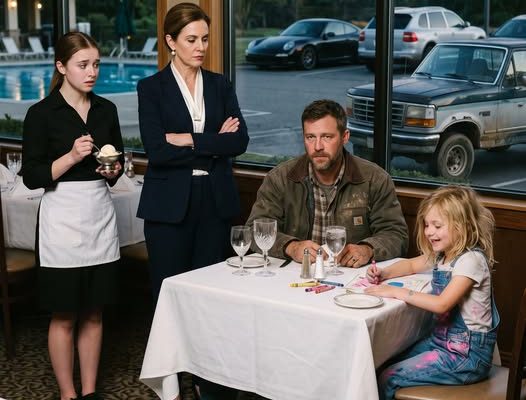
“Daddy, did we wear the wrong clothes?” My seven-year-old daughter whispered those words after the country club manager told us to leave. We had come for dinner at her late mother’s favorite table. Instead, the manager looked at my work boots and suggested McDonald’s. I reassured my daughter, then sent one quiet message. The manager called security—without realizing whose name was on her employment contract.

PART 1: THE TABLE THEY NEEDED

The manager waited until my daughter opened her crayons before telling us we would have to leave.

Lily looked up at her, then down at her paint-stained overalls.

“Daddy, did we wear the wrong clothes?”

We had spent the afternoon helping paint a house for a family who needed one. Before entering Callahan Hills Country Club, I had scrubbed the mud from my steel-toe boots and washed Lily’s hands in the truck with water from a bottle.

My jacket was faded. Her overalls had yellow paint on one knee. But we were clean, we had a reservation, and I had promised her dinner at table seventeen.

Her mother’s table.

Sarah had managed events here for six years before cancer took her two years ago. Whenever I came straight from a construction site, she seated us beside the pool.

“Chicken first,” she would tell Lily. “Then vanilla ice cream.”

We had not returned since her memorial.

That evening, Elena greeted us at the host stand. She recognized Lily immediately.

“You’ve gotten so tall.”

Lily smiled and held up seven fingers.

Elena’s expression softened when I asked whether table seventeen was available.

“I saved it when I saw your reservation, Mr. Callahan.”

She seated us, took our order, and brought Lily an extra napkin for her crayons.

Then the manager arrived.

Her name badge read PATRICIA STONE — GENERAL MANAGER.

“I’m afraid there’s been a seating error,” she said. “This area is reserved for our premium members.”

“Our reservation includes this area.”

She glanced at my jacket.

“We also maintain certain presentation standards.”

Across the room, a man in muddy golf shoes stretched his legs beneath a table. Patricia had passed him without a word.

“Could you show me the policy?” I asked.

Her smile tightened.

“Perhaps our takeaway menu would be more suitable.”

That was when Lily asked about our clothes.

I turned toward her immediately.

“No, sweetheart. You haven’t done anything wrong.”

Patricia leaned closer.

“There’s a McDonald’s two lights down. Your daughter might feel more comfortable there.”

Lily began putting her crayons away.

I rested my hand gently over hers.

“You don’t have to pack up.”

Then I took out my phone and opened a message Mark Davies had sent that afternoon.

Rachel and I will be in the upstairs office finishing the complaint review. Call if you need us.

I typed:

Please come to pool dining. Table seventeen. There’s something you need to see.

PART 2: THE PEOPLE SHE EXPECTED TO STAY QUIET

Elena returned carrying our meals.

Patricia stepped into her path.

“Those orders were supposed to be canceled.”

Elena looked from her to me.

“Their reservation is valid. I checked it myself.”

“We need this table for the Whitaker party.”

“They’re booked in the garden room.”

For a moment, Patricia said nothing.

Then she lowered her voice.

“Elena. Kitchen. Now.”

Lily’s fingers tightened around mine.

I crouched beside her chair.

“This is a grown-up problem. It isn’t because of you, and you don’t need to fix it.”

She nodded, but her eyes had filled.

From the kitchen doorway, someone called her name.

Nora, the pastry chef, stood there with a dish towel over her shoulder. She had made Lily’s birthday cakes when Sarah was alive.

“Is that my sprinkle inspector?”

Lily gave a small, uncertain smile.

I asked Nora whether Lily could eat at the little staff table beside the open dessert counter. It was only a few steps away, where I could see her without making her listen to every word.

“Of course,” Nora said.

I carried Lily’s plate over, helped her settle, and promised I would be right there.

When I returned, Patricia folded her arms.

“Thank you for finally being reasonable.”

“I moved my daughter away from this conversation. I haven’t agreed to leave.”

Elena stood beside the service station, holding our bill.

Patricia pointed toward the kitchen.

“Clock out. We’ll discuss your conduct tomorrow.”

“Her conduct?” I asked.

“This is an internal matter.”

My phone vibrated.

Mark had sent a short summary, followed by a message.

Coming downstairs now.

The review concerned nineteen complaints over eight weeks. Members reported being turned away from half-empty dining rooms, losing reserved golf times, and receiving charges they could not explain.

Several employees had described instructions to discourage diners who did not fit Patricia’s preferred image.

I looked up.

“Elena, have you been told to quote long waits to members dressed like me, even when tables are available?”

She glanced at Patricia.

That glance answered before she did.

“Yes,” she said quietly.

Patricia moved toward her.

“You are not authorized to discuss management decisions with a guest.”

“Then discuss them with me.”

Mark Davies stood at the entrance with Rachel Lin, our corporate counsel.

Patricia straightened.

“Mr. Davies. I was just handling a member issue.”

“I can see that.”

His eyes moved to me.

“Jack, is Lily all right?”

Patricia looked between us.

“You know each other?”

Mark paused.

“Patricia, this is Jack Callahan. He founded Callahan Hospitality.”

Her expression changed.

I watched her make the connection: my surname, the company name on her contract, the man whose photograph she had apparently never bothered to learn.

“Your company owns the club,” she said.

“Yes.”

Three years earlier, I had bought it when it was close to bankruptcy. After Sarah died, I stepped away from public events and delegated daily operations so I could raise Lily.

Elena knew me as Sarah’s husband. Most employees hired since the acquisition had never met me at all.

Patricia looked toward table seventeen.

“Why didn’t you say so?”

“Would you have treated my daughter differently?”

She opened her mouth.

Then closed it.

PART 3: WHAT THE RECORDS SHOWED

A security officer arrived carrying a radio.

“Ms. Stone? You requested assistance with a guest?”

Mark answered before she could.

“There’s no guest to remove. Please remain nearby while we finish a management meeting.”

I glanced toward the dessert counter. Lily was eating her chicken while Nora listened to something she was saying about yellow paint.

Then I turned back to Patricia.

“We’ll continue upstairs.”

She nodded quickly, relieved to leave the dining room.

Before following Mark, I stopped beside Lily.

“I need ten minutes upstairs. Are you comfortable staying with Nora?”

“Can I finish my picture?”

“Absolutely.”

In the office, Patricia sat opposite Rachel and smoothed her blazer.

“I wish someone had told me this was an inspection.”

“It wasn’t,” I said. “I came here to have dinner with my daughter.”

Rachel placed a folder on the desk.

“The review was already underway. Several members contacted corporate directly after their complaints here went unanswered.”

Patricia leaned back.

“People complain when standards improve.”

Rachel opened the first report.

“These members were told their reserved tee times had been canceled because of maintenance. The course remained open. Their places were reassigned to guests you sponsored.”

“Scheduling adjustments happen.”

“Repeatedly. Without the original members’ agreement.”

Mark placed another document beside it.

The club had a discretionary budget for resolving service complaints. Patricia had approved dozens of complimentary meals under that category.

But several members named on the records confirmed they had not visited on those dates.

Matching checks and bar reservations showed meals going to Patricia’s acquaintances instead.

“Your account approved these,” Rachel said. “We’ve asked you twice for the supporting records. You haven’t provided them.”

Patricia’s gaze shifted toward me.

“Jack, you understand hospitality. Sometimes relationships require flexibility.”

“Was that flexibility available to the members you sent away?”

She did not answer.

Mark explained that his team had also found inaccurate figures in the reports used to calculate her performance bonus. Those findings still required a full accounting review.

The treatment I had witnessed downstairs needed no further interpretation.

I turned to Mark.

“Patricia will not be returning to the floor as manager. Complete the separation process with Rachel. Preserve the records and continue the review.”

Patricia stood.

“You’re ending my career over a dinner?”

“I’m ending your employment here because of the decisions you made while responsible for other people.”

Rachel explained what would happen next. Patricia would receive the documentation, have an opportunity to respond to the financial findings, and arrange collection of her remaining belongings.

I left them to finish.

Downstairs, Elena was standing beside the service station, still wearing her apron but holding her handbag.

“Should I go?” she asked.

“Do you want to finish your shift?”

She nodded.

“Then put your bag away. You’re not being punished for honoring a reservation.”

Her shoulders dropped with relief.

When I reached Lily, she held up her picture.

Three people sat at a table beside a blue swimming pool.

I recognized myself, Lily, and Sarah.

“Nora said Mommy liked this table too,” she told me.

I sat down before answering.

“She did.”

PART 4: THE WORK AFTER THE APOLOGY

I apologized to Lily on the drive home.

She looked puzzled.

“You didn’t say the mean thing.”

“No. But you came with me, and it was my job to make sure you felt safe.”

She considered that.

“Elena was nice.”

“She was.”

“Even before that lady knew you were the boss.”

I looked at her in the rearview mirror.

“That’s the part that matters.”

The following morning, I met with the staff.

I told them what would change immediately and what still needed investigation. Then I asked questions and listened.

Once people believed they could speak without losing shifts, the details came quickly.

A host had been instructed to mark unwanted reservations as cancellations. A groundskeeper had been blamed for course closures that never occurred. Servers had stopped reporting problems because Patricia punished whoever brought them to her.

I had delegated management. I had also allowed too much information to reach me through the same person employees feared.

That had to change.

Over the next three weeks, corporate reviewed the complaints and corrected the records. Employees received money they had been wrongly denied, and affected members received direct explanations and appropriate reimbursements.

We created a reporting channel outside the club’s management team.

We also rewrote the dining policy in plain language. Clean work clothes were welcome in the casual pool restaurant. Any genuine dress requirements elsewhere had to be published and applied consistently.

Choosing the next manager took longer.

Elena had worked at the club for five years, first coordinating banquets with Sarah and later training servers and supervising dining shifts. Before joining us, she had managed a small hotel restaurant.

Under Patricia, she had lost most of those responsibilities after repeatedly challenging questionable instructions.

When Mark suggested an outside candidate, I asked him to interview Elena too.

“Not because she helped Lily,” I said. “Because we should know what she can do.”

She went through the same interviews and budgeting exercise as the other candidates. We appointed her acting manager with support from an experienced regional director and reviewed her progress over six months.

She earned the permanent position.

Members began returning. Employees recommended friends for open jobs again. Complaints that once disappeared into an office were answered.

The financial review continued separately. It was slower and less dramatic than the confrontation, but the records mattered more than anything said in anger that evening.

I kept closer contact with the club without trying to run every shift.

And, little by little, Lily stopped asking whether her clothes were good enough before we went somewhere new.

PART 5: TABLE SEVENTEEN

Six months later, we returned for dinner.

It was raining again.

I wore the same jacket, and Lily carried the same box of crayons, though several were now broken and the yellow was nearly gone.

Elena met us near the entrance.

“Table seventeen?”

Lily nodded.

We had just ordered when another family arrived: two parents and two little boys, all wearing clothes marked with paint.

The father hesitated at the host stand.

“We have a reservation. Under Mercer.”

The host checked the screen.

“Of course. Would you prefer a booth or a table by the pool?”

No glance at their shoes. No pause to decide what kind of people they might be.

One of the boys asked whether they served ice cream.

Lily turned toward me, smiling.

“They should get vanilla.”

“After dinner,” I said.

She rolled her eyes.

Across the room, Elena noticed a server struggling with a tray. She took two plates, helped deliver the order, and returned to greeting a member.

Nobody stiffened when she walked past.

I thought about Sarah then—how she remembered birthdays, kept spare crayons at the desk, and noticed the people who looked uncertain in a room.

For a long time, returning here had felt like walking into the space she left behind.

That evening, it felt like finding something she had taught us to keep.

Lily slid her drawing across the table.

This one showed the pool, our dinner plates, and a bowl of ice cream much larger than either of us.

“You forgot something,” I said.

She frowned.

“What?”

“Your chicken.”

She groaned exactly as she had when Sarah said it.

I laughed, and for once the memory did not arrive with a weight I had to hide.

Outside, rain shimmered beneath the pool lights. Inside, the Mercer boys argued quietly over which dessert to share, and their parents relaxed into their seats.

Nobody needed me to stand up or make a call.

Lily reached for another crayon.

And this time, table seventeen was just a table.

That was exactly what it should have been.

“Daddy, did we wear the wrong clothes?” My seven-year-old daughter whispered those words after the country club manager told us to leave. We had come for dinner at her late mother’s favorite table. Instead, the manager looked at my work boots and suggested McDonald’s. I reassured my daughter, then sent one quiet message. The manager called security—without realizing whose name was on her employment contract. Read More

“Daddy, did we wear the wrong clothes?” My seven-year-old daughter whispered those words after the country club manager told us to leave. We had come for dinner at her late mother’s favorite table. Instead, the manager looked at my work boots and suggested McDonald’s. I reassured my daughter, then sent one quiet message. The manager called security—without realizing whose name was on her employment contract.

PART 1: THE TABLE THEY NEEDED

The manager waited until my daughter opened her crayons before telling us we would have to leave.

Lily looked up at her, then down at her paint-stained overalls.

“Daddy, did we wear the wrong clothes?”

We had spent the afternoon helping paint a house for a family who needed one. Before entering Callahan Hills Country Club, I had scrubbed the mud from my steel-toe boots and washed Lily’s hands in the truck with water from a bottle.

My jacket was faded. Her overalls had yellow paint on one knee. But we were clean, we had a reservation, and I had promised her dinner at table seventeen.

Her mother’s table.

Sarah had managed events here for six years before cancer took her two years ago. Whenever I came straight from a construction site, she seated us beside the pool.

“Chicken first,” she would tell Lily. “Then vanilla ice cream.”

We had not returned since her memorial.

That evening, Elena greeted us at the host stand. She recognized Lily immediately.

“You’ve gotten so tall.”

Lily smiled and held up seven fingers.

Elena’s expression softened when I asked whether table seventeen was available.

“I saved it when I saw your reservation, Mr. Callahan.”

She seated us, took our order, and brought Lily an extra napkin for her crayons.

Then the manager arrived.

Her name badge read PATRICIA STONE — GENERAL MANAGER.

“I’m afraid there’s been a seating error,” she said. “This area is reserved for our premium members.”

“Our reservation includes this area.”

She glanced at my jacket.

“We also maintain certain presentation standards.”

Across the room, a man in muddy golf shoes stretched his legs beneath a table. Patricia had passed him without a word.

“Could you show me the policy?” I asked.

Her smile tightened.

“Perhaps our takeaway menu would be more suitable.”

That was when Lily asked about our clothes.

I turned toward her immediately.

“No, sweetheart. You haven’t done anything wrong.”

Patricia leaned closer.

“There’s a McDonald’s two lights down. Your daughter might feel more comfortable there.”

Lily began putting her crayons away.

I rested my hand gently over hers.

“You don’t have to pack up.”

Then I took out my phone and opened a message Mark Davies had sent that afternoon.

Rachel and I will be in the upstairs office finishing the complaint review. Call if you need us.

I typed:

Please come to pool dining. Table seventeen. There’s something you need to see.

PART 2: THE PEOPLE SHE EXPECTED TO STAY QUIET

Elena returned carrying our meals.

Patricia stepped into her path.

“Those orders were supposed to be canceled.”

Elena looked from her to me.

“Their reservation is valid. I checked it myself.”

“We need this table for the Whitaker party.”

“They’re booked in the garden room.”

For a moment, Patricia said nothing.

Then she lowered her voice.

“Elena. Kitchen. Now.”

Lily’s fingers tightened around mine.

I crouched beside her chair.

“This is a grown-up problem. It isn’t because of you, and you don’t need to fix it.”

She nodded, but her eyes had filled.

From the kitchen doorway, someone called her name.

Nora, the pastry chef, stood there with a dish towel over her shoulder. She had made Lily’s birthday cakes when Sarah was alive.

“Is that my sprinkle inspector?”

Lily gave a small, uncertain smile.

I asked Nora whether Lily could eat at the little staff table beside the open dessert counter. It was only a few steps away, where I could see her without making her listen to every word.

“Of course,” Nora said.

I carried Lily’s plate over, helped her settle, and promised I would be right there.

When I returned, Patricia folded her arms.

“Thank you for finally being reasonable.”

“I moved my daughter away from this conversation. I haven’t agreed to leave.”

Elena stood beside the service station, holding our bill.

Patricia pointed toward the kitchen.

“Clock out. We’ll discuss your conduct tomorrow.”

“Her conduct?” I asked.

“This is an internal matter.”

My phone vibrated.

Mark had sent a short summary, followed by a message.

Coming downstairs now.

The review concerned nineteen complaints over eight weeks. Members reported being turned away from half-empty dining rooms, losing reserved golf times, and receiving charges they could not explain.

Several employees had described instructions to discourage diners who did not fit Patricia’s preferred image.

I looked up.

“Elena, have you been told to quote long waits to members dressed like me, even when tables are available?”

She glanced at Patricia.

That glance answered before she did.

“Yes,” she said quietly.

Patricia moved toward her.

“You are not authorized to discuss management decisions with a guest.”

“Then discuss them with me.”

Mark Davies stood at the entrance with Rachel Lin, our corporate counsel.

Patricia straightened.

“Mr. Davies. I was just handling a member issue.”

“I can see that.”

His eyes moved to me.

“Jack, is Lily all right?”

Patricia looked between us.

“You know each other?”

Mark paused.

“Patricia, this is Jack Callahan. He founded Callahan Hospitality.”

Her expression changed.

I watched her make the connection: my surname, the company name on her contract, the man whose photograph she had apparently never bothered to learn.

“Your company owns the club,” she said.

“Yes.”

Three years earlier, I had bought it when it was close to bankruptcy. After Sarah died, I stepped away from public events and delegated daily operations so I could raise Lily.

Elena knew me as Sarah’s husband. Most employees hired since the acquisition had never met me at all.

Patricia looked toward table seventeen.

“Why didn’t you say so?”

“Would you have treated my daughter differently?”

She opened her mouth.

Then closed it.

PART 3: WHAT THE RECORDS SHOWED

A security officer arrived carrying a radio.

“Ms. Stone? You requested assistance with a guest?”

Mark answered before she could.

“There’s no guest to remove. Please remain nearby while we finish a management meeting.”

I glanced toward the dessert counter. Lily was eating her chicken while Nora listened to something she was saying about yellow paint.

Then I turned back to Patricia.

“We’ll continue upstairs.”

She nodded quickly, relieved to leave the dining room.

Before following Mark, I stopped beside Lily.

“I need ten minutes upstairs. Are you comfortable staying with Nora?”

“Can I finish my picture?”

“Absolutely.”

In the office, Patricia sat opposite Rachel and smoothed her blazer.

“I wish someone had told me this was an inspection.”

“It wasn’t,” I said. “I came here to have dinner with my daughter.”

Rachel placed a folder on the desk.

“The review was already underway. Several members contacted corporate directly after their complaints here went unanswered.”

Patricia leaned back.

“People complain when standards improve.”

Rachel opened the first report.

“These members were told their reserved tee times had been canceled because of maintenance. The course remained open. Their places were reassigned to guests you sponsored.”

“Scheduling adjustments happen.”

“Repeatedly. Without the original members’ agreement.”

Mark placed another document beside it.

The club had a discretionary budget for resolving service complaints. Patricia had approved dozens of complimentary meals under that category.

But several members named on the records confirmed they had not visited on those dates.

Matching checks and bar reservations showed meals going to Patricia’s acquaintances instead.

“Your account approved these,” Rachel said. “We’ve asked you twice for the supporting records. You haven’t provided them.”

Patricia’s gaze shifted toward me.

“Jack, you understand hospitality. Sometimes relationships require flexibility.”

“Was that flexibility available to the members you sent away?”

She did not answer.

Mark explained that his team had also found inaccurate figures in the reports used to calculate her performance bonus. Those findings still required a full accounting review.

The treatment I had witnessed downstairs needed no further interpretation.

I turned to Mark.

“Patricia will not be returning to the floor as manager. Complete the separation process with Rachel. Preserve the records and continue the review.”

Patricia stood.

“You’re ending my career over a dinner?”

“I’m ending your employment here because of the decisions you made while responsible for other people.”

Rachel explained what would happen next. Patricia would receive the documentation, have an opportunity to respond to the financial findings, and arrange collection of her remaining belongings.

I left them to finish.

Downstairs, Elena was standing beside the service station, still wearing her apron but holding her handbag.

“Should I go?” she asked.

“Do you want to finish your shift?”

She nodded.

“Then put your bag away. You’re not being punished for honoring a reservation.”

Her shoulders dropped with relief.

When I reached Lily, she held up her picture.

Three people sat at a table beside a blue swimming pool.

I recognized myself, Lily, and Sarah.

“Nora said Mommy liked this table too,” she told me.

I sat down before answering.

“She did.”

PART 4: THE WORK AFTER THE APOLOGY

I apologized to Lily on the drive home.

She looked puzzled.

“You didn’t say the mean thing.”

“No. But you came with me, and it was my job to make sure you felt safe.”

She considered that.

“Elena was nice.”

“She was.”

“Even before that lady knew you were the boss.”

I looked at her in the rearview mirror.

“That’s the part that matters.”

The following morning, I met with the staff.

I told them what would change immediately and what still needed investigation. Then I asked questions and listened.

Once people believed they could speak without losing shifts, the details came quickly.

A host had been instructed to mark unwanted reservations as cancellations. A groundskeeper had been blamed for course closures that never occurred. Servers had stopped reporting problems because Patricia punished whoever brought them to her.

I had delegated management. I had also allowed too much information to reach me through the same person employees feared.

That had to change.

Over the next three weeks, corporate reviewed the complaints and corrected the records. Employees received money they had been wrongly denied, and affected members received direct explanations and appropriate reimbursements.

We created a reporting channel outside the club’s management team.

We also rewrote the dining policy in plain language. Clean work clothes were welcome in the casual pool restaurant. Any genuine dress requirements elsewhere had to be published and applied consistently.

Choosing the next manager took longer.

Elena had worked at the club for five years, first coordinating banquets with Sarah and later training servers and supervising dining shifts. Before joining us, she had managed a small hotel restaurant.

Under Patricia, she had lost most of those responsibilities after repeatedly challenging questionable instructions.

When Mark suggested an outside candidate, I asked him to interview Elena too.

“Not because she helped Lily,” I said. “Because we should know what she can do.”

She went through the same interviews and budgeting exercise as the other candidates. We appointed her acting manager with support from an experienced regional director and reviewed her progress over six months.

She earned the permanent position.

Members began returning. Employees recommended friends for open jobs again. Complaints that once disappeared into an office were answered.

The financial review continued separately. It was slower and less dramatic than the confrontation, but the records mattered more than anything said in anger that evening.

I kept closer contact with the club without trying to run every shift.

And, little by little, Lily stopped asking whether her clothes were good enough before we went somewhere new.

PART 5: TABLE SEVENTEEN

Six months later, we returned for dinner.

It was raining again.

I wore the same jacket, and Lily carried the same box of crayons, though several were now broken and the yellow was nearly gone.

Elena met us near the entrance.

“Table seventeen?”

Lily nodded.

We had just ordered when another family arrived: two parents and two little boys, all wearing clothes marked with paint.

The father hesitated at the host stand.

“We have a reservation. Under Mercer.”

The host checked the screen.

“Of course. Would you prefer a booth or a table by the pool?”

No glance at their shoes. No pause to decide what kind of people they might be.

One of the boys asked whether they served ice cream.

Lily turned toward me, smiling.

“They should get vanilla.”

“After dinner,” I said.

She rolled her eyes.

Across the room, Elena noticed a server struggling with a tray. She took two plates, helped deliver the order, and returned to greeting a member.

Nobody stiffened when she walked past.

I thought about Sarah then—how she remembered birthdays, kept spare crayons at the desk, and noticed the people who looked uncertain in a room.

For a long time, returning here had felt like walking into the space she left behind.

That evening, it felt like finding something she had taught us to keep.

Lily slid her drawing across the table.

This one showed the pool, our dinner plates, and a bowl of ice cream much larger than either of us.

“You forgot something,” I said.

She frowned.

“What?”

“Your chicken.”

She groaned exactly as she had when Sarah said it.

I laughed, and for once the memory did not arrive with a weight I had to hide.

Outside, rain shimmered beneath the pool lights. Inside, the Mercer boys argued quietly over which dessert to share, and their parents relaxed into their seats.

Nobody needed me to stand up or make a call.

Lily reached for another crayon.

And this time, table seventeen was just a table.

That was exactly what it should have been.

“Daddy, did we wear the wrong clothes?” My seven-year-old daughter whispered those words after the country club manager told us to leave. We had come for dinner at her late mother’s favorite table. Instead, the manager looked at my work boots and suggested McDonald’s. I reassured my daughter, then sent one quiet message. The manager called security—without realizing whose name was on her employment contract. Read More

“This resort caters to successful people,” Mom said. My sister added, “Certainly not warehouse workers.” I stayed quiet. Then the general manager came over: “Ms. Williams, we need your explicit approval for your family’s reservation today.”

The transmission in my worn, seven-year-old Honda Civic gave off a miserable little whine as I eased into the visitor parking area at Azure Heights Resort.

Even from across the lot, I immediately recognized my mother’s black Mercedes and my older sister’s white BMW.

Both were parked proudly in the VIP valet section, gleaming under the sharp mountain sunlight like trophies.

Azure Heights stretched across fifteen acres of pristine lakefront property.

Stone.

Glass.

Water.

The resort had been designed to blend into the landscape rather than compete with it, with native river rock, soaring windows, and uninterrupted views of the deep blue lake below.

I had chosen this exact location for our annual family weekend with extraordinary care.

Every detail had been intentional.

“Well, look who actually made it.”

My sister Vanessa’s voice floated across the gravel before I had even closed my car door.

She stood near the entrance in oversized sunglasses, wearing the smug little smile she had perfected over most of her adult life.

“We were taking bets,” she continued. “I honestly thought that thing would break down before you reached the mountain.”

I opened the trunk.

The hinges complained loudly as I pulled out a plain canvas overnight bag.

“Traffic leaving the city was awful,” I said evenly.

Vanessa raised an eyebrow.

“You mean traffic leaving the warehouse district.”

I ignored that.

Then my mother appeared beside her.

Patricia Williams never simply walked into a place.

She arrived as if cameras were waiting.

She adjusted a pair of expensive tortoiseshell sunglasses and looked slowly from my car to my clothes.

“I’m surprised you managed the fuel cost, Maya.”

Her voice carried that familiar combination of concern and insult.

I gave her a small smile.

“I survive somehow.”

Vanessa slipped her arm through Mom’s.

“Don’t worry about the rooms. Mother and I already checked into the Premier Suites.”

She looked toward me.

“I’m sure they have something simpler somewhere. Maybe near the service corridor.”

A valet approached in a crisp uniform and held out his hand.

I dropped my scratched plastic key fob into his palm.

For half a second, his eyes moved toward the Honda.

Then toward the line of luxury cars surrounding it.

He recovered quickly.

Professional.

But I had seen the reaction.

Mom was already walking toward the entrance.

“We’ll need separate charges, of course,” she called casually.

Then she looked back at me.

“I wouldn’t want you worrying about splitting restaurant or spa expenses with us. This weekend is supposed to celebrate success.”

I said nothing.

The enormous glass entrance doors opened.

And the moment I stepped into the lobby, I felt the same quiet surge of satisfaction I had felt the first time I saw the completed building.

The ceiling rose dramatically overhead.

Massive reclaimed timber beams crossed the space.

A four-sided stone fireplace stood in the center of the lobby, casting warm light across the slate floor.

The entire western wall was glass.

Beyond it, the lake stretched toward the mountains.

Every brass fixture.

Every lighting angle.

Every piece of stone.

Every curve in the reception desk.

It looked exactly the way I had imagined it three years earlier.

“Beautiful, isn’t it?”

Vanessa slowly turned in a circle.

Her heels clicked against the floor.

“This, Maya, is what actual achievement looks like.”

She smiled.

“Not wearing fluorescent safety gear and punching a clock at some warehouse.”

I let my gaze move across the lobby.

“I’m glad both of you are doing well.”

Mom stopped to adjust her scarf.

“Are you?”

Her expression shifted into theatrical concern.

“Because every time I see you, you look more exhausted.”

She sighed.

“I warned you years ago. You insisted on chasing unrealistic ideas instead of building a sensible life.”

I already knew what was coming next.

“You should have married Richard.”

There it was.

“His dental practice is opening another location.”

“Mom, I never wanted Richard.”

“What you wanted was to be difficult.”

Her tone sharpened immediately.

“And look where that has left you.”

She gestured toward Vanessa.

“Your sister sells luxury property worth millions.”

Then toward herself.

“I run a successful consulting business.”

Finally, she looked at me.

“And you spend your days moving boxes around some industrial building.”

I almost smiled.

Almost.

A resort attendant passed carrying a silver tray of champagne.

Vanessa stopped him.

She lifted three crystal glasses.

One went to Mom.

She kept another.

Then, after a tiny pause, she kept the third as well.

She gave me an exaggerated look of sympathy.

“Oh, sorry, Maya. I forgot.”

She took a sip.

“You probably don’t want to deal with the tipping expected around here.”

I looked at the tray.

“The champagne is complimentary.”

Vanessa laughed.

“Even better.”

She lifted her glass toward me.

“Free has always suited your budget.”

It wasn’t said with anger.

That would have been easier.

Vanessa said it casually.

As if my supposed failure were simply a fact everyone had accepted years ago.

We continued toward reception.

Behind the desk stood a young woman in a perfectly tailored uniform.

Her brass name badge read:

JESSICA.

Mom straightened immediately.

I knew that posture.

She was preparing to request upgrades, special treatment, and probably a late checkout before Jessica even had the chance to greet her.

Vanessa stood beside her, still holding her champagne.

Both of them looked entirely comfortable.

Entirely certain of their place in the world.

And entirely certain of mine.

I stayed several steps behind them.

Quiet.

Watching.

Because the strange thing was, every insult they had made since I arrived depended on one assumption.

That I was the least successful person in the family.

That I had barely managed to afford this weekend.

That I had chosen this resort because I wanted one brief glimpse of the kind of life they believed belonged to people like them.

They had no idea why I knew the lobby so well.

No idea why I noticed every architectural detail.

No idea why the staff near the entrance had already recognized me and were carefully pretending not to.

And they certainly had no idea why I had selected Azure Heights for this particular family gathering.

Mom stepped up to Jessica’s desk.

Vanessa adjusted her sunglasses.

And I felt that familiar heat building quietly in my stomach.

Not anger.

Anticipation.

Because the performance was almost over.

And once it ended, neither of them would ever look at me the same way again.

“This resort caters to successful people,” Mom said. My sister added, “Certainly not warehouse workers.” I stayed quiet. Then the general manager came over: “Ms. Williams, we need your explicit approval for your family’s reservation today.” Read More

My mother told me, “This resort is for successful people,” and my sister added, “Not warehouse workers.” I remained completely silent. Moments later, the general manager approached: “Ms. Williams, we need your authorization for your family’s reservation today.”

The transmission in my worn, seven-year-old Honda Civic gave off a miserable little whine as I eased into the visitor parking area at Azure Heights Resort.

Even from across the lot, I immediately recognized my mother’s black Mercedes and my older sister’s white BMW.

Both were parked proudly in the VIP valet section, gleaming under the sharp mountain sunlight like trophies.

Azure Heights stretched across fifteen acres of pristine lakefront property.

Stone.

Glass.

Water.

The resort had been designed to blend into the landscape rather than compete with it, with native river rock, soaring windows, and uninterrupted views of the deep blue lake below.

I had chosen this exact location for our annual family weekend with extraordinary care.

Every detail had been intentional.

“Well, look who actually made it.”

My sister Vanessa’s voice floated across the gravel before I had even closed my car door.

She stood near the entrance in oversized sunglasses, wearing the smug little smile she had perfected over most of her adult life.

“We were taking bets,” she continued. “I honestly thought that thing would break down before you reached the mountain.”

I opened the trunk.

The hinges complained loudly as I pulled out a plain canvas overnight bag.

“Traffic leaving the city was awful,” I said evenly.

Vanessa raised an eyebrow.

“You mean traffic leaving the warehouse district.”

I ignored that.

Then my mother appeared beside her.

Patricia Williams never simply walked into a place.

She arrived as if cameras were waiting.

She adjusted a pair of expensive tortoiseshell sunglasses and looked slowly from my car to my clothes.

“I’m surprised you managed the fuel cost, Maya.”

Her voice carried that familiar combination of concern and insult.

I gave her a small smile.

“I survive somehow.”

Vanessa slipped her arm through Mom’s.

“Don’t worry about the rooms. Mother and I already checked into the Premier Suites.”

She looked toward me.

“I’m sure they have something simpler somewhere. Maybe near the service corridor.”

A valet approached in a crisp uniform and held out his hand.

I dropped my scratched plastic key fob into his palm.

For half a second, his eyes moved toward the Honda.

Then toward the line of luxury cars surrounding it.

He recovered quickly.

Professional.

But I had seen the reaction.

Mom was already walking toward the entrance.

“We’ll need separate charges, of course,” she called casually.

Then she looked back at me.

“I wouldn’t want you worrying about splitting restaurant or spa expenses with us. This weekend is supposed to celebrate success.”

I said nothing.

The enormous glass entrance doors opened.

And the moment I stepped into the lobby, I felt the same quiet surge of satisfaction I had felt the first time I saw the completed building.

The ceiling rose dramatically overhead.

Massive reclaimed timber beams crossed the space.

A four-sided stone fireplace stood in the center of the lobby, casting warm light across the slate floor.

The entire western wall was glass.

Beyond it, the lake stretched toward the mountains.

Every brass fixture.

Every lighting angle.

Every piece of stone.

Every curve in the reception desk.

It looked exactly the way I had imagined it three years earlier.

“Beautiful, isn’t it?”

Vanessa slowly turned in a circle.

Her heels clicked against the floor.

“This, Maya, is what actual achievement looks like.”

She smiled.

“Not wearing fluorescent safety gear and punching a clock at some warehouse.”

I let my gaze move across the lobby.

“I’m glad both of you are doing well.”

Mom stopped to adjust her scarf.

“Are you?”

Her expression shifted into theatrical concern.

“Because every time I see you, you look more exhausted.”

She sighed.

“I warned you years ago. You insisted on chasing unrealistic ideas instead of building a sensible life.”

I already knew what was coming next.

“You should have married Richard.”

There it was.

“His dental practice is opening another location.”

“Mom, I never wanted Richard.”

“What you wanted was to be difficult.”

Her tone sharpened immediately.

“And look where that has left you.”

She gestured toward Vanessa.

“Your sister sells luxury property worth millions.”

Then toward herself.

“I run a successful consulting business.”

Finally, she looked at me.

“And you spend your days moving boxes around some industrial building.”

I almost smiled.

Almost.

A resort attendant passed carrying a silver tray of champagne.

Vanessa stopped him.

She lifted three crystal glasses.

One went to Mom.

She kept another.

Then, after a tiny pause, she kept the third as well.

She gave me an exaggerated look of sympathy.

“Oh, sorry, Maya. I forgot.”

She took a sip.

“You probably don’t want to deal with the tipping expected around here.”

I looked at the tray.

“The champagne is complimentary.”

Vanessa laughed.

“Even better.”

She lifted her glass toward me.

“Free has always suited your budget.”

It wasn’t said with anger.

That would have been easier.

Vanessa said it casually.

As if my supposed failure were simply a fact everyone had accepted years ago.

We continued toward reception.

Behind the desk stood a young woman in a perfectly tailored uniform.

Her brass name badge read:

JESSICA.

Mom straightened immediately.

I knew that posture.

She was preparing to request upgrades, special treatment, and probably a late checkout before Jessica even had the chance to greet her.

Vanessa stood beside her, still holding her champagne.

Both of them looked entirely comfortable.

Entirely certain of their place in the world.

And entirely certain of mine.

I stayed several steps behind them.

Quiet.

Watching.

Because the strange thing was, every insult they had made since I arrived depended on one assumption.

That I was the least successful person in the family.

That I had barely managed to afford this weekend.

That I had chosen this resort because I wanted one brief glimpse of the kind of life they believed belonged to people like them.

They had no idea why I knew the lobby so well.

No idea why I noticed every architectural detail.

No idea why the staff near the entrance had already recognized me and were carefully pretending not to.

And they certainly had no idea why I had selected Azure Heights for this particular family gathering.

Mom stepped up to Jessica’s desk.

Vanessa adjusted her sunglasses.

And I felt that familiar heat building quietly in my stomach.

Not anger.

Anticipation.

Because the performance was almost over.

And once it ended, neither of them would ever look at me the same way again.

My mother told me, “This resort is for successful people,” and my sister added, “Not warehouse workers.” I remained completely silent. Moments later, the general manager approached: “Ms. Williams, we need your authorization for your family’s reservation today.” Read More

“This resort is meant for successful people,” my mother snapped. My sister sneered, “Not warehouse workers.” I held my tongue. Moments later, the general manager walked up to me: “Ms. Williams, we need your final approval for your family’s stay today.”

The transmission in my worn, seven-year-old Honda Civic gave off a miserable little whine as I eased into the visitor parking area at Azure Heights Resort.

Even from across the lot, I immediately recognized my mother’s black Mercedes and my older sister’s white BMW.

Both were parked proudly in the VIP valet section, gleaming under the sharp mountain sunlight like trophies.

Azure Heights stretched across fifteen acres of pristine lakefront property.

Stone.

Glass.

Water.

The resort had been designed to blend into the landscape rather than compete with it, with native river rock, soaring windows, and uninterrupted views of the deep blue lake below.

I had chosen this exact location for our annual family weekend with extraordinary care.

Every detail had been intentional.

“Well, look who actually made it.”

My sister Vanessa’s voice floated across the gravel before I had even closed my car door.

She stood near the entrance in oversized sunglasses, wearing the smug little smile she had perfected over most of her adult life.

“We were taking bets,” she continued. “I honestly thought that thing would break down before you reached the mountain.”

I opened the trunk.

The hinges complained loudly as I pulled out a plain canvas overnight bag.

“Traffic leaving the city was awful,” I said evenly.

Vanessa raised an eyebrow.

“You mean traffic leaving the warehouse district.”

I ignored that.

Then my mother appeared beside her.

Patricia Williams never simply walked into a place.

She arrived as if cameras were waiting.

She adjusted a pair of expensive tortoiseshell sunglasses and looked slowly from my car to my clothes.

“I’m surprised you managed the fuel cost, Maya.”

Her voice carried that familiar combination of concern and insult.

I gave her a small smile.

“I survive somehow.”

Vanessa slipped her arm through Mom’s.

“Don’t worry about the rooms. Mother and I already checked into the Premier Suites.”

She looked toward me.

“I’m sure they have something simpler somewhere. Maybe near the service corridor.”

A valet approached in a crisp uniform and held out his hand.

I dropped my scratched plastic key fob into his palm.

For half a second, his eyes moved toward the Honda.

Then toward the line of luxury cars surrounding it.

He recovered quickly.

Professional.

But I had seen the reaction.

Mom was already walking toward the entrance.

“We’ll need separate charges, of course,” she called casually.

Then she looked back at me.

“I wouldn’t want you worrying about splitting restaurant or spa expenses with us. This weekend is supposed to celebrate success.”

I said nothing.

The enormous glass entrance doors opened.

And the moment I stepped into the lobby, I felt the same quiet surge of satisfaction I had felt the first time I saw the completed building.

The ceiling rose dramatically overhead.

Massive reclaimed timber beams crossed the space.

A four-sided stone fireplace stood in the center of the lobby, casting warm light across the slate floor.

The entire western wall was glass.

Beyond it, the lake stretched toward the mountains.

Every brass fixture.

Every lighting angle.

Every piece of stone.

Every curve in the reception desk.

It looked exactly the way I had imagined it three years earlier.

“Beautiful, isn’t it?”

Vanessa slowly turned in a circle.

Her heels clicked against the floor.

“This, Maya, is what actual achievement looks like.”

She smiled.

“Not wearing fluorescent safety gear and punching a clock at some warehouse.”

I let my gaze move across the lobby.

“I’m glad both of you are doing well.”

Mom stopped to adjust her scarf.

“Are you?”

Her expression shifted into theatrical concern.

“Because every time I see you, you look more exhausted.”

She sighed.

“I warned you years ago. You insisted on chasing unrealistic ideas instead of building a sensible life.”

I already knew what was coming next.

“You should have married Richard.”

There it was.

“His dental practice is opening another location.”

“Mom, I never wanted Richard.”

“What you wanted was to be difficult.”

Her tone sharpened immediately.

“And look where that has left you.”

She gestured toward Vanessa.

“Your sister sells luxury property worth millions.”

Then toward herself.

“I run a successful consulting business.”

Finally, she looked at me.

“And you spend your days moving boxes around some industrial building.”

I almost smiled.

Almost.

A resort attendant passed carrying a silver tray of champagne.

Vanessa stopped him.

She lifted three crystal glasses.

One went to Mom.

She kept another.

Then, after a tiny pause, she kept the third as well.

She gave me an exaggerated look of sympathy.

“Oh, sorry, Maya. I forgot.”

She took a sip.

“You probably don’t want to deal with the tipping expected around here.”

I looked at the tray.

“The champagne is complimentary.”

Vanessa laughed.

“Even better.”

She lifted her glass toward me.

“Free has always suited your budget.”

It wasn’t said with anger.

That would have been easier.

Vanessa said it casually.

As if my supposed failure were simply a fact everyone had accepted years ago.

We continued toward reception.

Behind the desk stood a young woman in a perfectly tailored uniform.

Her brass name badge read:

JESSICA.

Mom straightened immediately.

I knew that posture.

She was preparing to request upgrades, special treatment, and probably a late checkout before Jessica even had the chance to greet her.

Vanessa stood beside her, still holding her champagne.

Both of them looked entirely comfortable.

Entirely certain of their place in the world.

And entirely certain of mine.

I stayed several steps behind them.

Quiet.

Watching.

Because the strange thing was, every insult they had made since I arrived depended on one assumption.

That I was the least successful person in the family.

That I had barely managed to afford this weekend.

That I had chosen this resort because I wanted one brief glimpse of the kind of life they believed belonged to people like them.

They had no idea why I knew the lobby so well.

No idea why I noticed every architectural detail.

No idea why the staff near the entrance had already recognized me and were carefully pretending not to.

And they certainly had no idea why I had selected Azure Heights for this particular family gathering.

Mom stepped up to Jessica’s desk.

Vanessa adjusted her sunglasses.

And I felt that familiar heat building quietly in my stomach.

Not anger.

Anticipation.

Because the performance was almost over.

And once it ended, neither of them would ever look at me the same way again.

“This resort is meant for successful people,” my mother snapped. My sister sneered, “Not warehouse workers.” I held my tongue. Moments later, the general manager walked up to me: “Ms. Williams, we need your final approval for your family’s stay today.” Read More

“This high-end resort is for successful people,” Mom said. My sister chimed in, “Not for warehouse workers.” I didn’t utter a word. Moments later, the general manager approached me: “Ms. Williams, we need your approval to honor your family’s reservation today.”

The transmission in my worn, seven-year-old Honda Civic gave off a miserable little whine as I eased into the visitor parking area at Azure Heights Resort.

Even from across the lot, I immediately recognized my mother’s black Mercedes and my older sister’s white BMW.

Both were parked proudly in the VIP valet section, gleaming under the sharp mountain sunlight like trophies.

Azure Heights stretched across fifteen acres of pristine lakefront property.

Stone.

Glass.

Water.

The resort had been designed to blend into the landscape rather than compete with it, with native river rock, soaring windows, and uninterrupted views of the deep blue lake below.

I had chosen this exact location for our annual family weekend with extraordinary care.

Every detail had been intentional.

“Well, look who actually made it.”

My sister Vanessa’s voice floated across the gravel before I had even closed my car door.

She stood near the entrance in oversized sunglasses, wearing the smug little smile she had perfected over most of her adult life.

“We were taking bets,” she continued. “I honestly thought that thing would break down before you reached the mountain.”

I opened the trunk.

The hinges complained loudly as I pulled out a plain canvas overnight bag.

“Traffic leaving the city was awful,” I said evenly.

Vanessa raised an eyebrow.

“You mean traffic leaving the warehouse district.”

I ignored that.

Then my mother appeared beside her.

Patricia Williams never simply walked into a place.

She arrived as if cameras were waiting.

She adjusted a pair of expensive tortoiseshell sunglasses and looked slowly from my car to my clothes.

“I’m surprised you managed the fuel cost, Maya.”

Her voice carried that familiar combination of concern and insult.

I gave her a small smile.

“I survive somehow.”

Vanessa slipped her arm through Mom’s.

“Don’t worry about the rooms. Mother and I already checked into the Premier Suites.”

She looked toward me.

“I’m sure they have something simpler somewhere. Maybe near the service corridor.”

A valet approached in a crisp uniform and held out his hand.

I dropped my scratched plastic key fob into his palm.

For half a second, his eyes moved toward the Honda.

Then toward the line of luxury cars surrounding it.

He recovered quickly.

Professional.

But I had seen the reaction.

Mom was already walking toward the entrance.

“We’ll need separate charges, of course,” she called casually.

Then she looked back at me.

“I wouldn’t want you worrying about splitting restaurant or spa expenses with us. This weekend is supposed to celebrate success.”

I said nothing.

The enormous glass entrance doors opened.

And the moment I stepped into the lobby, I felt the same quiet surge of satisfaction I had felt the first time I saw the completed building.

The ceiling rose dramatically overhead.

Massive reclaimed timber beams crossed the space.

A four-sided stone fireplace stood in the center of the lobby, casting warm light across the slate floor.

The entire western wall was glass.

Beyond it, the lake stretched toward the mountains.

Every brass fixture.

Every lighting angle.

Every piece of stone.

Every curve in the reception desk.

It looked exactly the way I had imagined it three years earlier.

“Beautiful, isn’t it?”

Vanessa slowly turned in a circle.

Her heels clicked against the floor.

“This, Maya, is what actual achievement looks like.”

She smiled.

“Not wearing fluorescent safety gear and punching a clock at some warehouse.”

I let my gaze move across the lobby.

“I’m glad both of you are doing well.”

Mom stopped to adjust her scarf.

“Are you?”

Her expression shifted into theatrical concern.

“Because every time I see you, you look more exhausted.”

She sighed.

“I warned you years ago. You insisted on chasing unrealistic ideas instead of building a sensible life.”

I already knew what was coming next.

“You should have married Richard.”

There it was.

“His dental practice is opening another location.”

“Mom, I never wanted Richard.”

“What you wanted was to be difficult.”

Her tone sharpened immediately.

“And look where that has left you.”

She gestured toward Vanessa.

“Your sister sells luxury property worth millions.”

Then toward herself.

“I run a successful consulting business.”

Finally, she looked at me.

“And you spend your days moving boxes around some industrial building.”

I almost smiled.

Almost.

A resort attendant passed carrying a silver tray of champagne.

Vanessa stopped him.

She lifted three crystal glasses.

One went to Mom.

She kept another.

Then, after a tiny pause, she kept the third as well.

She gave me an exaggerated look of sympathy.

“Oh, sorry, Maya. I forgot.”

She took a sip.

“You probably don’t want to deal with the tipping expected around here.”

I looked at the tray.

“The champagne is complimentary.”

Vanessa laughed.

“Even better.”

She lifted her glass toward me.

“Free has always suited your budget.”

It wasn’t said with anger.

That would have been easier.

Vanessa said it casually.

As if my supposed failure were simply a fact everyone had accepted years ago.

We continued toward reception.

Behind the desk stood a young woman in a perfectly tailored uniform.

Her brass name badge read:

JESSICA.

Mom straightened immediately.

I knew that posture.

She was preparing to request upgrades, special treatment, and probably a late checkout before Jessica even had the chance to greet her.

Vanessa stood beside her, still holding her champagne.

Both of them looked entirely comfortable.

Entirely certain of their place in the world.

And entirely certain of mine.

I stayed several steps behind them.

Quiet.

Watching.

Because the strange thing was, every insult they had made since I arrived depended on one assumption.

That I was the least successful person in the family.

That I had barely managed to afford this weekend.

That I had chosen this resort because I wanted one brief glimpse of the kind of life they believed belonged to people like them.

They had no idea why I knew the lobby so well.

No idea why I noticed every architectural detail.

No idea why the staff near the entrance had already recognized me and were carefully pretending not to.

And they certainly had no idea why I had selected Azure Heights for this particular family gathering.

Mom stepped up to Jessica’s desk.

Vanessa adjusted her sunglasses.

And I felt that familiar heat building quietly in my stomach.

Not anger.

Anticipation.

Because the performance was almost over.

And once it ended, neither of them would ever look at me the same way again.

“This high-end resort is for successful people,” Mom said. My sister chimed in, “Not for warehouse workers.” I didn’t utter a word. Moments later, the general manager approached me: “Ms. Williams, we need your approval to honor your family’s reservation today.” Read More
error: Content is protected !!