
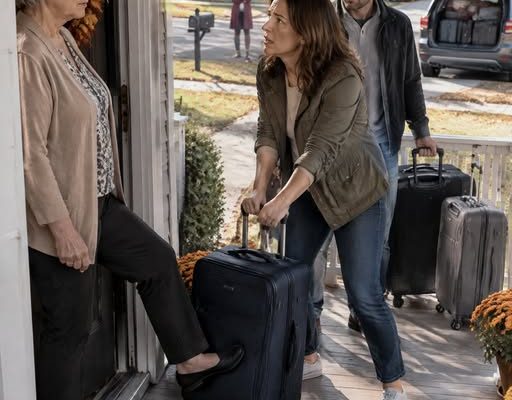
My mom told everyone I had bought her a lake house for retirement. Then a moving truck rolled into my driveway, she smiled and said, “The master bedroom is mine,” and I handed her an envelope.

My mom told everyone I bought her a lake house for retirement; then a moving truck pulled into my driveway, she smiled and said, “The master bedroom is mine,” I handed her an envelope, she opened it and whispered, “You didn’t…”

One woman carried a casserole dish. Another had a potted fern. A third held what looked like a framed Bible verse. Behind them, the moving truck idled in my driveway like the soundtrack to a hostage situation.

I stood in my half-unpacked kitchen wearing sweatpants and an old army T-shirt while my brain started doing math at combat speed.

The house had closed three days earlier. I had given the address to exactly four people: my realtor, my loan officer, Captain Henderson, and my mother.

That last one was clearly a tactical mistake.

I reached the front door before anyone could start unloading. When I opened it, Valerie spread her arms dramatically.

“There she is,” she announced.

The five women smiled expectantly.

“Mom,” I said carefully. “Why is there a moving truck in my driveway?”

Valerie laughed like I’d made a cute joke.

“Oh, Riley, don’t start with that serious face already. We’re celebrating.”

One of the church women handed me the casserole before I could refuse.

“Your mother has been talking non-stop about this beautiful home,” she said. “You’re such a blessing to her.”

That sentence hit like a warning shot.

Not your new home.

A blessing to her.

I looked toward the truck. Two movers were already lowering the ramp.

Mom noticed and waved casually.

“Well, we didn’t want to waste daylight,” she said. “The master suite furniture is very heavy.”

I blinked.

“The what?”

Valerie smiled wider.

“The master sweet, sweetheart, for my retirement. Honestly, I still can’t believe how generous you’re being.”

There it was.

Not a request.

Not a discussion.

A public announcement.

One woman actually clapped. Another said, “I told everybody at Bible study, your daughter was one of the good ones.”

My jaw tightened.

Mom climbed the porch steps like the place already belonged to her.

“You know how Chelsea’s condo is too small for me,” she continued loudly. “And Riley said, ‘This house has more than enough room.’ Didn’t you, honey?”

I had never said that.

Not once.

But Valerie had always treated reality like a rough draft.

I stayed in the doorway while the lake breeze moved through the trees and six women waited for the emotional Hallmark moment where the military daughter handed Mom the keys.

Instead, I said, “Nobody is moving into this house.”

Silence.

One church woman coughed.

Valerie’s smile twitched, then recovered.

“Oh, Riley.” She laughed nervously. “Don’t embarrass yourself.”

Interesting choice of words.

Not don’t embarrass me.

My mother knew exactly what she was doing.

This wasn’t just housing.

It was social warfare.

Valerie had spent my whole life building an image of herself as the struggling Christian mother who sacrificed everything for her children. She understood public pressure better than most people understood contracts.

Witnesses created pressure.

Pressure created compliance.

And compliance had worked on me for years.

The five women shifted awkwardly, holding casseroles and plants while the movers paused halfway down the ramp.

I stepped outside and closed the front door behind me.

That surprised Mom.

She had expected me to retreat into politeness.

Instead, I crossed my arms.

“Mom,” I said calmly. “You need to explain why you hired a moving truck without talking to me.”

Her expression hardened.

“I shouldn’t have to beg my own daughter for a place to live.”

“You never asked.”

“Oh, please,” she snapped quietly through her smile. “Don’t do this in front of people.”

There it was again.

Performance over honesty.

One church woman tried to smooth things over.

“I’m sure this is just a misunderstanding,” she said carefully.

Valerie grabbed onto it immediately.

“Exactly,” she replied loudly. “Riley’s been under a lot of stress. Military life makes her very rigid sometimes.”

Rigid.

Her favorite word for boundaries.

Chelsea forgot rent?

Riley would fix it.

Chelsea wrecked another car?

Riley could help.

Chelsea maxed another credit card?

Riley was rigid if I said no.

I looked at my mother standing there in pearls and church shoes, trying to corner me socially on my own property.

Part of me almost admired the strategy.

Manipulative, calculated, ridiculous—but strategically sound.

If I exploded, I’d look unstable.

If I surrendered, she won.

Valerie knew my childhood had trained me to avoid public conflict.

Smile politely.

Keep the peace.

Open the door.

Surrender quietly.

Then one mover called from the truck.

“Where do you want the bedroom set?”

Mom pointed straight at my house.

“The master bedroom,” she answered.

I laughed.

Not because it was funny.

Because the audacity was almost athletic.

I turned toward the church women.

“Did my mother tell you she never asked permission to move in?”

Every face changed.

Valerie stepped closer.

“Riley,” she hissed under her breath.

“No,” I said evenly. “I’m curious.”

Nobody answered.

One woman stared at her casserole like she regretted every decision that had brought her there.

Another lowered the fern.

And for the first time, Mom looked nervous.

She stood there with her perfect smile, expecting me to hand over the keys to the safest place I had ever built.

But she had forgotten one thing about my training.

You never surrender a fortified position just because the enemy brought an audience.

Have you ever had somebody try to pressure you into saying yes just because they created a public scene around you? Tell me in the comments and subscribe to the channel for more stories about family boundaries.

And the moment people realized kindness is not the same thing as weakness.

I kept one hand on the door while those women stood frozen on the porch.

Mom hated silence because silence gave people time to think.

So she filled it.

“Riley has always been dramatic,” Valerie said with a nervous laugh. “She gets that from the army.”

I almost corrected her.

“No, I got it from growing up in a house where every problem somehow became mine before I was as old enough to drive.”

Chelsea was three years older than me, but somehow I spent my childhood cleaning up after her.

Chelsea was the beautiful one.

That mattered to Mom.

Perfect blonde hair.

Perfect cheerleader teeth.

And the survival instincts of somebody who believed consequences were suggestions for other people.

Growing up, Chelsea rarely got punished.

She got rescued.

I got assigned.

When Chelsea forgot homework, I stayed up helping her.

When she wrecked Mom’s car at 17 while texting her boyfriend, I got a part-time job to help with the insurance increase.

When she dropped out of community college after one semester because the classes were negative energy, Mom cried in the kitchen and then asked me to help with Chelsea’s bills.

I was 15.

By 16, I worked weekends at a hardware store.

By 17, I understood our family system perfectly.

Chelsea was the investment.

I was the insurance policy.

If she succeeded, everyone celebrated her potential.

If she failed, somebody handed me the invoice.

The church women shifted while Valerie kept smiling as if the situation was still under control.

I remembered every emergency that somehow became urgent only after my paycheck arrived.

Over three years, I gave Chelsea $14,000 for temporary rent problems.

I know because I later made a spreadsheet.

Not loans.

Loans imply repayment.

These were family obligations.

Seven hundred here.

Twelve hundred there.

A vet bill for a dog Chelsea barely remembered she owned.

Three months of rent because her boyfriend had money problems.

A repossession payment because she ignored notices for weeks.

Every disaster came with the same speech from Mom.

Family helps family.

Funny how that only traveled one direction.

Chelsea treated adulthood like a free trial she kept forgetting to cancel.

At 25, she decided to become a fashion entrepreneur after watching three TikTok videos and buying a ring light.

At 27, she announced she was healing emotionally and couldn’t handle regular employment.

At 32, she still called Mom crying whenever a bill had too many numbers.

Valerie enabled all of it because Chelsea made her feel needed.

I made her feel exposed.

I was the child who asked questions, noticed patterns, and eventually realized Mom only praised sacrifice when somebody else made it.

That was part of why I enlisted at 18.

People assumed I joined the army for patriotism or discipline.

Honestly, it was the fastest legal way out of Mom’s house.

The army offered structure, housing, food, and distance.

Distance sounded incredible.

My recruiter promised travel and training.

I would have signed if he had only promised silence.

To my surprise, military life made sense to me.

There were rules.

Systems.

Accountability.

If someone repeatedly failed, people eventually stopped trusting them with responsibility.

Imagine my shock.

In my family, repeated failure usually earned Chelsea another rescue package and a motivational speech.

I became a combat engineer because I liked problems with actual answers.

Bridges held weight or collapsed.

Roads were safe or they weren’t.

Reality mattered.

Excuses didn’t.

That alone made military life less exhausting than family holidays.

But the financial drain followed me.

Every deployment brought requests.

Chelsea needed utilities.

Chelsea needed rent.

Chelsea needed help because her latest boyfriend was emotionally manipulative and apparently emotional manipulation cost exactly $900.

At first, I paid.

Guilt is difficult to unlearn when it was installed during childhood.

Mom was an expert.

She could make you feel selfish for refusing to drown.

The breaking point came two years before I bought the lake house.

I was deployed overseas, running on maybe three hours of sleep across two days. It was hot enough to make breathing irritating.

I was sitting in an operations shelter trying to eat a protein bar when my phone began vibrating nonstop.

Mom.

Mom.

Chelsea.

Mom again.

I stepped outside because I thought somebody had died.

Instead, Valerie started yelling.

“Chelsea is in serious trouble.”

I closed my eyes.

“What happened now?”

Her boutique had failed.

Not surprising.

Chelsea had opened an online clothing business despite knowing almost nothing about inventory, taxes, shipping, or basic math.

She had taken advance orders, mishandled customer money, and failed to pay vendors.

People were threatening lawsuits.

“How much?” I asked.

A pause.

Then Mom said, “8,500.”

I laughed once because exhaustion makes everything sound fake.

“You called me from a combat zone for $8,500.”

“It’s your sister’s future.”

“No,” I said. “It’s her consequences.”

Then Valerie said the sentence that changed something permanently.

“You are the most selfish soldier I have ever seen.”

Not daughter.

Soldier.

Like my existence mattered only when it was useful.

I stood in body armor covered in dust while Mom shamed me for refusing to finance another adult woman’s disaster from a war zone.

Suddenly everything became painfully clear.

I wasn’t family.

I was infrastructure.

An ATM with emotional conditioning.

A backup generator everyone used during emergencies without maintaining.

That night, I opened my banking app and reviewed years of transactions.

Every bailout.

Every transfer.

Every sacrifice explained as temporary.

That was the day I stopped behaving like a daughter and started auditing my life.

Audits are dangerous because numbers don’t care about family mythology.

The total told the truth.

I learned in the desert that if you keep pouring water into a cracked canteen, you’re the one who dies of thirst.

Looking at Mom on my porch, surrounded by witnesses, I knew she had come to drain the well again.

I stepped fully outside and pulled the door shut behind me.

That mattered.

People like Valerie look for openings.

If I left the door cracked two inches, she might interpret it as residency.

The women remained awkwardly silent while the moving truck idled below.

One mover leaned against it smoking like he’d already decided this job deserved hazard pay.

Valerie recovered first.

She always did.

Her entire personality was built around surviving embarrassment by pretending it wasn’t happening.

“Oh, honestly,” she laughed, waving her hand dramatically. “Riley’s just overwhelmed from the move. Once we get inside and settled, she’ll calm down.”

“We are not getting inside,” I said.

My voice remained level.

That irritated her more than yelling would have.

Mom knew how to weaponize emotional reactions. If I exploded, she could become the wounded parent dealing with her unstable military daughter.

Calm people are harder to manipulate.

One church woman cleared her throat.

“Valerie,” she said quietly. “Maybe there’s been some confusion about the arrangement.”

Mom ignored her and climbed another step.

“Do not do this to me in front of these women.”

Again.

Not honesty.

Not accountability.

Image management.

I looked at her.

“Mom, you brought an audience to force compliance. That was a tactical decision.”

The women blinked.

One almost looked impressed.

Valerie forced a laugh.

“See, tactical. She talks like this all the time now.”

“No,” I replied. “Just during hostile negotiations.”

The woman holding the fern nearly choked trying not to laugh.

That tiny crack made Mom nervous because her strategy depended on group pressure.

Once people questioned the performance, it began collapsing.

Valerie changed tactics.

Her expression softened.

Her shoulders dropped.

“Riley,” she said softly. “I have nowhere else to go.”

That would have destroyed me five years earlier.

Not anymore.

People with nowhere to go usually ask before hiring movers.

“Then you should have discussed that with me before showing up with a truck.”

“You would have said no.”

“That should have told you something.”

The silence was beautiful.

Even the movers stopped pretending not to listen.

Mom’s expression hardened again.

She tried to step around me.

I shifted one step and blocked the doorway.

Not aggressively.

Just enough.

Years in the army taught me that many confrontations escalate because somebody performs emotion instead of controlling space.

So I controlled space.

Valerie stopped inches away.

“You’re really going to humiliate your own mother like this?”

I almost laughed.

She had brought five spectators and a moving truck.

Yet somehow I was creating the scene.

One church woman said, “Maybe everyone should take a breath.”

“I’m perfectly calm,” I said.

And I was.

People often think boundaries require anger.

They don’t.

Clear instructions delivered calmly are harder to argue with.

I reached into my back pocket.

Mom’s eyes narrowed.

Then I pulled out a plain white envelope.

Valerie stared at it.

“What is that, a solution?”

I handed it over.

She hesitated, then opened it.

I watched her expression shift from confusion to disbelief to humiliation.

Inside was a reservation confirmation for the Sunset Inn, a budget motel about thirty minutes away.

Three nights.

Prepaid.

Non-refundable.

I’d booked it the previous night because some part of me suspected this was coming.

I also included directions because Mom had once gotten lost driving to Target and blamed the signs.

The porch fell silent.

One woman whispered, “Oh my goodness.”

Valerie looked up.

“You booked me a motel.”

“Yes.”

“You think this is funny?”

“No,” I said evenly. “I think this is appropriate.”

Her voice rose.

“I am your mother.”

“And you are not moving into my house.”

Even the movers exchanged looks.

I nodded toward the envelope.

“I prepaid for three nights at the Sunset Inn. That gives you 72 hours to figure out your living situation. You are not moving into my house.”

I said it loudly enough for everyone to hear.

No room for future revision.

Mom’s face lost color.

This wasn’t happening privately where she could rewrite the story later.

Her church friends were watching.

One woman lowered her casserole.

Another stared at Valerie.

“You told us Riley invited you.”

Mom opened her mouth.

Finally, she snapped.

“She did invite me.”

“I invited you to visit the house,” I corrected calmly. “Not move into it.”

One mover walked up the driveway.

“So, are we unloading or not?”

Without looking away from Mom, I answered, “No.”

He nodded immediately.

Honestly, he looked relieved.

Valerie turned emotional again.

“You would really leave your own mother homeless.”

“No,” I replied. “I paid for three nights at a motel.”

Facts were harder to argue with publicly.

I wasn’t abandoning her.

I wasn’t screaming.

I had provided temporary housing while refusing permanent occupation.

And she knew that made her look unreasonable.

The church women began stepping away.

The social pressure reversed.

Now Mom was the one trying to explain why she had brought a moving truck to a house she didn’t own.

She looked down at the reservation.

Then whispered, “Chelsea said this would work.”

Of course.

Chelsea had helped plan it.

I opened the front door behind me just enough to signal the conversation was over.

“You need to leave, Mom.”

Valerie stared like she no longer recognized me.

She probably didn’t.

The version of me she understood was the exhausted younger daughter who quietly fixed everything.

That version had retired.

The moving truck backed out.

The SUVs followed.

Mom sat in the passenger seat clutching the envelope.

When the last tail light vanished beyond the trees, I stepped inside, locked the door, and stood quietly for ten seconds.

No crying.

No shaking.

Just listening.

The house was silent again.

That was the first victory.

I moved the casserole off my counter and made coffee.

People talk about self-care like it requires candles and bubble baths.

Sometimes self-care is a locked deadbolt and medium roast.

My phone started buzzing before the coffee finished.

Aunt Linda.

Uncle Ray.

Chelsea.

Mom.

Unknown numbers.

By the time I poured my coffee, the family circus had arrived digitally.

Aunt Linda wrote, “I cannot believe you put your mother out on the street.”

Uncle Ray followed with, “Your military attitude has gone too far.”

Chelsea sent, “You’re disgusting. Mom is sobbing because of you.”

Barbara wrote, “I’m praying your heart softens before it’s too late.”

That one annoyed me most.

Before it’s too late sounded like Mom had hours to live instead of three prepaid motel nights.

Then came Valerie’s voicemail.

“My own daughter turned me away. I have nowhere to sleep tonight. I hope you understand what you’ve done, Riley.”

I looked at the reservation in my email.

Check-in at three.

Room prepaid.

Address clearly printed.

She had somewhere to sleep.

She just didn’t want a motel.

She wanted my master bedroom, my savings, my silence, and eventually my life turned into another Chelsea rescue mission.

I deleted nothing.

That mattered.

Years earlier, I would have blocked everyone immediately and tried to breathe through the guilt.

But pressure makes careless people reveal patterns.

So I documented.

Screenshots.

Voicemails.

Audio files.

I created a folder called Valerie House Incident.

By seven, I had apparently kicked Mom out.

By eight, I had abandoned an elderly woman.

Mom was 59 and could still chase clearance sales across three counties, but apparently now she was elderly.

By nine, somebody claimed deployment had made me unstable.

Then came the PTSD accusation.

Aunt Linda wrote, “Maybe the military damaged how you see family.”

I stared at that sentence longer than the others.

People love blaming trauma when boundaries make them uncomfortable.

It’s easier than admitting they benefited from your lack of them.

I replied to nobody.

I documented everything.

The next morning, Valerie changed tactics.

She didn’t check into the Sunset Inn.

Of course she didn’t.

Chelsea sent a photo of Mom curled on her couch under a blanket.

“Hope you’re proud.”

I zoomed in.

Behind her were boutique shopping bags, a giant television, decorative pillows, and Chelsea’s fake-marble coffee table.

Homeless had apparently become stylish.

Then the church women started circling back.

Barbara wrote, “Valerie says there were things you didn’t understand.”

Marilyn wrote, “Your mother said she was forced out with nowhere to go.”

Denise wrote, “I don’t want to judge, but this looks very harsh.”

By lunchtime, I had 27 texts, six voicemails, and an email from an uncle I hadn’t spoken to in years.

But buried inside the noise, something didn’t fit.

Valerie kept saying she had been forced out of her apartment.

Forced out.

Aunt Linda repeated it.

Barbara repeated it.

Then Chelsea slipped.

“You don’t even care that Mom lost everything because of that bank foreclosure mess.”

I stared at the screen.

Foreclosure.

Not eviction.

Not a lease problem.

Foreclosure.

That had a paper trail.

Mom didn’t rent an apartment.

She owned a condo.

A condo she had bragged about for years.

So why was everyone acting like some landlord suddenly threw her out?

I reread the messages.

Valerie: forced out.

Aunt Linda: no notice.

Church friends: nowhere to go.

Chelsea: foreclosure.

There it was.

The first crack.

And in my family, one crack usually meant something ugly behind the wall.

I made another coffee and opened my laptop.

Another voicemail from Valerie arrived.

“You think you’re so smart because you bought a house. You think that makes you better than us. But family doesn’t turn family away, Riley. Family makes room.”

I paused it.

Family makes room.

That was the whole philosophy.

Make room for Chelsea’s mistakes.

Make room for Valerie’s pride.

Make room for lies.

Make room for emergencies other people created.

But nobody ever asked whether I had room.

Nobody cared what it cost me.

Mom wanted my house because she had already consumed everything else.

The condo.

The savings.

The sympathy.

Now she wanted the sanctuary I had built through hazard pay, discipline, deployments, and years of delayed gratification.

By evening, I wasn’t surprised anymore.

I was focused.

Anger burns quickly.

Focus builds files.

They had called me cold, unstable, paranoid.

But I was about to collect data.

At six the next morning, I sat at the kitchen table with coffee, my laptop, and the lake behind me.

Mom’s condo records appeared first.

Unit 4B.

Purchased 19 years earlier.

Originally financed responsibly.

Then a second mortgage four years ago.

A refinancing adjustment two years later.

Then a home equity line of credit.

I leaned back.

That condo had been aggressively paid down for years.

Mom used to preach financial responsibility like she invented budgeting.

So why had she suddenly borrowed against everything?

Property tax records showed missed payments.

Not once.

Repeated late fees across nearly eighteen months.

This wasn’t a sudden hardship.

It was a slow financial collapse hidden beneath denial.

Then I searched court records.

Chelsea’s full name.

There it was.

A civil complaint filed eleven months earlier.

Then another.

Then a settlement agreement.

My stomach sank.

This wasn’t ordinary debt.

Chelsea had been sued by vendors and customers connected to her boutique.

She had taken advance payments for products she couldn’t deliver, then responded the way she always did under pressure: disappearing emotionally and hoping reality got distracted.

One lawsuit alleged fraudulent misrepresentation.

Another involved unpaid inventory contracts.

There were complaints, bounced payments, and enough documentation to make it obvious this was more than incompetence.

This was legal exposure.

I opened the settlement.

$62,000.

I laughed once under my breath.

Not because it was funny.

Because my sister had somehow turned Instagram entrepreneurship into felony-adjacent behavior.

And Mom covered it.

Every penny.

I followed the timeline.

The second mortgage aligned almost perfectly with Chelsea’s business collapse.

Retirement withdrawals followed.

Then the foreclosure filings.

Mom hadn’t lost her condo because life was unfair.

She had destroyed her finances protecting Chelsea from consequences.

I sat quietly and let the picture settle.

This was never about temporary housing.

It was a takeover plan.

Valerie drained her retirement, leveraged the condo, paid Chelsea’s legal disaster, and then showed up expecting my home to become permanent rescue headquarters.

Now I understood the audience.

Desperate people prefer public pressure because private conversations allow refusal.

The moving truck wasn’t optimism.

It was strategy.

If she established residency in my house, removing her later could become emotionally and legally complicated.

Then Chelsea would eventually need somewhere temporary too.

Temporary was another dishonest family word.

Temporary meant forever unless I fought my way out.

I opened my old banking spreadsheet and added the numbers.

$14,000 from me to Chelsea over three years.

$62,000 from Valerie through settlements and debt coverage.

Destroyed retirement.

Foreclosed condo.

And somehow I remained selfish because I wanted my own bedroom.

I called Captain Henderson around noon.

He was one of the few people I trusted to understand logistics, behavior, and damage assessment equally well.

He answered on the second ring.

“You sound focused,” he said immediately.

“That’s because I found the blast radius.”

I explained everything.

Mortgages.

Lawsuits.

Foreclosure.

Settlement.

When I finished, he paused.

“They weren’t visiting, Riley. They were relocating.”

“Yeah.”

“And they picked your house because it’s fully paid off.”

“Correct.”

Another pause.

“Good thing you didn’t let them through the front door.”

That stayed with me.

People from healthy families hear stories like this and assume the danger is emotional.

It isn’t only emotional.

It’s structural.

One manipulated decision becomes dependency.

Dependency becomes entitlement.

Entitlement becomes occupation.

And occupation can swallow your future.

Captain Henderson understood immediately.

“You documenting everything?” he asked.

“Already building the file.”

“Good.”

Then he said something that made me smile.

“Nothing scares manipulative people more than organized paperwork.”

True.

Chaos survives through confusion.

Documentation kills confusion.

I drove to the county records office to confirm the online records.

They matched.

The clerk even recognized Mom’s name.

“Oh, yeah,” she said casually while printing copies. “That foreclosure situation got messy.”

Messy.

Government employees always find calm words for disasters.

I left with a thick stack of paperwork.

Back home, Chelsea’s messages had shifted from guilt to anger.

“You think you’re better than everybody because you were in the military.”

Mom sent another.

“At least now I know how disposable I am to my own child.”

That arrived shortly after I had reviewed proof she nearly bankrupted herself for Chelsea while planning to occupy my house.

Disposable wasn’t the word I would have chosen.

Denied access was closer.

I didn’t respond.

I bought a thick manila folder.

Then I organized everything chronologically.

Mortgage filings.

Property records.

Court settlements.

Notices.

Retirement withdrawals.

Screenshots.

Voicemails.

I labeled sections.

The army permanently teaches you one thing:

When emotion rises, organization becomes power.

By evening, the folder sat on my kitchen table.

Every document told the same story.

Mom had sacrificed her financial future protecting Chelsea, then tried to transfer the burden onto me without consent.

Not because I was weak.

Because I was stable.

Stable people become targets in dysfunctional families.

Everyone assumes they can absorb pressure forever.

They never expect stability to develop boundaries.

Outside, the lake was calm.

Inside, my kitchen table looked like a fraud investigation.

Both were more peaceful than family holidays.

I closed the folder.

They thought they were dealing with the 18-year-old girl who surrendered her paycheck to keep peace.

They weren’t.

And the final audit was about to begin.

The drill started at 11:17 the next morning.

An actual drill.

I was in my office answering client emails when I heard it against the front door.

Then my phone buzzed.

Front door camera motion detected.

I opened the live feed.

Mom.

Chelsea.

A locksmith kneeling at my door with a power drill.

I leaned back slowly.

I almost respected the escalation.

It takes a special kind of confidence to attempt suburban forced entry in church clothes before noon.

Chelsea paced the porch while Valerie stood beside the locksmith looking offended by property law.

The camera picked up Mom saying, “I’m the homeowner. I lost my keys after staying with my daughter.”

The locksmith looked uncertain.

Good sign.

Their cars were halfway up the driveway.

Chelsea had even brought coffee.

I grabbed the manila folder and walked calmly toward the door.

Toxic people expect panic when they escalate.

Panic gives them momentum.

Calm makes them look ridiculous faster.

Before opening the door, I started recording.

Then stepped outside.

The locksmith jumped.

Chelsea froze.

Mom recovered first.

“Oh, good,” Valerie said immediately. “There you are. The smart lock malfunctioned.”

I looked at the locksmith.

“It didn’t malfunction. This is my house.”

His face changed completely.

“Wait,” he said. “You live here?”

“Yes.”

Valerie jumped in.

“She’s my daughter. This is a misunderstanding.”

“No,” I corrected calmly. “This is trespassing with power tools.”

Chelsea threw up her hands.

“Jesus Christ, Riley, stop acting insane.”

Interesting accusation while standing beside a locksmith drilling someone else’s door.

The locksmith started packing.

“I’m sorry,” he said to me. “They told me you were out of town and your mother owned the property.”

“She does not.”

He nodded.

“I’m leaving.”

Smart man.

Chelsea stepped toward him.

“You can’t leave. We paid you already.”

He looked exhausted.

“Ma’am, I’m not breaking into somebody’s occupied house.”

“It’s our family house.”

“No,” I said evenly. “It’s my house, purchased solely by me 5 days ago.”

The locksmith left quickly.

Then Chelsea unraveled.

“You are unbelievable,” she screamed at me. “Mom has nowhere to go because of you.”

Neighbors started noticing.

Curtains moved.

A man walking his dog slowed down.

Good.

My family loved audiences until audiences became witnesses.

Valerie switched on the tears.

“I cannot believe my own daughter is treating me this way,” she said loudly enough for nearby houses to hear.

Chelsea pointed at me.

“She has PTSD or something. Ever since the military, she’s been paranoid and cold.”

I almost smiled.

Accusing someone of instability while trying to force entry into her home was an ambitious strategy.

“You hired a locksmith under false pretenses.”

“We had no choice,” Chelsea yelled.

“You had several choices. You selected criminal improvisation.”

The dog walker laughed.

Chelsea heard him and got louder.

“You think you’re so much better than us because you bought a stupid house.”

“No,” I said calmly. “I think breaking into it is unacceptable.”

Valerie cried harder.

“I gave my whole life to my children.”

I opened the manila folder.

Both immediately focused on it.

Interesting.

“Do you know what I learned this week?” I asked quietly.

Neither answered.

“The foreclosure wasn’t an accident.”

Chelsea went pale.

Confirmation.

“You drained your retirement accounts. You refinanced the condo multiple times. You paid $62,000 to settle Chelsea’s fraud lawsuits.”

“Lower your voice,” Valerie hissed immediately.

I laughed once.

They had brought a locksmith to my house, but suddenly volume mattered.

Chelsea stormed closer.

“You don’t know what you’re talking about.”

“I know enough.”

“You went through Mom’s records.”

“Public records,” I corrected. “Turns out county databases are extremely educational.”

Valerie stopped crying completely.

Chelsea pointed toward the folder.

“You have no right digging into our lives.”

I looked at the door they had just tried to enter.

“You lost the privacy argument around the time you hired a locksmith.”

That silenced her for three seconds.

Then came the tantrum.

Chelsea screamed about loyalty, family obligation, sacrifice, and how I owed them because I was the successful one.

Owed.

Not loved.

Not respected.

Owed.

“You’re supposed to help family.”

“I already did,” I replied. “For years.”

“You’re abandoning us.”

“I’m refusing occupation.”

Then Mom softened her voice.

“Riley,” she whispered, “where are we supposed to go?”

For one second, I remembered why this used to work.

Not because it was true.

Because it was exhausting.

Toxic people make boundaries emotionally expensive.

But watching two grown adults attempt forced entry into my home while demanding sympathy finally settled something inside me.

Their disasters were no longer my responsibility.

Chelsea wanted a scene that would make me surrender.

So I pulled out my phone.

“What are you doing?”

“Creating documentation,” I said.

Then I called the police.

Calmly.

I explained that family members had attempted unauthorized entry using a locksmith under false pretenses and that I wanted formal trespass warnings.

When I hung up, Chelsea shouted, “You’re calling the cops on your own family.”

“No,” I corrected. “I’m involving professionals because my family doesn’t understand boundaries.”

Mom sat slowly on the porch bench.

She understood the situation had moved from emotional territory into documented territory.

Chelsea paced the lawn, calling me cold, heartless, and a brainwashed military robot.

I waited.

About fifteen minutes later, two familiar SUVs arrived.

Of course.

The church committee had returned.

Barbara stepped out first, followed by the same women from the moving-truck ambush.

This time they looked less confident.

Nobody brought casseroles.

Mom hurried toward them.

“She’s calling the police on us,” my mother announced dramatically.

Barbara looked between us.

“Valerie said this was becoming a family crisis.”

“It became a legal issue when they hired a locksmith,” I replied.

The women stiffened.

Apparently a homeless mother sounded sympathetic.

Forced entry tested the limits of hospitality.

Chelsea pointed at me.

“She’s lying. Mom lives here too.”

“I do not,” Valerie admitted automatically.

Then froze.

Barbara blinked.

“Wait. You don’t live here?”

Nobody answered.

Perfect timing.

A police cruiser entered the driveway.

A younger officer stepped out, followed by an older one who looked like he had no patience left for family melodrama.

The older officer approached me.

“You the homeowner?”

“Yes, sir.”

“Can you explain what’s happening?”

I handed him my ID and printed copies of the deed.

Organization becomes power.

While he reviewed them, Chelsea launched into a chaotic explanation of betrayal, trauma, housing instability, and my supposedly militant personality.

The older officer noticed the locksmith invoice.

“Did someone attempt to access the property without permission?”

“Yes,” I said calmly. “I have security footage.”

That simplified everything.

Valerie tried another emotional appeal.

“We’re family,” she said tearfully. “I raised her.”

The officer shrugged slightly.

“Ma’am, that doesn’t override property ownership.”

Simple.

Clean.

Beautiful.

Barbara stepped forward.

“Officer, surely this can be resolved privately.”

I looked at her.

“No,” I said evenly. “Private resolution is how this behavior survived for 30 years.”

Everyone went silent.

The officer asked me directly.

“Do you want them removed from the property?”

I looked at Mom, Chelsea, then the women who had originally arrived expecting me to surrender politely.

“Yes,” I answered calmly. “But before that, I think everyone here deserves accurate information.”

I lifted the folder.

Chelsea panicked.

“Oh my God, Riley, stop.”

No.

I was finished stopping.

I opened the folder and looked at Barbara.

“You were told my mother lost her housing unexpectedly. Correct?”

“Yes.”

“That’s false.”

I pulled out the foreclosure documents.

“My mother owned a condo. She refinanced it multiple times, opened a home equity line of credit, drained her retirement accounts, and eventually lost the property through foreclosure.”

The women stared.

“She did this covering legal settlements connected to Chelsea’s boutique business.”

“That’s private,” Chelsea screamed.

“No,” I replied. “Court records are public.”

I pulled out the settlement.

“$62,000.”

Barbara stared.

“Fraud-related civil claims involving customer payments and vendor contracts.”

The silence was extraordinary.

Not explosive.

Just five women mentally replaying everything Valerie had told them.

Mom finally snapped.

“You had no right digging through our finances.”

“You attempted to move into my house under false pretenses,” I replied. “That made your finances my problem.”

I handed copies to Barbara.

Mortgage filings.

Settlements.

Foreclosure notices.

Retirement withdrawals.

Everything dated.

Everything real.

And the narrative collapsed.

This wasn’t a helpless mother abandoned by a cruel daughter.

It was a financially ruined parent who sacrificed everything protecting one adult child and then planned to occupy the other child’s home permanently.

One woman looked embarrassed.

Another stepped away from Mom.

Chelsea backed toward her car.

“This is insane,” she snapped. “You’re obsessed with humiliating us.”

“No,” I said calmly. “I’m refusing to finance you.”

She practically ran to the SUV.

The older officer approached Valerie with the trespass forms.

“Ma’am,” he said to Valerie quietly. “You and your daughter are formally notified not to return to this property without permission.”

Valerie stared at the papers.

Barbara no longer looked sympathetic.

She looked disappointed.

That probably hurt Mom more than the warning.

Social approval was her oxygen.

For once, nobody was buying the performance.

The church women returned to their cars without saying goodbye.

When the last tail lights disappeared, the silence wasn’t heavy.

It felt clean.

I changed the front door code that afternoon.

Then I blocked everyone.

Mom.

Chelsea.

Aunt Linda.

Uncle Ray.

Even Barbara.

Not from anger.

Maintenance.

People call no contact revenge.

It isn’t.

It’s infrastructure repair.

You stop allowing repeated damage to systems already carrying too much weight.

Once the noise disappeared, something strange happened.

I slept.

Actually slept.

No midnight anxiety.

No guilt spirals.

No imaginary emergencies waiting in voicemail.

Just silence, lake water, and the occasional bird hitting the window because apparently nature also struggles with boundaries.

Weeks passed.

The foreclosure finished.

I heard Mom and Chelsea rented a tiny studio forty minutes away.

One bedroom.

Two adults.

A folding divider from Target trying its best.

Apparently Chelsea hated the lack of personal space, which was ironic considering she had tried to annex mine.

Mom stopped attending church.

Not because anyone was cruel.

Because people stopped trusting her version of events.

And surprisingly, I didn’t feel guilty.

I expected sadness.

Regret.

Conflict.

Instead, I felt peaceful in a way that almost seemed suspicious.

My nervous system kept waiting for the next emergency meeting.

None came.

For the first time in my adult life, nobody needed rescuing from consequences they had personally created.

My money stayed in my account.

My phone stayed quiet.

My house stayed mine.

About a month later, I unpacked my final kitchen box.

Inside were old photographs, Army challenge coins, and a framed photo from my deployment unit.

Captain Henderson stood in the center looking exhausted and annoyed at sunlight.

That photo gave me an idea.

I sent invitations for an actual housewarming party.

Not an ambush.

Not a guilt ceremony.

A real one.

Captain Henderson arrived first on a motorcycle loud enough to alarm three counties.

Behind him came three people from my old unit and Dana from engineering school.

Nobody arrived carrying emotional manipulation.

Huge improvement.

Captain Henderson walked inside, looked around, and nodded.

“Good structure,” he said.

From him, that was basically a standing ovation.

Dana brought wine.

Marcus brought steaks.

Jen brought tools because she spotted an uneven cabinet hinge and apparently couldn’t relax until civilization was restored.

That was when the contrast really hit me.

Healthy people enter your life differently.

Nobody asked what they could take.

They asked what they could help with.

Nobody treated my stability like community property.

Captain Henderson helped mount shelves while Marcus grilled by the lake.

At one point, I laughed so hard I had to sit down.

Real laughter.

The kind that feels strange after years of emotional exhaustion.

Later, we sat outside as the sun dropped behind the lake.

Marcus looked over the property.

“You really built something here.”

“I tried.”

Captain Henderson took a slow sip of bourbon.

“No,” he said. “You defended something here.”

Everyone went quiet.

Then he raised his glass.

“To Riley,” he said. “Comat engineer, survivor of family logistics warfare, builder of fortified peace.”

Everyone laughed.

Then he became serious.

“A lot of people can buy a house,” he continued. “Not many can protect one emotionally.”

That line stayed with me because the hardest part was never really financial.

It was psychological.

Toxic families teach reliable people that boundaries are cruelty.

If you’re responsible, hardworking, and calm under pressure, dysfunctional people may start treating you like an unlimited resource.

The longer you fix everything, the more offended they become when you stop.

That’s the trap.

People confuse access with love.

They think being related to you gives them permanent rights to your money, home, peace, time, and emotional labor.

But relationships without respect eventually become extraction.

I looked around at the people beside me.

None shared my DNA.

Yet they behaved more like family than the people who raised me.

Real family doesn’t arrive with moving trucks and locksmiths.

Real family respects locked doors.

Real family asks.

Real family contributes.

Captain Henderson pointed toward the lake.

“You know what your problem was for years?”

“I’m sure you’re about to tell me.”

“You built bridges for people who only traveled one direction.”

The stars appeared over the water while everyone kept talking and laughing.

For the first time in years, I didn’t feel like the emergency contact for other people’s bad decisions.

I simply felt home.

And if there’s one thing this disaster taught me, it’s this:

Respect is the foundation of any structure.

If guilt allows people to bypass your boundaries, eventually your house collapses.

True family doesn’t arrive with a moving truck to take your piece.

They show up with a hammer to help you build it.

If you’ve ever had to hand someone a reality check instead of the keys to your life, let me know your story in the comments.

Don’t forget to subscribe to the channel for more stories about turning your pain into power.

See you in the next one.

A few people later asked the same question in different ways.

Was losing my family worth it?

That sounds simple until you grow up where love and obligation are tied so tightly you can’t separate them.

So I’ll answer honestly.

Setting boundaries cost me something.

It cost me the version of my family I kept hoping might someday exist.

That hurt more than expected.

Even after years of disappointment, some part of you still hopes one calm conversation will magically make everybody reasonable.

Real life rarely works that way in families built around enabling.

When one person spends years fixing problems, paying bills, absorbing stress, calming chaos, and protecting everyone from consequences, the family system reorganizes around that role.

Your help stops looking like generosity.

It becomes infrastructure.

That was me.

Reliable daughter.

Emergency contact.

Financial backup plan.

Human fire extinguisher.

The moment I stepped away, everyone acted shocked.

Not because the system had been healthy.

Healthy systems don’t panic because one person says no.

Toxic systems do.

For a while after I cut contact, I waited for guilt to hit harder.

I expected some dramatic breakdown where I’d sit alone questioning everything.

Instead, I mostly felt exhaustion slowly leave my body.

That surprised me.

People raised around manipulation often don’t realize how much constant stress they normalized until the noise stops.

When your phone stops buzzing with emergencies, you notice how quiet your thoughts can be.

When nobody demands money, you realize how much fear controlled your financial choices.

When nobody constantly guilts you, you see how often you abandoned yourself to keep others comfortable.

That’s the part nobody teaches you.

Boundaries don’t only protect your future.

They introduce you to yourself again.

And there’s something else I wish I had learned earlier.

Helping people through genuine hardship is not wrong.

But helping somebody rebuild is different from helping somebody avoid accountability forever.

That difference matters.

If someone repeatedly creates disasters while expecting you to absorb the consequences, that isn’t support anymore.

It’s dependency disguised as love.

I ignored that for years because I thought being a good daughter required endless sacrifice.

It doesn’t.

Being a good person doesn’t require becoming financially, emotionally, or psychologically available for exploitation.

Manipulative people often react predictably when access disappears.

They escalate.

They guilt you.

They recruit outsiders.

They rewrite history.

They call you selfish for protecting things they considered theirs.

That doesn’t mean the boundary is wrong.

Often, it means the boundary is working.

Looking back, I don’t hate Mom.

I don’t hate Chelsea.

I hate the system we all participated in for years, where responsibility became punishment and irresponsibility became everyone else’s burden.

That system would eventually have destroyed my finances, peace, relationships, and probably my health if I kept participating.

So yes, boundaries cost me something.

But staying trapped would have cost much more.

Financial destruction inside families rarely happens in one dramatic event.

Usually, it happens through small favors.

One transfer.

One payment.

One temporary emergency.

One more rescue.

Years later, the responsible person finally sits down and adds everything honestly.

That spreadsheet changed my life.

Not emotionally.

Mathematically.

Numbers don’t care about guilt.

They don’t care about family roles or who cried the hardest.

Numbers show patterns.

And my pattern was simple.

Every time Chelsea failed, someone else paid.

First Mom.

Then me.

That’s how enabling spreads through families.

One person keeps rescuing bad behavior until everybody becomes exhausted trying to keep one adult functional.

And people who constantly get rescued rarely learn to survive independently because consequences never fully land.

Somebody interrupts the lesson.

A lot of us grew up hearing things like family takes care of each other.

Money isn’t more important than people.

You’re successful, so you should help.

Those ideas can be compassionate.

But manipulative families twist them into permanent financial access.

That’s why generosity needs boundaries.

You should help people you love through genuine hardship.

Medical emergencies happen.

Layoffs happen.

Divorce happens.

Life can hit responsible people hard.

But repeated chaos without changed behavior isn’t hardship forever.

Eventually, it becomes a lifestyle pattern.

That’s what I didn’t understand in my twenties.

I thought love meant automatically solving problems.

Now I know healthy adults solve problems together.

They don’t repeatedly hand them to the most responsible person in the room.

There were warning signs I wish I had noticed earlier.

First, secrecy.

If somebody describes their financial situation only emotionally instead of factually, pay attention.

Responsible adults can usually explain where the money went.

Second, urgency.

Manipulative people create pressure because pressure weakens critical thinking.

Everything becomes an emergency requiring immediate sacrifice from you.

Third, repetition.

If the same person needs rescue every six months while making the same decisions, you’re no longer witnessing bad luck.

You’re witnessing a cycle.

And responsible people often confuse access with compassion.

You can love somebody without giving them unlimited entry into your finances, your home, or your peace.

Buying the lake house taught me that.

That house wasn’t luck.

It represented years of deployments, missed holidays, strict saving, exhaustion, discipline, and delayed gratification.

Meanwhile, Chelsea lived like consequences were a subscription service somebody else automatically paid.

Eventually, Mom joined her financially.

That’s the tragedy of enabling.

It doesn’t save people.

It sinks everybody together.

Looking back, I believe Mom genuinely thought she was protecting Chelsea.

But protecting adults from every consequence eventually becomes harm too.

Accountability is uncomfortable.

Permanent dependency is devastating.

Sometimes the most loving thing you can do is stop interrupting the consequences someone spent years earning.

The strangest thing about peace is how uncomfortable it can feel at first.

People assume healing feels inspiring immediately.

That wasn’t my experience.

For weeks after everything happened, I kept waiting for another emergency.

Another call.

Another financial disaster.

Another emotional ambush disguised as concern.

My nervous system was so accustomed to chaos that silence felt suspicious.

Eventually, that changed.

I began realizing how much energy I had spent managing other people’s instability.

Not living my life.

Managing theirs.

There’s a difference.

Responsible people can become so busy surviving dysfunction that they never ask a very basic question:

What kind of life actually feels safe to me?

Not impressive.

Not successful online.

Safe.

Emotionally safe.

Financially safe.

Mentally safe.

That question changed everything.

Once I built around peace instead of guilt, I noticed how different healthy relationships felt.

Healthy people don’t punish you for boundaries.

Healthy people don’t manufacture emergencies every month.

Healthy people don’t treat your success like community property.

And healthy people don’t need you to become smaller for them to stay comfortable.

Captain Henderson and my friends showed me that without even trying.

Chosen family behaves differently.

At my housewarming, nobody expected access to my money, home, or emotional labor.

They came with food.

Tools.

Respect.

Support.

Contribution instead of extraction.

Mutual respect instead of leverage.

A lot of people stay trapped because they confuse familiarity with love.

But stress can feel familiar.

Chaos can feel familiar.

Being used can feel familiar.

That doesn’t make any of it healthy.

So if somebody listening to this is still living inside a similar situation, let me say this clearly.

You do not have to destroy your life to prove you love people.

You are allowed to protect your finances.

You are allowed to say no.

You are allowed to separate your peace from somebody else’s dysfunction.

And you do not need permission to build a better life than the one you came from.

Sometimes growth begins dramatically.

Sometimes it begins quietly.

A separate bank account.

A locked bedroom door.

A declined phone call.

A written agreement.

One honest sentence.

One boundary you finally stop apologizing for.

That’s how people rebuild themselves.

Piece by piece.

Looking back now, I don’t think the lake house was the most important thing I built.

The most important thing I built was self-respect strong enough to survive disappointment.

And once you build that, everything else gets stronger too.

My mom told everyone I had bought her a lake house for retirement. Then a moving truck rolled into my driveway, she smiled and said, “The master bedroom is mine,” and I handed her an envelope. Read More

My mom told everyone I had bought her a lake house for retirement. Then a moving truck rolled into my driveway, she smiled and said, “The master bedroom is mine,” and I handed her an envelope.

My mom told everyone I bought her a lake house for retirement; then a moving truck pulled into my driveway, she smiled and said, “The master bedroom is mine,” I handed her an envelope, she opened it and whispered, “You didn’t…”

One woman carried a casserole dish. Another had a potted fern. A third held what looked like a framed Bible verse. Behind them, the moving truck idled in my driveway like the soundtrack to a hostage situation.

I stood in my half-unpacked kitchen wearing sweatpants and an old army T-shirt while my brain started doing math at combat speed.

The house had closed three days earlier. I had given the address to exactly four people: my realtor, my loan officer, Captain Henderson, and my mother.

That last one was clearly a tactical mistake.

I reached the front door before anyone could start unloading. When I opened it, Valerie spread her arms dramatically.

“There she is,” she announced.

The five women smiled expectantly.

“Mom,” I said carefully. “Why is there a moving truck in my driveway?”

Valerie laughed like I’d made a cute joke.

“Oh, Riley, don’t start with that serious face already. We’re celebrating.”

One of the church women handed me the casserole before I could refuse.

“Your mother has been talking non-stop about this beautiful home,” she said. “You’re such a blessing to her.”

That sentence hit like a warning shot.

Not your new home.

A blessing to her.

I looked toward the truck. Two movers were already lowering the ramp.

Mom noticed and waved casually.

“Well, we didn’t want to waste daylight,” she said. “The master suite furniture is very heavy.”

I blinked.

“The what?”

Valerie smiled wider.

“The master sweet, sweetheart, for my retirement. Honestly, I still can’t believe how generous you’re being.”

There it was.

Not a request.

Not a discussion.

A public announcement.

One woman actually clapped. Another said, “I told everybody at Bible study, your daughter was one of the good ones.”

My jaw tightened.

Mom climbed the porch steps like the place already belonged to her.

“You know how Chelsea’s condo is too small for me,” she continued loudly. “And Riley said, ‘This house has more than enough room.’ Didn’t you, honey?”

I had never said that.

Not once.

But Valerie had always treated reality like a rough draft.

I stayed in the doorway while the lake breeze moved through the trees and six women waited for the emotional Hallmark moment where the military daughter handed Mom the keys.

Instead, I said, “Nobody is moving into this house.”

Silence.

One church woman coughed.

Valerie’s smile twitched, then recovered.

“Oh, Riley.” She laughed nervously. “Don’t embarrass yourself.”

Interesting choice of words.

Not don’t embarrass me.

My mother knew exactly what she was doing.

This wasn’t just housing.

It was social warfare.

Valerie had spent my whole life building an image of herself as the struggling Christian mother who sacrificed everything for her children. She understood public pressure better than most people understood contracts.

Witnesses created pressure.

Pressure created compliance.

And compliance had worked on me for years.

The five women shifted awkwardly, holding casseroles and plants while the movers paused halfway down the ramp.

I stepped outside and closed the front door behind me.

That surprised Mom.

She had expected me to retreat into politeness.

Instead, I crossed my arms.

“Mom,” I said calmly. “You need to explain why you hired a moving truck without talking to me.”

Her expression hardened.

“I shouldn’t have to beg my own daughter for a place to live.”

“You never asked.”

“Oh, please,” she snapped quietly through her smile. “Don’t do this in front of people.”

There it was again.

Performance over honesty.

One church woman tried to smooth things over.

“I’m sure this is just a misunderstanding,” she said carefully.

Valerie grabbed onto it immediately.

“Exactly,” she replied loudly. “Riley’s been under a lot of stress. Military life makes her very rigid sometimes.”

Rigid.

Her favorite word for boundaries.

Chelsea forgot rent?

Riley would fix it.

Chelsea wrecked another car?

Riley could help.

Chelsea maxed another credit card?

Riley was rigid if I said no.

I looked at my mother standing there in pearls and church shoes, trying to corner me socially on my own property.

Part of me almost admired the strategy.

Manipulative, calculated, ridiculous—but strategically sound.

If I exploded, I’d look unstable.

If I surrendered, she won.

Valerie knew my childhood had trained me to avoid public conflict.

Smile politely.

Keep the peace.

Open the door.

Surrender quietly.

Then one mover called from the truck.

“Where do you want the bedroom set?”

Mom pointed straight at my house.

“The master bedroom,” she answered.

I laughed.

Not because it was funny.

Because the audacity was almost athletic.

I turned toward the church women.

“Did my mother tell you she never asked permission to move in?”

Every face changed.

Valerie stepped closer.

“Riley,” she hissed under her breath.

“No,” I said evenly. “I’m curious.”

Nobody answered.

One woman stared at her casserole like she regretted every decision that had brought her there.

Another lowered the fern.

And for the first time, Mom looked nervous.

She stood there with her perfect smile, expecting me to hand over the keys to the safest place I had ever built.

But she had forgotten one thing about my training.

You never surrender a fortified position just because the enemy brought an audience.

Have you ever had somebody try to pressure you into saying yes just because they created a public scene around you? Tell me in the comments and subscribe to the channel for more stories about family boundaries.

And the moment people realized kindness is not the same thing as weakness.

I kept one hand on the door while those women stood frozen on the porch.

Mom hated silence because silence gave people time to think.

So she filled it.

“Riley has always been dramatic,” Valerie said with a nervous laugh. “She gets that from the army.”

I almost corrected her.

“No, I got it from growing up in a house where every problem somehow became mine before I was as old enough to drive.”

Chelsea was three years older than me, but somehow I spent my childhood cleaning up after her.

Chelsea was the beautiful one.

That mattered to Mom.

Perfect blonde hair.

Perfect cheerleader teeth.

And the survival instincts of somebody who believed consequences were suggestions for other people.

Growing up, Chelsea rarely got punished.

She got rescued.

I got assigned.

When Chelsea forgot homework, I stayed up helping her.

When she wrecked Mom’s car at 17 while texting her boyfriend, I got a part-time job to help with the insurance increase.

When she dropped out of community college after one semester because the classes were negative energy, Mom cried in the kitchen and then asked me to help with Chelsea’s bills.

I was 15.

By 16, I worked weekends at a hardware store.

By 17, I understood our family system perfectly.

Chelsea was the investment.

I was the insurance policy.

If she succeeded, everyone celebrated her potential.

If she failed, somebody handed me the invoice.

The church women shifted while Valerie kept smiling as if the situation was still under control.

I remembered every emergency that somehow became urgent only after my paycheck arrived.

Over three years, I gave Chelsea $14,000 for temporary rent problems.

I know because I later made a spreadsheet.

Not loans.

Loans imply repayment.

These were family obligations.

Seven hundred here.

Twelve hundred there.

A vet bill for a dog Chelsea barely remembered she owned.

Three months of rent because her boyfriend had money problems.

A repossession payment because she ignored notices for weeks.

Every disaster came with the same speech from Mom.

Family helps family.

Funny how that only traveled one direction.

Chelsea treated adulthood like a free trial she kept forgetting to cancel.

At 25, she decided to become a fashion entrepreneur after watching three TikTok videos and buying a ring light.

At 27, she announced she was healing emotionally and couldn’t handle regular employment.

At 32, she still called Mom crying whenever a bill had too many numbers.

Valerie enabled all of it because Chelsea made her feel needed.

I made her feel exposed.

I was the child who asked questions, noticed patterns, and eventually realized Mom only praised sacrifice when somebody else made it.

That was part of why I enlisted at 18.

People assumed I joined the army for patriotism or discipline.

Honestly, it was the fastest legal way out of Mom’s house.

The army offered structure, housing, food, and distance.

Distance sounded incredible.

My recruiter promised travel and training.

I would have signed if he had only promised silence.

To my surprise, military life made sense to me.

There were rules.

Systems.

Accountability.

If someone repeatedly failed, people eventually stopped trusting them with responsibility.

Imagine my shock.

In my family, repeated failure usually earned Chelsea another rescue package and a motivational speech.

I became a combat engineer because I liked problems with actual answers.

Bridges held weight or collapsed.

Roads were safe or they weren’t.

Reality mattered.

Excuses didn’t.

That alone made military life less exhausting than family holidays.

But the financial drain followed me.

Every deployment brought requests.

Chelsea needed utilities.

Chelsea needed rent.

Chelsea needed help because her latest boyfriend was emotionally manipulative and apparently emotional manipulation cost exactly $900.

At first, I paid.

Guilt is difficult to unlearn when it was installed during childhood.

Mom was an expert.

She could make you feel selfish for refusing to drown.

The breaking point came two years before I bought the lake house.

I was deployed overseas, running on maybe three hours of sleep across two days. It was hot enough to make breathing irritating.

I was sitting in an operations shelter trying to eat a protein bar when my phone began vibrating nonstop.

Mom.

Mom.

Chelsea.

Mom again.

I stepped outside because I thought somebody had died.

Instead, Valerie started yelling.

“Chelsea is in serious trouble.”

I closed my eyes.

“What happened now?”

Her boutique had failed.

Not surprising.

Chelsea had opened an online clothing business despite knowing almost nothing about inventory, taxes, shipping, or basic math.

She had taken advance orders, mishandled customer money, and failed to pay vendors.

People were threatening lawsuits.

“How much?” I asked.

A pause.

Then Mom said, “8,500.”

I laughed once because exhaustion makes everything sound fake.

“You called me from a combat zone for $8,500.”

“It’s your sister’s future.”

“No,” I said. “It’s her consequences.”

Then Valerie said the sentence that changed something permanently.

“You are the most selfish soldier I have ever seen.”

Not daughter.

Soldier.

Like my existence mattered only when it was useful.

I stood in body armor covered in dust while Mom shamed me for refusing to finance another adult woman’s disaster from a war zone.

Suddenly everything became painfully clear.

I wasn’t family.

I was infrastructure.

An ATM with emotional conditioning.

A backup generator everyone used during emergencies without maintaining.

That night, I opened my banking app and reviewed years of transactions.

Every bailout.

Every transfer.

Every sacrifice explained as temporary.

That was the day I stopped behaving like a daughter and started auditing my life.

Audits are dangerous because numbers don’t care about family mythology.

The total told the truth.

I learned in the desert that if you keep pouring water into a cracked canteen, you’re the one who dies of thirst.

Looking at Mom on my porch, surrounded by witnesses, I knew she had come to drain the well again.

I stepped fully outside and pulled the door shut behind me.

That mattered.

People like Valerie look for openings.

If I left the door cracked two inches, she might interpret it as residency.

The women remained awkwardly silent while the moving truck idled below.

One mover leaned against it smoking like he’d already decided this job deserved hazard pay.

Valerie recovered first.

She always did.

Her entire personality was built around surviving embarrassment by pretending it wasn’t happening.

“Oh, honestly,” she laughed, waving her hand dramatically. “Riley’s just overwhelmed from the move. Once we get inside and settled, she’ll calm down.”

“We are not getting inside,” I said.

My voice remained level.

That irritated her more than yelling would have.

Mom knew how to weaponize emotional reactions. If I exploded, she could become the wounded parent dealing with her unstable military daughter.

Calm people are harder to manipulate.

One church woman cleared her throat.

“Valerie,” she said quietly. “Maybe there’s been some confusion about the arrangement.”

Mom ignored her and climbed another step.

“Do not do this to me in front of these women.”

Again.

Not honesty.

Not accountability.

Image management.

I looked at her.

“Mom, you brought an audience to force compliance. That was a tactical decision.”

The women blinked.

One almost looked impressed.

Valerie forced a laugh.

“See, tactical. She talks like this all the time now.”

“No,” I replied. “Just during hostile negotiations.”

The woman holding the fern nearly choked trying not to laugh.

That tiny crack made Mom nervous because her strategy depended on group pressure.

Once people questioned the performance, it began collapsing.

Valerie changed tactics.

Her expression softened.

Her shoulders dropped.

“Riley,” she said softly. “I have nowhere else to go.”

That would have destroyed me five years earlier.

Not anymore.

People with nowhere to go usually ask before hiring movers.

“Then you should have discussed that with me before showing up with a truck.”

“You would have said no.”

“That should have told you something.”

The silence was beautiful.

Even the movers stopped pretending not to listen.

Mom’s expression hardened again.

She tried to step around me.

I shifted one step and blocked the doorway.

Not aggressively.

Just enough.

Years in the army taught me that many confrontations escalate because somebody performs emotion instead of controlling space.

So I controlled space.

Valerie stopped inches away.

“You’re really going to humiliate your own mother like this?”

I almost laughed.

She had brought five spectators and a moving truck.

Yet somehow I was creating the scene.

One church woman said, “Maybe everyone should take a breath.”

“I’m perfectly calm,” I said.

And I was.

People often think boundaries require anger.

They don’t.

Clear instructions delivered calmly are harder to argue with.

I reached into my back pocket.

Mom’s eyes narrowed.

Then I pulled out a plain white envelope.

Valerie stared at it.

“What is that, a solution?”

I handed it over.

She hesitated, then opened it.

I watched her expression shift from confusion to disbelief to humiliation.

Inside was a reservation confirmation for the Sunset Inn, a budget motel about thirty minutes away.

Three nights.

Prepaid.

Non-refundable.

I’d booked it the previous night because some part of me suspected this was coming.

I also included directions because Mom had once gotten lost driving to Target and blamed the signs.

The porch fell silent.

One woman whispered, “Oh my goodness.”

Valerie looked up.

“You booked me a motel.”

“Yes.”

“You think this is funny?”

“No,” I said evenly. “I think this is appropriate.”

Her voice rose.

“I am your mother.”

“And you are not moving into my house.”

Even the movers exchanged looks.

I nodded toward the envelope.

“I prepaid for three nights at the Sunset Inn. That gives you 72 hours to figure out your living situation. You are not moving into my house.”

I said it loudly enough for everyone to hear.

No room for future revision.

Mom’s face lost color.

This wasn’t happening privately where she could rewrite the story later.

Her church friends were watching.

One woman lowered her casserole.

Another stared at Valerie.

“You told us Riley invited you.”

Mom opened her mouth.

Finally, she snapped.

“She did invite me.”

“I invited you to visit the house,” I corrected calmly. “Not move into it.”

One mover walked up the driveway.

“So, are we unloading or not?”

Without looking away from Mom, I answered, “No.”

He nodded immediately.

Honestly, he looked relieved.

Valerie turned emotional again.

“You would really leave your own mother homeless.”

“No,” I replied. “I paid for three nights at a motel.”

Facts were harder to argue with publicly.

I wasn’t abandoning her.

I wasn’t screaming.

I had provided temporary housing while refusing permanent occupation.

And she knew that made her look unreasonable.

The church women began stepping away.

The social pressure reversed.

Now Mom was the one trying to explain why she had brought a moving truck to a house she didn’t own.

She looked down at the reservation.

Then whispered, “Chelsea said this would work.”

Of course.

Chelsea had helped plan it.

I opened the front door behind me just enough to signal the conversation was over.

“You need to leave, Mom.”

Valerie stared like she no longer recognized me.

She probably didn’t.

The version of me she understood was the exhausted younger daughter who quietly fixed everything.

That version had retired.

The moving truck backed out.

The SUVs followed.

Mom sat in the passenger seat clutching the envelope.

When the last tail light vanished beyond the trees, I stepped inside, locked the door, and stood quietly for ten seconds.

No crying.

No shaking.

Just listening.

The house was silent again.

That was the first victory.

I moved the casserole off my counter and made coffee.

People talk about self-care like it requires candles and bubble baths.

Sometimes self-care is a locked deadbolt and medium roast.

My phone started buzzing before the coffee finished.

Aunt Linda.

Uncle Ray.

Chelsea.

Mom.

Unknown numbers.

By the time I poured my coffee, the family circus had arrived digitally.

Aunt Linda wrote, “I cannot believe you put your mother out on the street.”

Uncle Ray followed with, “Your military attitude has gone too far.”

Chelsea sent, “You’re disgusting. Mom is sobbing because of you.”

Barbara wrote, “I’m praying your heart softens before it’s too late.”

That one annoyed me most.

Before it’s too late sounded like Mom had hours to live instead of three prepaid motel nights.

Then came Valerie’s voicemail.

“My own daughter turned me away. I have nowhere to sleep tonight. I hope you understand what you’ve done, Riley.”

I looked at the reservation in my email.

Check-in at three.

Room prepaid.

Address clearly printed.

She had somewhere to sleep.

She just didn’t want a motel.

She wanted my master bedroom, my savings, my silence, and eventually my life turned into another Chelsea rescue mission.

I deleted nothing.

That mattered.

Years earlier, I would have blocked everyone immediately and tried to breathe through the guilt.

But pressure makes careless people reveal patterns.

So I documented.

Screenshots.

Voicemails.

Audio files.

I created a folder called Valerie House Incident.

By seven, I had apparently kicked Mom out.

By eight, I had abandoned an elderly woman.

Mom was 59 and could still chase clearance sales across three counties, but apparently now she was elderly.

By nine, somebody claimed deployment had made me unstable.

Then came the PTSD accusation.

Aunt Linda wrote, “Maybe the military damaged how you see family.”

I stared at that sentence longer than the others.

People love blaming trauma when boundaries make them uncomfortable.

It’s easier than admitting they benefited from your lack of them.

I replied to nobody.

I documented everything.

The next morning, Valerie changed tactics.

She didn’t check into the Sunset Inn.

Of course she didn’t.

Chelsea sent a photo of Mom curled on her couch under a blanket.

“Hope you’re proud.”

I zoomed in.

Behind her were boutique shopping bags, a giant television, decorative pillows, and Chelsea’s fake-marble coffee table.

Homeless had apparently become stylish.

Then the church women started circling back.

Barbara wrote, “Valerie says there were things you didn’t understand.”

Marilyn wrote, “Your mother said she was forced out with nowhere to go.”

Denise wrote, “I don’t want to judge, but this looks very harsh.”

By lunchtime, I had 27 texts, six voicemails, and an email from an uncle I hadn’t spoken to in years.

But buried inside the noise, something didn’t fit.

Valerie kept saying she had been forced out of her apartment.

Forced out.

Aunt Linda repeated it.

Barbara repeated it.

Then Chelsea slipped.

“You don’t even care that Mom lost everything because of that bank foreclosure mess.”

I stared at the screen.

Foreclosure.

Not eviction.

Not a lease problem.

Foreclosure.

That had a paper trail.

Mom didn’t rent an apartment.

She owned a condo.

A condo she had bragged about for years.

So why was everyone acting like some landlord suddenly threw her out?

I reread the messages.

Valerie: forced out.

Aunt Linda: no notice.

Church friends: nowhere to go.

Chelsea: foreclosure.

There it was.

The first crack.

And in my family, one crack usually meant something ugly behind the wall.

I made another coffee and opened my laptop.

Another voicemail from Valerie arrived.

“You think you’re so smart because you bought a house. You think that makes you better than us. But family doesn’t turn family away, Riley. Family makes room.”

I paused it.

Family makes room.

That was the whole philosophy.

Make room for Chelsea’s mistakes.

Make room for Valerie’s pride.

Make room for lies.

Make room for emergencies other people created.

But nobody ever asked whether I had room.

Nobody cared what it cost me.

Mom wanted my house because she had already consumed everything else.

The condo.

The savings.

The sympathy.

Now she wanted the sanctuary I had built through hazard pay, discipline, deployments, and years of delayed gratification.

By evening, I wasn’t surprised anymore.

I was focused.

Anger burns quickly.

Focus builds files.

They had called me cold, unstable, paranoid.

But I was about to collect data.

At six the next morning, I sat at the kitchen table with coffee, my laptop, and the lake behind me.

Mom’s condo records appeared first.

Unit 4B.

Purchased 19 years earlier.

Originally financed responsibly.

Then a second mortgage four years ago.

A refinancing adjustment two years later.

Then a home equity line of credit.

I leaned back.

That condo had been aggressively paid down for years.

Mom used to preach financial responsibility like she invented budgeting.

So why had she suddenly borrowed against everything?

Property tax records showed missed payments.

Not once.

Repeated late fees across nearly eighteen months.

This wasn’t a sudden hardship.

It was a slow financial collapse hidden beneath denial.

Then I searched court records.

Chelsea’s full name.

There it was.

A civil complaint filed eleven months earlier.

Then another.

Then a settlement agreement.

My stomach sank.

This wasn’t ordinary debt.

Chelsea had been sued by vendors and customers connected to her boutique.

She had taken advance payments for products she couldn’t deliver, then responded the way she always did under pressure: disappearing emotionally and hoping reality got distracted.

One lawsuit alleged fraudulent misrepresentation.

Another involved unpaid inventory contracts.

There were complaints, bounced payments, and enough documentation to make it obvious this was more than incompetence.

This was legal exposure.

I opened the settlement.

$62,000.

I laughed once under my breath.

Not because it was funny.

Because my sister had somehow turned Instagram entrepreneurship into felony-adjacent behavior.

And Mom covered it.

Every penny.

I followed the timeline.

The second mortgage aligned almost perfectly with Chelsea’s business collapse.

Retirement withdrawals followed.

Then the foreclosure filings.

Mom hadn’t lost her condo because life was unfair.

She had destroyed her finances protecting Chelsea from consequences.

I sat quietly and let the picture settle.

This was never about temporary housing.

It was a takeover plan.

Valerie drained her retirement, leveraged the condo, paid Chelsea’s legal disaster, and then showed up expecting my home to become permanent rescue headquarters.

Now I understood the audience.

Desperate people prefer public pressure because private conversations allow refusal.

The moving truck wasn’t optimism.

It was strategy.

If she established residency in my house, removing her later could become emotionally and legally complicated.

Then Chelsea would eventually need somewhere temporary too.

Temporary was another dishonest family word.

Temporary meant forever unless I fought my way out.

I opened my old banking spreadsheet and added the numbers.

$14,000 from me to Chelsea over three years.

$62,000 from Valerie through settlements and debt coverage.

Destroyed retirement.

Foreclosed condo.

And somehow I remained selfish because I wanted my own bedroom.

I called Captain Henderson around noon.

He was one of the few people I trusted to understand logistics, behavior, and damage assessment equally well.

He answered on the second ring.

“You sound focused,” he said immediately.

“That’s because I found the blast radius.”

I explained everything.

Mortgages.

Lawsuits.

Foreclosure.

Settlement.

When I finished, he paused.

“They weren’t visiting, Riley. They were relocating.”

“Yeah.”

“And they picked your house because it’s fully paid off.”

“Correct.”

Another pause.

“Good thing you didn’t let them through the front door.”

That stayed with me.

People from healthy families hear stories like this and assume the danger is emotional.

It isn’t only emotional.

It’s structural.

One manipulated decision becomes dependency.

Dependency becomes entitlement.

Entitlement becomes occupation.

And occupation can swallow your future.

Captain Henderson understood immediately.

“You documenting everything?” he asked.

“Already building the file.”

“Good.”

Then he said something that made me smile.

“Nothing scares manipulative people more than organized paperwork.”

True.

Chaos survives through confusion.

Documentation kills confusion.

I drove to the county records office to confirm the online records.

They matched.

The clerk even recognized Mom’s name.

“Oh, yeah,” she said casually while printing copies. “That foreclosure situation got messy.”

Messy.

Government employees always find calm words for disasters.

I left with a thick stack of paperwork.

Back home, Chelsea’s messages had shifted from guilt to anger.

“You think you’re better than everybody because you were in the military.”

Mom sent another.

“At least now I know how disposable I am to my own child.”

That arrived shortly after I had reviewed proof she nearly bankrupted herself for Chelsea while planning to occupy my house.

Disposable wasn’t the word I would have chosen.

Denied access was closer.

I didn’t respond.

I bought a thick manila folder.

Then I organized everything chronologically.

Mortgage filings.

Property records.

Court settlements.

Notices.

Retirement withdrawals.

Screenshots.

Voicemails.

I labeled sections.

The army permanently teaches you one thing:

When emotion rises, organization becomes power.

By evening, the folder sat on my kitchen table.

Every document told the same story.

Mom had sacrificed her financial future protecting Chelsea, then tried to transfer the burden onto me without consent.

Not because I was weak.

Because I was stable.

Stable people become targets in dysfunctional families.

Everyone assumes they can absorb pressure forever.

They never expect stability to develop boundaries.

Outside, the lake was calm.

Inside, my kitchen table looked like a fraud investigation.

Both were more peaceful than family holidays.

I closed the folder.

They thought they were dealing with the 18-year-old girl who surrendered her paycheck to keep peace.

They weren’t.

And the final audit was about to begin.

The drill started at 11:17 the next morning.

An actual drill.

I was in my office answering client emails when I heard it against the front door.

Then my phone buzzed.

Front door camera motion detected.

I opened the live feed.

Mom.

Chelsea.

A locksmith kneeling at my door with a power drill.

I leaned back slowly.

I almost respected the escalation.

It takes a special kind of confidence to attempt suburban forced entry in church clothes before noon.

Chelsea paced the porch while Valerie stood beside the locksmith looking offended by property law.

The camera picked up Mom saying, “I’m the homeowner. I lost my keys after staying with my daughter.”

The locksmith looked uncertain.

Good sign.

Their cars were halfway up the driveway.

Chelsea had even brought coffee.

I grabbed the manila folder and walked calmly toward the door.

Toxic people expect panic when they escalate.

Panic gives them momentum.

Calm makes them look ridiculous faster.

Before opening the door, I started recording.

Then stepped outside.

The locksmith jumped.

Chelsea froze.

Mom recovered first.

“Oh, good,” Valerie said immediately. “There you are. The smart lock malfunctioned.”

I looked at the locksmith.

“It didn’t malfunction. This is my house.”

His face changed completely.

“Wait,” he said. “You live here?”

“Yes.”

Valerie jumped in.

“She’s my daughter. This is a misunderstanding.”

“No,” I corrected calmly. “This is trespassing with power tools.”

Chelsea threw up her hands.

“Jesus Christ, Riley, stop acting insane.”

Interesting accusation while standing beside a locksmith drilling someone else’s door.

The locksmith started packing.

“I’m sorry,” he said to me. “They told me you were out of town and your mother owned the property.”

“She does not.”

He nodded.

“I’m leaving.”

Smart man.

Chelsea stepped toward him.

“You can’t leave. We paid you already.”

He looked exhausted.

“Ma’am, I’m not breaking into somebody’s occupied house.”

“It’s our family house.”

“No,” I said evenly. “It’s my house, purchased solely by me 5 days ago.”

The locksmith left quickly.

Then Chelsea unraveled.

“You are unbelievable,” she screamed at me. “Mom has nowhere to go because of you.”

Neighbors started noticing.

Curtains moved.

A man walking his dog slowed down.

Good.

My family loved audiences until audiences became witnesses.

Valerie switched on the tears.

“I cannot believe my own daughter is treating me this way,” she said loudly enough for nearby houses to hear.

Chelsea pointed at me.

“She has PTSD or something. Ever since the military, she’s been paranoid and cold.”

I almost smiled.

Accusing someone of instability while trying to force entry into her home was an ambitious strategy.

“You hired a locksmith under false pretenses.”

“We had no choice,” Chelsea yelled.

“You had several choices. You selected criminal improvisation.”

The dog walker laughed.

Chelsea heard him and got louder.

“You think you’re so much better than us because you bought a stupid house.”

“No,” I said calmly. “I think breaking into it is unacceptable.”

Valerie cried harder.

“I gave my whole life to my children.”

I opened the manila folder.

Both immediately focused on it.

Interesting.

“Do you know what I learned this week?” I asked quietly.

Neither answered.

“The foreclosure wasn’t an accident.”

Chelsea went pale.

Confirmation.

“You drained your retirement accounts. You refinanced the condo multiple times. You paid $62,000 to settle Chelsea’s fraud lawsuits.”

“Lower your voice,” Valerie hissed immediately.

I laughed once.

They had brought a locksmith to my house, but suddenly volume mattered.

Chelsea stormed closer.

“You don’t know what you’re talking about.”

“I know enough.”

“You went through Mom’s records.”

“Public records,” I corrected. “Turns out county databases are extremely educational.”

Valerie stopped crying completely.

Chelsea pointed toward the folder.

“You have no right digging into our lives.”

I looked at the door they had just tried to enter.

“You lost the privacy argument around the time you hired a locksmith.”

That silenced her for three seconds.

Then came the tantrum.

Chelsea screamed about loyalty, family obligation, sacrifice, and how I owed them because I was the successful one.

Owed.

Not loved.

Not respected.

Owed.

“You’re supposed to help family.”

“I already did,” I replied. “For years.”

“You’re abandoning us.”

“I’m refusing occupation.”

Then Mom softened her voice.

“Riley,” she whispered, “where are we supposed to go?”

For one second, I remembered why this used to work.

Not because it was true.

Because it was exhausting.

Toxic people make boundaries emotionally expensive.

But watching two grown adults attempt forced entry into my home while demanding sympathy finally settled something inside me.

Their disasters were no longer my responsibility.

Chelsea wanted a scene that would make me surrender.

So I pulled out my phone.

“What are you doing?”

“Creating documentation,” I said.

Then I called the police.

Calmly.

I explained that family members had attempted unauthorized entry using a locksmith under false pretenses and that I wanted formal trespass warnings.

When I hung up, Chelsea shouted, “You’re calling the cops on your own family.”

“No,” I corrected. “I’m involving professionals because my family doesn’t understand boundaries.”

Mom sat slowly on the porch bench.

She understood the situation had moved from emotional territory into documented territory.

Chelsea paced the lawn, calling me cold, heartless, and a brainwashed military robot.

I waited.

About fifteen minutes later, two familiar SUVs arrived.

Of course.

The church committee had returned.

Barbara stepped out first, followed by the same women from the moving-truck ambush.

This time they looked less confident.

Nobody brought casseroles.

Mom hurried toward them.

“She’s calling the police on us,” my mother announced dramatically.

Barbara looked between us.

“Valerie said this was becoming a family crisis.”

“It became a legal issue when they hired a locksmith,” I replied.

The women stiffened.

Apparently a homeless mother sounded sympathetic.

Forced entry tested the limits of hospitality.

Chelsea pointed at me.

“She’s lying. Mom lives here too.”

“I do not,” Valerie admitted automatically.

Then froze.

Barbara blinked.

“Wait. You don’t live here?”

Nobody answered.

Perfect timing.

A police cruiser entered the driveway.

A younger officer stepped out, followed by an older one who looked like he had no patience left for family melodrama.

The older officer approached me.

“You the homeowner?”

“Yes, sir.”

“Can you explain what’s happening?”

I handed him my ID and printed copies of the deed.

Organization becomes power.

While he reviewed them, Chelsea launched into a chaotic explanation of betrayal, trauma, housing instability, and my supposedly militant personality.

The older officer noticed the locksmith invoice.

“Did someone attempt to access the property without permission?”

“Yes,” I said calmly. “I have security footage.”

That simplified everything.

Valerie tried another emotional appeal.

“We’re family,” she said tearfully. “I raised her.”

The officer shrugged slightly.

“Ma’am, that doesn’t override property ownership.”

Simple.

Clean.

Beautiful.

Barbara stepped forward.

“Officer, surely this can be resolved privately.”

I looked at her.

“No,” I said evenly. “Private resolution is how this behavior survived for 30 years.”

Everyone went silent.

The officer asked me directly.

“Do you want them removed from the property?”

I looked at Mom, Chelsea, then the women who had originally arrived expecting me to surrender politely.

“Yes,” I answered calmly. “But before that, I think everyone here deserves accurate information.”

I lifted the folder.

Chelsea panicked.

“Oh my God, Riley, stop.”

No.

I was finished stopping.

I opened the folder and looked at Barbara.

“You were told my mother lost her housing unexpectedly. Correct?”

“Yes.”

“That’s false.”

I pulled out the foreclosure documents.

“My mother owned a condo. She refinanced it multiple times, opened a home equity line of credit, drained her retirement accounts, and eventually lost the property through foreclosure.”

The women stared.

“She did this covering legal settlements connected to Chelsea’s boutique business.”

“That’s private,” Chelsea screamed.

“No,” I replied. “Court records are public.”

I pulled out the settlement.

“$62,000.”

Barbara stared.

“Fraud-related civil claims involving customer payments and vendor contracts.”

The silence was extraordinary.

Not explosive.

Just five women mentally replaying everything Valerie had told them.

Mom finally snapped.

“You had no right digging through our finances.”

“You attempted to move into my house under false pretenses,” I replied. “That made your finances my problem.”

I handed copies to Barbara.

Mortgage filings.

Settlements.

Foreclosure notices.

Retirement withdrawals.

Everything dated.

Everything real.

And the narrative collapsed.

This wasn’t a helpless mother abandoned by a cruel daughter.

It was a financially ruined parent who sacrificed everything protecting one adult child and then planned to occupy the other child’s home permanently.

One woman looked embarrassed.

Another stepped away from Mom.

Chelsea backed toward her car.

“This is insane,” she snapped. “You’re obsessed with humiliating us.”

“No,” I said calmly. “I’m refusing to finance you.”

She practically ran to the SUV.

The older officer approached Valerie with the trespass forms.

“Ma’am,” he said to Valerie quietly. “You and your daughter are formally notified not to return to this property without permission.”

Valerie stared at the papers.

Barbara no longer looked sympathetic.

She looked disappointed.

That probably hurt Mom more than the warning.

Social approval was her oxygen.

For once, nobody was buying the performance.

The church women returned to their cars without saying goodbye.

When the last tail lights disappeared, the silence wasn’t heavy.

It felt clean.

I changed the front door code that afternoon.

Then I blocked everyone.

Mom.

Chelsea.

Aunt Linda.

Uncle Ray.

Even Barbara.

Not from anger.

Maintenance.

People call no contact revenge.

It isn’t.

It’s infrastructure repair.

You stop allowing repeated damage to systems already carrying too much weight.

Once the noise disappeared, something strange happened.

I slept.

Actually slept.

No midnight anxiety.

No guilt spirals.

No imaginary emergencies waiting in voicemail.

Just silence, lake water, and the occasional bird hitting the window because apparently nature also struggles with boundaries.

Weeks passed.

The foreclosure finished.

I heard Mom and Chelsea rented a tiny studio forty minutes away.

One bedroom.

Two adults.

A folding divider from Target trying its best.

Apparently Chelsea hated the lack of personal space, which was ironic considering she had tried to annex mine.

Mom stopped attending church.

Not because anyone was cruel.

Because people stopped trusting her version of events.

And surprisingly, I didn’t feel guilty.

I expected sadness.

Regret.

Conflict.

Instead, I felt peaceful in a way that almost seemed suspicious.

My nervous system kept waiting for the next emergency meeting.

None came.

For the first time in my adult life, nobody needed rescuing from consequences they had personally created.

My money stayed in my account.

My phone stayed quiet.

My house stayed mine.

About a month later, I unpacked my final kitchen box.

Inside were old photographs, Army challenge coins, and a framed photo from my deployment unit.

Captain Henderson stood in the center looking exhausted and annoyed at sunlight.

That photo gave me an idea.

I sent invitations for an actual housewarming party.

Not an ambush.

Not a guilt ceremony.

A real one.

Captain Henderson arrived first on a motorcycle loud enough to alarm three counties.

Behind him came three people from my old unit and Dana from engineering school.

Nobody arrived carrying emotional manipulation.

Huge improvement.

Captain Henderson walked inside, looked around, and nodded.

“Good structure,” he said.

From him, that was basically a standing ovation.

Dana brought wine.

Marcus brought steaks.

Jen brought tools because she spotted an uneven cabinet hinge and apparently couldn’t relax until civilization was restored.

That was when the contrast really hit me.

Healthy people enter your life differently.

Nobody asked what they could take.

They asked what they could help with.

Nobody treated my stability like community property.

Captain Henderson helped mount shelves while Marcus grilled by the lake.

At one point, I laughed so hard I had to sit down.

Real laughter.

The kind that feels strange after years of emotional exhaustion.

Later, we sat outside as the sun dropped behind the lake.

Marcus looked over the property.

“You really built something here.”

“I tried.”

Captain Henderson took a slow sip of bourbon.

“No,” he said. “You defended something here.”

Everyone went quiet.

Then he raised his glass.

“To Riley,” he said. “Comat engineer, survivor of family logistics warfare, builder of fortified peace.”

Everyone laughed.

Then he became serious.

“A lot of people can buy a house,” he continued. “Not many can protect one emotionally.”

That line stayed with me because the hardest part was never really financial.

It was psychological.

Toxic families teach reliable people that boundaries are cruelty.

If you’re responsible, hardworking, and calm under pressure, dysfunctional people may start treating you like an unlimited resource.

The longer you fix everything, the more offended they become when you stop.

That’s the trap.

People confuse access with love.

They think being related to you gives them permanent rights to your money, home, peace, time, and emotional labor.

But relationships without respect eventually become extraction.

I looked around at the people beside me.

None shared my DNA.

Yet they behaved more like family than the people who raised me.

Real family doesn’t arrive with moving trucks and locksmiths.

Real family respects locked doors.

Real family asks.

Real family contributes.

Captain Henderson pointed toward the lake.

“You know what your problem was for years?”

“I’m sure you’re about to tell me.”

“You built bridges for people who only traveled one direction.”

The stars appeared over the water while everyone kept talking and laughing.

For the first time in years, I didn’t feel like the emergency contact for other people’s bad decisions.

I simply felt home.

And if there’s one thing this disaster taught me, it’s this:

Respect is the foundation of any structure.

If guilt allows people to bypass your boundaries, eventually your house collapses.

True family doesn’t arrive with a moving truck to take your piece.

They show up with a hammer to help you build it.

If you’ve ever had to hand someone a reality check instead of the keys to your life, let me know your story in the comments.

Don’t forget to subscribe to the channel for more stories about turning your pain into power.

See you in the next one.

A few people later asked the same question in different ways.

Was losing my family worth it?

That sounds simple until you grow up where love and obligation are tied so tightly you can’t separate them.

So I’ll answer honestly.

Setting boundaries cost me something.

It cost me the version of my family I kept hoping might someday exist.

That hurt more than expected.

Even after years of disappointment, some part of you still hopes one calm conversation will magically make everybody reasonable.

Real life rarely works that way in families built around enabling.

When one person spends years fixing problems, paying bills, absorbing stress, calming chaos, and protecting everyone from consequences, the family system reorganizes around that role.

Your help stops looking like generosity.

It becomes infrastructure.

That was me.

Reliable daughter.

Emergency contact.

Financial backup plan.

Human fire extinguisher.

The moment I stepped away, everyone acted shocked.

Not because the system had been healthy.

Healthy systems don’t panic because one person says no.

Toxic systems do.

For a while after I cut contact, I waited for guilt to hit harder.

I expected some dramatic breakdown where I’d sit alone questioning everything.

Instead, I mostly felt exhaustion slowly leave my body.

That surprised me.

People raised around manipulation often don’t realize how much constant stress they normalized until the noise stops.

When your phone stops buzzing with emergencies, you notice how quiet your thoughts can be.

When nobody demands money, you realize how much fear controlled your financial choices.

When nobody constantly guilts you, you see how often you abandoned yourself to keep others comfortable.

That’s the part nobody teaches you.

Boundaries don’t only protect your future.

They introduce you to yourself again.

And there’s something else I wish I had learned earlier.

Helping people through genuine hardship is not wrong.

But helping somebody rebuild is different from helping somebody avoid accountability forever.

That difference matters.

If someone repeatedly creates disasters while expecting you to absorb the consequences, that isn’t support anymore.

It’s dependency disguised as love.

I ignored that for years because I thought being a good daughter required endless sacrifice.

It doesn’t.

Being a good person doesn’t require becoming financially, emotionally, or psychologically available for exploitation.

Manipulative people often react predictably when access disappears.

They escalate.

They guilt you.

They recruit outsiders.

They rewrite history.

They call you selfish for protecting things they considered theirs.

That doesn’t mean the boundary is wrong.

Often, it means the boundary is working.

Looking back, I don’t hate Mom.

I don’t hate Chelsea.

I hate the system we all participated in for years, where responsibility became punishment and irresponsibility became everyone else’s burden.

That system would eventually have destroyed my finances, peace, relationships, and probably my health if I kept participating.

So yes, boundaries cost me something.

But staying trapped would have cost much more.

Financial destruction inside families rarely happens in one dramatic event.

Usually, it happens through small favors.

One transfer.

One payment.

One temporary emergency.

One more rescue.

Years later, the responsible person finally sits down and adds everything honestly.

That spreadsheet changed my life.

Not emotionally.

Mathematically.

Numbers don’t care about guilt.

They don’t care about family roles or who cried the hardest.

Numbers show patterns.

And my pattern was simple.

Every time Chelsea failed, someone else paid.

First Mom.

Then me.

That’s how enabling spreads through families.

One person keeps rescuing bad behavior until everybody becomes exhausted trying to keep one adult functional.

And people who constantly get rescued rarely learn to survive independently because consequences never fully land.

Somebody interrupts the lesson.

A lot of us grew up hearing things like family takes care of each other.

Money isn’t more important than people.

You’re successful, so you should help.

Those ideas can be compassionate.

But manipulative families twist them into permanent financial access.

That’s why generosity needs boundaries.

You should help people you love through genuine hardship.

Medical emergencies happen.

Layoffs happen.

Divorce happens.

Life can hit responsible people hard.

But repeated chaos without changed behavior isn’t hardship forever.

Eventually, it becomes a lifestyle pattern.

That’s what I didn’t understand in my twenties.

I thought love meant automatically solving problems.

Now I know healthy adults solve problems together.

They don’t repeatedly hand them to the most responsible person in the room.

There were warning signs I wish I had noticed earlier.

First, secrecy.

If somebody describes their financial situation only emotionally instead of factually, pay attention.

Responsible adults can usually explain where the money went.

Second, urgency.

Manipulative people create pressure because pressure weakens critical thinking.

Everything becomes an emergency requiring immediate sacrifice from you.

Third, repetition.

If the same person needs rescue every six months while making the same decisions, you’re no longer witnessing bad luck.

You’re witnessing a cycle.

And responsible people often confuse access with compassion.

You can love somebody without giving them unlimited entry into your finances, your home, or your peace.

Buying the lake house taught me that.

That house wasn’t luck.

It represented years of deployments, missed holidays, strict saving, exhaustion, discipline, and delayed gratification.

Meanwhile, Chelsea lived like consequences were a subscription service somebody else automatically paid.

Eventually, Mom joined her financially.

That’s the tragedy of enabling.

It doesn’t save people.

It sinks everybody together.

Looking back, I believe Mom genuinely thought she was protecting Chelsea.

But protecting adults from every consequence eventually becomes harm too.

Accountability is uncomfortable.

Permanent dependency is devastating.

Sometimes the most loving thing you can do is stop interrupting the consequences someone spent years earning.

The strangest thing about peace is how uncomfortable it can feel at first.

People assume healing feels inspiring immediately.

That wasn’t my experience.

For weeks after everything happened, I kept waiting for another emergency.

Another call.

Another financial disaster.

Another emotional ambush disguised as concern.

My nervous system was so accustomed to chaos that silence felt suspicious.

Eventually, that changed.

I began realizing how much energy I had spent managing other people’s instability.

Not living my life.

Managing theirs.

There’s a difference.

Responsible people can become so busy surviving dysfunction that they never ask a very basic question:

What kind of life actually feels safe to me?

Not impressive.

Not successful online.

Safe.

Emotionally safe.

Financially safe.

Mentally safe.

That question changed everything.

Once I built around peace instead of guilt, I noticed how different healthy relationships felt.

Healthy people don’t punish you for boundaries.

Healthy people don’t manufacture emergencies every month.

Healthy people don’t treat your success like community property.

And healthy people don’t need you to become smaller for them to stay comfortable.

Captain Henderson and my friends showed me that without even trying.

Chosen family behaves differently.

At my housewarming, nobody expected access to my money, home, or emotional labor.

They came with food.

Tools.

Respect.

Support.

Contribution instead of extraction.

Mutual respect instead of leverage.

A lot of people stay trapped because they confuse familiarity with love.

But stress can feel familiar.

Chaos can feel familiar.

Being used can feel familiar.

That doesn’t make any of it healthy.

So if somebody listening to this is still living inside a similar situation, let me say this clearly.

You do not have to destroy your life to prove you love people.

You are allowed to protect your finances.

You are allowed to say no.

You are allowed to separate your peace from somebody else’s dysfunction.

And you do not need permission to build a better life than the one you came from.

Sometimes growth begins dramatically.

Sometimes it begins quietly.

A separate bank account.

A locked bedroom door.

A declined phone call.

A written agreement.

One honest sentence.

One boundary you finally stop apologizing for.

That’s how people rebuild themselves.

Piece by piece.

Looking back now, I don’t think the lake house was the most important thing I built.

The most important thing I built was self-respect strong enough to survive disappointment.

And once you build that, everything else gets stronger too.

My mom told everyone I had bought her a lake house for retirement. Then a moving truck rolled into my driveway, she smiled and said, “The master bedroom is mine,” and I handed her an envelope. Read More

My mom told everyone I had bought her a lake house for retirement. Then a moving truck rolled into my driveway, she smiled and said, “The master bedroom is mine,” and I handed her an envelope.

My mom told everyone I bought her a lake house for retirement; then a moving truck pulled into my driveway, she smiled and said, “The master bedroom is mine,” I handed her an envelope, she opened it and whispered, “You didn’t…”

One woman carried a casserole dish. Another had a potted fern. A third held what looked like a framed Bible verse. Behind them, the moving truck idled in my driveway like the soundtrack to a hostage situation.

I stood in my half-unpacked kitchen wearing sweatpants and an old army T-shirt while my brain started doing math at combat speed.

The house had closed three days earlier. I had given the address to exactly four people: my realtor, my loan officer, Captain Henderson, and my mother.

That last one was clearly a tactical mistake.

I reached the front door before anyone could start unloading. When I opened it, Valerie spread her arms dramatically.

“There she is,” she announced.

The five women smiled expectantly.

“Mom,” I said carefully. “Why is there a moving truck in my driveway?”

Valerie laughed like I’d made a cute joke.

“Oh, Riley, don’t start with that serious face already. We’re celebrating.”

One of the church women handed me the casserole before I could refuse.

“Your mother has been talking non-stop about this beautiful home,” she said. “You’re such a blessing to her.”

That sentence hit like a warning shot.

Not your new home.

A blessing to her.

I looked toward the truck. Two movers were already lowering the ramp.

Mom noticed and waved casually.

“Well, we didn’t want to waste daylight,” she said. “The master suite furniture is very heavy.”

I blinked.

“The what?”

Valerie smiled wider.

“The master sweet, sweetheart, for my retirement. Honestly, I still can’t believe how generous you’re being.”

There it was.

Not a request.

Not a discussion.

A public announcement.

One woman actually clapped. Another said, “I told everybody at Bible study, your daughter was one of the good ones.”

My jaw tightened.

Mom climbed the porch steps like the place already belonged to her.

“You know how Chelsea’s condo is too small for me,” she continued loudly. “And Riley said, ‘This house has more than enough room.’ Didn’t you, honey?”

I had never said that.

Not once.

But Valerie had always treated reality like a rough draft.

I stayed in the doorway while the lake breeze moved through the trees and six women waited for the emotional Hallmark moment where the military daughter handed Mom the keys.

Instead, I said, “Nobody is moving into this house.”

Silence.

One church woman coughed.

Valerie’s smile twitched, then recovered.

“Oh, Riley.” She laughed nervously. “Don’t embarrass yourself.”

Interesting choice of words.

Not don’t embarrass me.

My mother knew exactly what she was doing.

This wasn’t just housing.

It was social warfare.

Valerie had spent my whole life building an image of herself as the struggling Christian mother who sacrificed everything for her children. She understood public pressure better than most people understood contracts.

Witnesses created pressure.

Pressure created compliance.

And compliance had worked on me for years.

The five women shifted awkwardly, holding casseroles and plants while the movers paused halfway down the ramp.

I stepped outside and closed the front door behind me.

That surprised Mom.

She had expected me to retreat into politeness.

Instead, I crossed my arms.

“Mom,” I said calmly. “You need to explain why you hired a moving truck without talking to me.”

Her expression hardened.

“I shouldn’t have to beg my own daughter for a place to live.”

“You never asked.”

“Oh, please,” she snapped quietly through her smile. “Don’t do this in front of people.”

There it was again.

Performance over honesty.

One church woman tried to smooth things over.

“I’m sure this is just a misunderstanding,” she said carefully.

Valerie grabbed onto it immediately.

“Exactly,” she replied loudly. “Riley’s been under a lot of stress. Military life makes her very rigid sometimes.”

Rigid.

Her favorite word for boundaries.

Chelsea forgot rent?

Riley would fix it.

Chelsea wrecked another car?

Riley could help.

Chelsea maxed another credit card?

Riley was rigid if I said no.

I looked at my mother standing there in pearls and church shoes, trying to corner me socially on my own property.

Part of me almost admired the strategy.

Manipulative, calculated, ridiculous—but strategically sound.

If I exploded, I’d look unstable.

If I surrendered, she won.

Valerie knew my childhood had trained me to avoid public conflict.

Smile politely.

Keep the peace.

Open the door.

Surrender quietly.

Then one mover called from the truck.

“Where do you want the bedroom set?”

Mom pointed straight at my house.

“The master bedroom,” she answered.

I laughed.

Not because it was funny.

Because the audacity was almost athletic.

I turned toward the church women.

“Did my mother tell you she never asked permission to move in?”

Every face changed.

Valerie stepped closer.

“Riley,” she hissed under her breath.

“No,” I said evenly. “I’m curious.”

Nobody answered.

One woman stared at her casserole like she regretted every decision that had brought her there.

Another lowered the fern.

And for the first time, Mom looked nervous.

She stood there with her perfect smile, expecting me to hand over the keys to the safest place I had ever built.

But she had forgotten one thing about my training.

You never surrender a fortified position just because the enemy brought an audience.

Have you ever had somebody try to pressure you into saying yes just because they created a public scene around you? Tell me in the comments and subscribe to the channel for more stories about family boundaries.

And the moment people realized kindness is not the same thing as weakness.

I kept one hand on the door while those women stood frozen on the porch.

Mom hated silence because silence gave people time to think.

So she filled it.

“Riley has always been dramatic,” Valerie said with a nervous laugh. “She gets that from the army.”

I almost corrected her.

“No, I got it from growing up in a house where every problem somehow became mine before I was as old enough to drive.”

Chelsea was three years older than me, but somehow I spent my childhood cleaning up after her.

Chelsea was the beautiful one.

That mattered to Mom.

Perfect blonde hair.

Perfect cheerleader teeth.

And the survival instincts of somebody who believed consequences were suggestions for other people.

Growing up, Chelsea rarely got punished.

She got rescued.

I got assigned.

When Chelsea forgot homework, I stayed up helping her.

When she wrecked Mom’s car at 17 while texting her boyfriend, I got a part-time job to help with the insurance increase.

When she dropped out of community college after one semester because the classes were negative energy, Mom cried in the kitchen and then asked me to help with Chelsea’s bills.

I was 15.

By 16, I worked weekends at a hardware store.

By 17, I understood our family system perfectly.

Chelsea was the investment.

I was the insurance policy.

If she succeeded, everyone celebrated her potential.

If she failed, somebody handed me the invoice.

The church women shifted while Valerie kept smiling as if the situation was still under control.

I remembered every emergency that somehow became urgent only after my paycheck arrived.

Over three years, I gave Chelsea $14,000 for temporary rent problems.

I know because I later made a spreadsheet.

Not loans.

Loans imply repayment.

These were family obligations.

Seven hundred here.

Twelve hundred there.

A vet bill for a dog Chelsea barely remembered she owned.

Three months of rent because her boyfriend had money problems.

A repossession payment because she ignored notices for weeks.

Every disaster came with the same speech from Mom.

Family helps family.

Funny how that only traveled one direction.

Chelsea treated adulthood like a free trial she kept forgetting to cancel.

At 25, she decided to become a fashion entrepreneur after watching three TikTok videos and buying a ring light.

At 27, she announced she was healing emotionally and couldn’t handle regular employment.

At 32, she still called Mom crying whenever a bill had too many numbers.

Valerie enabled all of it because Chelsea made her feel needed.

I made her feel exposed.

I was the child who asked questions, noticed patterns, and eventually realized Mom only praised sacrifice when somebody else made it.

That was part of why I enlisted at 18.

People assumed I joined the army for patriotism or discipline.

Honestly, it was the fastest legal way out of Mom’s house.

The army offered structure, housing, food, and distance.

Distance sounded incredible.

My recruiter promised travel and training.

I would have signed if he had only promised silence.

To my surprise, military life made sense to me.

There were rules.

Systems.

Accountability.

If someone repeatedly failed, people eventually stopped trusting them with responsibility.

Imagine my shock.

In my family, repeated failure usually earned Chelsea another rescue package and a motivational speech.

I became a combat engineer because I liked problems with actual answers.

Bridges held weight or collapsed.

Roads were safe or they weren’t.

Reality mattered.

Excuses didn’t.

That alone made military life less exhausting than family holidays.

But the financial drain followed me.

Every deployment brought requests.

Chelsea needed utilities.

Chelsea needed rent.

Chelsea needed help because her latest boyfriend was emotionally manipulative and apparently emotional manipulation cost exactly $900.

At first, I paid.

Guilt is difficult to unlearn when it was installed during childhood.

Mom was an expert.

She could make you feel selfish for refusing to drown.

The breaking point came two years before I bought the lake house.

I was deployed overseas, running on maybe three hours of sleep across two days. It was hot enough to make breathing irritating.

I was sitting in an operations shelter trying to eat a protein bar when my phone began vibrating nonstop.

Mom.

Mom.

Chelsea.

Mom again.

I stepped outside because I thought somebody had died.

Instead, Valerie started yelling.

“Chelsea is in serious trouble.”

I closed my eyes.

“What happened now?”

Her boutique had failed.

Not surprising.

Chelsea had opened an online clothing business despite knowing almost nothing about inventory, taxes, shipping, or basic math.

She had taken advance orders, mishandled customer money, and failed to pay vendors.

People were threatening lawsuits.

“How much?” I asked.

A pause.

Then Mom said, “8,500.”

I laughed once because exhaustion makes everything sound fake.

“You called me from a combat zone for $8,500.”

“It’s your sister’s future.”

“No,” I said. “It’s her consequences.”

Then Valerie said the sentence that changed something permanently.

“You are the most selfish soldier I have ever seen.”

Not daughter.

Soldier.

Like my existence mattered only when it was useful.

I stood in body armor covered in dust while Mom shamed me for refusing to finance another adult woman’s disaster from a war zone.

Suddenly everything became painfully clear.

I wasn’t family.

I was infrastructure.

An ATM with emotional conditioning.

A backup generator everyone used during emergencies without maintaining.

That night, I opened my banking app and reviewed years of transactions.

Every bailout.

Every transfer.

Every sacrifice explained as temporary.

That was the day I stopped behaving like a daughter and started auditing my life.

Audits are dangerous because numbers don’t care about family mythology.

The total told the truth.

I learned in the desert that if you keep pouring water into a cracked canteen, you’re the one who dies of thirst.

Looking at Mom on my porch, surrounded by witnesses, I knew she had come to drain the well again.

I stepped fully outside and pulled the door shut behind me.

That mattered.

People like Valerie look for openings.

If I left the door cracked two inches, she might interpret it as residency.

The women remained awkwardly silent while the moving truck idled below.

One mover leaned against it smoking like he’d already decided this job deserved hazard pay.

Valerie recovered first.

She always did.

Her entire personality was built around surviving embarrassment by pretending it wasn’t happening.

“Oh, honestly,” she laughed, waving her hand dramatically. “Riley’s just overwhelmed from the move. Once we get inside and settled, she’ll calm down.”

“We are not getting inside,” I said.

My voice remained level.

That irritated her more than yelling would have.

Mom knew how to weaponize emotional reactions. If I exploded, she could become the wounded parent dealing with her unstable military daughter.

Calm people are harder to manipulate.

One church woman cleared her throat.

“Valerie,” she said quietly. “Maybe there’s been some confusion about the arrangement.”

Mom ignored her and climbed another step.

“Do not do this to me in front of these women.”

Again.

Not honesty.

Not accountability.

Image management.

I looked at her.

“Mom, you brought an audience to force compliance. That was a tactical decision.”

The women blinked.

One almost looked impressed.

Valerie forced a laugh.

“See, tactical. She talks like this all the time now.”

“No,” I replied. “Just during hostile negotiations.”

The woman holding the fern nearly choked trying not to laugh.

That tiny crack made Mom nervous because her strategy depended on group pressure.

Once people questioned the performance, it began collapsing.

Valerie changed tactics.

Her expression softened.

Her shoulders dropped.

“Riley,” she said softly. “I have nowhere else to go.”

That would have destroyed me five years earlier.

Not anymore.

People with nowhere to go usually ask before hiring movers.

“Then you should have discussed that with me before showing up with a truck.”

“You would have said no.”

“That should have told you something.”

The silence was beautiful.

Even the movers stopped pretending not to listen.

Mom’s expression hardened again.

She tried to step around me.

I shifted one step and blocked the doorway.

Not aggressively.

Just enough.

Years in the army taught me that many confrontations escalate because somebody performs emotion instead of controlling space.

So I controlled space.

Valerie stopped inches away.

“You’re really going to humiliate your own mother like this?”

I almost laughed.

She had brought five spectators and a moving truck.

Yet somehow I was creating the scene.

One church woman said, “Maybe everyone should take a breath.”

“I’m perfectly calm,” I said.

And I was.

People often think boundaries require anger.

They don’t.

Clear instructions delivered calmly are harder to argue with.

I reached into my back pocket.

Mom’s eyes narrowed.

Then I pulled out a plain white envelope.

Valerie stared at it.

“What is that, a solution?”

I handed it over.

She hesitated, then opened it.

I watched her expression shift from confusion to disbelief to humiliation.

Inside was a reservation confirmation for the Sunset Inn, a budget motel about thirty minutes away.

Three nights.

Prepaid.

Non-refundable.

I’d booked it the previous night because some part of me suspected this was coming.

I also included directions because Mom had once gotten lost driving to Target and blamed the signs.

The porch fell silent.

One woman whispered, “Oh my goodness.”

Valerie looked up.

“You booked me a motel.”

“Yes.”

“You think this is funny?”

“No,” I said evenly. “I think this is appropriate.”

Her voice rose.

“I am your mother.”

“And you are not moving into my house.”

Even the movers exchanged looks.

I nodded toward the envelope.

“I prepaid for three nights at the Sunset Inn. That gives you 72 hours to figure out your living situation. You are not moving into my house.”

I said it loudly enough for everyone to hear.

No room for future revision.

Mom’s face lost color.

This wasn’t happening privately where she could rewrite the story later.

Her church friends were watching.

One woman lowered her casserole.

Another stared at Valerie.

“You told us Riley invited you.”

Mom opened her mouth.

Finally, she snapped.

“She did invite me.”

“I invited you to visit the house,” I corrected calmly. “Not move into it.”

One mover walked up the driveway.

“So, are we unloading or not?”

Without looking away from Mom, I answered, “No.”

He nodded immediately.

Honestly, he looked relieved.

Valerie turned emotional again.

“You would really leave your own mother homeless.”

“No,” I replied. “I paid for three nights at a motel.”

Facts were harder to argue with publicly.

I wasn’t abandoning her.

I wasn’t screaming.

I had provided temporary housing while refusing permanent occupation.

And she knew that made her look unreasonable.

The church women began stepping away.

The social pressure reversed.

Now Mom was the one trying to explain why she had brought a moving truck to a house she didn’t own.

She looked down at the reservation.

Then whispered, “Chelsea said this would work.”

Of course.

Chelsea had helped plan it.

I opened the front door behind me just enough to signal the conversation was over.

“You need to leave, Mom.”

Valerie stared like she no longer recognized me.

She probably didn’t.

The version of me she understood was the exhausted younger daughter who quietly fixed everything.

That version had retired.

The moving truck backed out.

The SUVs followed.

Mom sat in the passenger seat clutching the envelope.

When the last tail light vanished beyond the trees, I stepped inside, locked the door, and stood quietly for ten seconds.

No crying.

No shaking.

Just listening.

The house was silent again.

That was the first victory.

I moved the casserole off my counter and made coffee.

People talk about self-care like it requires candles and bubble baths.

Sometimes self-care is a locked deadbolt and medium roast.

My phone started buzzing before the coffee finished.

Aunt Linda.

Uncle Ray.

Chelsea.

Mom.

Unknown numbers.

By the time I poured my coffee, the family circus had arrived digitally.

Aunt Linda wrote, “I cannot believe you put your mother out on the street.”

Uncle Ray followed with, “Your military attitude has gone too far.”

Chelsea sent, “You’re disgusting. Mom is sobbing because of you.”

Barbara wrote, “I’m praying your heart softens before it’s too late.”

That one annoyed me most.

Before it’s too late sounded like Mom had hours to live instead of three prepaid motel nights.

Then came Valerie’s voicemail.

“My own daughter turned me away. I have nowhere to sleep tonight. I hope you understand what you’ve done, Riley.”

I looked at the reservation in my email.

Check-in at three.

Room prepaid.

Address clearly printed.

She had somewhere to sleep.

She just didn’t want a motel.

She wanted my master bedroom, my savings, my silence, and eventually my life turned into another Chelsea rescue mission.

I deleted nothing.

That mattered.

Years earlier, I would have blocked everyone immediately and tried to breathe through the guilt.

But pressure makes careless people reveal patterns.

So I documented.

Screenshots.

Voicemails.

Audio files.

I created a folder called Valerie House Incident.

By seven, I had apparently kicked Mom out.

By eight, I had abandoned an elderly woman.

Mom was 59 and could still chase clearance sales across three counties, but apparently now she was elderly.

By nine, somebody claimed deployment had made me unstable.

Then came the PTSD accusation.

Aunt Linda wrote, “Maybe the military damaged how you see family.”

I stared at that sentence longer than the others.

People love blaming trauma when boundaries make them uncomfortable.

It’s easier than admitting they benefited from your lack of them.

I replied to nobody.

I documented everything.

The next morning, Valerie changed tactics.

She didn’t check into the Sunset Inn.

Of course she didn’t.

Chelsea sent a photo of Mom curled on her couch under a blanket.

“Hope you’re proud.”

I zoomed in.

Behind her were boutique shopping bags, a giant television, decorative pillows, and Chelsea’s fake-marble coffee table.

Homeless had apparently become stylish.

Then the church women started circling back.

Barbara wrote, “Valerie says there were things you didn’t understand.”

Marilyn wrote, “Your mother said she was forced out with nowhere to go.”

Denise wrote, “I don’t want to judge, but this looks very harsh.”

By lunchtime, I had 27 texts, six voicemails, and an email from an uncle I hadn’t spoken to in years.

But buried inside the noise, something didn’t fit.

Valerie kept saying she had been forced out of her apartment.

Forced out.

Aunt Linda repeated it.

Barbara repeated it.

Then Chelsea slipped.

“You don’t even care that Mom lost everything because of that bank foreclosure mess.”

I stared at the screen.

Foreclosure.

Not eviction.

Not a lease problem.

Foreclosure.

That had a paper trail.

Mom didn’t rent an apartment.

She owned a condo.

A condo she had bragged about for years.

So why was everyone acting like some landlord suddenly threw her out?

I reread the messages.

Valerie: forced out.

Aunt Linda: no notice.

Church friends: nowhere to go.

Chelsea: foreclosure.

There it was.

The first crack.

And in my family, one crack usually meant something ugly behind the wall.

I made another coffee and opened my laptop.

Another voicemail from Valerie arrived.

“You think you’re so smart because you bought a house. You think that makes you better than us. But family doesn’t turn family away, Riley. Family makes room.”

I paused it.

Family makes room.

That was the whole philosophy.

Make room for Chelsea’s mistakes.

Make room for Valerie’s pride.

Make room for lies.

Make room for emergencies other people created.

But nobody ever asked whether I had room.

Nobody cared what it cost me.

Mom wanted my house because she had already consumed everything else.

The condo.

The savings.

The sympathy.

Now she wanted the sanctuary I had built through hazard pay, discipline, deployments, and years of delayed gratification.

By evening, I wasn’t surprised anymore.

I was focused.

Anger burns quickly.

Focus builds files.

They had called me cold, unstable, paranoid.

But I was about to collect data.

At six the next morning, I sat at the kitchen table with coffee, my laptop, and the lake behind me.

Mom’s condo records appeared first.

Unit 4B.

Purchased 19 years earlier.

Originally financed responsibly.

Then a second mortgage four years ago.

A refinancing adjustment two years later.

Then a home equity line of credit.

I leaned back.

That condo had been aggressively paid down for years.

Mom used to preach financial responsibility like she invented budgeting.

So why had she suddenly borrowed against everything?

Property tax records showed missed payments.

Not once.

Repeated late fees across nearly eighteen months.

This wasn’t a sudden hardship.

It was a slow financial collapse hidden beneath denial.

Then I searched court records.

Chelsea’s full name.

There it was.

A civil complaint filed eleven months earlier.

Then another.

Then a settlement agreement.

My stomach sank.

This wasn’t ordinary debt.

Chelsea had been sued by vendors and customers connected to her boutique.

She had taken advance payments for products she couldn’t deliver, then responded the way she always did under pressure: disappearing emotionally and hoping reality got distracted.

One lawsuit alleged fraudulent misrepresentation.

Another involved unpaid inventory contracts.

There were complaints, bounced payments, and enough documentation to make it obvious this was more than incompetence.

This was legal exposure.

I opened the settlement.

$62,000.

I laughed once under my breath.

Not because it was funny.

Because my sister had somehow turned Instagram entrepreneurship into felony-adjacent behavior.

And Mom covered it.

Every penny.

I followed the timeline.

The second mortgage aligned almost perfectly with Chelsea’s business collapse.

Retirement withdrawals followed.

Then the foreclosure filings.

Mom hadn’t lost her condo because life was unfair.

She had destroyed her finances protecting Chelsea from consequences.

I sat quietly and let the picture settle.

This was never about temporary housing.

It was a takeover plan.

Valerie drained her retirement, leveraged the condo, paid Chelsea’s legal disaster, and then showed up expecting my home to become permanent rescue headquarters.

Now I understood the audience.

Desperate people prefer public pressure because private conversations allow refusal.

The moving truck wasn’t optimism.

It was strategy.

If she established residency in my house, removing her later could become emotionally and legally complicated.

Then Chelsea would eventually need somewhere temporary too.

Temporary was another dishonest family word.

Temporary meant forever unless I fought my way out.

I opened my old banking spreadsheet and added the numbers.

$14,000 from me to Chelsea over three years.

$62,000 from Valerie through settlements and debt coverage.

Destroyed retirement.

Foreclosed condo.

And somehow I remained selfish because I wanted my own bedroom.

I called Captain Henderson around noon.

He was one of the few people I trusted to understand logistics, behavior, and damage assessment equally well.

He answered on the second ring.

“You sound focused,” he said immediately.

“That’s because I found the blast radius.”

I explained everything.

Mortgages.

Lawsuits.

Foreclosure.

Settlement.

When I finished, he paused.

“They weren’t visiting, Riley. They were relocating.”

“Yeah.”

“And they picked your house because it’s fully paid off.”

“Correct.”

Another pause.

“Good thing you didn’t let them through the front door.”

That stayed with me.

People from healthy families hear stories like this and assume the danger is emotional.

It isn’t only emotional.

It’s structural.

One manipulated decision becomes dependency.

Dependency becomes entitlement.

Entitlement becomes occupation.

And occupation can swallow your future.

Captain Henderson understood immediately.

“You documenting everything?” he asked.

“Already building the file.”

“Good.”

Then he said something that made me smile.

“Nothing scares manipulative people more than organized paperwork.”

True.

Chaos survives through confusion.

Documentation kills confusion.

I drove to the county records office to confirm the online records.

They matched.

The clerk even recognized Mom’s name.

“Oh, yeah,” she said casually while printing copies. “That foreclosure situation got messy.”

Messy.

Government employees always find calm words for disasters.

I left with a thick stack of paperwork.

Back home, Chelsea’s messages had shifted from guilt to anger.

“You think you’re better than everybody because you were in the military.”

Mom sent another.

“At least now I know how disposable I am to my own child.”

That arrived shortly after I had reviewed proof she nearly bankrupted herself for Chelsea while planning to occupy my house.

Disposable wasn’t the word I would have chosen.

Denied access was closer.

I didn’t respond.

I bought a thick manila folder.

Then I organized everything chronologically.

Mortgage filings.

Property records.

Court settlements.

Notices.

Retirement withdrawals.

Screenshots.

Voicemails.

I labeled sections.

The army permanently teaches you one thing:

When emotion rises, organization becomes power.

By evening, the folder sat on my kitchen table.

Every document told the same story.

Mom had sacrificed her financial future protecting Chelsea, then tried to transfer the burden onto me without consent.

Not because I was weak.

Because I was stable.

Stable people become targets in dysfunctional families.

Everyone assumes they can absorb pressure forever.

They never expect stability to develop boundaries.

Outside, the lake was calm.

Inside, my kitchen table looked like a fraud investigation.

Both were more peaceful than family holidays.

I closed the folder.

They thought they were dealing with the 18-year-old girl who surrendered her paycheck to keep peace.

They weren’t.

And the final audit was about to begin.

The drill started at 11:17 the next morning.

An actual drill.

I was in my office answering client emails when I heard it against the front door.

Then my phone buzzed.

Front door camera motion detected.

I opened the live feed.

Mom.

Chelsea.

A locksmith kneeling at my door with a power drill.

I leaned back slowly.

I almost respected the escalation.

It takes a special kind of confidence to attempt suburban forced entry in church clothes before noon.

Chelsea paced the porch while Valerie stood beside the locksmith looking offended by property law.

The camera picked up Mom saying, “I’m the homeowner. I lost my keys after staying with my daughter.”

The locksmith looked uncertain.

Good sign.

Their cars were halfway up the driveway.

Chelsea had even brought coffee.

I grabbed the manila folder and walked calmly toward the door.

Toxic people expect panic when they escalate.

Panic gives them momentum.

Calm makes them look ridiculous faster.

Before opening the door, I started recording.

Then stepped outside.

The locksmith jumped.

Chelsea froze.

Mom recovered first.

“Oh, good,” Valerie said immediately. “There you are. The smart lock malfunctioned.”

I looked at the locksmith.

“It didn’t malfunction. This is my house.”

His face changed completely.

“Wait,” he said. “You live here?”

“Yes.”

Valerie jumped in.

“She’s my daughter. This is a misunderstanding.”

“No,” I corrected calmly. “This is trespassing with power tools.”

Chelsea threw up her hands.

“Jesus Christ, Riley, stop acting insane.”

Interesting accusation while standing beside a locksmith drilling someone else’s door.

The locksmith started packing.

“I’m sorry,” he said to me. “They told me you were out of town and your mother owned the property.”

“She does not.”

He nodded.

“I’m leaving.”

Smart man.

Chelsea stepped toward him.

“You can’t leave. We paid you already.”

He looked exhausted.

“Ma’am, I’m not breaking into somebody’s occupied house.”

“It’s our family house.”

“No,” I said evenly. “It’s my house, purchased solely by me 5 days ago.”

The locksmith left quickly.

Then Chelsea unraveled.

“You are unbelievable,” she screamed at me. “Mom has nowhere to go because of you.”

Neighbors started noticing.

Curtains moved.

A man walking his dog slowed down.

Good.

My family loved audiences until audiences became witnesses.

Valerie switched on the tears.

“I cannot believe my own daughter is treating me this way,” she said loudly enough for nearby houses to hear.

Chelsea pointed at me.

“She has PTSD or something. Ever since the military, she’s been paranoid and cold.”

I almost smiled.

Accusing someone of instability while trying to force entry into her home was an ambitious strategy.

“You hired a locksmith under false pretenses.”

“We had no choice,” Chelsea yelled.

“You had several choices. You selected criminal improvisation.”

The dog walker laughed.

Chelsea heard him and got louder.

“You think you’re so much better than us because you bought a stupid house.”

“No,” I said calmly. “I think breaking into it is unacceptable.”

Valerie cried harder.

“I gave my whole life to my children.”

I opened the manila folder.

Both immediately focused on it.

Interesting.

“Do you know what I learned this week?” I asked quietly.

Neither answered.

“The foreclosure wasn’t an accident.”

Chelsea went pale.

Confirmation.

“You drained your retirement accounts. You refinanced the condo multiple times. You paid $62,000 to settle Chelsea’s fraud lawsuits.”

“Lower your voice,” Valerie hissed immediately.

I laughed once.

They had brought a locksmith to my house, but suddenly volume mattered.

Chelsea stormed closer.

“You don’t know what you’re talking about.”

“I know enough.”

“You went through Mom’s records.”

“Public records,” I corrected. “Turns out county databases are extremely educational.”

Valerie stopped crying completely.

Chelsea pointed toward the folder.

“You have no right digging into our lives.”

I looked at the door they had just tried to enter.

“You lost the privacy argument around the time you hired a locksmith.”

That silenced her for three seconds.

Then came the tantrum.

Chelsea screamed about loyalty, family obligation, sacrifice, and how I owed them because I was the successful one.

Owed.

Not loved.

Not respected.

Owed.

“You’re supposed to help family.”

“I already did,” I replied. “For years.”

“You’re abandoning us.”

“I’m refusing occupation.”

Then Mom softened her voice.

“Riley,” she whispered, “where are we supposed to go?”

For one second, I remembered why this used to work.

Not because it was true.

Because it was exhausting.

Toxic people make boundaries emotionally expensive.

But watching two grown adults attempt forced entry into my home while demanding sympathy finally settled something inside me.

Their disasters were no longer my responsibility.

Chelsea wanted a scene that would make me surrender.

So I pulled out my phone.

“What are you doing?”

“Creating documentation,” I said.

Then I called the police.

Calmly.

I explained that family members had attempted unauthorized entry using a locksmith under false pretenses and that I wanted formal trespass warnings.

When I hung up, Chelsea shouted, “You’re calling the cops on your own family.”

“No,” I corrected. “I’m involving professionals because my family doesn’t understand boundaries.”

Mom sat slowly on the porch bench.

She understood the situation had moved from emotional territory into documented territory.

Chelsea paced the lawn, calling me cold, heartless, and a brainwashed military robot.

I waited.

About fifteen minutes later, two familiar SUVs arrived.

Of course.

The church committee had returned.

Barbara stepped out first, followed by the same women from the moving-truck ambush.

This time they looked less confident.

Nobody brought casseroles.

Mom hurried toward them.

“She’s calling the police on us,” my mother announced dramatically.

Barbara looked between us.

“Valerie said this was becoming a family crisis.”

“It became a legal issue when they hired a locksmith,” I replied.

The women stiffened.

Apparently a homeless mother sounded sympathetic.

Forced entry tested the limits of hospitality.

Chelsea pointed at me.

“She’s lying. Mom lives here too.”

“I do not,” Valerie admitted automatically.

Then froze.

Barbara blinked.

“Wait. You don’t live here?”

Nobody answered.

Perfect timing.

A police cruiser entered the driveway.

A younger officer stepped out, followed by an older one who looked like he had no patience left for family melodrama.

The older officer approached me.

“You the homeowner?”

“Yes, sir.”

“Can you explain what’s happening?”

I handed him my ID and printed copies of the deed.

Organization becomes power.

While he reviewed them, Chelsea launched into a chaotic explanation of betrayal, trauma, housing instability, and my supposedly militant personality.

The older officer noticed the locksmith invoice.

“Did someone attempt to access the property without permission?”

“Yes,” I said calmly. “I have security footage.”

That simplified everything.

Valerie tried another emotional appeal.

“We’re family,” she said tearfully. “I raised her.”

The officer shrugged slightly.

“Ma’am, that doesn’t override property ownership.”

Simple.

Clean.

Beautiful.

Barbara stepped forward.

“Officer, surely this can be resolved privately.”

I looked at her.

“No,” I said evenly. “Private resolution is how this behavior survived for 30 years.”

Everyone went silent.

The officer asked me directly.

“Do you want them removed from the property?”

I looked at Mom, Chelsea, then the women who had originally arrived expecting me to surrender politely.

“Yes,” I answered calmly. “But before that, I think everyone here deserves accurate information.”

I lifted the folder.

Chelsea panicked.

“Oh my God, Riley, stop.”

No.

I was finished stopping.

I opened the folder and looked at Barbara.

“You were told my mother lost her housing unexpectedly. Correct?”

“Yes.”

“That’s false.”

I pulled out the foreclosure documents.

“My mother owned a condo. She refinanced it multiple times, opened a home equity line of credit, drained her retirement accounts, and eventually lost the property through foreclosure.”

The women stared.

“She did this covering legal settlements connected to Chelsea’s boutique business.”

“That’s private,” Chelsea screamed.

“No,” I replied. “Court records are public.”

I pulled out the settlement.

“$62,000.”

Barbara stared.

“Fraud-related civil claims involving customer payments and vendor contracts.”

The silence was extraordinary.

Not explosive.

Just five women mentally replaying everything Valerie had told them.

Mom finally snapped.

“You had no right digging through our finances.”

“You attempted to move into my house under false pretenses,” I replied. “That made your finances my problem.”

I handed copies to Barbara.

Mortgage filings.

Settlements.

Foreclosure notices.

Retirement withdrawals.

Everything dated.

Everything real.

And the narrative collapsed.

This wasn’t a helpless mother abandoned by a cruel daughter.

It was a financially ruined parent who sacrificed everything protecting one adult child and then planned to occupy the other child’s home permanently.

One woman looked embarrassed.

Another stepped away from Mom.

Chelsea backed toward her car.

“This is insane,” she snapped. “You’re obsessed with humiliating us.”

“No,” I said calmly. “I’m refusing to finance you.”

She practically ran to the SUV.

The older officer approached Valerie with the trespass forms.

“Ma’am,” he said to Valerie quietly. “You and your daughter are formally notified not to return to this property without permission.”

Valerie stared at the papers.

Barbara no longer looked sympathetic.

She looked disappointed.

That probably hurt Mom more than the warning.

Social approval was her oxygen.

For once, nobody was buying the performance.

The church women returned to their cars without saying goodbye.

When the last tail lights disappeared, the silence wasn’t heavy.

It felt clean.

I changed the front door code that afternoon.

Then I blocked everyone.

Mom.

Chelsea.

Aunt Linda.

Uncle Ray.

Even Barbara.

Not from anger.

Maintenance.

People call no contact revenge.

It isn’t.

It’s infrastructure repair.

You stop allowing repeated damage to systems already carrying too much weight.

Once the noise disappeared, something strange happened.

I slept.

Actually slept.

No midnight anxiety.

No guilt spirals.

No imaginary emergencies waiting in voicemail.

Just silence, lake water, and the occasional bird hitting the window because apparently nature also struggles with boundaries.

Weeks passed.

The foreclosure finished.

I heard Mom and Chelsea rented a tiny studio forty minutes away.

One bedroom.

Two adults.

A folding divider from Target trying its best.

Apparently Chelsea hated the lack of personal space, which was ironic considering she had tried to annex mine.

Mom stopped attending church.

Not because anyone was cruel.

Because people stopped trusting her version of events.

And surprisingly, I didn’t feel guilty.

I expected sadness.

Regret.

Conflict.

Instead, I felt peaceful in a way that almost seemed suspicious.

My nervous system kept waiting for the next emergency meeting.

None came.

For the first time in my adult life, nobody needed rescuing from consequences they had personally created.

My money stayed in my account.

My phone stayed quiet.

My house stayed mine.

About a month later, I unpacked my final kitchen box.

Inside were old photographs, Army challenge coins, and a framed photo from my deployment unit.

Captain Henderson stood in the center looking exhausted and annoyed at sunlight.

That photo gave me an idea.

I sent invitations for an actual housewarming party.

Not an ambush.

Not a guilt ceremony.

A real one.

Captain Henderson arrived first on a motorcycle loud enough to alarm three counties.

Behind him came three people from my old unit and Dana from engineering school.

Nobody arrived carrying emotional manipulation.

Huge improvement.

Captain Henderson walked inside, looked around, and nodded.

“Good structure,” he said.

From him, that was basically a standing ovation.

Dana brought wine.

Marcus brought steaks.

Jen brought tools because she spotted an uneven cabinet hinge and apparently couldn’t relax until civilization was restored.

That was when the contrast really hit me.

Healthy people enter your life differently.

Nobody asked what they could take.

They asked what they could help with.

Nobody treated my stability like community property.

Captain Henderson helped mount shelves while Marcus grilled by the lake.

At one point, I laughed so hard I had to sit down.

Real laughter.

The kind that feels strange after years of emotional exhaustion.

Later, we sat outside as the sun dropped behind the lake.

Marcus looked over the property.

“You really built something here.”

“I tried.”

Captain Henderson took a slow sip of bourbon.

“No,” he said. “You defended something here.”

Everyone went quiet.

Then he raised his glass.

“To Riley,” he said. “Comat engineer, survivor of family logistics warfare, builder of fortified peace.”

Everyone laughed.

Then he became serious.

“A lot of people can buy a house,” he continued. “Not many can protect one emotionally.”

That line stayed with me because the hardest part was never really financial.

It was psychological.

Toxic families teach reliable people that boundaries are cruelty.

If you’re responsible, hardworking, and calm under pressure, dysfunctional people may start treating you like an unlimited resource.

The longer you fix everything, the more offended they become when you stop.

That’s the trap.

People confuse access with love.

They think being related to you gives them permanent rights to your money, home, peace, time, and emotional labor.

But relationships without respect eventually become extraction.

I looked around at the people beside me.

None shared my DNA.

Yet they behaved more like family than the people who raised me.

Real family doesn’t arrive with moving trucks and locksmiths.

Real family respects locked doors.

Real family asks.

Real family contributes.

Captain Henderson pointed toward the lake.

“You know what your problem was for years?”

“I’m sure you’re about to tell me.”

“You built bridges for people who only traveled one direction.”

The stars appeared over the water while everyone kept talking and laughing.

For the first time in years, I didn’t feel like the emergency contact for other people’s bad decisions.

I simply felt home.

And if there’s one thing this disaster taught me, it’s this:

Respect is the foundation of any structure.

If guilt allows people to bypass your boundaries, eventually your house collapses.

True family doesn’t arrive with a moving truck to take your piece.

They show up with a hammer to help you build it.

If you’ve ever had to hand someone a reality check instead of the keys to your life, let me know your story in the comments.

Don’t forget to subscribe to the channel for more stories about turning your pain into power.

See you in the next one.

A few people later asked the same question in different ways.

Was losing my family worth it?

That sounds simple until you grow up where love and obligation are tied so tightly you can’t separate them.

So I’ll answer honestly.

Setting boundaries cost me something.

It cost me the version of my family I kept hoping might someday exist.

That hurt more than expected.

Even after years of disappointment, some part of you still hopes one calm conversation will magically make everybody reasonable.

Real life rarely works that way in families built around enabling.

When one person spends years fixing problems, paying bills, absorbing stress, calming chaos, and protecting everyone from consequences, the family system reorganizes around that role.

Your help stops looking like generosity.

It becomes infrastructure.

That was me.

Reliable daughter.

Emergency contact.

Financial backup plan.

Human fire extinguisher.

The moment I stepped away, everyone acted shocked.

Not because the system had been healthy.

Healthy systems don’t panic because one person says no.

Toxic systems do.

For a while after I cut contact, I waited for guilt to hit harder.

I expected some dramatic breakdown where I’d sit alone questioning everything.

Instead, I mostly felt exhaustion slowly leave my body.

That surprised me.

People raised around manipulation often don’t realize how much constant stress they normalized until the noise stops.

When your phone stops buzzing with emergencies, you notice how quiet your thoughts can be.

When nobody demands money, you realize how much fear controlled your financial choices.

When nobody constantly guilts you, you see how often you abandoned yourself to keep others comfortable.

That’s the part nobody teaches you.

Boundaries don’t only protect your future.

They introduce you to yourself again.

And there’s something else I wish I had learned earlier.

Helping people through genuine hardship is not wrong.

But helping somebody rebuild is different from helping somebody avoid accountability forever.

That difference matters.

If someone repeatedly creates disasters while expecting you to absorb the consequences, that isn’t support anymore.

It’s dependency disguised as love.

I ignored that for years because I thought being a good daughter required endless sacrifice.

It doesn’t.

Being a good person doesn’t require becoming financially, emotionally, or psychologically available for exploitation.

Manipulative people often react predictably when access disappears.

They escalate.

They guilt you.

They recruit outsiders.

They rewrite history.

They call you selfish for protecting things they considered theirs.

That doesn’t mean the boundary is wrong.

Often, it means the boundary is working.

Looking back, I don’t hate Mom.

I don’t hate Chelsea.

I hate the system we all participated in for years, where responsibility became punishment and irresponsibility became everyone else’s burden.

That system would eventually have destroyed my finances, peace, relationships, and probably my health if I kept participating.

So yes, boundaries cost me something.

But staying trapped would have cost much more.

Financial destruction inside families rarely happens in one dramatic event.

Usually, it happens through small favors.

One transfer.

One payment.

One temporary emergency.

One more rescue.

Years later, the responsible person finally sits down and adds everything honestly.

That spreadsheet changed my life.

Not emotionally.

Mathematically.

Numbers don’t care about guilt.

They don’t care about family roles or who cried the hardest.

Numbers show patterns.

And my pattern was simple.

Every time Chelsea failed, someone else paid.

First Mom.

Then me.

That’s how enabling spreads through families.

One person keeps rescuing bad behavior until everybody becomes exhausted trying to keep one adult functional.

And people who constantly get rescued rarely learn to survive independently because consequences never fully land.

Somebody interrupts the lesson.

A lot of us grew up hearing things like family takes care of each other.

Money isn’t more important than people.

You’re successful, so you should help.

Those ideas can be compassionate.

But manipulative families twist them into permanent financial access.

That’s why generosity needs boundaries.

You should help people you love through genuine hardship.

Medical emergencies happen.

Layoffs happen.

Divorce happens.

Life can hit responsible people hard.

But repeated chaos without changed behavior isn’t hardship forever.

Eventually, it becomes a lifestyle pattern.

That’s what I didn’t understand in my twenties.

I thought love meant automatically solving problems.

Now I know healthy adults solve problems together.

They don’t repeatedly hand them to the most responsible person in the room.

There were warning signs I wish I had noticed earlier.

First, secrecy.

If somebody describes their financial situation only emotionally instead of factually, pay attention.

Responsible adults can usually explain where the money went.

Second, urgency.

Manipulative people create pressure because pressure weakens critical thinking.

Everything becomes an emergency requiring immediate sacrifice from you.

Third, repetition.

If the same person needs rescue every six months while making the same decisions, you’re no longer witnessing bad luck.

You’re witnessing a cycle.

And responsible people often confuse access with compassion.

You can love somebody without giving them unlimited entry into your finances, your home, or your peace.

Buying the lake house taught me that.

That house wasn’t luck.

It represented years of deployments, missed holidays, strict saving, exhaustion, discipline, and delayed gratification.

Meanwhile, Chelsea lived like consequences were a subscription service somebody else automatically paid.

Eventually, Mom joined her financially.

That’s the tragedy of enabling.

It doesn’t save people.

It sinks everybody together.

Looking back, I believe Mom genuinely thought she was protecting Chelsea.

But protecting adults from every consequence eventually becomes harm too.

Accountability is uncomfortable.

Permanent dependency is devastating.

Sometimes the most loving thing you can do is stop interrupting the consequences someone spent years earning.

The strangest thing about peace is how uncomfortable it can feel at first.

People assume healing feels inspiring immediately.

That wasn’t my experience.

For weeks after everything happened, I kept waiting for another emergency.

Another call.

Another financial disaster.

Another emotional ambush disguised as concern.

My nervous system was so accustomed to chaos that silence felt suspicious.

Eventually, that changed.

I began realizing how much energy I had spent managing other people’s instability.

Not living my life.

Managing theirs.

There’s a difference.

Responsible people can become so busy surviving dysfunction that they never ask a very basic question:

What kind of life actually feels safe to me?

Not impressive.

Not successful online.

Safe.

Emotionally safe.

Financially safe.

Mentally safe.

That question changed everything.

Once I built around peace instead of guilt, I noticed how different healthy relationships felt.

Healthy people don’t punish you for boundaries.

Healthy people don’t manufacture emergencies every month.

Healthy people don’t treat your success like community property.

And healthy people don’t need you to become smaller for them to stay comfortable.

Captain Henderson and my friends showed me that without even trying.

Chosen family behaves differently.

At my housewarming, nobody expected access to my money, home, or emotional labor.

They came with food.

Tools.

Respect.

Support.

Contribution instead of extraction.

Mutual respect instead of leverage.

A lot of people stay trapped because they confuse familiarity with love.

But stress can feel familiar.

Chaos can feel familiar.

Being used can feel familiar.

That doesn’t make any of it healthy.

So if somebody listening to this is still living inside a similar situation, let me say this clearly.

You do not have to destroy your life to prove you love people.

You are allowed to protect your finances.

You are allowed to say no.

You are allowed to separate your peace from somebody else’s dysfunction.

And you do not need permission to build a better life than the one you came from.

Sometimes growth begins dramatically.

Sometimes it begins quietly.

A separate bank account.

A locked bedroom door.

A declined phone call.

A written agreement.

One honest sentence.

One boundary you finally stop apologizing for.

That’s how people rebuild themselves.

Piece by piece.

Looking back now, I don’t think the lake house was the most important thing I built.

The most important thing I built was self-respect strong enough to survive disappointment.

And once you build that, everything else gets stronger too.

My mom told everyone I had bought her a lake house for retirement. Then a moving truck rolled into my driveway, she smiled and said, “The master bedroom is mine,” and I handed her an envelope. Read More

My mom told everyone I had bought her a lake house for retirement. Then a moving truck rolled into my driveway, she smiled and said, “The master bedroom is mine,” and I handed her an envelope.

My mom told everyone I bought her a lake house for retirement; then a moving truck pulled into my driveway, she smiled and said, “The master bedroom is mine,” I handed her an envelope, she opened it and whispered, “You didn’t…”

One woman carried a casserole dish. Another had a potted fern. A third held what looked like a framed Bible verse. Behind them, the moving truck idled in my driveway like the soundtrack to a hostage situation.

I stood in my half-unpacked kitchen wearing sweatpants and an old army T-shirt while my brain started doing math at combat speed.

The house had closed three days earlier. I had given the address to exactly four people: my realtor, my loan officer, Captain Henderson, and my mother.

That last one was clearly a tactical mistake.

I reached the front door before anyone could start unloading. When I opened it, Valerie spread her arms dramatically.

“There she is,” she announced.

The five women smiled expectantly.

“Mom,” I said carefully. “Why is there a moving truck in my driveway?”

Valerie laughed like I’d made a cute joke.

“Oh, Riley, don’t start with that serious face already. We’re celebrating.”

One of the church women handed me the casserole before I could refuse.

“Your mother has been talking non-stop about this beautiful home,” she said. “You’re such a blessing to her.”

That sentence hit like a warning shot.

Not your new home.

A blessing to her.

I looked toward the truck. Two movers were already lowering the ramp.

Mom noticed and waved casually.

“Well, we didn’t want to waste daylight,” she said. “The master suite furniture is very heavy.”

I blinked.

“The what?”

Valerie smiled wider.

“The master sweet, sweetheart, for my retirement. Honestly, I still can’t believe how generous you’re being.”

There it was.

Not a request.

Not a discussion.

A public announcement.

One woman actually clapped. Another said, “I told everybody at Bible study, your daughter was one of the good ones.”

My jaw tightened.

Mom climbed the porch steps like the place already belonged to her.

“You know how Chelsea’s condo is too small for me,” she continued loudly. “And Riley said, ‘This house has more than enough room.’ Didn’t you, honey?”

I had never said that.

Not once.

But Valerie had always treated reality like a rough draft.

I stayed in the doorway while the lake breeze moved through the trees and six women waited for the emotional Hallmark moment where the military daughter handed Mom the keys.

Instead, I said, “Nobody is moving into this house.”

Silence.

One church woman coughed.

Valerie’s smile twitched, then recovered.

“Oh, Riley.” She laughed nervously. “Don’t embarrass yourself.”

Interesting choice of words.

Not don’t embarrass me.

My mother knew exactly what she was doing.

This wasn’t just housing.

It was social warfare.

Valerie had spent my whole life building an image of herself as the struggling Christian mother who sacrificed everything for her children. She understood public pressure better than most people understood contracts.

Witnesses created pressure.

Pressure created compliance.

And compliance had worked on me for years.

The five women shifted awkwardly, holding casseroles and plants while the movers paused halfway down the ramp.

I stepped outside and closed the front door behind me.

That surprised Mom.

She had expected me to retreat into politeness.

Instead, I crossed my arms.

“Mom,” I said calmly. “You need to explain why you hired a moving truck without talking to me.”

Her expression hardened.

“I shouldn’t have to beg my own daughter for a place to live.”

“You never asked.”

“Oh, please,” she snapped quietly through her smile. “Don’t do this in front of people.”

There it was again.

Performance over honesty.

One church woman tried to smooth things over.

“I’m sure this is just a misunderstanding,” she said carefully.

Valerie grabbed onto it immediately.

“Exactly,” she replied loudly. “Riley’s been under a lot of stress. Military life makes her very rigid sometimes.”

Rigid.

Her favorite word for boundaries.

Chelsea forgot rent?

Riley would fix it.

Chelsea wrecked another car?

Riley could help.

Chelsea maxed another credit card?

Riley was rigid if I said no.

I looked at my mother standing there in pearls and church shoes, trying to corner me socially on my own property.

Part of me almost admired the strategy.

Manipulative, calculated, ridiculous—but strategically sound.

If I exploded, I’d look unstable.

If I surrendered, she won.

Valerie knew my childhood had trained me to avoid public conflict.

Smile politely.

Keep the peace.

Open the door.

Surrender quietly.

Then one mover called from the truck.

“Where do you want the bedroom set?”

Mom pointed straight at my house.

“The master bedroom,” she answered.

I laughed.

Not because it was funny.

Because the audacity was almost athletic.

I turned toward the church women.

“Did my mother tell you she never asked permission to move in?”

Every face changed.

Valerie stepped closer.

“Riley,” she hissed under her breath.

“No,” I said evenly. “I’m curious.”

Nobody answered.

One woman stared at her casserole like she regretted every decision that had brought her there.

Another lowered the fern.

And for the first time, Mom looked nervous.

She stood there with her perfect smile, expecting me to hand over the keys to the safest place I had ever built.

But she had forgotten one thing about my training.

You never surrender a fortified position just because the enemy brought an audience.

Have you ever had somebody try to pressure you into saying yes just because they created a public scene around you? Tell me in the comments and subscribe to the channel for more stories about family boundaries.

And the moment people realized kindness is not the same thing as weakness.

I kept one hand on the door while those women stood frozen on the porch.

Mom hated silence because silence gave people time to think.

So she filled it.

“Riley has always been dramatic,” Valerie said with a nervous laugh. “She gets that from the army.”

I almost corrected her.

“No, I got it from growing up in a house where every problem somehow became mine before I was as old enough to drive.”

Chelsea was three years older than me, but somehow I spent my childhood cleaning up after her.

Chelsea was the beautiful one.

That mattered to Mom.

Perfect blonde hair.

Perfect cheerleader teeth.

And the survival instincts of somebody who believed consequences were suggestions for other people.

Growing up, Chelsea rarely got punished.

She got rescued.

I got assigned.

When Chelsea forgot homework, I stayed up helping her.

When she wrecked Mom’s car at 17 while texting her boyfriend, I got a part-time job to help with the insurance increase.

When she dropped out of community college after one semester because the classes were negative energy, Mom cried in the kitchen and then asked me to help with Chelsea’s bills.

I was 15.

By 16, I worked weekends at a hardware store.

By 17, I understood our family system perfectly.

Chelsea was the investment.

I was the insurance policy.

If she succeeded, everyone celebrated her potential.

If she failed, somebody handed me the invoice.

The church women shifted while Valerie kept smiling as if the situation was still under control.

I remembered every emergency that somehow became urgent only after my paycheck arrived.

Over three years, I gave Chelsea $14,000 for temporary rent problems.

I know because I later made a spreadsheet.

Not loans.

Loans imply repayment.

These were family obligations.

Seven hundred here.

Twelve hundred there.

A vet bill for a dog Chelsea barely remembered she owned.

Three months of rent because her boyfriend had money problems.

A repossession payment because she ignored notices for weeks.

Every disaster came with the same speech from Mom.

Family helps family.

Funny how that only traveled one direction.

Chelsea treated adulthood like a free trial she kept forgetting to cancel.

At 25, she decided to become a fashion entrepreneur after watching three TikTok videos and buying a ring light.

At 27, she announced she was healing emotionally and couldn’t handle regular employment.

At 32, she still called Mom crying whenever a bill had too many numbers.

Valerie enabled all of it because Chelsea made her feel needed.

I made her feel exposed.

I was the child who asked questions, noticed patterns, and eventually realized Mom only praised sacrifice when somebody else made it.

That was part of why I enlisted at 18.

People assumed I joined the army for patriotism or discipline.

Honestly, it was the fastest legal way out of Mom’s house.

The army offered structure, housing, food, and distance.

Distance sounded incredible.

My recruiter promised travel and training.

I would have signed if he had only promised silence.

To my surprise, military life made sense to me.

There were rules.

Systems.

Accountability.

If someone repeatedly failed, people eventually stopped trusting them with responsibility.

Imagine my shock.

In my family, repeated failure usually earned Chelsea another rescue package and a motivational speech.

I became a combat engineer because I liked problems with actual answers.

Bridges held weight or collapsed.

Roads were safe or they weren’t.

Reality mattered.

Excuses didn’t.

That alone made military life less exhausting than family holidays.

But the financial drain followed me.

Every deployment brought requests.

Chelsea needed utilities.

Chelsea needed rent.

Chelsea needed help because her latest boyfriend was emotionally manipulative and apparently emotional manipulation cost exactly $900.

At first, I paid.

Guilt is difficult to unlearn when it was installed during childhood.

Mom was an expert.

She could make you feel selfish for refusing to drown.

The breaking point came two years before I bought the lake house.

I was deployed overseas, running on maybe three hours of sleep across two days. It was hot enough to make breathing irritating.

I was sitting in an operations shelter trying to eat a protein bar when my phone began vibrating nonstop.

Mom.

Mom.

Chelsea.

Mom again.

I stepped outside because I thought somebody had died.

Instead, Valerie started yelling.

“Chelsea is in serious trouble.”

I closed my eyes.

“What happened now?”

Her boutique had failed.

Not surprising.

Chelsea had opened an online clothing business despite knowing almost nothing about inventory, taxes, shipping, or basic math.

She had taken advance orders, mishandled customer money, and failed to pay vendors.

People were threatening lawsuits.

“How much?” I asked.

A pause.

Then Mom said, “8,500.”

I laughed once because exhaustion makes everything sound fake.

“You called me from a combat zone for $8,500.”

“It’s your sister’s future.”

“No,” I said. “It’s her consequences.”

Then Valerie said the sentence that changed something permanently.

“You are the most selfish soldier I have ever seen.”

Not daughter.

Soldier.

Like my existence mattered only when it was useful.

I stood in body armor covered in dust while Mom shamed me for refusing to finance another adult woman’s disaster from a war zone.

Suddenly everything became painfully clear.

I wasn’t family.

I was infrastructure.

An ATM with emotional conditioning.

A backup generator everyone used during emergencies without maintaining.

That night, I opened my banking app and reviewed years of transactions.

Every bailout.

Every transfer.

Every sacrifice explained as temporary.

That was the day I stopped behaving like a daughter and started auditing my life.

Audits are dangerous because numbers don’t care about family mythology.

The total told the truth.

I learned in the desert that if you keep pouring water into a cracked canteen, you’re the one who dies of thirst.

Looking at Mom on my porch, surrounded by witnesses, I knew she had come to drain the well again.

I stepped fully outside and pulled the door shut behind me.

That mattered.

People like Valerie look for openings.

If I left the door cracked two inches, she might interpret it as residency.

The women remained awkwardly silent while the moving truck idled below.

One mover leaned against it smoking like he’d already decided this job deserved hazard pay.

Valerie recovered first.

She always did.

Her entire personality was built around surviving embarrassment by pretending it wasn’t happening.

“Oh, honestly,” she laughed, waving her hand dramatically. “Riley’s just overwhelmed from the move. Once we get inside and settled, she’ll calm down.”

“We are not getting inside,” I said.

My voice remained level.

That irritated her more than yelling would have.

Mom knew how to weaponize emotional reactions. If I exploded, she could become the wounded parent dealing with her unstable military daughter.

Calm people are harder to manipulate.

One church woman cleared her throat.

“Valerie,” she said quietly. “Maybe there’s been some confusion about the arrangement.”

Mom ignored her and climbed another step.

“Do not do this to me in front of these women.”

Again.

Not honesty.

Not accountability.

Image management.

I looked at her.

“Mom, you brought an audience to force compliance. That was a tactical decision.”

The women blinked.

One almost looked impressed.

Valerie forced a laugh.

“See, tactical. She talks like this all the time now.”

“No,” I replied. “Just during hostile negotiations.”

The woman holding the fern nearly choked trying not to laugh.

That tiny crack made Mom nervous because her strategy depended on group pressure.

Once people questioned the performance, it began collapsing.

Valerie changed tactics.

Her expression softened.

Her shoulders dropped.

“Riley,” she said softly. “I have nowhere else to go.”

That would have destroyed me five years earlier.

Not anymore.

People with nowhere to go usually ask before hiring movers.

“Then you should have discussed that with me before showing up with a truck.”

“You would have said no.”

“That should have told you something.”

The silence was beautiful.

Even the movers stopped pretending not to listen.

Mom’s expression hardened again.

She tried to step around me.

I shifted one step and blocked the doorway.

Not aggressively.

Just enough.

Years in the army taught me that many confrontations escalate because somebody performs emotion instead of controlling space.

So I controlled space.

Valerie stopped inches away.

“You’re really going to humiliate your own mother like this?”

I almost laughed.

She had brought five spectators and a moving truck.

Yet somehow I was creating the scene.

One church woman said, “Maybe everyone should take a breath.”

“I’m perfectly calm,” I said.

And I was.

People often think boundaries require anger.

They don’t.

Clear instructions delivered calmly are harder to argue with.

I reached into my back pocket.

Mom’s eyes narrowed.

Then I pulled out a plain white envelope.

Valerie stared at it.

“What is that, a solution?”

I handed it over.

She hesitated, then opened it.

I watched her expression shift from confusion to disbelief to humiliation.

Inside was a reservation confirmation for the Sunset Inn, a budget motel about thirty minutes away.

Three nights.

Prepaid.

Non-refundable.

I’d booked it the previous night because some part of me suspected this was coming.

I also included directions because Mom had once gotten lost driving to Target and blamed the signs.

The porch fell silent.

One woman whispered, “Oh my goodness.”

Valerie looked up.

“You booked me a motel.”

“Yes.”

“You think this is funny?”

“No,” I said evenly. “I think this is appropriate.”

Her voice rose.

“I am your mother.”

“And you are not moving into my house.”

Even the movers exchanged looks.

I nodded toward the envelope.

“I prepaid for three nights at the Sunset Inn. That gives you 72 hours to figure out your living situation. You are not moving into my house.”

I said it loudly enough for everyone to hear.

No room for future revision.

Mom’s face lost color.

This wasn’t happening privately where she could rewrite the story later.

Her church friends were watching.

One woman lowered her casserole.

Another stared at Valerie.

“You told us Riley invited you.”

Mom opened her mouth.

Finally, she snapped.

“She did invite me.”

“I invited you to visit the house,” I corrected calmly. “Not move into it.”

One mover walked up the driveway.

“So, are we unloading or not?”

Without looking away from Mom, I answered, “No.”

He nodded immediately.

Honestly, he looked relieved.

Valerie turned emotional again.

“You would really leave your own mother homeless.”

“No,” I replied. “I paid for three nights at a motel.”

Facts were harder to argue with publicly.

I wasn’t abandoning her.

I wasn’t screaming.

I had provided temporary housing while refusing permanent occupation.

And she knew that made her look unreasonable.

The church women began stepping away.

The social pressure reversed.

Now Mom was the one trying to explain why she had brought a moving truck to a house she didn’t own.

She looked down at the reservation.

Then whispered, “Chelsea said this would work.”

Of course.

Chelsea had helped plan it.

I opened the front door behind me just enough to signal the conversation was over.

“You need to leave, Mom.”

Valerie stared like she no longer recognized me.

She probably didn’t.

The version of me she understood was the exhausted younger daughter who quietly fixed everything.

That version had retired.

The moving truck backed out.

The SUVs followed.

Mom sat in the passenger seat clutching the envelope.

When the last tail light vanished beyond the trees, I stepped inside, locked the door, and stood quietly for ten seconds.

No crying.

No shaking.

Just listening.

The house was silent again.

That was the first victory.

I moved the casserole off my counter and made coffee.

People talk about self-care like it requires candles and bubble baths.

Sometimes self-care is a locked deadbolt and medium roast.

My phone started buzzing before the coffee finished.

Aunt Linda.

Uncle Ray.

Chelsea.

Mom.

Unknown numbers.

By the time I poured my coffee, the family circus had arrived digitally.

Aunt Linda wrote, “I cannot believe you put your mother out on the street.”

Uncle Ray followed with, “Your military attitude has gone too far.”

Chelsea sent, “You’re disgusting. Mom is sobbing because of you.”

Barbara wrote, “I’m praying your heart softens before it’s too late.”

That one annoyed me most.

Before it’s too late sounded like Mom had hours to live instead of three prepaid motel nights.

Then came Valerie’s voicemail.

“My own daughter turned me away. I have nowhere to sleep tonight. I hope you understand what you’ve done, Riley.”

I looked at the reservation in my email.

Check-in at three.

Room prepaid.

Address clearly printed.

She had somewhere to sleep.

She just didn’t want a motel.

She wanted my master bedroom, my savings, my silence, and eventually my life turned into another Chelsea rescue mission.

I deleted nothing.

That mattered.

Years earlier, I would have blocked everyone immediately and tried to breathe through the guilt.

But pressure makes careless people reveal patterns.

So I documented.

Screenshots.

Voicemails.

Audio files.

I created a folder called Valerie House Incident.

By seven, I had apparently kicked Mom out.

By eight, I had abandoned an elderly woman.

Mom was 59 and could still chase clearance sales across three counties, but apparently now she was elderly.

By nine, somebody claimed deployment had made me unstable.

Then came the PTSD accusation.

Aunt Linda wrote, “Maybe the military damaged how you see family.”

I stared at that sentence longer than the others.

People love blaming trauma when boundaries make them uncomfortable.

It’s easier than admitting they benefited from your lack of them.

I replied to nobody.

I documented everything.

The next morning, Valerie changed tactics.

She didn’t check into the Sunset Inn.

Of course she didn’t.

Chelsea sent a photo of Mom curled on her couch under a blanket.

“Hope you’re proud.”

I zoomed in.

Behind her were boutique shopping bags, a giant television, decorative pillows, and Chelsea’s fake-marble coffee table.

Homeless had apparently become stylish.

Then the church women started circling back.

Barbara wrote, “Valerie says there were things you didn’t understand.”

Marilyn wrote, “Your mother said she was forced out with nowhere to go.”

Denise wrote, “I don’t want to judge, but this looks very harsh.”

By lunchtime, I had 27 texts, six voicemails, and an email from an uncle I hadn’t spoken to in years.

But buried inside the noise, something didn’t fit.

Valerie kept saying she had been forced out of her apartment.

Forced out.

Aunt Linda repeated it.

Barbara repeated it.

Then Chelsea slipped.

“You don’t even care that Mom lost everything because of that bank foreclosure mess.”

I stared at the screen.

Foreclosure.

Not eviction.

Not a lease problem.

Foreclosure.

That had a paper trail.

Mom didn’t rent an apartment.

She owned a condo.

A condo she had bragged about for years.

So why was everyone acting like some landlord suddenly threw her out?

I reread the messages.

Valerie: forced out.

Aunt Linda: no notice.

Church friends: nowhere to go.

Chelsea: foreclosure.

There it was.

The first crack.

And in my family, one crack usually meant something ugly behind the wall.

I made another coffee and opened my laptop.

Another voicemail from Valerie arrived.

“You think you’re so smart because you bought a house. You think that makes you better than us. But family doesn’t turn family away, Riley. Family makes room.”

I paused it.

Family makes room.

That was the whole philosophy.

Make room for Chelsea’s mistakes.

Make room for Valerie’s pride.

Make room for lies.

Make room for emergencies other people created.

But nobody ever asked whether I had room.

Nobody cared what it cost me.

Mom wanted my house because she had already consumed everything else.

The condo.

The savings.

The sympathy.

Now she wanted the sanctuary I had built through hazard pay, discipline, deployments, and years of delayed gratification.

By evening, I wasn’t surprised anymore.

I was focused.

Anger burns quickly.

Focus builds files.

They had called me cold, unstable, paranoid.

But I was about to collect data.

At six the next morning, I sat at the kitchen table with coffee, my laptop, and the lake behind me.

Mom’s condo records appeared first.

Unit 4B.

Purchased 19 years earlier.

Originally financed responsibly.

Then a second mortgage four years ago.

A refinancing adjustment two years later.

Then a home equity line of credit.

I leaned back.

That condo had been aggressively paid down for years.

Mom used to preach financial responsibility like she invented budgeting.

So why had she suddenly borrowed against everything?

Property tax records showed missed payments.

Not once.

Repeated late fees across nearly eighteen months.

This wasn’t a sudden hardship.

It was a slow financial collapse hidden beneath denial.

Then I searched court records.

Chelsea’s full name.

There it was.

A civil complaint filed eleven months earlier.

Then another.

Then a settlement agreement.

My stomach sank.

This wasn’t ordinary debt.

Chelsea had been sued by vendors and customers connected to her boutique.

She had taken advance payments for products she couldn’t deliver, then responded the way she always did under pressure: disappearing emotionally and hoping reality got distracted.

One lawsuit alleged fraudulent misrepresentation.

Another involved unpaid inventory contracts.

There were complaints, bounced payments, and enough documentation to make it obvious this was more than incompetence.

This was legal exposure.

I opened the settlement.

$62,000.

I laughed once under my breath.

Not because it was funny.

Because my sister had somehow turned Instagram entrepreneurship into felony-adjacent behavior.

And Mom covered it.

Every penny.

I followed the timeline.

The second mortgage aligned almost perfectly with Chelsea’s business collapse.

Retirement withdrawals followed.

Then the foreclosure filings.

Mom hadn’t lost her condo because life was unfair.

She had destroyed her finances protecting Chelsea from consequences.

I sat quietly and let the picture settle.

This was never about temporary housing.

It was a takeover plan.

Valerie drained her retirement, leveraged the condo, paid Chelsea’s legal disaster, and then showed up expecting my home to become permanent rescue headquarters.

Now I understood the audience.

Desperate people prefer public pressure because private conversations allow refusal.

The moving truck wasn’t optimism.

It was strategy.

If she established residency in my house, removing her later could become emotionally and legally complicated.

Then Chelsea would eventually need somewhere temporary too.

Temporary was another dishonest family word.

Temporary meant forever unless I fought my way out.

I opened my old banking spreadsheet and added the numbers.

$14,000 from me to Chelsea over three years.

$62,000 from Valerie through settlements and debt coverage.

Destroyed retirement.

Foreclosed condo.

And somehow I remained selfish because I wanted my own bedroom.

I called Captain Henderson around noon.

He was one of the few people I trusted to understand logistics, behavior, and damage assessment equally well.

He answered on the second ring.

“You sound focused,” he said immediately.

“That’s because I found the blast radius.”

I explained everything.

Mortgages.

Lawsuits.

Foreclosure.

Settlement.

When I finished, he paused.

“They weren’t visiting, Riley. They were relocating.”

“Yeah.”

“And they picked your house because it’s fully paid off.”

“Correct.”

Another pause.

“Good thing you didn’t let them through the front door.”

That stayed with me.

People from healthy families hear stories like this and assume the danger is emotional.

It isn’t only emotional.

It’s structural.

One manipulated decision becomes dependency.

Dependency becomes entitlement.

Entitlement becomes occupation.

And occupation can swallow your future.

Captain Henderson understood immediately.

“You documenting everything?” he asked.

“Already building the file.”

“Good.”

Then he said something that made me smile.

“Nothing scares manipulative people more than organized paperwork.”

True.

Chaos survives through confusion.

Documentation kills confusion.

I drove to the county records office to confirm the online records.

They matched.

The clerk even recognized Mom’s name.

“Oh, yeah,” she said casually while printing copies. “That foreclosure situation got messy.”

Messy.

Government employees always find calm words for disasters.

I left with a thick stack of paperwork.

Back home, Chelsea’s messages had shifted from guilt to anger.

“You think you’re better than everybody because you were in the military.”

Mom sent another.

“At least now I know how disposable I am to my own child.”

That arrived shortly after I had reviewed proof she nearly bankrupted herself for Chelsea while planning to occupy my house.

Disposable wasn’t the word I would have chosen.

Denied access was closer.

I didn’t respond.

I bought a thick manila folder.

Then I organized everything chronologically.

Mortgage filings.

Property records.

Court settlements.

Notices.

Retirement withdrawals.

Screenshots.

Voicemails.

I labeled sections.

The army permanently teaches you one thing:

When emotion rises, organization becomes power.

By evening, the folder sat on my kitchen table.

Every document told the same story.

Mom had sacrificed her financial future protecting Chelsea, then tried to transfer the burden onto me without consent.

Not because I was weak.

Because I was stable.

Stable people become targets in dysfunctional families.

Everyone assumes they can absorb pressure forever.

They never expect stability to develop boundaries.

Outside, the lake was calm.

Inside, my kitchen table looked like a fraud investigation.

Both were more peaceful than family holidays.

I closed the folder.

They thought they were dealing with the 18-year-old girl who surrendered her paycheck to keep peace.

They weren’t.

And the final audit was about to begin.

The drill started at 11:17 the next morning.

An actual drill.

I was in my office answering client emails when I heard it against the front door.

Then my phone buzzed.

Front door camera motion detected.

I opened the live feed.

Mom.

Chelsea.

A locksmith kneeling at my door with a power drill.

I leaned back slowly.

I almost respected the escalation.

It takes a special kind of confidence to attempt suburban forced entry in church clothes before noon.

Chelsea paced the porch while Valerie stood beside the locksmith looking offended by property law.

The camera picked up Mom saying, “I’m the homeowner. I lost my keys after staying with my daughter.”

The locksmith looked uncertain.

Good sign.

Their cars were halfway up the driveway.

Chelsea had even brought coffee.

I grabbed the manila folder and walked calmly toward the door.

Toxic people expect panic when they escalate.

Panic gives them momentum.

Calm makes them look ridiculous faster.

Before opening the door, I started recording.

Then stepped outside.

The locksmith jumped.

Chelsea froze.

Mom recovered first.

“Oh, good,” Valerie said immediately. “There you are. The smart lock malfunctioned.”

I looked at the locksmith.

“It didn’t malfunction. This is my house.”

His face changed completely.

“Wait,” he said. “You live here?”

“Yes.”

Valerie jumped in.

“She’s my daughter. This is a misunderstanding.”

“No,” I corrected calmly. “This is trespassing with power tools.”

Chelsea threw up her hands.

“Jesus Christ, Riley, stop acting insane.”

Interesting accusation while standing beside a locksmith drilling someone else’s door.

The locksmith started packing.

“I’m sorry,” he said to me. “They told me you were out of town and your mother owned the property.”

“She does not.”

He nodded.

“I’m leaving.”

Smart man.

Chelsea stepped toward him.

“You can’t leave. We paid you already.”

He looked exhausted.

“Ma’am, I’m not breaking into somebody’s occupied house.”

“It’s our family house.”

“No,” I said evenly. “It’s my house, purchased solely by me 5 days ago.”

The locksmith left quickly.

Then Chelsea unraveled.

“You are unbelievable,” she screamed at me. “Mom has nowhere to go because of you.”

Neighbors started noticing.

Curtains moved.

A man walking his dog slowed down.

Good.

My family loved audiences until audiences became witnesses.

Valerie switched on the tears.

“I cannot believe my own daughter is treating me this way,” she said loudly enough for nearby houses to hear.

Chelsea pointed at me.

“She has PTSD or something. Ever since the military, she’s been paranoid and cold.”

I almost smiled.

Accusing someone of instability while trying to force entry into her home was an ambitious strategy.

“You hired a locksmith under false pretenses.”

“We had no choice,” Chelsea yelled.

“You had several choices. You selected criminal improvisation.”

The dog walker laughed.

Chelsea heard him and got louder.

“You think you’re so much better than us because you bought a stupid house.”

“No,” I said calmly. “I think breaking into it is unacceptable.”

Valerie cried harder.

“I gave my whole life to my children.”

I opened the manila folder.

Both immediately focused on it.

Interesting.

“Do you know what I learned this week?” I asked quietly.

Neither answered.

“The foreclosure wasn’t an accident.”

Chelsea went pale.

Confirmation.

“You drained your retirement accounts. You refinanced the condo multiple times. You paid $62,000 to settle Chelsea’s fraud lawsuits.”

“Lower your voice,” Valerie hissed immediately.

I laughed once.

They had brought a locksmith to my house, but suddenly volume mattered.

Chelsea stormed closer.

“You don’t know what you’re talking about.”

“I know enough.”

“You went through Mom’s records.”

“Public records,” I corrected. “Turns out county databases are extremely educational.”

Valerie stopped crying completely.

Chelsea pointed toward the folder.

“You have no right digging into our lives.”

I looked at the door they had just tried to enter.

“You lost the privacy argument around the time you hired a locksmith.”

That silenced her for three seconds.

Then came the tantrum.

Chelsea screamed about loyalty, family obligation, sacrifice, and how I owed them because I was the successful one.

Owed.

Not loved.

Not respected.

Owed.

“You’re supposed to help family.”

“I already did,” I replied. “For years.”

“You’re abandoning us.”

“I’m refusing occupation.”

Then Mom softened her voice.

“Riley,” she whispered, “where are we supposed to go?”

For one second, I remembered why this used to work.

Not because it was true.

Because it was exhausting.

Toxic people make boundaries emotionally expensive.

But watching two grown adults attempt forced entry into my home while demanding sympathy finally settled something inside me.

Their disasters were no longer my responsibility.

Chelsea wanted a scene that would make me surrender.

So I pulled out my phone.

“What are you doing?”

“Creating documentation,” I said.

Then I called the police.

Calmly.

I explained that family members had attempted unauthorized entry using a locksmith under false pretenses and that I wanted formal trespass warnings.

When I hung up, Chelsea shouted, “You’re calling the cops on your own family.”

“No,” I corrected. “I’m involving professionals because my family doesn’t understand boundaries.”

Mom sat slowly on the porch bench.

She understood the situation had moved from emotional territory into documented territory.

Chelsea paced the lawn, calling me cold, heartless, and a brainwashed military robot.

I waited.

About fifteen minutes later, two familiar SUVs arrived.

Of course.

The church committee had returned.

Barbara stepped out first, followed by the same women from the moving-truck ambush.

This time they looked less confident.

Nobody brought casseroles.

Mom hurried toward them.

“She’s calling the police on us,” my mother announced dramatically.

Barbara looked between us.

“Valerie said this was becoming a family crisis.”

“It became a legal issue when they hired a locksmith,” I replied.

The women stiffened.

Apparently a homeless mother sounded sympathetic.

Forced entry tested the limits of hospitality.

Chelsea pointed at me.

“She’s lying. Mom lives here too.”

“I do not,” Valerie admitted automatically.

Then froze.

Barbara blinked.

“Wait. You don’t live here?”

Nobody answered.

Perfect timing.

A police cruiser entered the driveway.

A younger officer stepped out, followed by an older one who looked like he had no patience left for family melodrama.

The older officer approached me.

“You the homeowner?”

“Yes, sir.”

“Can you explain what’s happening?”

I handed him my ID and printed copies of the deed.

Organization becomes power.

While he reviewed them, Chelsea launched into a chaotic explanation of betrayal, trauma, housing instability, and my supposedly militant personality.

The older officer noticed the locksmith invoice.

“Did someone attempt to access the property without permission?”

“Yes,” I said calmly. “I have security footage.”

That simplified everything.

Valerie tried another emotional appeal.

“We’re family,” she said tearfully. “I raised her.”

The officer shrugged slightly.

“Ma’am, that doesn’t override property ownership.”

Simple.

Clean.

Beautiful.

Barbara stepped forward.

“Officer, surely this can be resolved privately.”

I looked at her.

“No,” I said evenly. “Private resolution is how this behavior survived for 30 years.”

Everyone went silent.

The officer asked me directly.

“Do you want them removed from the property?”

I looked at Mom, Chelsea, then the women who had originally arrived expecting me to surrender politely.

“Yes,” I answered calmly. “But before that, I think everyone here deserves accurate information.”

I lifted the folder.

Chelsea panicked.

“Oh my God, Riley, stop.”

No.

I was finished stopping.

I opened the folder and looked at Barbara.

“You were told my mother lost her housing unexpectedly. Correct?”

“Yes.”

“That’s false.”

I pulled out the foreclosure documents.

“My mother owned a condo. She refinanced it multiple times, opened a home equity line of credit, drained her retirement accounts, and eventually lost the property through foreclosure.”

The women stared.

“She did this covering legal settlements connected to Chelsea’s boutique business.”

“That’s private,” Chelsea screamed.

“No,” I replied. “Court records are public.”

I pulled out the settlement.

“$62,000.”

Barbara stared.

“Fraud-related civil claims involving customer payments and vendor contracts.”

The silence was extraordinary.

Not explosive.

Just five women mentally replaying everything Valerie had told them.

Mom finally snapped.

“You had no right digging through our finances.”

“You attempted to move into my house under false pretenses,” I replied. “That made your finances my problem.”

I handed copies to Barbara.

Mortgage filings.

Settlements.

Foreclosure notices.

Retirement withdrawals.

Everything dated.

Everything real.

And the narrative collapsed.

This wasn’t a helpless mother abandoned by a cruel daughter.

It was a financially ruined parent who sacrificed everything protecting one adult child and then planned to occupy the other child’s home permanently.

One woman looked embarrassed.

Another stepped away from Mom.

Chelsea backed toward her car.

“This is insane,” she snapped. “You’re obsessed with humiliating us.”

“No,” I said calmly. “I’m refusing to finance you.”

She practically ran to the SUV.

The older officer approached Valerie with the trespass forms.

“Ma’am,” he said to Valerie quietly. “You and your daughter are formally notified not to return to this property without permission.”

Valerie stared at the papers.

Barbara no longer looked sympathetic.

She looked disappointed.

That probably hurt Mom more than the warning.

Social approval was her oxygen.

For once, nobody was buying the performance.

The church women returned to their cars without saying goodbye.

When the last tail lights disappeared, the silence wasn’t heavy.

It felt clean.

I changed the front door code that afternoon.

Then I blocked everyone.

Mom.

Chelsea.

Aunt Linda.

Uncle Ray.

Even Barbara.

Not from anger.

Maintenance.

People call no contact revenge.

It isn’t.

It’s infrastructure repair.

You stop allowing repeated damage to systems already carrying too much weight.

Once the noise disappeared, something strange happened.

I slept.

Actually slept.

No midnight anxiety.

No guilt spirals.

No imaginary emergencies waiting in voicemail.

Just silence, lake water, and the occasional bird hitting the window because apparently nature also struggles with boundaries.

Weeks passed.

The foreclosure finished.

I heard Mom and Chelsea rented a tiny studio forty minutes away.

One bedroom.

Two adults.

A folding divider from Target trying its best.

Apparently Chelsea hated the lack of personal space, which was ironic considering she had tried to annex mine.

Mom stopped attending church.

Not because anyone was cruel.

Because people stopped trusting her version of events.

And surprisingly, I didn’t feel guilty.

I expected sadness.

Regret.

Conflict.

Instead, I felt peaceful in a way that almost seemed suspicious.

My nervous system kept waiting for the next emergency meeting.

None came.

For the first time in my adult life, nobody needed rescuing from consequences they had personally created.

My money stayed in my account.

My phone stayed quiet.

My house stayed mine.

About a month later, I unpacked my final kitchen box.

Inside were old photographs, Army challenge coins, and a framed photo from my deployment unit.

Captain Henderson stood in the center looking exhausted and annoyed at sunlight.

That photo gave me an idea.

I sent invitations for an actual housewarming party.

Not an ambush.

Not a guilt ceremony.

A real one.

Captain Henderson arrived first on a motorcycle loud enough to alarm three counties.

Behind him came three people from my old unit and Dana from engineering school.

Nobody arrived carrying emotional manipulation.

Huge improvement.

Captain Henderson walked inside, looked around, and nodded.

“Good structure,” he said.

From him, that was basically a standing ovation.

Dana brought wine.

Marcus brought steaks.

Jen brought tools because she spotted an uneven cabinet hinge and apparently couldn’t relax until civilization was restored.

That was when the contrast really hit me.

Healthy people enter your life differently.

Nobody asked what they could take.

They asked what they could help with.

Nobody treated my stability like community property.

Captain Henderson helped mount shelves while Marcus grilled by the lake.

At one point, I laughed so hard I had to sit down.

Real laughter.

The kind that feels strange after years of emotional exhaustion.

Later, we sat outside as the sun dropped behind the lake.

Marcus looked over the property.

“You really built something here.”

“I tried.”

Captain Henderson took a slow sip of bourbon.

“No,” he said. “You defended something here.”

Everyone went quiet.

Then he raised his glass.

“To Riley,” he said. “Comat engineer, survivor of family logistics warfare, builder of fortified peace.”

Everyone laughed.

Then he became serious.

“A lot of people can buy a house,” he continued. “Not many can protect one emotionally.”

That line stayed with me because the hardest part was never really financial.

It was psychological.

Toxic families teach reliable people that boundaries are cruelty.

If you’re responsible, hardworking, and calm under pressure, dysfunctional people may start treating you like an unlimited resource.

The longer you fix everything, the more offended they become when you stop.

That’s the trap.

People confuse access with love.

They think being related to you gives them permanent rights to your money, home, peace, time, and emotional labor.

But relationships without respect eventually become extraction.

I looked around at the people beside me.

None shared my DNA.

Yet they behaved more like family than the people who raised me.

Real family doesn’t arrive with moving trucks and locksmiths.

Real family respects locked doors.

Real family asks.

Real family contributes.

Captain Henderson pointed toward the lake.

“You know what your problem was for years?”

“I’m sure you’re about to tell me.”

“You built bridges for people who only traveled one direction.”

The stars appeared over the water while everyone kept talking and laughing.

For the first time in years, I didn’t feel like the emergency contact for other people’s bad decisions.

I simply felt home.

And if there’s one thing this disaster taught me, it’s this:

Respect is the foundation of any structure.

If guilt allows people to bypass your boundaries, eventually your house collapses.

True family doesn’t arrive with a moving truck to take your piece.

They show up with a hammer to help you build it.

If you’ve ever had to hand someone a reality check instead of the keys to your life, let me know your story in the comments.

Don’t forget to subscribe to the channel for more stories about turning your pain into power.

See you in the next one.

A few people later asked the same question in different ways.

Was losing my family worth it?

That sounds simple until you grow up where love and obligation are tied so tightly you can’t separate them.

So I’ll answer honestly.

Setting boundaries cost me something.

It cost me the version of my family I kept hoping might someday exist.

That hurt more than expected.

Even after years of disappointment, some part of you still hopes one calm conversation will magically make everybody reasonable.

Real life rarely works that way in families built around enabling.

When one person spends years fixing problems, paying bills, absorbing stress, calming chaos, and protecting everyone from consequences, the family system reorganizes around that role.

Your help stops looking like generosity.

It becomes infrastructure.

That was me.

Reliable daughter.

Emergency contact.

Financial backup plan.

Human fire extinguisher.

The moment I stepped away, everyone acted shocked.

Not because the system had been healthy.

Healthy systems don’t panic because one person says no.

Toxic systems do.

For a while after I cut contact, I waited for guilt to hit harder.

I expected some dramatic breakdown where I’d sit alone questioning everything.

Instead, I mostly felt exhaustion slowly leave my body.

That surprised me.

People raised around manipulation often don’t realize how much constant stress they normalized until the noise stops.

When your phone stops buzzing with emergencies, you notice how quiet your thoughts can be.

When nobody demands money, you realize how much fear controlled your financial choices.

When nobody constantly guilts you, you see how often you abandoned yourself to keep others comfortable.

That’s the part nobody teaches you.

Boundaries don’t only protect your future.

They introduce you to yourself again.

And there’s something else I wish I had learned earlier.

Helping people through genuine hardship is not wrong.

But helping somebody rebuild is different from helping somebody avoid accountability forever.

That difference matters.

If someone repeatedly creates disasters while expecting you to absorb the consequences, that isn’t support anymore.

It’s dependency disguised as love.

I ignored that for years because I thought being a good daughter required endless sacrifice.

It doesn’t.

Being a good person doesn’t require becoming financially, emotionally, or psychologically available for exploitation.

Manipulative people often react predictably when access disappears.

They escalate.

They guilt you.

They recruit outsiders.

They rewrite history.

They call you selfish for protecting things they considered theirs.

That doesn’t mean the boundary is wrong.

Often, it means the boundary is working.

Looking back, I don’t hate Mom.

I don’t hate Chelsea.

I hate the system we all participated in for years, where responsibility became punishment and irresponsibility became everyone else’s burden.

That system would eventually have destroyed my finances, peace, relationships, and probably my health if I kept participating.

So yes, boundaries cost me something.

But staying trapped would have cost much more.

Financial destruction inside families rarely happens in one dramatic event.

Usually, it happens through small favors.

One transfer.

One payment.

One temporary emergency.

One more rescue.

Years later, the responsible person finally sits down and adds everything honestly.

That spreadsheet changed my life.

Not emotionally.

Mathematically.

Numbers don’t care about guilt.

They don’t care about family roles or who cried the hardest.

Numbers show patterns.

And my pattern was simple.

Every time Chelsea failed, someone else paid.

First Mom.

Then me.

That’s how enabling spreads through families.

One person keeps rescuing bad behavior until everybody becomes exhausted trying to keep one adult functional.

And people who constantly get rescued rarely learn to survive independently because consequences never fully land.

Somebody interrupts the lesson.

A lot of us grew up hearing things like family takes care of each other.

Money isn’t more important than people.

You’re successful, so you should help.

Those ideas can be compassionate.

But manipulative families twist them into permanent financial access.

That’s why generosity needs boundaries.

You should help people you love through genuine hardship.

Medical emergencies happen.

Layoffs happen.

Divorce happens.

Life can hit responsible people hard.

But repeated chaos without changed behavior isn’t hardship forever.

Eventually, it becomes a lifestyle pattern.

That’s what I didn’t understand in my twenties.

I thought love meant automatically solving problems.

Now I know healthy adults solve problems together.

They don’t repeatedly hand them to the most responsible person in the room.

There were warning signs I wish I had noticed earlier.

First, secrecy.

If somebody describes their financial situation only emotionally instead of factually, pay attention.

Responsible adults can usually explain where the money went.

Second, urgency.

Manipulative people create pressure because pressure weakens critical thinking.

Everything becomes an emergency requiring immediate sacrifice from you.

Third, repetition.

If the same person needs rescue every six months while making the same decisions, you’re no longer witnessing bad luck.

You’re witnessing a cycle.

And responsible people often confuse access with compassion.

You can love somebody without giving them unlimited entry into your finances, your home, or your peace.

Buying the lake house taught me that.

That house wasn’t luck.

It represented years of deployments, missed holidays, strict saving, exhaustion, discipline, and delayed gratification.

Meanwhile, Chelsea lived like consequences were a subscription service somebody else automatically paid.

Eventually, Mom joined her financially.

That’s the tragedy of enabling.

It doesn’t save people.

It sinks everybody together.

Looking back, I believe Mom genuinely thought she was protecting Chelsea.

But protecting adults from every consequence eventually becomes harm too.

Accountability is uncomfortable.

Permanent dependency is devastating.

Sometimes the most loving thing you can do is stop interrupting the consequences someone spent years earning.

The strangest thing about peace is how uncomfortable it can feel at first.

People assume healing feels inspiring immediately.

That wasn’t my experience.

For weeks after everything happened, I kept waiting for another emergency.

Another call.

Another financial disaster.

Another emotional ambush disguised as concern.

My nervous system was so accustomed to chaos that silence felt suspicious.

Eventually, that changed.

I began realizing how much energy I had spent managing other people’s instability.

Not living my life.

Managing theirs.

There’s a difference.

Responsible people can become so busy surviving dysfunction that they never ask a very basic question:

What kind of life actually feels safe to me?

Not impressive.

Not successful online.

Safe.

Emotionally safe.

Financially safe.

Mentally safe.

That question changed everything.

Once I built around peace instead of guilt, I noticed how different healthy relationships felt.

Healthy people don’t punish you for boundaries.

Healthy people don’t manufacture emergencies every month.

Healthy people don’t treat your success like community property.

And healthy people don’t need you to become smaller for them to stay comfortable.

Captain Henderson and my friends showed me that without even trying.

Chosen family behaves differently.

At my housewarming, nobody expected access to my money, home, or emotional labor.

They came with food.

Tools.

Respect.

Support.

Contribution instead of extraction.

Mutual respect instead of leverage.

A lot of people stay trapped because they confuse familiarity with love.

But stress can feel familiar.

Chaos can feel familiar.

Being used can feel familiar.

That doesn’t make any of it healthy.

So if somebody listening to this is still living inside a similar situation, let me say this clearly.

You do not have to destroy your life to prove you love people.

You are allowed to protect your finances.

You are allowed to say no.

You are allowed to separate your peace from somebody else’s dysfunction.

And you do not need permission to build a better life than the one you came from.

Sometimes growth begins dramatically.

Sometimes it begins quietly.

A separate bank account.

A locked bedroom door.

A declined phone call.

A written agreement.

One honest sentence.

One boundary you finally stop apologizing for.

That’s how people rebuild themselves.

Piece by piece.

Looking back now, I don’t think the lake house was the most important thing I built.

The most important thing I built was self-respect strong enough to survive disappointment.

And once you build that, everything else gets stronger too.

My mom told everyone I had bought her a lake house for retirement. Then a moving truck rolled into my driveway, she smiled and said, “The master bedroom is mine,” and I handed her an envelope. Read More

My mom told everyone I had bought her a lake house for retirement. Then a moving truck rolled into my driveway, she smiled and said, “The master bedroom is mine,” and I handed her an envelope.

My mom told everyone I bought her a lake house for retirement; then a moving truck pulled into my driveway, she smiled and said, “The master bedroom is mine,” I handed her an envelope, she opened it and whispered, “You didn’t…”

One woman carried a casserole dish. Another had a potted fern. A third held what looked like a framed Bible verse. Behind them, the moving truck idled in my driveway like the soundtrack to a hostage situation.

I stood in my half-unpacked kitchen wearing sweatpants and an old army T-shirt while my brain started doing math at combat speed.

The house had closed three days earlier. I had given the address to exactly four people: my realtor, my loan officer, Captain Henderson, and my mother.

That last one was clearly a tactical mistake.

I reached the front door before anyone could start unloading. When I opened it, Valerie spread her arms dramatically.

“There she is,” she announced.

The five women smiled expectantly.

“Mom,” I said carefully. “Why is there a moving truck in my driveway?”

Valerie laughed like I’d made a cute joke.

“Oh, Riley, don’t start with that serious face already. We’re celebrating.”

One of the church women handed me the casserole before I could refuse.

“Your mother has been talking non-stop about this beautiful home,” she said. “You’re such a blessing to her.”

That sentence hit like a warning shot.

Not your new home.

A blessing to her.

I looked toward the truck. Two movers were already lowering the ramp.

Mom noticed and waved casually.

“Well, we didn’t want to waste daylight,” she said. “The master suite furniture is very heavy.”

I blinked.

“The what?”

Valerie smiled wider.

“The master sweet, sweetheart, for my retirement. Honestly, I still can’t believe how generous you’re being.”

There it was.

Not a request.

Not a discussion.

A public announcement.

One woman actually clapped. Another said, “I told everybody at Bible study, your daughter was one of the good ones.”

My jaw tightened.

Mom climbed the porch steps like the place already belonged to her.

“You know how Chelsea’s condo is too small for me,” she continued loudly. “And Riley said, ‘This house has more than enough room.’ Didn’t you, honey?”

I had never said that.

Not once.

But Valerie had always treated reality like a rough draft.

I stayed in the doorway while the lake breeze moved through the trees and six women waited for the emotional Hallmark moment where the military daughter handed Mom the keys.

Instead, I said, “Nobody is moving into this house.”

Silence.

One church woman coughed.

Valerie’s smile twitched, then recovered.

“Oh, Riley.” She laughed nervously. “Don’t embarrass yourself.”

Interesting choice of words.

Not don’t embarrass me.

My mother knew exactly what she was doing.

This wasn’t just housing.

It was social warfare.

Valerie had spent my whole life building an image of herself as the struggling Christian mother who sacrificed everything for her children. She understood public pressure better than most people understood contracts.

Witnesses created pressure.

Pressure created compliance.

And compliance had worked on me for years.

The five women shifted awkwardly, holding casseroles and plants while the movers paused halfway down the ramp.

I stepped outside and closed the front door behind me.

That surprised Mom.

She had expected me to retreat into politeness.

Instead, I crossed my arms.

“Mom,” I said calmly. “You need to explain why you hired a moving truck without talking to me.”

Her expression hardened.

“I shouldn’t have to beg my own daughter for a place to live.”

“You never asked.”

“Oh, please,” she snapped quietly through her smile. “Don’t do this in front of people.”

There it was again.

Performance over honesty.

One church woman tried to smooth things over.

“I’m sure this is just a misunderstanding,” she said carefully.

Valerie grabbed onto it immediately.

“Exactly,” she replied loudly. “Riley’s been under a lot of stress. Military life makes her very rigid sometimes.”

Rigid.

Her favorite word for boundaries.

Chelsea forgot rent?

Riley would fix it.

Chelsea wrecked another car?

Riley could help.

Chelsea maxed another credit card?

Riley was rigid if I said no.

I looked at my mother standing there in pearls and church shoes, trying to corner me socially on my own property.

Part of me almost admired the strategy.

Manipulative, calculated, ridiculous—but strategically sound.

If I exploded, I’d look unstable.

If I surrendered, she won.

Valerie knew my childhood had trained me to avoid public conflict.

Smile politely.

Keep the peace.

Open the door.

Surrender quietly.

Then one mover called from the truck.

“Where do you want the bedroom set?”

Mom pointed straight at my house.

“The master bedroom,” she answered.

I laughed.

Not because it was funny.

Because the audacity was almost athletic.

I turned toward the church women.

“Did my mother tell you she never asked permission to move in?”

Every face changed.

Valerie stepped closer.

“Riley,” she hissed under her breath.

“No,” I said evenly. “I’m curious.”

Nobody answered.

One woman stared at her casserole like she regretted every decision that had brought her there.

Another lowered the fern.

And for the first time, Mom looked nervous.

She stood there with her perfect smile, expecting me to hand over the keys to the safest place I had ever built.

But she had forgotten one thing about my training.

You never surrender a fortified position just because the enemy brought an audience.

Have you ever had somebody try to pressure you into saying yes just because they created a public scene around you? Tell me in the comments and subscribe to the channel for more stories about family boundaries.

And the moment people realized kindness is not the same thing as weakness.

I kept one hand on the door while those women stood frozen on the porch.

Mom hated silence because silence gave people time to think.

So she filled it.

“Riley has always been dramatic,” Valerie said with a nervous laugh. “She gets that from the army.”

I almost corrected her.

“No, I got it from growing up in a house where every problem somehow became mine before I was as old enough to drive.”

Chelsea was three years older than me, but somehow I spent my childhood cleaning up after her.

Chelsea was the beautiful one.

That mattered to Mom.

Perfect blonde hair.

Perfect cheerleader teeth.

And the survival instincts of somebody who believed consequences were suggestions for other people.

Growing up, Chelsea rarely got punished.

She got rescued.

I got assigned.

When Chelsea forgot homework, I stayed up helping her.

When she wrecked Mom’s car at 17 while texting her boyfriend, I got a part-time job to help with the insurance increase.

When she dropped out of community college after one semester because the classes were negative energy, Mom cried in the kitchen and then asked me to help with Chelsea’s bills.

I was 15.

By 16, I worked weekends at a hardware store.

By 17, I understood our family system perfectly.

Chelsea was the investment.

I was the insurance policy.

If she succeeded, everyone celebrated her potential.

If she failed, somebody handed me the invoice.

The church women shifted while Valerie kept smiling as if the situation was still under control.

I remembered every emergency that somehow became urgent only after my paycheck arrived.

Over three years, I gave Chelsea $14,000 for temporary rent problems.

I know because I later made a spreadsheet.

Not loans.

Loans imply repayment.

These were family obligations.

Seven hundred here.

Twelve hundred there.

A vet bill for a dog Chelsea barely remembered she owned.

Three months of rent because her boyfriend had money problems.

A repossession payment because she ignored notices for weeks.

Every disaster came with the same speech from Mom.

Family helps family.

Funny how that only traveled one direction.

Chelsea treated adulthood like a free trial she kept forgetting to cancel.

At 25, she decided to become a fashion entrepreneur after watching three TikTok videos and buying a ring light.

At 27, she announced she was healing emotionally and couldn’t handle regular employment.

At 32, she still called Mom crying whenever a bill had too many numbers.

Valerie enabled all of it because Chelsea made her feel needed.

I made her feel exposed.

I was the child who asked questions, noticed patterns, and eventually realized Mom only praised sacrifice when somebody else made it.

That was part of why I enlisted at 18.

People assumed I joined the army for patriotism or discipline.

Honestly, it was the fastest legal way out of Mom’s house.

The army offered structure, housing, food, and distance.

Distance sounded incredible.

My recruiter promised travel and training.

I would have signed if he had only promised silence.

To my surprise, military life made sense to me.

There were rules.

Systems.

Accountability.

If someone repeatedly failed, people eventually stopped trusting them with responsibility.

Imagine my shock.

In my family, repeated failure usually earned Chelsea another rescue package and a motivational speech.

I became a combat engineer because I liked problems with actual answers.

Bridges held weight or collapsed.

Roads were safe or they weren’t.

Reality mattered.

Excuses didn’t.

That alone made military life less exhausting than family holidays.

But the financial drain followed me.

Every deployment brought requests.

Chelsea needed utilities.

Chelsea needed rent.

Chelsea needed help because her latest boyfriend was emotionally manipulative and apparently emotional manipulation cost exactly $900.

At first, I paid.

Guilt is difficult to unlearn when it was installed during childhood.

Mom was an expert.

She could make you feel selfish for refusing to drown.

The breaking point came two years before I bought the lake house.

I was deployed overseas, running on maybe three hours of sleep across two days. It was hot enough to make breathing irritating.

I was sitting in an operations shelter trying to eat a protein bar when my phone began vibrating nonstop.

Mom.

Mom.

Chelsea.

Mom again.

I stepped outside because I thought somebody had died.

Instead, Valerie started yelling.

“Chelsea is in serious trouble.”

I closed my eyes.

“What happened now?”

Her boutique had failed.

Not surprising.

Chelsea had opened an online clothing business despite knowing almost nothing about inventory, taxes, shipping, or basic math.

She had taken advance orders, mishandled customer money, and failed to pay vendors.

People were threatening lawsuits.

“How much?” I asked.

A pause.

Then Mom said, “8,500.”

I laughed once because exhaustion makes everything sound fake.

“You called me from a combat zone for $8,500.”

“It’s your sister’s future.”

“No,” I said. “It’s her consequences.”

Then Valerie said the sentence that changed something permanently.

“You are the most selfish soldier I have ever seen.”

Not daughter.

Soldier.

Like my existence mattered only when it was useful.

I stood in body armor covered in dust while Mom shamed me for refusing to finance another adult woman’s disaster from a war zone.

Suddenly everything became painfully clear.

I wasn’t family.

I was infrastructure.

An ATM with emotional conditioning.

A backup generator everyone used during emergencies without maintaining.

That night, I opened my banking app and reviewed years of transactions.

Every bailout.

Every transfer.

Every sacrifice explained as temporary.

That was the day I stopped behaving like a daughter and started auditing my life.

Audits are dangerous because numbers don’t care about family mythology.

The total told the truth.

I learned in the desert that if you keep pouring water into a cracked canteen, you’re the one who dies of thirst.

Looking at Mom on my porch, surrounded by witnesses, I knew she had come to drain the well again.

I stepped fully outside and pulled the door shut behind me.

That mattered.

People like Valerie look for openings.

If I left the door cracked two inches, she might interpret it as residency.

The women remained awkwardly silent while the moving truck idled below.

One mover leaned against it smoking like he’d already decided this job deserved hazard pay.

Valerie recovered first.

She always did.

Her entire personality was built around surviving embarrassment by pretending it wasn’t happening.

“Oh, honestly,” she laughed, waving her hand dramatically. “Riley’s just overwhelmed from the move. Once we get inside and settled, she’ll calm down.”

“We are not getting inside,” I said.

My voice remained level.

That irritated her more than yelling would have.

Mom knew how to weaponize emotional reactions. If I exploded, she could become the wounded parent dealing with her unstable military daughter.

Calm people are harder to manipulate.

One church woman cleared her throat.

“Valerie,” she said quietly. “Maybe there’s been some confusion about the arrangement.”

Mom ignored her and climbed another step.

“Do not do this to me in front of these women.”

Again.

Not honesty.

Not accountability.

Image management.

I looked at her.

“Mom, you brought an audience to force compliance. That was a tactical decision.”

The women blinked.

One almost looked impressed.

Valerie forced a laugh.

“See, tactical. She talks like this all the time now.”

“No,” I replied. “Just during hostile negotiations.”

The woman holding the fern nearly choked trying not to laugh.

That tiny crack made Mom nervous because her strategy depended on group pressure.

Once people questioned the performance, it began collapsing.

Valerie changed tactics.

Her expression softened.

Her shoulders dropped.

“Riley,” she said softly. “I have nowhere else to go.”

That would have destroyed me five years earlier.

Not anymore.

People with nowhere to go usually ask before hiring movers.

“Then you should have discussed that with me before showing up with a truck.”

“You would have said no.”

“That should have told you something.”

The silence was beautiful.

Even the movers stopped pretending not to listen.

Mom’s expression hardened again.

She tried to step around me.

I shifted one step and blocked the doorway.

Not aggressively.

Just enough.

Years in the army taught me that many confrontations escalate because somebody performs emotion instead of controlling space.

So I controlled space.

Valerie stopped inches away.

“You’re really going to humiliate your own mother like this?”

I almost laughed.

She had brought five spectators and a moving truck.

Yet somehow I was creating the scene.

One church woman said, “Maybe everyone should take a breath.”

“I’m perfectly calm,” I said.

And I was.

People often think boundaries require anger.

They don’t.

Clear instructions delivered calmly are harder to argue with.

I reached into my back pocket.

Mom’s eyes narrowed.

Then I pulled out a plain white envelope.

Valerie stared at it.

“What is that, a solution?”

I handed it over.

She hesitated, then opened it.

I watched her expression shift from confusion to disbelief to humiliation.

Inside was a reservation confirmation for the Sunset Inn, a budget motel about thirty minutes away.

Three nights.

Prepaid.

Non-refundable.

I’d booked it the previous night because some part of me suspected this was coming.

I also included directions because Mom had once gotten lost driving to Target and blamed the signs.

The porch fell silent.

One woman whispered, “Oh my goodness.”

Valerie looked up.

“You booked me a motel.”

“Yes.”

“You think this is funny?”

“No,” I said evenly. “I think this is appropriate.”

Her voice rose.

“I am your mother.”

“And you are not moving into my house.”

Even the movers exchanged looks.

I nodded toward the envelope.

“I prepaid for three nights at the Sunset Inn. That gives you 72 hours to figure out your living situation. You are not moving into my house.”

I said it loudly enough for everyone to hear.

No room for future revision.

Mom’s face lost color.

This wasn’t happening privately where she could rewrite the story later.

Her church friends were watching.

One woman lowered her casserole.

Another stared at Valerie.

“You told us Riley invited you.”

Mom opened her mouth.

Finally, she snapped.

“She did invite me.”

“I invited you to visit the house,” I corrected calmly. “Not move into it.”

One mover walked up the driveway.

“So, are we unloading or not?”

Without looking away from Mom, I answered, “No.”

He nodded immediately.

Honestly, he looked relieved.

Valerie turned emotional again.

“You would really leave your own mother homeless.”

“No,” I replied. “I paid for three nights at a motel.”

Facts were harder to argue with publicly.

I wasn’t abandoning her.

I wasn’t screaming.

I had provided temporary housing while refusing permanent occupation.

And she knew that made her look unreasonable.

The church women began stepping away.

The social pressure reversed.

Now Mom was the one trying to explain why she had brought a moving truck to a house she didn’t own.

She looked down at the reservation.

Then whispered, “Chelsea said this would work.”

Of course.

Chelsea had helped plan it.

I opened the front door behind me just enough to signal the conversation was over.

“You need to leave, Mom.”

Valerie stared like she no longer recognized me.

She probably didn’t.

The version of me she understood was the exhausted younger daughter who quietly fixed everything.

That version had retired.

The moving truck backed out.

The SUVs followed.

Mom sat in the passenger seat clutching the envelope.

When the last tail light vanished beyond the trees, I stepped inside, locked the door, and stood quietly for ten seconds.

No crying.

No shaking.

Just listening.

The house was silent again.

That was the first victory.

I moved the casserole off my counter and made coffee.

People talk about self-care like it requires candles and bubble baths.

Sometimes self-care is a locked deadbolt and medium roast.

My phone started buzzing before the coffee finished.

Aunt Linda.

Uncle Ray.

Chelsea.

Mom.

Unknown numbers.

By the time I poured my coffee, the family circus had arrived digitally.

Aunt Linda wrote, “I cannot believe you put your mother out on the street.”

Uncle Ray followed with, “Your military attitude has gone too far.”

Chelsea sent, “You’re disgusting. Mom is sobbing because of you.”

Barbara wrote, “I’m praying your heart softens before it’s too late.”

That one annoyed me most.

Before it’s too late sounded like Mom had hours to live instead of three prepaid motel nights.

Then came Valerie’s voicemail.

“My own daughter turned me away. I have nowhere to sleep tonight. I hope you understand what you’ve done, Riley.”

I looked at the reservation in my email.

Check-in at three.

Room prepaid.

Address clearly printed.

She had somewhere to sleep.

She just didn’t want a motel.

She wanted my master bedroom, my savings, my silence, and eventually my life turned into another Chelsea rescue mission.

I deleted nothing.

That mattered.

Years earlier, I would have blocked everyone immediately and tried to breathe through the guilt.

But pressure makes careless people reveal patterns.

So I documented.

Screenshots.

Voicemails.

Audio files.

I created a folder called Valerie House Incident.

By seven, I had apparently kicked Mom out.

By eight, I had abandoned an elderly woman.

Mom was 59 and could still chase clearance sales across three counties, but apparently now she was elderly.

By nine, somebody claimed deployment had made me unstable.

Then came the PTSD accusation.

Aunt Linda wrote, “Maybe the military damaged how you see family.”

I stared at that sentence longer than the others.

People love blaming trauma when boundaries make them uncomfortable.

It’s easier than admitting they benefited from your lack of them.

I replied to nobody.

I documented everything.

The next morning, Valerie changed tactics.

She didn’t check into the Sunset Inn.

Of course she didn’t.

Chelsea sent a photo of Mom curled on her couch under a blanket.

“Hope you’re proud.”

I zoomed in.

Behind her were boutique shopping bags, a giant television, decorative pillows, and Chelsea’s fake-marble coffee table.

Homeless had apparently become stylish.

Then the church women started circling back.

Barbara wrote, “Valerie says there were things you didn’t understand.”

Marilyn wrote, “Your mother said she was forced out with nowhere to go.”

Denise wrote, “I don’t want to judge, but this looks very harsh.”

By lunchtime, I had 27 texts, six voicemails, and an email from an uncle I hadn’t spoken to in years.

But buried inside the noise, something didn’t fit.

Valerie kept saying she had been forced out of her apartment.

Forced out.

Aunt Linda repeated it.

Barbara repeated it.

Then Chelsea slipped.

“You don’t even care that Mom lost everything because of that bank foreclosure mess.”

I stared at the screen.

Foreclosure.

Not eviction.

Not a lease problem.

Foreclosure.

That had a paper trail.

Mom didn’t rent an apartment.

She owned a condo.

A condo she had bragged about for years.

So why was everyone acting like some landlord suddenly threw her out?

I reread the messages.

Valerie: forced out.

Aunt Linda: no notice.

Church friends: nowhere to go.

Chelsea: foreclosure.

There it was.

The first crack.

And in my family, one crack usually meant something ugly behind the wall.

I made another coffee and opened my laptop.

Another voicemail from Valerie arrived.

“You think you’re so smart because you bought a house. You think that makes you better than us. But family doesn’t turn family away, Riley. Family makes room.”

I paused it.

Family makes room.

That was the whole philosophy.

Make room for Chelsea’s mistakes.

Make room for Valerie’s pride.

Make room for lies.

Make room for emergencies other people created.

But nobody ever asked whether I had room.

Nobody cared what it cost me.

Mom wanted my house because she had already consumed everything else.

The condo.

The savings.

The sympathy.

Now she wanted the sanctuary I had built through hazard pay, discipline, deployments, and years of delayed gratification.

By evening, I wasn’t surprised anymore.

I was focused.

Anger burns quickly.

Focus builds files.

They had called me cold, unstable, paranoid.

But I was about to collect data.

At six the next morning, I sat at the kitchen table with coffee, my laptop, and the lake behind me.

Mom’s condo records appeared first.

Unit 4B.

Purchased 19 years earlier.

Originally financed responsibly.

Then a second mortgage four years ago.

A refinancing adjustment two years later.

Then a home equity line of credit.

I leaned back.

That condo had been aggressively paid down for years.

Mom used to preach financial responsibility like she invented budgeting.

So why had she suddenly borrowed against everything?

Property tax records showed missed payments.

Not once.

Repeated late fees across nearly eighteen months.

This wasn’t a sudden hardship.

It was a slow financial collapse hidden beneath denial.

Then I searched court records.

Chelsea’s full name.

There it was.

A civil complaint filed eleven months earlier.

Then another.

Then a settlement agreement.

My stomach sank.

This wasn’t ordinary debt.

Chelsea had been sued by vendors and customers connected to her boutique.

She had taken advance payments for products she couldn’t deliver, then responded the way she always did under pressure: disappearing emotionally and hoping reality got distracted.

One lawsuit alleged fraudulent misrepresentation.

Another involved unpaid inventory contracts.

There were complaints, bounced payments, and enough documentation to make it obvious this was more than incompetence.

This was legal exposure.

I opened the settlement.

$62,000.

I laughed once under my breath.

Not because it was funny.

Because my sister had somehow turned Instagram entrepreneurship into felony-adjacent behavior.

And Mom covered it.

Every penny.

I followed the timeline.

The second mortgage aligned almost perfectly with Chelsea’s business collapse.

Retirement withdrawals followed.

Then the foreclosure filings.

Mom hadn’t lost her condo because life was unfair.

She had destroyed her finances protecting Chelsea from consequences.

I sat quietly and let the picture settle.

This was never about temporary housing.

It was a takeover plan.

Valerie drained her retirement, leveraged the condo, paid Chelsea’s legal disaster, and then showed up expecting my home to become permanent rescue headquarters.

Now I understood the audience.

Desperate people prefer public pressure because private conversations allow refusal.

The moving truck wasn’t optimism.

It was strategy.

If she established residency in my house, removing her later could become emotionally and legally complicated.

Then Chelsea would eventually need somewhere temporary too.

Temporary was another dishonest family word.

Temporary meant forever unless I fought my way out.

I opened my old banking spreadsheet and added the numbers.

$14,000 from me to Chelsea over three years.

$62,000 from Valerie through settlements and debt coverage.

Destroyed retirement.

Foreclosed condo.

And somehow I remained selfish because I wanted my own bedroom.

I called Captain Henderson around noon.

He was one of the few people I trusted to understand logistics, behavior, and damage assessment equally well.

He answered on the second ring.

“You sound focused,” he said immediately.

“That’s because I found the blast radius.”

I explained everything.

Mortgages.

Lawsuits.

Foreclosure.

Settlement.

When I finished, he paused.

“They weren’t visiting, Riley. They were relocating.”

“Yeah.”

“And they picked your house because it’s fully paid off.”

“Correct.”

Another pause.

“Good thing you didn’t let them through the front door.”

That stayed with me.

People from healthy families hear stories like this and assume the danger is emotional.

It isn’t only emotional.

It’s structural.

One manipulated decision becomes dependency.

Dependency becomes entitlement.

Entitlement becomes occupation.

And occupation can swallow your future.

Captain Henderson understood immediately.

“You documenting everything?” he asked.

“Already building the file.”

“Good.”

Then he said something that made me smile.

“Nothing scares manipulative people more than organized paperwork.”

True.

Chaos survives through confusion.

Documentation kills confusion.

I drove to the county records office to confirm the online records.

They matched.

The clerk even recognized Mom’s name.

“Oh, yeah,” she said casually while printing copies. “That foreclosure situation got messy.”

Messy.

Government employees always find calm words for disasters.

I left with a thick stack of paperwork.

Back home, Chelsea’s messages had shifted from guilt to anger.

“You think you’re better than everybody because you were in the military.”

Mom sent another.

“At least now I know how disposable I am to my own child.”

That arrived shortly after I had reviewed proof she nearly bankrupted herself for Chelsea while planning to occupy my house.

Disposable wasn’t the word I would have chosen.

Denied access was closer.

I didn’t respond.

I bought a thick manila folder.

Then I organized everything chronologically.

Mortgage filings.

Property records.

Court settlements.

Notices.

Retirement withdrawals.

Screenshots.

Voicemails.

I labeled sections.

The army permanently teaches you one thing:

When emotion rises, organization becomes power.

By evening, the folder sat on my kitchen table.

Every document told the same story.

Mom had sacrificed her financial future protecting Chelsea, then tried to transfer the burden onto me without consent.

Not because I was weak.

Because I was stable.

Stable people become targets in dysfunctional families.

Everyone assumes they can absorb pressure forever.

They never expect stability to develop boundaries.

Outside, the lake was calm.

Inside, my kitchen table looked like a fraud investigation.

Both were more peaceful than family holidays.

I closed the folder.

They thought they were dealing with the 18-year-old girl who surrendered her paycheck to keep peace.

They weren’t.

And the final audit was about to begin.

The drill started at 11:17 the next morning.

An actual drill.

I was in my office answering client emails when I heard it against the front door.

Then my phone buzzed.

Front door camera motion detected.

I opened the live feed.

Mom.

Chelsea.

A locksmith kneeling at my door with a power drill.

I leaned back slowly.

I almost respected the escalation.

It takes a special kind of confidence to attempt suburban forced entry in church clothes before noon.

Chelsea paced the porch while Valerie stood beside the locksmith looking offended by property law.

The camera picked up Mom saying, “I’m the homeowner. I lost my keys after staying with my daughter.”

The locksmith looked uncertain.

Good sign.

Their cars were halfway up the driveway.

Chelsea had even brought coffee.

I grabbed the manila folder and walked calmly toward the door.

Toxic people expect panic when they escalate.

Panic gives them momentum.

Calm makes them look ridiculous faster.

Before opening the door, I started recording.

Then stepped outside.

The locksmith jumped.

Chelsea froze.

Mom recovered first.

“Oh, good,” Valerie said immediately. “There you are. The smart lock malfunctioned.”

I looked at the locksmith.

“It didn’t malfunction. This is my house.”

His face changed completely.

“Wait,” he said. “You live here?”

“Yes.”

Valerie jumped in.

“She’s my daughter. This is a misunderstanding.”

“No,” I corrected calmly. “This is trespassing with power tools.”

Chelsea threw up her hands.

“Jesus Christ, Riley, stop acting insane.”

Interesting accusation while standing beside a locksmith drilling someone else’s door.

The locksmith started packing.

“I’m sorry,” he said to me. “They told me you were out of town and your mother owned the property.”

“She does not.”

He nodded.

“I’m leaving.”

Smart man.

Chelsea stepped toward him.

“You can’t leave. We paid you already.”

He looked exhausted.

“Ma’am, I’m not breaking into somebody’s occupied house.”

“It’s our family house.”

“No,” I said evenly. “It’s my house, purchased solely by me 5 days ago.”

The locksmith left quickly.

Then Chelsea unraveled.

“You are unbelievable,” she screamed at me. “Mom has nowhere to go because of you.”

Neighbors started noticing.

Curtains moved.

A man walking his dog slowed down.

Good.

My family loved audiences until audiences became witnesses.

Valerie switched on the tears.

“I cannot believe my own daughter is treating me this way,” she said loudly enough for nearby houses to hear.

Chelsea pointed at me.

“She has PTSD or something. Ever since the military, she’s been paranoid and cold.”

I almost smiled.

Accusing someone of instability while trying to force entry into her home was an ambitious strategy.

“You hired a locksmith under false pretenses.”

“We had no choice,” Chelsea yelled.

“You had several choices. You selected criminal improvisation.”

The dog walker laughed.

Chelsea heard him and got louder.

“You think you’re so much better than us because you bought a stupid house.”

“No,” I said calmly. “I think breaking into it is unacceptable.”

Valerie cried harder.

“I gave my whole life to my children.”

I opened the manila folder.

Both immediately focused on it.

Interesting.

“Do you know what I learned this week?” I asked quietly.

Neither answered.

“The foreclosure wasn’t an accident.”

Chelsea went pale.

Confirmation.

“You drained your retirement accounts. You refinanced the condo multiple times. You paid $62,000 to settle Chelsea’s fraud lawsuits.”

“Lower your voice,” Valerie hissed immediately.

I laughed once.

They had brought a locksmith to my house, but suddenly volume mattered.

Chelsea stormed closer.

“You don’t know what you’re talking about.”

“I know enough.”

“You went through Mom’s records.”

“Public records,” I corrected. “Turns out county databases are extremely educational.”

Valerie stopped crying completely.

Chelsea pointed toward the folder.

“You have no right digging into our lives.”

I looked at the door they had just tried to enter.

“You lost the privacy argument around the time you hired a locksmith.”

That silenced her for three seconds.

Then came the tantrum.

Chelsea screamed about loyalty, family obligation, sacrifice, and how I owed them because I was the successful one.

Owed.

Not loved.

Not respected.

Owed.

“You’re supposed to help family.”

“I already did,” I replied. “For years.”

“You’re abandoning us.”

“I’m refusing occupation.”

Then Mom softened her voice.

“Riley,” she whispered, “where are we supposed to go?”

For one second, I remembered why this used to work.

Not because it was true.

Because it was exhausting.

Toxic people make boundaries emotionally expensive.

But watching two grown adults attempt forced entry into my home while demanding sympathy finally settled something inside me.

Their disasters were no longer my responsibility.

Chelsea wanted a scene that would make me surrender.

So I pulled out my phone.

“What are you doing?”

“Creating documentation,” I said.

Then I called the police.

Calmly.

I explained that family members had attempted unauthorized entry using a locksmith under false pretenses and that I wanted formal trespass warnings.

When I hung up, Chelsea shouted, “You’re calling the cops on your own family.”

“No,” I corrected. “I’m involving professionals because my family doesn’t understand boundaries.”

Mom sat slowly on the porch bench.

She understood the situation had moved from emotional territory into documented territory.

Chelsea paced the lawn, calling me cold, heartless, and a brainwashed military robot.

I waited.

About fifteen minutes later, two familiar SUVs arrived.

Of course.

The church committee had returned.

Barbara stepped out first, followed by the same women from the moving-truck ambush.

This time they looked less confident.

Nobody brought casseroles.

Mom hurried toward them.

“She’s calling the police on us,” my mother announced dramatically.

Barbara looked between us.

“Valerie said this was becoming a family crisis.”

“It became a legal issue when they hired a locksmith,” I replied.

The women stiffened.

Apparently a homeless mother sounded sympathetic.

Forced entry tested the limits of hospitality.

Chelsea pointed at me.

“She’s lying. Mom lives here too.”

“I do not,” Valerie admitted automatically.

Then froze.

Barbara blinked.

“Wait. You don’t live here?”

Nobody answered.

Perfect timing.

A police cruiser entered the driveway.

A younger officer stepped out, followed by an older one who looked like he had no patience left for family melodrama.

The older officer approached me.

“You the homeowner?”

“Yes, sir.”

“Can you explain what’s happening?”

I handed him my ID and printed copies of the deed.

Organization becomes power.

While he reviewed them, Chelsea launched into a chaotic explanation of betrayal, trauma, housing instability, and my supposedly militant personality.

The older officer noticed the locksmith invoice.

“Did someone attempt to access the property without permission?”

“Yes,” I said calmly. “I have security footage.”

That simplified everything.

Valerie tried another emotional appeal.

“We’re family,” she said tearfully. “I raised her.”

The officer shrugged slightly.

“Ma’am, that doesn’t override property ownership.”

Simple.

Clean.

Beautiful.

Barbara stepped forward.

“Officer, surely this can be resolved privately.”

I looked at her.

“No,” I said evenly. “Private resolution is how this behavior survived for 30 years.”

Everyone went silent.

The officer asked me directly.

“Do you want them removed from the property?”

I looked at Mom, Chelsea, then the women who had originally arrived expecting me to surrender politely.

“Yes,” I answered calmly. “But before that, I think everyone here deserves accurate information.”

I lifted the folder.

Chelsea panicked.

“Oh my God, Riley, stop.”

No.

I was finished stopping.

I opened the folder and looked at Barbara.

“You were told my mother lost her housing unexpectedly. Correct?”

“Yes.”

“That’s false.”

I pulled out the foreclosure documents.

“My mother owned a condo. She refinanced it multiple times, opened a home equity line of credit, drained her retirement accounts, and eventually lost the property through foreclosure.”

The women stared.

“She did this covering legal settlements connected to Chelsea’s boutique business.”

“That’s private,” Chelsea screamed.

“No,” I replied. “Court records are public.”

I pulled out the settlement.

“$62,000.”

Barbara stared.

“Fraud-related civil claims involving customer payments and vendor contracts.”

The silence was extraordinary.

Not explosive.

Just five women mentally replaying everything Valerie had told them.

Mom finally snapped.

“You had no right digging through our finances.”

“You attempted to move into my house under false pretenses,” I replied. “That made your finances my problem.”

I handed copies to Barbara.

Mortgage filings.

Settlements.

Foreclosure notices.

Retirement withdrawals.

Everything dated.

Everything real.

And the narrative collapsed.

This wasn’t a helpless mother abandoned by a cruel daughter.

It was a financially ruined parent who sacrificed everything protecting one adult child and then planned to occupy the other child’s home permanently.

One woman looked embarrassed.

Another stepped away from Mom.

Chelsea backed toward her car.

“This is insane,” she snapped. “You’re obsessed with humiliating us.”

“No,” I said calmly. “I’m refusing to finance you.”

She practically ran to the SUV.

The older officer approached Valerie with the trespass forms.

“Ma’am,” he said to Valerie quietly. “You and your daughter are formally notified not to return to this property without permission.”

Valerie stared at the papers.

Barbara no longer looked sympathetic.

She looked disappointed.

That probably hurt Mom more than the warning.

Social approval was her oxygen.

For once, nobody was buying the performance.

The church women returned to their cars without saying goodbye.

When the last tail lights disappeared, the silence wasn’t heavy.

It felt clean.

I changed the front door code that afternoon.

Then I blocked everyone.

Mom.

Chelsea.

Aunt Linda.

Uncle Ray.

Even Barbara.

Not from anger.

Maintenance.

People call no contact revenge.

It isn’t.

It’s infrastructure repair.

You stop allowing repeated damage to systems already carrying too much weight.

Once the noise disappeared, something strange happened.

I slept.

Actually slept.

No midnight anxiety.

No guilt spirals.

No imaginary emergencies waiting in voicemail.

Just silence, lake water, and the occasional bird hitting the window because apparently nature also struggles with boundaries.

Weeks passed.

The foreclosure finished.

I heard Mom and Chelsea rented a tiny studio forty minutes away.

One bedroom.

Two adults.

A folding divider from Target trying its best.

Apparently Chelsea hated the lack of personal space, which was ironic considering she had tried to annex mine.

Mom stopped attending church.

Not because anyone was cruel.

Because people stopped trusting her version of events.

And surprisingly, I didn’t feel guilty.

I expected sadness.

Regret.

Conflict.

Instead, I felt peaceful in a way that almost seemed suspicious.

My nervous system kept waiting for the next emergency meeting.

None came.

For the first time in my adult life, nobody needed rescuing from consequences they had personally created.

My money stayed in my account.

My phone stayed quiet.

My house stayed mine.

About a month later, I unpacked my final kitchen box.

Inside were old photographs, Army challenge coins, and a framed photo from my deployment unit.

Captain Henderson stood in the center looking exhausted and annoyed at sunlight.

That photo gave me an idea.

I sent invitations for an actual housewarming party.

Not an ambush.

Not a guilt ceremony.

A real one.

Captain Henderson arrived first on a motorcycle loud enough to alarm three counties.

Behind him came three people from my old unit and Dana from engineering school.

Nobody arrived carrying emotional manipulation.

Huge improvement.

Captain Henderson walked inside, looked around, and nodded.

“Good structure,” he said.

From him, that was basically a standing ovation.

Dana brought wine.

Marcus brought steaks.

Jen brought tools because she spotted an uneven cabinet hinge and apparently couldn’t relax until civilization was restored.

That was when the contrast really hit me.

Healthy people enter your life differently.

Nobody asked what they could take.

They asked what they could help with.

Nobody treated my stability like community property.

Captain Henderson helped mount shelves while Marcus grilled by the lake.

At one point, I laughed so hard I had to sit down.

Real laughter.

The kind that feels strange after years of emotional exhaustion.

Later, we sat outside as the sun dropped behind the lake.

Marcus looked over the property.

“You really built something here.”

“I tried.”

Captain Henderson took a slow sip of bourbon.

“No,” he said. “You defended something here.”

Everyone went quiet.

Then he raised his glass.

“To Riley,” he said. “Comat engineer, survivor of family logistics warfare, builder of fortified peace.”

Everyone laughed.

Then he became serious.

“A lot of people can buy a house,” he continued. “Not many can protect one emotionally.”

That line stayed with me because the hardest part was never really financial.

It was psychological.

Toxic families teach reliable people that boundaries are cruelty.

If you’re responsible, hardworking, and calm under pressure, dysfunctional people may start treating you like an unlimited resource.

The longer you fix everything, the more offended they become when you stop.

That’s the trap.

People confuse access with love.

They think being related to you gives them permanent rights to your money, home, peace, time, and emotional labor.

But relationships without respect eventually become extraction.

I looked around at the people beside me.

None shared my DNA.

Yet they behaved more like family than the people who raised me.

Real family doesn’t arrive with moving trucks and locksmiths.

Real family respects locked doors.

Real family asks.

Real family contributes.

Captain Henderson pointed toward the lake.

“You know what your problem was for years?”

“I’m sure you’re about to tell me.”

“You built bridges for people who only traveled one direction.”

The stars appeared over the water while everyone kept talking and laughing.

For the first time in years, I didn’t feel like the emergency contact for other people’s bad decisions.

I simply felt home.

And if there’s one thing this disaster taught me, it’s this:

Respect is the foundation of any structure.

If guilt allows people to bypass your boundaries, eventually your house collapses.

True family doesn’t arrive with a moving truck to take your piece.

They show up with a hammer to help you build it.

If you’ve ever had to hand someone a reality check instead of the keys to your life, let me know your story in the comments.

Don’t forget to subscribe to the channel for more stories about turning your pain into power.

See you in the next one.

A few people later asked the same question in different ways.

Was losing my family worth it?

That sounds simple until you grow up where love and obligation are tied so tightly you can’t separate them.

So I’ll answer honestly.

Setting boundaries cost me something.

It cost me the version of my family I kept hoping might someday exist.

That hurt more than expected.

Even after years of disappointment, some part of you still hopes one calm conversation will magically make everybody reasonable.

Real life rarely works that way in families built around enabling.

When one person spends years fixing problems, paying bills, absorbing stress, calming chaos, and protecting everyone from consequences, the family system reorganizes around that role.

Your help stops looking like generosity.

It becomes infrastructure.

That was me.

Reliable daughter.

Emergency contact.

Financial backup plan.

Human fire extinguisher.

The moment I stepped away, everyone acted shocked.

Not because the system had been healthy.

Healthy systems don’t panic because one person says no.

Toxic systems do.

For a while after I cut contact, I waited for guilt to hit harder.

I expected some dramatic breakdown where I’d sit alone questioning everything.

Instead, I mostly felt exhaustion slowly leave my body.

That surprised me.

People raised around manipulation often don’t realize how much constant stress they normalized until the noise stops.

When your phone stops buzzing with emergencies, you notice how quiet your thoughts can be.

When nobody demands money, you realize how much fear controlled your financial choices.

When nobody constantly guilts you, you see how often you abandoned yourself to keep others comfortable.

That’s the part nobody teaches you.

Boundaries don’t only protect your future.

They introduce you to yourself again.

And there’s something else I wish I had learned earlier.

Helping people through genuine hardship is not wrong.

But helping somebody rebuild is different from helping somebody avoid accountability forever.

That difference matters.

If someone repeatedly creates disasters while expecting you to absorb the consequences, that isn’t support anymore.

It’s dependency disguised as love.

I ignored that for years because I thought being a good daughter required endless sacrifice.

It doesn’t.

Being a good person doesn’t require becoming financially, emotionally, or psychologically available for exploitation.

Manipulative people often react predictably when access disappears.

They escalate.

They guilt you.

They recruit outsiders.

They rewrite history.

They call you selfish for protecting things they considered theirs.

That doesn’t mean the boundary is wrong.

Often, it means the boundary is working.

Looking back, I don’t hate Mom.

I don’t hate Chelsea.

I hate the system we all participated in for years, where responsibility became punishment and irresponsibility became everyone else’s burden.

That system would eventually have destroyed my finances, peace, relationships, and probably my health if I kept participating.

So yes, boundaries cost me something.

But staying trapped would have cost much more.

Financial destruction inside families rarely happens in one dramatic event.

Usually, it happens through small favors.

One transfer.

One payment.

One temporary emergency.

One more rescue.

Years later, the responsible person finally sits down and adds everything honestly.

That spreadsheet changed my life.

Not emotionally.

Mathematically.

Numbers don’t care about guilt.

They don’t care about family roles or who cried the hardest.

Numbers show patterns.

And my pattern was simple.

Every time Chelsea failed, someone else paid.

First Mom.

Then me.

That’s how enabling spreads through families.

One person keeps rescuing bad behavior until everybody becomes exhausted trying to keep one adult functional.

And people who constantly get rescued rarely learn to survive independently because consequences never fully land.

Somebody interrupts the lesson.

A lot of us grew up hearing things like family takes care of each other.

Money isn’t more important than people.

You’re successful, so you should help.

Those ideas can be compassionate.

But manipulative families twist them into permanent financial access.

That’s why generosity needs boundaries.

You should help people you love through genuine hardship.

Medical emergencies happen.

Layoffs happen.

Divorce happens.

Life can hit responsible people hard.

But repeated chaos without changed behavior isn’t hardship forever.

Eventually, it becomes a lifestyle pattern.

That’s what I didn’t understand in my twenties.

I thought love meant automatically solving problems.

Now I know healthy adults solve problems together.

They don’t repeatedly hand them to the most responsible person in the room.

There were warning signs I wish I had noticed earlier.

First, secrecy.

If somebody describes their financial situation only emotionally instead of factually, pay attention.

Responsible adults can usually explain where the money went.

Second, urgency.

Manipulative people create pressure because pressure weakens critical thinking.

Everything becomes an emergency requiring immediate sacrifice from you.

Third, repetition.

If the same person needs rescue every six months while making the same decisions, you’re no longer witnessing bad luck.

You’re witnessing a cycle.

And responsible people often confuse access with compassion.

You can love somebody without giving them unlimited entry into your finances, your home, or your peace.

Buying the lake house taught me that.

That house wasn’t luck.

It represented years of deployments, missed holidays, strict saving, exhaustion, discipline, and delayed gratification.

Meanwhile, Chelsea lived like consequences were a subscription service somebody else automatically paid.

Eventually, Mom joined her financially.

That’s the tragedy of enabling.

It doesn’t save people.

It sinks everybody together.

Looking back, I believe Mom genuinely thought she was protecting Chelsea.

But protecting adults from every consequence eventually becomes harm too.

Accountability is uncomfortable.

Permanent dependency is devastating.

Sometimes the most loving thing you can do is stop interrupting the consequences someone spent years earning.

The strangest thing about peace is how uncomfortable it can feel at first.

People assume healing feels inspiring immediately.

That wasn’t my experience.

For weeks after everything happened, I kept waiting for another emergency.

Another call.

Another financial disaster.

Another emotional ambush disguised as concern.

My nervous system was so accustomed to chaos that silence felt suspicious.

Eventually, that changed.

I began realizing how much energy I had spent managing other people’s instability.

Not living my life.

Managing theirs.

There’s a difference.

Responsible people can become so busy surviving dysfunction that they never ask a very basic question:

What kind of life actually feels safe to me?

Not impressive.

Not successful online.

Safe.

Emotionally safe.

Financially safe.

Mentally safe.

That question changed everything.

Once I built around peace instead of guilt, I noticed how different healthy relationships felt.

Healthy people don’t punish you for boundaries.

Healthy people don’t manufacture emergencies every month.

Healthy people don’t treat your success like community property.

And healthy people don’t need you to become smaller for them to stay comfortable.

Captain Henderson and my friends showed me that without even trying.

Chosen family behaves differently.

At my housewarming, nobody expected access to my money, home, or emotional labor.

They came with food.

Tools.

Respect.

Support.

Contribution instead of extraction.

Mutual respect instead of leverage.

A lot of people stay trapped because they confuse familiarity with love.

But stress can feel familiar.

Chaos can feel familiar.

Being used can feel familiar.

That doesn’t make any of it healthy.

So if somebody listening to this is still living inside a similar situation, let me say this clearly.

You do not have to destroy your life to prove you love people.

You are allowed to protect your finances.

You are allowed to say no.

You are allowed to separate your peace from somebody else’s dysfunction.

And you do not need permission to build a better life than the one you came from.

Sometimes growth begins dramatically.

Sometimes it begins quietly.

A separate bank account.

A locked bedroom door.

A declined phone call.

A written agreement.

One honest sentence.

One boundary you finally stop apologizing for.

That’s how people rebuild themselves.

Piece by piece.

Looking back now, I don’t think the lake house was the most important thing I built.

The most important thing I built was self-respect strong enough to survive disappointment.

And once you build that, everything else gets stronger too.

My mom told everyone I had bought her a lake house for retirement. Then a moving truck rolled into my driveway, she smiled and said, “The master bedroom is mine,” and I handed her an envelope. Read More

My mom told everyone I had bought her a lake house for retirement. Then a moving truck rolled into my driveway, she smiled and said, “The master bedroom is mine,” and I handed her an envelope.

My mom told everyone I bought her a lake house for retirement; then a moving truck pulled into my driveway, she smiled and said, “The master bedroom is mine,” I handed her an envelope, she opened it and whispered, “You didn’t…”

One woman carried a casserole dish. Another had a potted fern. A third held what looked like a framed Bible verse. Behind them, the moving truck idled in my driveway like the soundtrack to a hostage situation.

I stood in my half-unpacked kitchen wearing sweatpants and an old army T-shirt while my brain started doing math at combat speed.

The house had closed three days earlier. I had given the address to exactly four people: my realtor, my loan officer, Captain Henderson, and my mother.

That last one was clearly a tactical mistake.

I reached the front door before anyone could start unloading. When I opened it, Valerie spread her arms dramatically.

“There she is,” she announced.

The five women smiled expectantly.

“Mom,” I said carefully. “Why is there a moving truck in my driveway?”

Valerie laughed like I’d made a cute joke.

“Oh, Riley, don’t start with that serious face already. We’re celebrating.”

One of the church women handed me the casserole before I could refuse.

“Your mother has been talking non-stop about this beautiful home,” she said. “You’re such a blessing to her.”

That sentence hit like a warning shot.

Not your new home.

A blessing to her.

I looked toward the truck. Two movers were already lowering the ramp.

Mom noticed and waved casually.

“Well, we didn’t want to waste daylight,” she said. “The master suite furniture is very heavy.”

I blinked.

“The what?”

Valerie smiled wider.

“The master sweet, sweetheart, for my retirement. Honestly, I still can’t believe how generous you’re being.”

There it was.

Not a request.

Not a discussion.

A public announcement.

One woman actually clapped. Another said, “I told everybody at Bible study, your daughter was one of the good ones.”

My jaw tightened.

Mom climbed the porch steps like the place already belonged to her.

“You know how Chelsea’s condo is too small for me,” she continued loudly. “And Riley said, ‘This house has more than enough room.’ Didn’t you, honey?”

I had never said that.

Not once.

But Valerie had always treated reality like a rough draft.

I stayed in the doorway while the lake breeze moved through the trees and six women waited for the emotional Hallmark moment where the military daughter handed Mom the keys.

Instead, I said, “Nobody is moving into this house.”

Silence.

One church woman coughed.

Valerie’s smile twitched, then recovered.

“Oh, Riley.” She laughed nervously. “Don’t embarrass yourself.”

Interesting choice of words.

Not don’t embarrass me.

My mother knew exactly what she was doing.

This wasn’t just housing.

It was social warfare.

Valerie had spent my whole life building an image of herself as the struggling Christian mother who sacrificed everything for her children. She understood public pressure better than most people understood contracts.

Witnesses created pressure.

Pressure created compliance.

And compliance had worked on me for years.

The five women shifted awkwardly, holding casseroles and plants while the movers paused halfway down the ramp.

I stepped outside and closed the front door behind me.

That surprised Mom.

She had expected me to retreat into politeness.

Instead, I crossed my arms.

“Mom,” I said calmly. “You need to explain why you hired a moving truck without talking to me.”

Her expression hardened.

“I shouldn’t have to beg my own daughter for a place to live.”

“You never asked.”

“Oh, please,” she snapped quietly through her smile. “Don’t do this in front of people.”

There it was again.

Performance over honesty.

One church woman tried to smooth things over.

“I’m sure this is just a misunderstanding,” she said carefully.

Valerie grabbed onto it immediately.

“Exactly,” she replied loudly. “Riley’s been under a lot of stress. Military life makes her very rigid sometimes.”

Rigid.

Her favorite word for boundaries.

Chelsea forgot rent?

Riley would fix it.

Chelsea wrecked another car?

Riley could help.

Chelsea maxed another credit card?

Riley was rigid if I said no.

I looked at my mother standing there in pearls and church shoes, trying to corner me socially on my own property.

Part of me almost admired the strategy.

Manipulative, calculated, ridiculous—but strategically sound.

If I exploded, I’d look unstable.

If I surrendered, she won.

Valerie knew my childhood had trained me to avoid public conflict.

Smile politely.

Keep the peace.

Open the door.

Surrender quietly.

Then one mover called from the truck.

“Where do you want the bedroom set?”

Mom pointed straight at my house.

“The master bedroom,” she answered.

I laughed.

Not because it was funny.

Because the audacity was almost athletic.

I turned toward the church women.

“Did my mother tell you she never asked permission to move in?”

Every face changed.

Valerie stepped closer.

“Riley,” she hissed under her breath.

“No,” I said evenly. “I’m curious.”

Nobody answered.

One woman stared at her casserole like she regretted every decision that had brought her there.

Another lowered the fern.

And for the first time, Mom looked nervous.

She stood there with her perfect smile, expecting me to hand over the keys to the safest place I had ever built.

But she had forgotten one thing about my training.

You never surrender a fortified position just because the enemy brought an audience.

Have you ever had somebody try to pressure you into saying yes just because they created a public scene around you? Tell me in the comments and subscribe to the channel for more stories about family boundaries.

And the moment people realized kindness is not the same thing as weakness.

I kept one hand on the door while those women stood frozen on the porch.

Mom hated silence because silence gave people time to think.

So she filled it.

“Riley has always been dramatic,” Valerie said with a nervous laugh. “She gets that from the army.”

I almost corrected her.

“No, I got it from growing up in a house where every problem somehow became mine before I was as old enough to drive.”

Chelsea was three years older than me, but somehow I spent my childhood cleaning up after her.

Chelsea was the beautiful one.

That mattered to Mom.

Perfect blonde hair.

Perfect cheerleader teeth.

And the survival instincts of somebody who believed consequences were suggestions for other people.

Growing up, Chelsea rarely got punished.

She got rescued.

I got assigned.

When Chelsea forgot homework, I stayed up helping her.

When she wrecked Mom’s car at 17 while texting her boyfriend, I got a part-time job to help with the insurance increase.

When she dropped out of community college after one semester because the classes were negative energy, Mom cried in the kitchen and then asked me to help with Chelsea’s bills.

I was 15.

By 16, I worked weekends at a hardware store.

By 17, I understood our family system perfectly.

Chelsea was the investment.

I was the insurance policy.

If she succeeded, everyone celebrated her potential.

If she failed, somebody handed me the invoice.

The church women shifted while Valerie kept smiling as if the situation was still under control.

I remembered every emergency that somehow became urgent only after my paycheck arrived.

Over three years, I gave Chelsea $14,000 for temporary rent problems.

I know because I later made a spreadsheet.

Not loans.

Loans imply repayment.

These were family obligations.

Seven hundred here.

Twelve hundred there.

A vet bill for a dog Chelsea barely remembered she owned.

Three months of rent because her boyfriend had money problems.

A repossession payment because she ignored notices for weeks.

Every disaster came with the same speech from Mom.

Family helps family.

Funny how that only traveled one direction.

Chelsea treated adulthood like a free trial she kept forgetting to cancel.

At 25, she decided to become a fashion entrepreneur after watching three TikTok videos and buying a ring light.

At 27, she announced she was healing emotionally and couldn’t handle regular employment.

At 32, she still called Mom crying whenever a bill had too many numbers.

Valerie enabled all of it because Chelsea made her feel needed.

I made her feel exposed.

I was the child who asked questions, noticed patterns, and eventually realized Mom only praised sacrifice when somebody else made it.

That was part of why I enlisted at 18.

People assumed I joined the army for patriotism or discipline.

Honestly, it was the fastest legal way out of Mom’s house.

The army offered structure, housing, food, and distance.

Distance sounded incredible.

My recruiter promised travel and training.

I would have signed if he had only promised silence.

To my surprise, military life made sense to me.

There were rules.

Systems.

Accountability.

If someone repeatedly failed, people eventually stopped trusting them with responsibility.

Imagine my shock.

In my family, repeated failure usually earned Chelsea another rescue package and a motivational speech.

I became a combat engineer because I liked problems with actual answers.

Bridges held weight or collapsed.

Roads were safe or they weren’t.

Reality mattered.

Excuses didn’t.

That alone made military life less exhausting than family holidays.

But the financial drain followed me.

Every deployment brought requests.

Chelsea needed utilities.

Chelsea needed rent.

Chelsea needed help because her latest boyfriend was emotionally manipulative and apparently emotional manipulation cost exactly $900.

At first, I paid.

Guilt is difficult to unlearn when it was installed during childhood.

Mom was an expert.

She could make you feel selfish for refusing to drown.

The breaking point came two years before I bought the lake house.

I was deployed overseas, running on maybe three hours of sleep across two days. It was hot enough to make breathing irritating.

I was sitting in an operations shelter trying to eat a protein bar when my phone began vibrating nonstop.

Mom.

Mom.

Chelsea.

Mom again.

I stepped outside because I thought somebody had died.

Instead, Valerie started yelling.

“Chelsea is in serious trouble.”

I closed my eyes.

“What happened now?”

Her boutique had failed.

Not surprising.

Chelsea had opened an online clothing business despite knowing almost nothing about inventory, taxes, shipping, or basic math.

She had taken advance orders, mishandled customer money, and failed to pay vendors.

People were threatening lawsuits.

“How much?” I asked.

A pause.

Then Mom said, “8,500.”

I laughed once because exhaustion makes everything sound fake.

“You called me from a combat zone for $8,500.”

“It’s your sister’s future.”

“No,” I said. “It’s her consequences.”

Then Valerie said the sentence that changed something permanently.

“You are the most selfish soldier I have ever seen.”

Not daughter.

Soldier.

Like my existence mattered only when it was useful.

I stood in body armor covered in dust while Mom shamed me for refusing to finance another adult woman’s disaster from a war zone.

Suddenly everything became painfully clear.

I wasn’t family.

I was infrastructure.

An ATM with emotional conditioning.

A backup generator everyone used during emergencies without maintaining.

That night, I opened my banking app and reviewed years of transactions.

Every bailout.

Every transfer.

Every sacrifice explained as temporary.

That was the day I stopped behaving like a daughter and started auditing my life.

Audits are dangerous because numbers don’t care about family mythology.

The total told the truth.

I learned in the desert that if you keep pouring water into a cracked canteen, you’re the one who dies of thirst.

Looking at Mom on my porch, surrounded by witnesses, I knew she had come to drain the well again.

I stepped fully outside and pulled the door shut behind me.

That mattered.

People like Valerie look for openings.

If I left the door cracked two inches, she might interpret it as residency.

The women remained awkwardly silent while the moving truck idled below.

One mover leaned against it smoking like he’d already decided this job deserved hazard pay.

Valerie recovered first.

She always did.

Her entire personality was built around surviving embarrassment by pretending it wasn’t happening.

“Oh, honestly,” she laughed, waving her hand dramatically. “Riley’s just overwhelmed from the move. Once we get inside and settled, she’ll calm down.”

“We are not getting inside,” I said.

My voice remained level.

That irritated her more than yelling would have.

Mom knew how to weaponize emotional reactions. If I exploded, she could become the wounded parent dealing with her unstable military daughter.

Calm people are harder to manipulate.

One church woman cleared her throat.

“Valerie,” she said quietly. “Maybe there’s been some confusion about the arrangement.”

Mom ignored her and climbed another step.

“Do not do this to me in front of these women.”

Again.

Not honesty.

Not accountability.

Image management.

I looked at her.

“Mom, you brought an audience to force compliance. That was a tactical decision.”

The women blinked.

One almost looked impressed.

Valerie forced a laugh.

“See, tactical. She talks like this all the time now.”

“No,” I replied. “Just during hostile negotiations.”

The woman holding the fern nearly choked trying not to laugh.

That tiny crack made Mom nervous because her strategy depended on group pressure.

Once people questioned the performance, it began collapsing.

Valerie changed tactics.

Her expression softened.

Her shoulders dropped.

“Riley,” she said softly. “I have nowhere else to go.”

That would have destroyed me five years earlier.

Not anymore.

People with nowhere to go usually ask before hiring movers.

“Then you should have discussed that with me before showing up with a truck.”

“You would have said no.”

“That should have told you something.”

The silence was beautiful.

Even the movers stopped pretending not to listen.

Mom’s expression hardened again.

She tried to step around me.

I shifted one step and blocked the doorway.

Not aggressively.

Just enough.

Years in the army taught me that many confrontations escalate because somebody performs emotion instead of controlling space.

So I controlled space.

Valerie stopped inches away.

“You’re really going to humiliate your own mother like this?”

I almost laughed.

She had brought five spectators and a moving truck.

Yet somehow I was creating the scene.

One church woman said, “Maybe everyone should take a breath.”

“I’m perfectly calm,” I said.

And I was.

People often think boundaries require anger.

They don’t.

Clear instructions delivered calmly are harder to argue with.

I reached into my back pocket.

Mom’s eyes narrowed.

Then I pulled out a plain white envelope.

Valerie stared at it.

“What is that, a solution?”

I handed it over.

She hesitated, then opened it.

I watched her expression shift from confusion to disbelief to humiliation.

Inside was a reservation confirmation for the Sunset Inn, a budget motel about thirty minutes away.

Three nights.

Prepaid.

Non-refundable.

I’d booked it the previous night because some part of me suspected this was coming.

I also included directions because Mom had once gotten lost driving to Target and blamed the signs.

The porch fell silent.

One woman whispered, “Oh my goodness.”

Valerie looked up.

“You booked me a motel.”

“Yes.”

“You think this is funny?”

“No,” I said evenly. “I think this is appropriate.”

Her voice rose.

“I am your mother.”

“And you are not moving into my house.”

Even the movers exchanged looks.

I nodded toward the envelope.

“I prepaid for three nights at the Sunset Inn. That gives you 72 hours to figure out your living situation. You are not moving into my house.”

I said it loudly enough for everyone to hear.

No room for future revision.

Mom’s face lost color.

This wasn’t happening privately where she could rewrite the story later.

Her church friends were watching.

One woman lowered her casserole.

Another stared at Valerie.

“You told us Riley invited you.”

Mom opened her mouth.

Finally, she snapped.

“She did invite me.”

“I invited you to visit the house,” I corrected calmly. “Not move into it.”

One mover walked up the driveway.

“So, are we unloading or not?”

Without looking away from Mom, I answered, “No.”

He nodded immediately.

Honestly, he looked relieved.

Valerie turned emotional again.

“You would really leave your own mother homeless.”

“No,” I replied. “I paid for three nights at a motel.”

Facts were harder to argue with publicly.

I wasn’t abandoning her.

I wasn’t screaming.

I had provided temporary housing while refusing permanent occupation.

And she knew that made her look unreasonable.

The church women began stepping away.

The social pressure reversed.

Now Mom was the one trying to explain why she had brought a moving truck to a house she didn’t own.

She looked down at the reservation.

Then whispered, “Chelsea said this would work.”

Of course.

Chelsea had helped plan it.

I opened the front door behind me just enough to signal the conversation was over.

“You need to leave, Mom.”

Valerie stared like she no longer recognized me.

She probably didn’t.

The version of me she understood was the exhausted younger daughter who quietly fixed everything.

That version had retired.

The moving truck backed out.

The SUVs followed.

Mom sat in the passenger seat clutching the envelope.

When the last tail light vanished beyond the trees, I stepped inside, locked the door, and stood quietly for ten seconds.

No crying.

No shaking.

Just listening.

The house was silent again.

That was the first victory.

I moved the casserole off my counter and made coffee.

People talk about self-care like it requires candles and bubble baths.

Sometimes self-care is a locked deadbolt and medium roast.

My phone started buzzing before the coffee finished.

Aunt Linda.

Uncle Ray.

Chelsea.

Mom.

Unknown numbers.

By the time I poured my coffee, the family circus had arrived digitally.

Aunt Linda wrote, “I cannot believe you put your mother out on the street.”

Uncle Ray followed with, “Your military attitude has gone too far.”

Chelsea sent, “You’re disgusting. Mom is sobbing because of you.”

Barbara wrote, “I’m praying your heart softens before it’s too late.”

That one annoyed me most.

Before it’s too late sounded like Mom had hours to live instead of three prepaid motel nights.

Then came Valerie’s voicemail.

“My own daughter turned me away. I have nowhere to sleep tonight. I hope you understand what you’ve done, Riley.”

I looked at the reservation in my email.

Check-in at three.

Room prepaid.

Address clearly printed.

She had somewhere to sleep.

She just didn’t want a motel.

She wanted my master bedroom, my savings, my silence, and eventually my life turned into another Chelsea rescue mission.

I deleted nothing.

That mattered.

Years earlier, I would have blocked everyone immediately and tried to breathe through the guilt.

But pressure makes careless people reveal patterns.

So I documented.

Screenshots.

Voicemails.

Audio files.

I created a folder called Valerie House Incident.

By seven, I had apparently kicked Mom out.

By eight, I had abandoned an elderly woman.

Mom was 59 and could still chase clearance sales across three counties, but apparently now she was elderly.

By nine, somebody claimed deployment had made me unstable.

Then came the PTSD accusation.

Aunt Linda wrote, “Maybe the military damaged how you see family.”

I stared at that sentence longer than the others.

People love blaming trauma when boundaries make them uncomfortable.

It’s easier than admitting they benefited from your lack of them.

I replied to nobody.

I documented everything.

The next morning, Valerie changed tactics.

She didn’t check into the Sunset Inn.

Of course she didn’t.

Chelsea sent a photo of Mom curled on her couch under a blanket.

“Hope you’re proud.”

I zoomed in.

Behind her were boutique shopping bags, a giant television, decorative pillows, and Chelsea’s fake-marble coffee table.

Homeless had apparently become stylish.

Then the church women started circling back.

Barbara wrote, “Valerie says there were things you didn’t understand.”

Marilyn wrote, “Your mother said she was forced out with nowhere to go.”

Denise wrote, “I don’t want to judge, but this looks very harsh.”

By lunchtime, I had 27 texts, six voicemails, and an email from an uncle I hadn’t spoken to in years.

But buried inside the noise, something didn’t fit.

Valerie kept saying she had been forced out of her apartment.

Forced out.

Aunt Linda repeated it.

Barbara repeated it.

Then Chelsea slipped.

“You don’t even care that Mom lost everything because of that bank foreclosure mess.”

I stared at the screen.

Foreclosure.

Not eviction.

Not a lease problem.

Foreclosure.

That had a paper trail.

Mom didn’t rent an apartment.

She owned a condo.

A condo she had bragged about for years.

So why was everyone acting like some landlord suddenly threw her out?

I reread the messages.

Valerie: forced out.

Aunt Linda: no notice.

Church friends: nowhere to go.

Chelsea: foreclosure.

There it was.

The first crack.

And in my family, one crack usually meant something ugly behind the wall.

I made another coffee and opened my laptop.

Another voicemail from Valerie arrived.

“You think you’re so smart because you bought a house. You think that makes you better than us. But family doesn’t turn family away, Riley. Family makes room.”

I paused it.

Family makes room.

That was the whole philosophy.

Make room for Chelsea’s mistakes.

Make room for Valerie’s pride.

Make room for lies.

Make room for emergencies other people created.

But nobody ever asked whether I had room.

Nobody cared what it cost me.

Mom wanted my house because she had already consumed everything else.

The condo.

The savings.

The sympathy.

Now she wanted the sanctuary I had built through hazard pay, discipline, deployments, and years of delayed gratification.

By evening, I wasn’t surprised anymore.

I was focused.

Anger burns quickly.

Focus builds files.

They had called me cold, unstable, paranoid.

But I was about to collect data.

At six the next morning, I sat at the kitchen table with coffee, my laptop, and the lake behind me.

Mom’s condo records appeared first.

Unit 4B.

Purchased 19 years earlier.

Originally financed responsibly.

Then a second mortgage four years ago.

A refinancing adjustment two years later.

Then a home equity line of credit.

I leaned back.

That condo had been aggressively paid down for years.

Mom used to preach financial responsibility like she invented budgeting.

So why had she suddenly borrowed against everything?

Property tax records showed missed payments.

Not once.

Repeated late fees across nearly eighteen months.

This wasn’t a sudden hardship.

It was a slow financial collapse hidden beneath denial.

Then I searched court records.

Chelsea’s full name.

There it was.

A civil complaint filed eleven months earlier.

Then another.

Then a settlement agreement.

My stomach sank.

This wasn’t ordinary debt.

Chelsea had been sued by vendors and customers connected to her boutique.

She had taken advance payments for products she couldn’t deliver, then responded the way she always did under pressure: disappearing emotionally and hoping reality got distracted.

One lawsuit alleged fraudulent misrepresentation.

Another involved unpaid inventory contracts.

There were complaints, bounced payments, and enough documentation to make it obvious this was more than incompetence.

This was legal exposure.

I opened the settlement.

$62,000.

I laughed once under my breath.

Not because it was funny.

Because my sister had somehow turned Instagram entrepreneurship into felony-adjacent behavior.

And Mom covered it.

Every penny.

I followed the timeline.

The second mortgage aligned almost perfectly with Chelsea’s business collapse.

Retirement withdrawals followed.

Then the foreclosure filings.

Mom hadn’t lost her condo because life was unfair.

She had destroyed her finances protecting Chelsea from consequences.

I sat quietly and let the picture settle.

This was never about temporary housing.

It was a takeover plan.

Valerie drained her retirement, leveraged the condo, paid Chelsea’s legal disaster, and then showed up expecting my home to become permanent rescue headquarters.

Now I understood the audience.

Desperate people prefer public pressure because private conversations allow refusal.

The moving truck wasn’t optimism.

It was strategy.

If she established residency in my house, removing her later could become emotionally and legally complicated.

Then Chelsea would eventually need somewhere temporary too.

Temporary was another dishonest family word.

Temporary meant forever unless I fought my way out.

I opened my old banking spreadsheet and added the numbers.

$14,000 from me to Chelsea over three years.

$62,000 from Valerie through settlements and debt coverage.

Destroyed retirement.

Foreclosed condo.

And somehow I remained selfish because I wanted my own bedroom.

I called Captain Henderson around noon.

He was one of the few people I trusted to understand logistics, behavior, and damage assessment equally well.

He answered on the second ring.

“You sound focused,” he said immediately.

“That’s because I found the blast radius.”

I explained everything.

Mortgages.

Lawsuits.

Foreclosure.

Settlement.

When I finished, he paused.

“They weren’t visiting, Riley. They were relocating.”

“Yeah.”

“And they picked your house because it’s fully paid off.”

“Correct.”

Another pause.

“Good thing you didn’t let them through the front door.”

That stayed with me.

People from healthy families hear stories like this and assume the danger is emotional.

It isn’t only emotional.

It’s structural.

One manipulated decision becomes dependency.

Dependency becomes entitlement.

Entitlement becomes occupation.

And occupation can swallow your future.

Captain Henderson understood immediately.

“You documenting everything?” he asked.

“Already building the file.”

“Good.”

Then he said something that made me smile.

“Nothing scares manipulative people more than organized paperwork.”

True.

Chaos survives through confusion.

Documentation kills confusion.

I drove to the county records office to confirm the online records.

They matched.

The clerk even recognized Mom’s name.

“Oh, yeah,” she said casually while printing copies. “That foreclosure situation got messy.”

Messy.

Government employees always find calm words for disasters.

I left with a thick stack of paperwork.

Back home, Chelsea’s messages had shifted from guilt to anger.

“You think you’re better than everybody because you were in the military.”

Mom sent another.

“At least now I know how disposable I am to my own child.”

That arrived shortly after I had reviewed proof she nearly bankrupted herself for Chelsea while planning to occupy my house.

Disposable wasn’t the word I would have chosen.

Denied access was closer.

I didn’t respond.

I bought a thick manila folder.

Then I organized everything chronologically.

Mortgage filings.

Property records.

Court settlements.

Notices.

Retirement withdrawals.

Screenshots.

Voicemails.

I labeled sections.

The army permanently teaches you one thing:

When emotion rises, organization becomes power.

By evening, the folder sat on my kitchen table.

Every document told the same story.

Mom had sacrificed her financial future protecting Chelsea, then tried to transfer the burden onto me without consent.

Not because I was weak.

Because I was stable.

Stable people become targets in dysfunctional families.

Everyone assumes they can absorb pressure forever.

They never expect stability to develop boundaries.

Outside, the lake was calm.

Inside, my kitchen table looked like a fraud investigation.

Both were more peaceful than family holidays.

I closed the folder.

They thought they were dealing with the 18-year-old girl who surrendered her paycheck to keep peace.

They weren’t.

And the final audit was about to begin.

The drill started at 11:17 the next morning.

An actual drill.

I was in my office answering client emails when I heard it against the front door.

Then my phone buzzed.

Front door camera motion detected.

I opened the live feed.

Mom.

Chelsea.

A locksmith kneeling at my door with a power drill.

I leaned back slowly.

I almost respected the escalation.

It takes a special kind of confidence to attempt suburban forced entry in church clothes before noon.

Chelsea paced the porch while Valerie stood beside the locksmith looking offended by property law.

The camera picked up Mom saying, “I’m the homeowner. I lost my keys after staying with my daughter.”

The locksmith looked uncertain.

Good sign.

Their cars were halfway up the driveway.

Chelsea had even brought coffee.

I grabbed the manila folder and walked calmly toward the door.

Toxic people expect panic when they escalate.

Panic gives them momentum.

Calm makes them look ridiculous faster.

Before opening the door, I started recording.

Then stepped outside.

The locksmith jumped.

Chelsea froze.

Mom recovered first.

“Oh, good,” Valerie said immediately. “There you are. The smart lock malfunctioned.”

I looked at the locksmith.

“It didn’t malfunction. This is my house.”

His face changed completely.

“Wait,” he said. “You live here?”

“Yes.”

Valerie jumped in.

“She’s my daughter. This is a misunderstanding.”

“No,” I corrected calmly. “This is trespassing with power tools.”

Chelsea threw up her hands.

“Jesus Christ, Riley, stop acting insane.”

Interesting accusation while standing beside a locksmith drilling someone else’s door.

The locksmith started packing.

“I’m sorry,” he said to me. “They told me you were out of town and your mother owned the property.”

“She does not.”

He nodded.

“I’m leaving.”

Smart man.

Chelsea stepped toward him.

“You can’t leave. We paid you already.”

He looked exhausted.

“Ma’am, I’m not breaking into somebody’s occupied house.”

“It’s our family house.”

“No,” I said evenly. “It’s my house, purchased solely by me 5 days ago.”

The locksmith left quickly.

Then Chelsea unraveled.

“You are unbelievable,” she screamed at me. “Mom has nowhere to go because of you.”

Neighbors started noticing.

Curtains moved.

A man walking his dog slowed down.

Good.

My family loved audiences until audiences became witnesses.

Valerie switched on the tears.

“I cannot believe my own daughter is treating me this way,” she said loudly enough for nearby houses to hear.

Chelsea pointed at me.

“She has PTSD or something. Ever since the military, she’s been paranoid and cold.”

I almost smiled.

Accusing someone of instability while trying to force entry into her home was an ambitious strategy.

“You hired a locksmith under false pretenses.”

“We had no choice,” Chelsea yelled.

“You had several choices. You selected criminal improvisation.”

The dog walker laughed.

Chelsea heard him and got louder.

“You think you’re so much better than us because you bought a stupid house.”

“No,” I said calmly. “I think breaking into it is unacceptable.”

Valerie cried harder.

“I gave my whole life to my children.”

I opened the manila folder.

Both immediately focused on it.

Interesting.

“Do you know what I learned this week?” I asked quietly.

Neither answered.

“The foreclosure wasn’t an accident.”

Chelsea went pale.

Confirmation.

“You drained your retirement accounts. You refinanced the condo multiple times. You paid $62,000 to settle Chelsea’s fraud lawsuits.”

“Lower your voice,” Valerie hissed immediately.

I laughed once.

They had brought a locksmith to my house, but suddenly volume mattered.

Chelsea stormed closer.

“You don’t know what you’re talking about.”

“I know enough.”

“You went through Mom’s records.”

“Public records,” I corrected. “Turns out county databases are extremely educational.”

Valerie stopped crying completely.

Chelsea pointed toward the folder.

“You have no right digging into our lives.”

I looked at the door they had just tried to enter.

“You lost the privacy argument around the time you hired a locksmith.”

That silenced her for three seconds.

Then came the tantrum.

Chelsea screamed about loyalty, family obligation, sacrifice, and how I owed them because I was the successful one.

Owed.

Not loved.

Not respected.

Owed.

“You’re supposed to help family.”

“I already did,” I replied. “For years.”

“You’re abandoning us.”

“I’m refusing occupation.”

Then Mom softened her voice.

“Riley,” she whispered, “where are we supposed to go?”

For one second, I remembered why this used to work.

Not because it was true.

Because it was exhausting.

Toxic people make boundaries emotionally expensive.

But watching two grown adults attempt forced entry into my home while demanding sympathy finally settled something inside me.

Their disasters were no longer my responsibility.

Chelsea wanted a scene that would make me surrender.

So I pulled out my phone.

“What are you doing?”

“Creating documentation,” I said.

Then I called the police.

Calmly.

I explained that family members had attempted unauthorized entry using a locksmith under false pretenses and that I wanted formal trespass warnings.

When I hung up, Chelsea shouted, “You’re calling the cops on your own family.”

“No,” I corrected. “I’m involving professionals because my family doesn’t understand boundaries.”

Mom sat slowly on the porch bench.

She understood the situation had moved from emotional territory into documented territory.

Chelsea paced the lawn, calling me cold, heartless, and a brainwashed military robot.

I waited.

About fifteen minutes later, two familiar SUVs arrived.

Of course.

The church committee had returned.

Barbara stepped out first, followed by the same women from the moving-truck ambush.

This time they looked less confident.

Nobody brought casseroles.

Mom hurried toward them.

“She’s calling the police on us,” my mother announced dramatically.

Barbara looked between us.

“Valerie said this was becoming a family crisis.”

“It became a legal issue when they hired a locksmith,” I replied.

The women stiffened.

Apparently a homeless mother sounded sympathetic.

Forced entry tested the limits of hospitality.

Chelsea pointed at me.

“She’s lying. Mom lives here too.”

“I do not,” Valerie admitted automatically.

Then froze.

Barbara blinked.

“Wait. You don’t live here?”

Nobody answered.

Perfect timing.

A police cruiser entered the driveway.

A younger officer stepped out, followed by an older one who looked like he had no patience left for family melodrama.

The older officer approached me.

“You the homeowner?”

“Yes, sir.”

“Can you explain what’s happening?”

I handed him my ID and printed copies of the deed.

Organization becomes power.

While he reviewed them, Chelsea launched into a chaotic explanation of betrayal, trauma, housing instability, and my supposedly militant personality.

The older officer noticed the locksmith invoice.

“Did someone attempt to access the property without permission?”

“Yes,” I said calmly. “I have security footage.”

That simplified everything.

Valerie tried another emotional appeal.

“We’re family,” she said tearfully. “I raised her.”

The officer shrugged slightly.

“Ma’am, that doesn’t override property ownership.”

Simple.

Clean.

Beautiful.

Barbara stepped forward.

“Officer, surely this can be resolved privately.”

I looked at her.

“No,” I said evenly. “Private resolution is how this behavior survived for 30 years.”

Everyone went silent.

The officer asked me directly.

“Do you want them removed from the property?”

I looked at Mom, Chelsea, then the women who had originally arrived expecting me to surrender politely.

“Yes,” I answered calmly. “But before that, I think everyone here deserves accurate information.”

I lifted the folder.

Chelsea panicked.

“Oh my God, Riley, stop.”

No.

I was finished stopping.

I opened the folder and looked at Barbara.

“You were told my mother lost her housing unexpectedly. Correct?”

“Yes.”

“That’s false.”

I pulled out the foreclosure documents.

“My mother owned a condo. She refinanced it multiple times, opened a home equity line of credit, drained her retirement accounts, and eventually lost the property through foreclosure.”

The women stared.

“She did this covering legal settlements connected to Chelsea’s boutique business.”

“That’s private,” Chelsea screamed.

“No,” I replied. “Court records are public.”

I pulled out the settlement.

“$62,000.”

Barbara stared.

“Fraud-related civil claims involving customer payments and vendor contracts.”

The silence was extraordinary.

Not explosive.

Just five women mentally replaying everything Valerie had told them.

Mom finally snapped.

“You had no right digging through our finances.”

“You attempted to move into my house under false pretenses,” I replied. “That made your finances my problem.”

I handed copies to Barbara.

Mortgage filings.

Settlements.

Foreclosure notices.

Retirement withdrawals.

Everything dated.

Everything real.

And the narrative collapsed.

This wasn’t a helpless mother abandoned by a cruel daughter.

It was a financially ruined parent who sacrificed everything protecting one adult child and then planned to occupy the other child’s home permanently.

One woman looked embarrassed.

Another stepped away from Mom.

Chelsea backed toward her car.

“This is insane,” she snapped. “You’re obsessed with humiliating us.”

“No,” I said calmly. “I’m refusing to finance you.”

She practically ran to the SUV.

The older officer approached Valerie with the trespass forms.

“Ma’am,” he said to Valerie quietly. “You and your daughter are formally notified not to return to this property without permission.”

Valerie stared at the papers.

Barbara no longer looked sympathetic.

She looked disappointed.

That probably hurt Mom more than the warning.

Social approval was her oxygen.

For once, nobody was buying the performance.

The church women returned to their cars without saying goodbye.

When the last tail lights disappeared, the silence wasn’t heavy.

It felt clean.

I changed the front door code that afternoon.

Then I blocked everyone.

Mom.

Chelsea.

Aunt Linda.

Uncle Ray.

Even Barbara.

Not from anger.

Maintenance.

People call no contact revenge.

It isn’t.

It’s infrastructure repair.

You stop allowing repeated damage to systems already carrying too much weight.

Once the noise disappeared, something strange happened.

I slept.

Actually slept.

No midnight anxiety.

No guilt spirals.

No imaginary emergencies waiting in voicemail.

Just silence, lake water, and the occasional bird hitting the window because apparently nature also struggles with boundaries.

Weeks passed.

The foreclosure finished.

I heard Mom and Chelsea rented a tiny studio forty minutes away.

One bedroom.

Two adults.

A folding divider from Target trying its best.

Apparently Chelsea hated the lack of personal space, which was ironic considering she had tried to annex mine.

Mom stopped attending church.

Not because anyone was cruel.

Because people stopped trusting her version of events.

And surprisingly, I didn’t feel guilty.

I expected sadness.

Regret.

Conflict.

Instead, I felt peaceful in a way that almost seemed suspicious.

My nervous system kept waiting for the next emergency meeting.

None came.

For the first time in my adult life, nobody needed rescuing from consequences they had personally created.

My money stayed in my account.

My phone stayed quiet.

My house stayed mine.

About a month later, I unpacked my final kitchen box.

Inside were old photographs, Army challenge coins, and a framed photo from my deployment unit.

Captain Henderson stood in the center looking exhausted and annoyed at sunlight.

That photo gave me an idea.

I sent invitations for an actual housewarming party.

Not an ambush.

Not a guilt ceremony.

A real one.

Captain Henderson arrived first on a motorcycle loud enough to alarm three counties.

Behind him came three people from my old unit and Dana from engineering school.

Nobody arrived carrying emotional manipulation.

Huge improvement.

Captain Henderson walked inside, looked around, and nodded.

“Good structure,” he said.

From him, that was basically a standing ovation.

Dana brought wine.

Marcus brought steaks.

Jen brought tools because she spotted an uneven cabinet hinge and apparently couldn’t relax until civilization was restored.

That was when the contrast really hit me.

Healthy people enter your life differently.

Nobody asked what they could take.

They asked what they could help with.

Nobody treated my stability like community property.

Captain Henderson helped mount shelves while Marcus grilled by the lake.

At one point, I laughed so hard I had to sit down.

Real laughter.

The kind that feels strange after years of emotional exhaustion.

Later, we sat outside as the sun dropped behind the lake.

Marcus looked over the property.

“You really built something here.”

“I tried.”

Captain Henderson took a slow sip of bourbon.

“No,” he said. “You defended something here.”

Everyone went quiet.

Then he raised his glass.

“To Riley,” he said. “Comat engineer, survivor of family logistics warfare, builder of fortified peace.”

Everyone laughed.

Then he became serious.

“A lot of people can buy a house,” he continued. “Not many can protect one emotionally.”

That line stayed with me because the hardest part was never really financial.

It was psychological.

Toxic families teach reliable people that boundaries are cruelty.

If you’re responsible, hardworking, and calm under pressure, dysfunctional people may start treating you like an unlimited resource.

The longer you fix everything, the more offended they become when you stop.

That’s the trap.

People confuse access with love.

They think being related to you gives them permanent rights to your money, home, peace, time, and emotional labor.

But relationships without respect eventually become extraction.

I looked around at the people beside me.

None shared my DNA.

Yet they behaved more like family than the people who raised me.

Real family doesn’t arrive with moving trucks and locksmiths.

Real family respects locked doors.

Real family asks.

Real family contributes.

Captain Henderson pointed toward the lake.

“You know what your problem was for years?”

“I’m sure you’re about to tell me.”

“You built bridges for people who only traveled one direction.”

The stars appeared over the water while everyone kept talking and laughing.

For the first time in years, I didn’t feel like the emergency contact for other people’s bad decisions.

I simply felt home.

And if there’s one thing this disaster taught me, it’s this:

Respect is the foundation of any structure.

If guilt allows people to bypass your boundaries, eventually your house collapses.

True family doesn’t arrive with a moving truck to take your piece.

They show up with a hammer to help you build it.

If you’ve ever had to hand someone a reality check instead of the keys to your life, let me know your story in the comments.

Don’t forget to subscribe to the channel for more stories about turning your pain into power.

See you in the next one.

A few people later asked the same question in different ways.

Was losing my family worth it?

That sounds simple until you grow up where love and obligation are tied so tightly you can’t separate them.

So I’ll answer honestly.

Setting boundaries cost me something.

It cost me the version of my family I kept hoping might someday exist.

That hurt more than expected.

Even after years of disappointment, some part of you still hopes one calm conversation will magically make everybody reasonable.

Real life rarely works that way in families built around enabling.

When one person spends years fixing problems, paying bills, absorbing stress, calming chaos, and protecting everyone from consequences, the family system reorganizes around that role.

Your help stops looking like generosity.

It becomes infrastructure.

That was me.

Reliable daughter.

Emergency contact.

Financial backup plan.

Human fire extinguisher.

The moment I stepped away, everyone acted shocked.

Not because the system had been healthy.

Healthy systems don’t panic because one person says no.

Toxic systems do.

For a while after I cut contact, I waited for guilt to hit harder.

I expected some dramatic breakdown where I’d sit alone questioning everything.

Instead, I mostly felt exhaustion slowly leave my body.

That surprised me.

People raised around manipulation often don’t realize how much constant stress they normalized until the noise stops.

When your phone stops buzzing with emergencies, you notice how quiet your thoughts can be.

When nobody demands money, you realize how much fear controlled your financial choices.

When nobody constantly guilts you, you see how often you abandoned yourself to keep others comfortable.

That’s the part nobody teaches you.

Boundaries don’t only protect your future.

They introduce you to yourself again.

And there’s something else I wish I had learned earlier.

Helping people through genuine hardship is not wrong.

But helping somebody rebuild is different from helping somebody avoid accountability forever.

That difference matters.

If someone repeatedly creates disasters while expecting you to absorb the consequences, that isn’t support anymore.

It’s dependency disguised as love.

I ignored that for years because I thought being a good daughter required endless sacrifice.

It doesn’t.

Being a good person doesn’t require becoming financially, emotionally, or psychologically available for exploitation.

Manipulative people often react predictably when access disappears.

They escalate.

They guilt you.

They recruit outsiders.

They rewrite history.

They call you selfish for protecting things they considered theirs.

That doesn’t mean the boundary is wrong.

Often, it means the boundary is working.

Looking back, I don’t hate Mom.

I don’t hate Chelsea.

I hate the system we all participated in for years, where responsibility became punishment and irresponsibility became everyone else’s burden.

That system would eventually have destroyed my finances, peace, relationships, and probably my health if I kept participating.

So yes, boundaries cost me something.

But staying trapped would have cost much more.

Financial destruction inside families rarely happens in one dramatic event.

Usually, it happens through small favors.

One transfer.

One payment.

One temporary emergency.

One more rescue.

Years later, the responsible person finally sits down and adds everything honestly.

That spreadsheet changed my life.

Not emotionally.

Mathematically.

Numbers don’t care about guilt.

They don’t care about family roles or who cried the hardest.

Numbers show patterns.

And my pattern was simple.

Every time Chelsea failed, someone else paid.

First Mom.

Then me.

That’s how enabling spreads through families.

One person keeps rescuing bad behavior until everybody becomes exhausted trying to keep one adult functional.

And people who constantly get rescued rarely learn to survive independently because consequences never fully land.

Somebody interrupts the lesson.

A lot of us grew up hearing things like family takes care of each other.

Money isn’t more important than people.

You’re successful, so you should help.

Those ideas can be compassionate.

But manipulative families twist them into permanent financial access.

That’s why generosity needs boundaries.

You should help people you love through genuine hardship.

Medical emergencies happen.

Layoffs happen.

Divorce happens.

Life can hit responsible people hard.

But repeated chaos without changed behavior isn’t hardship forever.

Eventually, it becomes a lifestyle pattern.

That’s what I didn’t understand in my twenties.

I thought love meant automatically solving problems.

Now I know healthy adults solve problems together.

They don’t repeatedly hand them to the most responsible person in the room.

There were warning signs I wish I had noticed earlier.

First, secrecy.

If somebody describes their financial situation only emotionally instead of factually, pay attention.

Responsible adults can usually explain where the money went.

Second, urgency.

Manipulative people create pressure because pressure weakens critical thinking.

Everything becomes an emergency requiring immediate sacrifice from you.

Third, repetition.

If the same person needs rescue every six months while making the same decisions, you’re no longer witnessing bad luck.

You’re witnessing a cycle.

And responsible people often confuse access with compassion.

You can love somebody without giving them unlimited entry into your finances, your home, or your peace.

Buying the lake house taught me that.

That house wasn’t luck.

It represented years of deployments, missed holidays, strict saving, exhaustion, discipline, and delayed gratification.

Meanwhile, Chelsea lived like consequences were a subscription service somebody else automatically paid.

Eventually, Mom joined her financially.

That’s the tragedy of enabling.

It doesn’t save people.

It sinks everybody together.

Looking back, I believe Mom genuinely thought she was protecting Chelsea.

But protecting adults from every consequence eventually becomes harm too.

Accountability is uncomfortable.

Permanent dependency is devastating.

Sometimes the most loving thing you can do is stop interrupting the consequences someone spent years earning.

The strangest thing about peace is how uncomfortable it can feel at first.

People assume healing feels inspiring immediately.

That wasn’t my experience.

For weeks after everything happened, I kept waiting for another emergency.

Another call.

Another financial disaster.

Another emotional ambush disguised as concern.

My nervous system was so accustomed to chaos that silence felt suspicious.

Eventually, that changed.

I began realizing how much energy I had spent managing other people’s instability.

Not living my life.

Managing theirs.

There’s a difference.

Responsible people can become so busy surviving dysfunction that they never ask a very basic question:

What kind of life actually feels safe to me?

Not impressive.

Not successful online.

Safe.

Emotionally safe.

Financially safe.

Mentally safe.

That question changed everything.

Once I built around peace instead of guilt, I noticed how different healthy relationships felt.

Healthy people don’t punish you for boundaries.

Healthy people don’t manufacture emergencies every month.

Healthy people don’t treat your success like community property.

And healthy people don’t need you to become smaller for them to stay comfortable.

Captain Henderson and my friends showed me that without even trying.

Chosen family behaves differently.

At my housewarming, nobody expected access to my money, home, or emotional labor.

They came with food.

Tools.

Respect.

Support.

Contribution instead of extraction.

Mutual respect instead of leverage.

A lot of people stay trapped because they confuse familiarity with love.

But stress can feel familiar.

Chaos can feel familiar.

Being used can feel familiar.

That doesn’t make any of it healthy.

So if somebody listening to this is still living inside a similar situation, let me say this clearly.

You do not have to destroy your life to prove you love people.

You are allowed to protect your finances.

You are allowed to say no.

You are allowed to separate your peace from somebody else’s dysfunction.

And you do not need permission to build a better life than the one you came from.

Sometimes growth begins dramatically.

Sometimes it begins quietly.

A separate bank account.

A locked bedroom door.

A declined phone call.

A written agreement.

One honest sentence.

One boundary you finally stop apologizing for.

That’s how people rebuild themselves.

Piece by piece.

Looking back now, I don’t think the lake house was the most important thing I built.

The most important thing I built was self-respect strong enough to survive disappointment.

And once you build that, everything else gets stronger too.

My mom told everyone I had bought her a lake house for retirement. Then a moving truck rolled into my driveway, she smiled and said, “The master bedroom is mine,” and I handed her an envelope. Read More

My Son Showed Up With Luggage to Take Over My House, Then Confessed He Already Knew What I Would Say

“You are not moving into my house.”

Dorothy Bennett said the words calmly as she planted one shoe against the navy suitcase that had already begun rolling across her threshold.

Amanda stopped instantly, both hands still wrapped around the handle.

Behind her, Michael stood on the porch holding two more suitcases, unable—or unwilling—to look his mother in the eye.

For several long seconds, nobody moved.

One wheel of the suitcase tapped softly against the wooden sill.

Dorothy heard that tiny sound more clearly than anything else.

Amanda slowly lifted her chin.

“What did you just say?”

Dorothy kept one hand against the white doorframe.

“You heard me.”

Amanda tugged the suitcase again.

Dorothy’s foot stayed exactly where it was.

“Move,” Amanda said.

“No.”

Michael shifted awkwardly behind his wife, one suitcase bumping against his leg.

“Mom, please.”

Dorothy looked past Amanda and directly at her son.

“No, Michael.”

His face tightened.

Amanda stared at Dorothy as though she expected her to laugh and admit this was some kind of joke.

Dorothy didn’t.

It was a bright October afternoon in suburban Columbus.

Orange leaves scraped across Dorothy’s porch.

Across the street, her neighbor Linda Harper had stopped beside her mailbox.

Two houses down, the sound of a lawn mower suddenly disappeared.

Amanda noticed.

Her expression hardened.

“We have nowhere else to go.”

Dorothy remained calm.

“That doesn’t give you the right to move into my house without asking.”

Amanda blinked.

“The right?”

“You showed up with luggage.”

“We lost our home.”

“I know.”

“You know?”

“Yes.”

“And you’re still going to leave us standing outside?”

“You came here without calling me first.”

Amanda pulled at the suitcase again.

Dorothy didn’t move.

Michael exhaled.

“Amanda, give her a minute.”

His wife spun toward him.

“We don’t have a minute anymore.”

Her voice carried across the lawn.

Linda suddenly became very interested in the grocery advertisement in her hands.

Dorothy knew she was listening.

Amanda knew it too.

Embarrassment flashed across her face.

Then anger replaced it.

“Can we at least discuss this inside?”

“No.”

Michael’s shoulders dropped.

“Mom.”

Dorothy felt that word.

For thirty-six years, she had heard every possible version of it.

Hungry.

Scared.

Excited.

Embarrassed.

This version sounded trapped.

Amanda stepped closer.

“You know what happened.”

“I know your house sale collapsed.”

“You know we lost everything.”

“I know you lost the house.”

Amanda gave a humorless laugh.

“That is everything.”

Dorothy studied her.

“No. It isn’t.”

Amanda narrowed her eyes.

Dorothy looked toward the street.

Michael’s SUV sat crooked near the curb.

Its cargo area was packed nearly to the ceiling.

Boxes filled the rear seats.

Garment bags hung from the hooks.

A rolled mattress pad was pressed against one window.

This wasn’t an emergency visit.

They hadn’t come to ask for help.

They had come to move in.

Dorothy pointed toward the vehicle.

“You packed your belongings.”

Amanda glanced back.

“So?”

“You filled the car.”

Michael looked at the porch.

“You brought suitcases.”

Dorothy lightly touched the navy case with the toe of her shoe.

“You drove here expecting to stay.”

Amanda crossed her arms.

“We’re family.”

“Family calls first.”

“We needed help.”

“Help starts with asking.”

Amanda’s cheeks reddened.

“You knew we were struggling.”

“Yes.”

“And you did nothing.”

Michael finally raised his head.

“That’s not fair.”

Amanda turned sharply.

“Michael, stay out of this.”

The words came so quickly that he stopped immediately.

Dorothy noticed.

Not just the silence.

She noticed how her son’s shoulders folded inward.

How his eyes dropped before Amanda had even finished speaking.

How naturally he surrendered his voice.

Dorothy had seen that expression before.

At Thanksgiving.

At Easter brunch.

At a summer barbecue.

Michael would begin saying something, Amanda would look at him, and somehow he would decide not to finish.

Dorothy had always explained it away.

Married couples developed habits.

They compromised.

They communicated without words.

But watching him now, Dorothy realized something.

This didn’t look like compromise.

It looked like retreat.

Amanda faced Dorothy again.

“Move your foot.”

“No.”

A dry leaf scraped across the porch between them.

Amanda looked over Dorothy’s shoulder and into the house.

It was modest, comfortable, and carefully maintained.

Family photographs covered one wall.

A small table near the entrance held a ceramic bowl for keys.

Beyond it, sunlight stretched across the hardwood floor.

A knitted blanket rested over one arm of the couch.

Amanda’s gaze moved toward the staircase.

Dorothy noticed.

“You have three bedrooms,” Amanda said.

“I’m aware of how many bedrooms my house has.”

“You only use one.”

“Yes.”

“So what is the problem?”

Dorothy tightened her fingers around the doorframe.

“The problem is that you made a decision about my home before you arrived.”

Amanda scoffed.

“We assumed you would help.”

“You were right about that.”

Amanda’s expression shifted.

Dorothy continued.

“You were wrong to assume that helping meant letting you move in.”

Michael lowered one suitcase to the porch.

It landed with a heavy thud.

“Can everybody stop for one second?”

Neither woman answered him.

Michael rubbed both hands across his face.

He looked exhausted.

For a moment, Dorothy nearly softened.

Then Amanda spoke again.

“You always make everything difficult.”

Dorothy turned toward her.

“Always?”

“Yes.”

“How?”

“You make everything about what makes you comfortable.”

Dorothy stared at her daughter-in-law.

Amanda continued.

“We just lost six hundred and twenty thousand dollars.”

The number seemed to travel across the street.

Linda lowered her grocery flyer.

Amanda saw her and immediately looked furious.

“Wonderful.”

Dorothy said nothing.

“Now the entire neighborhood knows.”

“You announced the amount.”

“You forced me to explain.”

“I didn’t force you to tell everyone the number.”

Amanda moved closer.

“Stop humiliating me.”

Dorothy almost laughed at the irony.

But nothing about this was funny.

“You brought your belongings onto my porch without permission.”

“You knew the investment failed.”

“Yes.”

“You knew the buyer backed out.”

“Yes.”

“You knew we were desperate.”

“I knew you were having problems.”

“And you did nothing.”

Michael looked up.

“Stop saying that.”

Amanda turned on him.

“I told you to stay out of this.”

Dorothy’s expression changed.

“You will not talk to him like that here.”

Amanda stared at her.

“He’s my husband.”

“And he’s an adult.”

“Exactly.”

“Then allow him to speak.”

Michael opened his mouth.

Nothing came out.

Amanda gave Dorothy a cold smile.

“See?”

Dorothy looked at her son.

He appeared miserable.

But there was something else in his expression.

Guilt.

Dorothy knew Michael’s guilty face.

She had seen it when cookies disappeared before dinner when he was seven.

When he dented the garage door at sixteen.

When his first credit-card statement arrived after college.

Back then, the guilt had come from knowing consequences were coming.

This was different.

He wasn’t simply ashamed.

He was hiding something.

Dorothy became certain of it.

“Amanda,” Michael said carefully, “maybe we should leave.”

Her head snapped toward him.

“And go where?”

“I don’t know.”

“Exactly.”

Michael looked at his mother for half a second.

Then his eyes fell again.

Dorothy could feel the secret between them.

She just didn’t know what it was yet.

Amanda grabbed the suitcase handle.

“We’re talking about this inside.”

Dorothy blocked her.

“No.”

Amanda looked down at Dorothy’s shoe, then back at her face.

“You really want to do this?”

“I’m not doing anything.”

“You’re rejecting your family.”

“I’m rejecting an uninvited move into my house.”

“That’s the same thing.”

“No, it isn’t.”

Amanda stepped closer.

“Yes, it is.”

Dorothy’s voice remained level.

“They are completely different.”

Another gust of wind carried leaves across the yard.

Somewhere nearby, a dog barked.

Dorothy could sense people watching from neighboring windows.

She hated that part.

She had lived there for nineteen years.

She knew which neighbors collected packages for one another.

Which teenagers shoveled snow for older residents.

Whose marriage had nearly ended and somehow survived.

Privacy in a neighborhood like theirs was often more illusion than reality.

But Dorothy wasn’t going to surrender control over her home simply because other people were watching.

Amanda glanced toward the houses again.

Then leaned toward Dorothy.

“You’re enjoying this.”

Dorothy’s eyes hardened.

“Enjoying what?”

“Making me beg.”

“You haven’t begged.”

Amanda recoiled.

Michael quietly said her name.

She ignored him.

Dorothy continued.

“You didn’t arrive asking for an answer. You arrived believing you already had one.”

“We had no choice.”

“You had a choice to call me.”

“You would’ve said no.”

Michael closed his eyes.

Dorothy caught it immediately.

That sentence mattered.

She looked at Amanda.

“How did you know?”

Amanda hesitated.

Only for a second.

“Because I know you.”

Dorothy turned toward Michael.

His face had gone pale.

There it was again.

Fear.

Guilt.

Knowledge.

Dorothy stored that moment away.

Amanda pushed forward.

“You have plenty of space.”

“That isn’t relevant.”

“You live here alone.”

“Also irrelevant.”

“Three bedrooms, two bathrooms, a finished basement—”

Dorothy raised her eyebrows.

Amanda stopped.

She had revealed too much.

Dorothy looked at her son.

“You discussed my basement?”

Michael rubbed the back of his neck.

“Mom, not exactly.”

Amanda interrupted.

“We discussed our options.”

“Without me.”

“We were trying to solve a problem.”

“With my house.”

Amanda threw up her hands.

“Why are you obsessed with technicalities?”

Dorothy glanced at the luggage.

“Permission is not a technicality.”

“Dorothy—”

“A locked door isn’t a technicality.”

“We’re family.”

“A boundary doesn’t disappear because we eat Christmas dinner together.”

Michael stared at the porch floor.

Amanda’s voice became colder.

“You’ve changed.”

Dorothy almost smiled.

“No.”

“Yes, you have.”

“I learned to recognize decisions disguised as requests.”

Amanda dropped her arms.

“This is unbelievable.”

Michael whispered, “She’s right about that.”

Amanda spun toward him.

“What?”

He swallowed.

“I said she’s right.”

Amanda stared.

For a second, Michael looked as if he might continue.

Then she gave him a look.

His mouth closed.

Dorothy felt her stomach tighten.

She remembered another afternoon several months earlier.

Michael and Amanda had visited in July.

Amanda criticized the way Michael parked the car.

He apologized three times.

Later, Dorothy had asked him whether everything was okay.

He smiled.

“Just stress, Mom.”

Dorothy had accepted that answer.

Now she wondered how many explanations she had accepted because questioning them would have required her to do something.

Amanda bent toward the suitcase again.

“We’re going inside.”

“No.”

“Stop saying that.”

“Then stop making the same demand.”

Michael stepped forward.

“Please.”

Dorothy looked at him.

“Please what?”

He hesitated.

“Can we at least talk somewhere the neighbors can’t watch us?”

That request softened her.

Dorothy understood his embarrassment.

But she also understood what opening the door would mean.

Once the luggage crossed the threshold, the situation would change.

Coats would come off.

Coffee would be offered.

Michael would sit on the couch, and Dorothy would see the little boy he had once been.

The suitcase would go upstairs.

Then perhaps another.

Amanda understood that too.

Dorothy remained in the doorway.

“We can talk here.”

Amanda laughed bitterly.

“How convenient.”

“No. It isn’t.”

Across the street, Linda finally went inside.

Dorothy wished that made things easier.

It didn’t.

Amanda looked toward the nearby windows again.

“You love making me look ridiculous.”

“You came here with an SUV full of possessions. The audience existed before I opened the door.”

“Stop acting superior.”

“I’m standing in my own doorway.”

“You’re acting like we’re trying to steal something.”

Dorothy looked at the packed vehicle.

“You are trying to enter someone’s home without that person agreeing.”

Amanda shook her head.

“Listen to yourself.”

“I am.”

“You sound heartless.”

The word hit Dorothy.

Amanda noticed.

So she pushed harder.

“What kind of mother does this?”

“Amanda,” Michael warned.

She ignored him.

“What kind of mother watches her son lose his home and leaves him standing outside?”

Dorothy looked at Michael.

That was the dangerous part.

Amanda’s accusation contained just enough truth to hurt.

Michael was her son.

He was struggling.

She loved him.

But none of those truths erased another truth.

This was Dorothy’s home.

She looked back at Amanda.

“The kind of mother who expects her grown son to ask before moving into her house.”

Amanda shook her head.

“Unbelievable.”

Michael sat on one suitcase.

Suddenly he looked much younger than thirty-six.

“Mom, we made a mistake.”

Dorothy’s anger shifted.

It didn’t disappear.

But it changed.

“What mistake?”

Michael glanced at Amanda.

Amanda answered for him.

“The investment.”

Dorothy kept her eyes on Michael.

“I asked my son.”

Amanda stiffened.

Michael rubbed his hands together.

“The investment was a mistake.”

Dorothy waited.

“We thought selling the house would cover more than it did.”

“I know.”

“We had a buyer,” Amanda added.

“I know.”

“They backed out.”

“I know.”

“The bridge financing became a disaster.”

“I know enough.”

Amanda frowned.

“Then why are you interrogating us?”

“Because you’re standing outside my house with everything you packed.”

Dorothy looked at Michael.

“How long were you planning to stay?”

Amanda answered immediately.

“As long as necessary.”

Dorothy didn’t look at her.

“I asked Michael.”

Amanda’s jaw tightened.

Michael inhaled slowly.

“We don’t know.”

Dorothy nodded.

There it was.

No week.

No month.

No move-out date.

No actual plan.

Amanda spread her hands.

“Why does it matter?”

“Because temporary has an ending.”

“We lost everything.”

“You lost money.”

Amanda stared.

“That feels like everything.”

“No.”

Dorothy lowered her voice.

“You both still have jobs.”

Michael nodded.

“You still own two vehicles.”

Another nod.

“You still have insurance.”

Amanda rolled her eyes.

“Wonderful.”

“You still have income.”

“Not enough.”

“You still have choices.”

“Terrible choices.”

“Terrible choices are still choices.”

Amanda stepped forward.

“You have no idea what we’ve been through.”

Dorothy didn’t answer.

She looked at Michael.

He seemed tired in a way that had nothing to do with money.

For a moment, Dorothy imagined stepping aside.

She pictured carrying the navy suitcase upstairs.

Michael sitting at her kitchen table.

Coffee brewing.

Scrambled eggs the following morning.

No more arguments tonight.

Michael had slept in that upstairs guest room during college vacations.

One of his old baseball trophies was still packed in a closet.

She remembered him at eight years old, running through the hallway in muddy shoes.

Opening the door would be easy.

That was exactly why she was afraid to do it.

Dorothy imagined the first week.

Amanda rearranging the guest bathroom.

Michael apologizing.

Dorothy telling herself not to be difficult.

Then the second week.

A shelf in the refrigerator becoming theirs.

Then two.

The basement becoming an office.

A spare key.

Mail arriving at her address.

One month becoming two.

Amanda arguing that moving again would be wasteful.

Dorothy lowering her television because Amanda had a work call.

Moving her sewing supplies from the spare room.

Coming home one afternoon and discovering furniture rearranged.

None of those things had happened yet.

Dorothy knew that.

But Amanda had already counted the bedrooms.

The bathrooms.

The basement.

Without ever asking Dorothy.

That mattered.

Dorothy looked at Michael.

“I love you.”

His expression tightened.

“I know.”

“I will help you.”

Amanda made a dismissive sound.

Dorothy ignored her.

“But letting you move into my home is not the help I’m offering.”

Michael gave a faint nod.

Amanda stared at him.

“You’re accepting this?”

“I’m listening.”

“No. You’re giving in.”

His shoulders tightened.

Amanda moved toward him.

“We talked about this.”

Michael looked at his mother.

Dorothy caught the meaning immediately.

“You talked about what?”

Amanda answered.

“Our options.”

“That answer keeps becoming less specific.”

“Because you twist everything.”

“I asked a simple question.”

Michael stood.

“Mom…”

“Yes?”

Before he could continue, Amanda interrupted.

“We knew this would happen.”

Dorothy became very still.

“Knew what?”

Amanda gestured toward her.

“This. You turning an emergency into some lecture about boundaries.”

The atmosphere changed.

Michael stared at his wife.

Amanda realized what she had revealed.

She tried to recover.

“You always do this.”

Dorothy ignored that.

“You knew I would object?”

“Oh, please.”

“How?”

“Because you’re predictable.”

Dorothy looked at Michael.

His face confirmed it.

He had known.

Her voice became softer.

“Michael, did you know I would say no?”

Amanda stepped between them.

“That’s ridiculous.”

Dorothy kept looking at him.

“Michael.”

He swallowed.

Amanda turned toward him.

“Don’t.”

One word.

Soft.

Sharp.

Michael’s eyes immediately dropped.

Something inside Dorothy hardened.

Not against her son.

Against the pattern.

“Look at me,” she said.

Michael raised his eyes.

“Did you know?”

He hesitated.

Amanda touched his arm.

“We don’t need to do this.”

Michael pulled his arm away.

The movement was tiny.

Amanda looked surprised.

Michael seemed surprised too.

“Amanda, let me speak.”

Her expression turned cold.

“We agreed.”

“Agreed to what?” Dorothy asked.

Amanda looked furious.

Michael stepped away from his wife.

“We agreed we needed somewhere to stay.”

“That isn’t what she meant,” Dorothy said.

Michael rubbed his forehead.

“I know.”

Amanda’s voice became dangerously calm.

“Michael.”

He looked at her.

Something silent passed between them.

But this time Michael didn’t immediately retreat.

Amanda tightened her jaw.

“We are not discussing this in front of your mother.”

Michael answered before Dorothy could.

“She’s already part of it.”

Amanda laughed.

“That’s exactly the problem.”

Dorothy raised an eyebrow.

“My problem?”

“You interfere.”

“You’re standing on my property.”

“That isn’t what I mean.”

“Then explain.”

Amanda pointed toward Michael.

“You make him feel guilty. One disappointed sentence from you, and suddenly he acts like he’s seventeen again.”

Michael frowned.

“That’s not fair.”

“There. You’re defending her again.”

Shame crossed his face.

Then Dorothy saw something different.

Anger.

Not sudden anger.

Old anger.

The kind that had been collecting quietly.

Amanda pointed at Dorothy.

“She has always treated you like you aren’t capable of handling your own life.”

Michael looked at his mother.

The accusation hurt.

Dorothy examined herself before answering.

Maybe she had worried too much.

Maybe she had sometimes given advice he never requested.

Maybe part of her still saw the young man he used to be.

Those things could be true.

But they didn’t change what was happening today.

“If Michael wants to talk to me about my mistakes, I’ll listen.”

Amanda blinked.

Dorothy continued.

“But my mistakes do not give either of you permission to move into my home.”

Amanda laughed bitterly.

“Everything is about permission with you.”

“Today? Yes.”

“You’re impossible.”

“Maybe.”

For half a second, Michael almost smiled.

Amanda noticed.

Her expression hardened.

Michael noticed that too.

Something changed in the silence that followed.

Amanda was no longer controlling every pause.

Dorothy looked at her son.

“What are you hiding?”

Michael froze.

Amanda answered instantly.

“Nothing.”

“I asked him.”

“He isn’t hiding anything.”

“Then he can tell me that himself.”

Michael stared down.

Amanda stepped toward Dorothy.

“You’re inventing drama because you don’t want to admit you’re selfish.”

Michael flinched.

Dorothy finally looked at Amanda.

“That’s enough.”

Amanda scoffed.

“What are you going to do?”

“Nothing dramatic.”

“Of course.”

“I’m going to keep my front door closed.”

Amanda stared at her.

“And Michael is going to decide whether he wants to tell me the truth.”

Amanda looked at him.

The entire porch seemed to hold its breath.

Michael slowly lifted his eyes.

They were wet.

Dorothy’s anger cracked.

“Son…”

Amanda sighed loudly.

“Oh, please.”

Michael turned toward her.

“Stop.”

Amanda froze.

So did Dorothy.

He hadn’t raised his voice.

He didn’t need to.

“What?” Amanda asked.

“I said stop.”

For the first time that afternoon, Amanda looked uncertain.

Michael rubbed both hands over his face.

“I can’t keep doing this.”

“Doing what?”

“This.”

“This what?”

Michael looked at the suitcases.

Then his mother.

Then Amanda.

“Pretending we didn’t already know.”

Amanda’s face emptied.

Dorothy felt her heartbeat change.

“Knew what?”

Amanda shook her head.

“Michael, don’t.”

He closed his eyes.

Then opened them.

The guilt was no longer hidden.

“I knew you would say no.”

Dorothy absorbed the words quietly.

“You knew?”

Michael nodded.

“Yes.”

“How?”

His mouth tightened.

“Because we talked about it.”

Amanda jumped in.

“Because you know your mother.”

Michael shook his head.

“No.”

She stared at him.

He continued.

“I told you she would never agree to us arriving with our belongings and simply moving in.”

Everything suddenly made sense.

The packed SUV.

Amanda knowing exactly how many bedrooms Dorothy had.

The finished basement.

The confidence with which she had walked toward the door.

Michael’s inability to meet his mother’s eyes.

“We knew this would happen.”

Dorothy felt sadness before anger.

Michael looked sick.

“I told Amanda we needed to call first.”

Amanda crossed her arms.

“We didn’t have time.”

Michael looked at her.

“We had two days.”

“We were losing our home.”

“We still had phones.”

“So now I’m the villain?”

“No.”

Michael shook his head.

“I’m telling the truth.”

“You agreed to come.”

“After arguing with you for two days.”

Dorothy briefly closed her eyes.

That didn’t make Michael innocent.

He had still gotten into the car.

Still carried the luggage.

Still participated.

But now she understood his guilt.

She looked at him.

“You knew I would refuse.”

“Yes.”

“And you came anyway.”

He swallowed.

“Yes.”

Amanda stepped forward.

“Because we had no other choice.”

Michael turned to her.

“No.”

She stared.

“No,” he repeated.

His voice shook, but he didn’t retreat.

“We had choices.”

“Name one.”

“A hotel.”

“With what money?”

“Something short-term.”

“That’s your solution?”

“I don’t know yet.”

“Exactly.”

Michael looked toward the SUV.

“We figure something out.”

Amanda’s mouth fell open.

“After everything we lost?”

“Yes.”

“You want us to waste money on a hotel because your mother won’t give us one empty bedroom?”

Michael winced.

So did Dorothy.

There it was.

The assumption finally spoken aloud.

Not assistance.

Not shelter.

Entitlement.

Michael looked at his mother.

“I’m sorry.”

Amanda made an angry noise.

He kept going.

“I should have called you.”

Dorothy remained silent.

“I shouldn’t have carried these suitcases onto the porch.”

“Michael—”

He ignored Amanda.

“I already knew your answer.”

Dorothy’s throat tightened.

“And you let her think pushing through my doorway might change it.”

He looked down.

“Yes.”

Amanda’s face turned red.

“I did not push through anything.”

Everyone looked at the navy suitcase still resting against Dorothy’s shoe.

Nobody needed to answer.

Michael walked forward.

“What are you doing?” Amanda demanded.

He reached for the suitcase.

Dorothy finally moved her foot.

Michael pulled it backward.

The wheels rolled across the threshold in reverse.

The sound was small.

But Dorothy felt it deeply.

Amanda grabbed the handle.

“Stop.”

Michael held it.

“We’re leaving.”

“No, we aren’t.”

“Yes.”

“Michael.”

He looked at her.

“We are not moving into my mother’s house.”

Amanda stared.

“You don’t get to decide that by yourself.”

Michael’s face twisted.

“That’s exactly what we tried to do to her.”

Amanda recoiled.

Dorothy said nothing.

Michael tightened his grip.

Amanda lowered her voice.

“So you’re choosing her.”

“No.”

“That’s exactly what this is.”

“No.”

“You’re choosing your mother over your wife.”

Michael looked exhausted.

“I’m choosing not to take control of someone else’s home.”

“She has three bedrooms!”

Michael closed his eyes briefly.

“I know.”

Amanda waited.

He opened them.

“And none of them belong to us.”

Tears stung Dorothy’s eyes.

Amanda looked at the remaining luggage.

Then the doorway.

Then the neighbors’ houses.

Embarrassment crossed her face again.

This time Dorothy felt no satisfaction.

Amanda had lost her home.

She had lost a tremendous amount of money.

She was frightened.

Fear could explain some of her behavior.

It did not excuse it.

Michael rolled the first suitcase toward the driveway.

Then he returned for another.

Amanda watched him.

“You’re serious.”

“Yes.”

“You’re going to put us in a hotel?”

“I’m going to find somewhere for us.”

“With what?”

“We still have jobs.”

Dorothy recognized her own words.

Amanda did too.

Michael continued.

“We still have the cars.”

Amanda looked away.

“We still have options.”

“Bad ones.”

Michael nodded.

“Bad options are still options.”

Something shifted on the porch.

Not exactly in Dorothy’s favor.

Toward reality.

Amanda no longer had Michael’s silence supporting her plan.

And Dorothy no longer had to defend her boundary alone.

Michael carried another suitcase toward the SUV.

When he returned, he looked at his mother.

“I’m sorry.”

Dorothy nodded.

“I know.”

Relief flickered across his face.

Then she added,

“But being sorry doesn’t erase what happened.”

His expression fell.

“I know.”

“You participated.”

“Yes.”

“You came here knowing how I felt.”

“Yes.”

“You allowed me to become the obstacle in a plan you already knew I had never agreed to.”

He swallowed.

“Yes.”

“You forced me to defend a boundary you already knew existed.”

His eyes dropped.

“I did.”

Dorothy’s voice softened.

“That hurt me.”

Michael looked up.

“I know.”

“No.”

She shook her head.

“I need you to actually hear me.”

He remained still.

Her eyes filled.

“I would have helped you.”

His eyes reddened.

“I know.”

“You turned help into surrender.”

Michael nodded.

“I’m sorry.”

This time, Dorothy believed he understood.

Amanda stood near the railing.

Her anger seemed to be running out of energy.

Dorothy looked at her.

“Amanda.”

Her eyes lifted.

“I know you’re scared.”

“Don’t pity me.”

“I’m not.”

“It sounds like you are.”

“I’m telling you that fear does not equal permission.”

Amanda looked away.

“You can be angry at me.”

No response.

“You can decide I’m cold.”

Still nothing.

“You can tell people I refused to let you move in.”

Amanda looked back.

“But you cannot change what happened.”

Her voice was quieter.

“And what happened?”

“You chose my house as your solution before asking the woman who owns it.”

Amanda flinched.

Dorothy took no pleasure in that.

Michael reached for the final suitcase.

Amanda kept hold of the handle.

For several seconds, husband and wife stood connected by a piece of luggage.

Neither pulled.

Amanda’s voice finally cracked.

“Where are we supposed to sleep tonight?”

Michael’s face softened.

“I don’t know yet.”

“That’s reassuring.”

“No.”

He shook his head.

“It isn’t.”

She stared at him.

“But we’ll work it out without taking something that was never offered.”

Amanda slowly released the handle.

Michael took the suitcase.

Dorothy almost opened the door wider.

The impulse came back stronger than before.

One night.

She could give them one night.

Surely one night wouldn’t hurt.

But then she remembered Amanda counting the bedrooms.

The basement.

The packed SUV.

Michael admitting they had discussed this for two days.

One night freely offered might quickly turn into something else.

Dorothy chose clarity.

“I’ll help you find somewhere.”

Amanda gave her a bitter smile.

“A motel?”

“A hotel. A short-term rental. Whatever makes sense.”

“With our money?”

“Yes.”

Amanda laughed quietly.

“I can help make calls.”

She looked skeptical.

“I can help compare options.”

“You just won’t give us a bedroom.”

“That’s correct.”

Amanda shook her head.

“At least you’re consistent.”

Dorothy accepted that.

Michael carried the final suitcase down the steps.

Suddenly, the porch seemed enormous.

Amanda remained beside Dorothy.

Without all the bags between them, everything looked different.

She glanced inside the house one more time.

Dorothy followed her gaze.

Nothing had changed.

The blanket was still on the couch.

The photographs remained untouched.

The staircase remained quiet.

Dorothy felt relieved.

Then guilty for feeling relieved.

She allowed both feelings to exist.

Amanda spoke softly.

“I really thought you would give in.”

Dorothy looked at her.

The honesty surprised both of them.

“I know.”

“How?”

“You packed everything.”

Amanda glanced toward the SUV.

“You don’t pack like that when you expect to have a conversation.”

Amanda said nothing.

“You pack like that when you expect someone to comply.”

Her eyes fell.

Michael walked back toward them.

Amanda looked at him.

“You told her.”

“Yes.”

“Everything?”

“Enough.”

Her jaw tightened.

“You made me look terrible.”

Michael shook his head.

“No.”

“You planned this.”

“You agreed.”

“Yes.”

He nodded.

“And that was wrong.”

Amanda’s eyes flashed.

“So now I’m alone?”

“No.”

“You’re acting like it.”

“I’m still your husband.”

“Could have fooled me.”

“But I’m not going to pretend what we did was okay.”

Amanda looked toward Dorothy.

Michael continued.

“I should have stopped this before we ever got into the car.”

“You could have.”

“Yes.”

“You didn’t.”

“No.”

He didn’t defend himself.

He simply stood inside his part of the blame.

Dorothy noticed.

So did Amanda.

Her shoulders finally lowered.

Michael looked at his mother.

“We’re leaving.”

Dorothy nodded.

He hesitated.

“Can I call you tonight?”

“Yes.”

Amanda looked surprised.

“But not to reopen this argument.”

“I understand.”

“Call me so I know you’re safe.”

His expression softened.

“Okay.”

“And tomorrow, if you want help working out a longer-term solution, call me.”

Amanda looked at Dorothy.

“Why would you help us?”

“Because refusing to let you move into my house doesn’t mean I want you homeless.”

Amanda didn’t seem to know what to say.

Michael looked close to tears.

Dorothy kept her voice calm.

“I meant what I said.”

“You’ll help?” Michael asked.

“Yes.”

“But not like this.”

“No.”

He nodded.

“That’s fair.”

Amanda looked irritated by the word.

Then exhaustion replaced the anger.

She stared toward their vehicle.

Six hundred and twenty thousand dollars had disappeared.

Their house was gone.

Their pride had taken a beating.

And now their marriage had a problem they could no longer ignore.

There was no victory here.

Dorothy understood that.

She had protected her home.

She had not solved their problems.

Amanda stepped down from the porch.

Then stopped.

“I thought family was supposed to catch you when you fall.”

Dorothy absorbed the sentence before answering.

“Sometimes.”

Amanda narrowed her eyes.

Dorothy continued.

“But sometimes family also has to stop you from falling through somebody else.”

Amanda stared at her.

Dorothy didn’t know whether she understood.

Maybe not yet.

Some lessons took time.

Amanda walked toward the vehicle.

Michael followed.

Dorothy stayed in the doorway.

He opened the SUV and began loading the suitcases again.

The navy one went in first.

Dorothy watched it disappear behind the boxes.

She remembered the tiny sound its wheel had made when it crossed her threshold.

Now that sound seemed like the dividing line of the entire afternoon.

Michael closed the rear door.

Amanda stood beside the passenger side without opening it.

Michael walked toward her.

They spoke quietly.

Dorothy couldn’t hear the words.

Amanda turned away.

Michael waited.

He didn’t chase her or argue.

Eventually, Amanda opened the passenger door.

Michael glanced back toward his mother.

Dorothy raised one hand.

He did the same.

Neither smiled.

That felt more honest.

Michael got behind the wheel.

The SUV remained parked for another few seconds.

Then it pulled away.

Dorothy watched until it disappeared around the corner.

Slowly, the neighborhood came back to life.

The lawn mower restarted.

A garage door opened.

A dog barked somewhere down the street.

Linda came outside again.

She didn’t cross the road.

Dorothy appreciated that.

Linda simply raised one hand.

Dorothy returned the gesture.

Nothing else needed to be said.

Dorothy looked down at her threshold.

A faint dark mark remained where the suitcase wheel had rubbed against the wood.

She crouched and touched it.

Almost nothing.

She could clean it tomorrow.

Dorothy stepped inside and closed the front door.

The latch clicked.

She leaned against it.

Only then did she cry.

Not dramatically.

No collapse.

No loud sobbing.

Just quiet tears that had waited until she was finally alone.

She cried because Michael was hurting.

Because he had lied without speaking.

Because Amanda was frightened and had turned that fear into cruelty.

And because boundaries could hurt even when they were necessary.

After several minutes, Dorothy wiped her face and walked into the kitchen.

Her phone rested beside the fruit bowl.

No messages.

She filled the kettle and turned on the burner.

The familiar routine steadied her.

She looked down the hallway.

Everything was unchanged.

That gave her peace.

And sadness.

Dorothy had never wanted to win.

She only wanted to remain herself inside her own home.

Then her phone buzzed.

She grabbed it immediately.

Michael.

Found somewhere for tonight. We’re safe.

Dorothy stared at the screen.

Another message appeared.

You were right. I should have called.

She slowly exhaled.

Then a third.

I knew you’d say no. I came anyway because I was afraid to stand up to the plan.

Dorothy read that one twice.

The truth hurt.

But suddenly everything made sense.

His lowered eyes.

His silence.

Amanda’s certainty.

The detailed knowledge of Dorothy’s home.

The packed vehicle.

Michael’s guilt hadn’t come from losing their money.

It came from knowing the boundary and helping cross it anyway.

Dorothy began typing.

Thank you for telling me the truth.

She paused.

Then sent another message.

Tomorrow we can talk about help that respects everyone involved.

His answer arrived almost immediately.

I’d like that.

Dorothy placed the phone beside the kettle.

Steam curled upward.

She poured hot water over a tea bag.

Her hands had finally stopped trembling.

Outside, the setting sun turned the October trees gold.

Dorothy carried her mug into the living room and sat beneath the knitted throw Amanda had looked at earlier.

For several minutes, she did absolutely nothing.

No television.

No phone calls.

No explanations to the neighbors.

She simply listened.

The refrigerator hummed.

A floorboard settled upstairs.

The heating system clicked on.

Ordinary sounds.

Her sounds.

Her home.

Dorothy looked toward a framed photograph near the staircase.

Michael was eighteen in it, standing beside her in his graduation gown with an enormous smile.

She touched the frame.

That afternoon had not brought that boy back.

Something more realistic had happened.

It had forced the grown man to choose.

Not between his mother and his wife.

Between avoidance and honesty.

Michael had finally admitted he knew Dorothy would refuse.

He admitted they had knowingly arrived without permission.

And most importantly, he had finally stopped carrying the luggage forward.

He had carried it back.

That didn’t repair everything.

Tomorrow would still be difficult.

Amanda might still be furious.

They still needed somewhere to live.

Their finances were still damaged.

Dorothy’s trust in her son had been wounded.

Michael and Amanda now had a conversation waiting for them that neither could avoid.

None of those problems disappeared.

Dorothy didn’t need a perfect ending.

She only needed the truth to remain standing after everyone’s anger faded.

Her phone buzzed again.

Michael had sent one last message.

Love you, Mom.

Dorothy stared at it for a moment.

Love you too.

Then she added:

Call me tomorrow.

His reply appeared almost immediately.

I will.

Dorothy placed the phone facedown.

She wrapped both hands around her warm mug.

Across the room, the front door remained closed.

For the first time all afternoon, it didn’t feel like rejection.

It felt like a boundary that had finally shown them where love could stand without losing itself.

My Son Showed Up With Luggage to Take Over My House, Then Confessed He Already Knew What I Would Say Read More

My Son Showed Up With Luggage to Take Over My House, Then Confessed He Already Knew What I Would Say

“You are not moving into my house.”

Dorothy Bennett said the words calmly as she planted one shoe against the navy suitcase that had already begun rolling across her threshold.

Amanda stopped instantly, both hands still wrapped around the handle.

Behind her, Michael stood on the porch holding two more suitcases, unable—or unwilling—to look his mother in the eye.

For several long seconds, nobody moved.

One wheel of the suitcase tapped softly against the wooden sill.

Dorothy heard that tiny sound more clearly than anything else.

Amanda slowly lifted her chin.

“What did you just say?”

Dorothy kept one hand against the white doorframe.

“You heard me.”

Amanda tugged the suitcase again.

Dorothy’s foot stayed exactly where it was.

“Move,” Amanda said.

“No.”

Michael shifted awkwardly behind his wife, one suitcase bumping against his leg.

“Mom, please.”

Dorothy looked past Amanda and directly at her son.

“No, Michael.”

His face tightened.

Amanda stared at Dorothy as though she expected her to laugh and admit this was some kind of joke.

Dorothy didn’t.

It was a bright October afternoon in suburban Columbus.

Orange leaves scraped across Dorothy’s porch.

Across the street, her neighbor Linda Harper had stopped beside her mailbox.

Two houses down, the sound of a lawn mower suddenly disappeared.

Amanda noticed.

Her expression hardened.

“We have nowhere else to go.”

Dorothy remained calm.

“That doesn’t give you the right to move into my house without asking.”

Amanda blinked.

“The right?”

“You showed up with luggage.”

“We lost our home.”

“I know.”

“You know?”

“Yes.”

“And you’re still going to leave us standing outside?”

“You came here without calling me first.”

Amanda pulled at the suitcase again.

Dorothy didn’t move.

Michael exhaled.

“Amanda, give her a minute.”

His wife spun toward him.

“We don’t have a minute anymore.”

Her voice carried across the lawn.

Linda suddenly became very interested in the grocery advertisement in her hands.

Dorothy knew she was listening.

Amanda knew it too.

Embarrassment flashed across her face.

Then anger replaced it.

“Can we at least discuss this inside?”

“No.”

Michael’s shoulders dropped.

“Mom.”

Dorothy felt that word.

For thirty-six years, she had heard every possible version of it.

Hungry.

Scared.

Excited.

Embarrassed.

This version sounded trapped.

Amanda stepped closer.

“You know what happened.”

“I know your house sale collapsed.”

“You know we lost everything.”

“I know you lost the house.”

Amanda gave a humorless laugh.

“That is everything.”

Dorothy studied her.

“No. It isn’t.”

Amanda narrowed her eyes.

Dorothy looked toward the street.

Michael’s SUV sat crooked near the curb.

Its cargo area was packed nearly to the ceiling.

Boxes filled the rear seats.

Garment bags hung from the hooks.

A rolled mattress pad was pressed against one window.

This wasn’t an emergency visit.

They hadn’t come to ask for help.

They had come to move in.

Dorothy pointed toward the vehicle.

“You packed your belongings.”

Amanda glanced back.

“So?”

“You filled the car.”

Michael looked at the porch.

“You brought suitcases.”

Dorothy lightly touched the navy case with the toe of her shoe.

“You drove here expecting to stay.”

Amanda crossed her arms.

“We’re family.”

“Family calls first.”

“We needed help.”

“Help starts with asking.”

Amanda’s cheeks reddened.

“You knew we were struggling.”

“Yes.”

“And you did nothing.”

Michael finally raised his head.

“That’s not fair.”

Amanda turned sharply.

“Michael, stay out of this.”

The words came so quickly that he stopped immediately.

Dorothy noticed.

Not just the silence.

She noticed how her son’s shoulders folded inward.

How his eyes dropped before Amanda had even finished speaking.

How naturally he surrendered his voice.

Dorothy had seen that expression before.

At Thanksgiving.

At Easter brunch.

At a summer barbecue.

Michael would begin saying something, Amanda would look at him, and somehow he would decide not to finish.

Dorothy had always explained it away.

Married couples developed habits.

They compromised.

They communicated without words.

But watching him now, Dorothy realized something.

This didn’t look like compromise.

It looked like retreat.

Amanda faced Dorothy again.

“Move your foot.”

“No.”

A dry leaf scraped across the porch between them.

Amanda looked over Dorothy’s shoulder and into the house.

It was modest, comfortable, and carefully maintained.

Family photographs covered one wall.

A small table near the entrance held a ceramic bowl for keys.

Beyond it, sunlight stretched across the hardwood floor.

A knitted blanket rested over one arm of the couch.

Amanda’s gaze moved toward the staircase.

Dorothy noticed.

“You have three bedrooms,” Amanda said.

“I’m aware of how many bedrooms my house has.”

“You only use one.”

“Yes.”

“So what is the problem?”

Dorothy tightened her fingers around the doorframe.

“The problem is that you made a decision about my home before you arrived.”

Amanda scoffed.

“We assumed you would help.”

“You were right about that.”

Amanda’s expression shifted.

Dorothy continued.

“You were wrong to assume that helping meant letting you move in.”

Michael lowered one suitcase to the porch.

It landed with a heavy thud.

“Can everybody stop for one second?”

Neither woman answered him.

Michael rubbed both hands across his face.

He looked exhausted.

For a moment, Dorothy nearly softened.

Then Amanda spoke again.

“You always make everything difficult.”

Dorothy turned toward her.

“Always?”

“Yes.”

“How?”

“You make everything about what makes you comfortable.”

Dorothy stared at her daughter-in-law.

Amanda continued.

“We just lost six hundred and twenty thousand dollars.”

The number seemed to travel across the street.

Linda lowered her grocery flyer.

Amanda saw her and immediately looked furious.

“Wonderful.”

Dorothy said nothing.

“Now the entire neighborhood knows.”

“You announced the amount.”

“You forced me to explain.”

“I didn’t force you to tell everyone the number.”

Amanda moved closer.

“Stop humiliating me.”

Dorothy almost laughed at the irony.

But nothing about this was funny.

“You brought your belongings onto my porch without permission.”

“You knew the investment failed.”

“Yes.”

“You knew the buyer backed out.”

“Yes.”

“You knew we were desperate.”

“I knew you were having problems.”

“And you did nothing.”

Michael looked up.

“Stop saying that.”

Amanda turned on him.

“I told you to stay out of this.”

Dorothy’s expression changed.

“You will not talk to him like that here.”

Amanda stared at her.

“He’s my husband.”

“And he’s an adult.”

“Exactly.”

“Then allow him to speak.”

Michael opened his mouth.

Nothing came out.

Amanda gave Dorothy a cold smile.

“See?”

Dorothy looked at her son.

He appeared miserable.

But there was something else in his expression.

Guilt.

Dorothy knew Michael’s guilty face.

She had seen it when cookies disappeared before dinner when he was seven.

When he dented the garage door at sixteen.

When his first credit-card statement arrived after college.

Back then, the guilt had come from knowing consequences were coming.

This was different.

He wasn’t simply ashamed.

He was hiding something.

Dorothy became certain of it.

“Amanda,” Michael said carefully, “maybe we should leave.”

Her head snapped toward him.

“And go where?”

“I don’t know.”

“Exactly.”

Michael looked at his mother for half a second.

Then his eyes fell again.

Dorothy could feel the secret between them.

She just didn’t know what it was yet.

Amanda grabbed the suitcase handle.

“We’re talking about this inside.”

Dorothy blocked her.

“No.”

Amanda looked down at Dorothy’s shoe, then back at her face.

“You really want to do this?”

“I’m not doing anything.”

“You’re rejecting your family.”

“I’m rejecting an uninvited move into my house.”

“That’s the same thing.”

“No, it isn’t.”

Amanda stepped closer.

“Yes, it is.”

Dorothy’s voice remained level.

“They are completely different.”

Another gust of wind carried leaves across the yard.

Somewhere nearby, a dog barked.

Dorothy could sense people watching from neighboring windows.

She hated that part.

She had lived there for nineteen years.

She knew which neighbors collected packages for one another.

Which teenagers shoveled snow for older residents.

Whose marriage had nearly ended and somehow survived.

Privacy in a neighborhood like theirs was often more illusion than reality.

But Dorothy wasn’t going to surrender control over her home simply because other people were watching.

Amanda glanced toward the houses again.

Then leaned toward Dorothy.

“You’re enjoying this.”

Dorothy’s eyes hardened.

“Enjoying what?”

“Making me beg.”

“You haven’t begged.”

Amanda recoiled.

Michael quietly said her name.

She ignored him.

Dorothy continued.

“You didn’t arrive asking for an answer. You arrived believing you already had one.”

“We had no choice.”

“You had a choice to call me.”

“You would’ve said no.”

Michael closed his eyes.

Dorothy caught it immediately.

That sentence mattered.

She looked at Amanda.

“How did you know?”

Amanda hesitated.

Only for a second.

“Because I know you.”

Dorothy turned toward Michael.

His face had gone pale.

There it was again.

Fear.

Guilt.

Knowledge.

Dorothy stored that moment away.

Amanda pushed forward.

“You have plenty of space.”

“That isn’t relevant.”

“You live here alone.”

“Also irrelevant.”

“Three bedrooms, two bathrooms, a finished basement—”

Dorothy raised her eyebrows.

Amanda stopped.

She had revealed too much.

Dorothy looked at her son.

“You discussed my basement?”

Michael rubbed the back of his neck.

“Mom, not exactly.”

Amanda interrupted.

“We discussed our options.”

“Without me.”

“We were trying to solve a problem.”

“With my house.”

Amanda threw up her hands.

“Why are you obsessed with technicalities?”

Dorothy glanced at the luggage.

“Permission is not a technicality.”

“Dorothy—”

“A locked door isn’t a technicality.”

“We’re family.”

“A boundary doesn’t disappear because we eat Christmas dinner together.”

Michael stared at the porch floor.

Amanda’s voice became colder.

“You’ve changed.”

Dorothy almost smiled.

“No.”

“Yes, you have.”

“I learned to recognize decisions disguised as requests.”

Amanda dropped her arms.

“This is unbelievable.”

Michael whispered, “She’s right about that.”

Amanda spun toward him.

“What?”

He swallowed.

“I said she’s right.”

Amanda stared.

For a second, Michael looked as if he might continue.

Then she gave him a look.

His mouth closed.

Dorothy felt her stomach tighten.

She remembered another afternoon several months earlier.

Michael and Amanda had visited in July.

Amanda criticized the way Michael parked the car.

He apologized three times.

Later, Dorothy had asked him whether everything was okay.

He smiled.

“Just stress, Mom.”

Dorothy had accepted that answer.

Now she wondered how many explanations she had accepted because questioning them would have required her to do something.

Amanda bent toward the suitcase again.

“We’re going inside.”

“No.”

“Stop saying that.”

“Then stop making the same demand.”

Michael stepped forward.

“Please.”

Dorothy looked at him.

“Please what?”

He hesitated.

“Can we at least talk somewhere the neighbors can’t watch us?”

That request softened her.

Dorothy understood his embarrassment.

But she also understood what opening the door would mean.

Once the luggage crossed the threshold, the situation would change.

Coats would come off.

Coffee would be offered.

Michael would sit on the couch, and Dorothy would see the little boy he had once been.

The suitcase would go upstairs.

Then perhaps another.

Amanda understood that too.

Dorothy remained in the doorway.

“We can talk here.”

Amanda laughed bitterly.

“How convenient.”

“No. It isn’t.”

Across the street, Linda finally went inside.

Dorothy wished that made things easier.

It didn’t.

Amanda looked toward the nearby windows again.

“You love making me look ridiculous.”

“You came here with an SUV full of possessions. The audience existed before I opened the door.”

“Stop acting superior.”

“I’m standing in my own doorway.”

“You’re acting like we’re trying to steal something.”

Dorothy looked at the packed vehicle.

“You are trying to enter someone’s home without that person agreeing.”

Amanda shook her head.

“Listen to yourself.”

“I am.”

“You sound heartless.”

The word hit Dorothy.

Amanda noticed.

So she pushed harder.

“What kind of mother does this?”

“Amanda,” Michael warned.

She ignored him.

“What kind of mother watches her son lose his home and leaves him standing outside?”

Dorothy looked at Michael.

That was the dangerous part.

Amanda’s accusation contained just enough truth to hurt.

Michael was her son.

He was struggling.

She loved him.

But none of those truths erased another truth.

This was Dorothy’s home.

She looked back at Amanda.

“The kind of mother who expects her grown son to ask before moving into her house.”

Amanda shook her head.

“Unbelievable.”

Michael sat on one suitcase.

Suddenly he looked much younger than thirty-six.

“Mom, we made a mistake.”

Dorothy’s anger shifted.

It didn’t disappear.

But it changed.

“What mistake?”

Michael glanced at Amanda.

Amanda answered for him.

“The investment.”

Dorothy kept her eyes on Michael.

“I asked my son.”

Amanda stiffened.

Michael rubbed his hands together.

“The investment was a mistake.”

Dorothy waited.

“We thought selling the house would cover more than it did.”

“I know.”

“We had a buyer,” Amanda added.

“I know.”

“They backed out.”

“I know.”

“The bridge financing became a disaster.”

“I know enough.”

Amanda frowned.

“Then why are you interrogating us?”

“Because you’re standing outside my house with everything you packed.”

Dorothy looked at Michael.

“How long were you planning to stay?”

Amanda answered immediately.

“As long as necessary.”

Dorothy didn’t look at her.

“I asked Michael.”

Amanda’s jaw tightened.

Michael inhaled slowly.

“We don’t know.”

Dorothy nodded.

There it was.

No week.

No month.

No move-out date.

No actual plan.

Amanda spread her hands.

“Why does it matter?”

“Because temporary has an ending.”

“We lost everything.”

“You lost money.”

Amanda stared.

“That feels like everything.”

“No.”

Dorothy lowered her voice.

“You both still have jobs.”

Michael nodded.

“You still own two vehicles.”

Another nod.

“You still have insurance.”

Amanda rolled her eyes.

“Wonderful.”

“You still have income.”

“Not enough.”

“You still have choices.”

“Terrible choices.”

“Terrible choices are still choices.”

Amanda stepped forward.

“You have no idea what we’ve been through.”

Dorothy didn’t answer.

She looked at Michael.

He seemed tired in a way that had nothing to do with money.

For a moment, Dorothy imagined stepping aside.

She pictured carrying the navy suitcase upstairs.

Michael sitting at her kitchen table.

Coffee brewing.

Scrambled eggs the following morning.

No more arguments tonight.

Michael had slept in that upstairs guest room during college vacations.

One of his old baseball trophies was still packed in a closet.

She remembered him at eight years old, running through the hallway in muddy shoes.

Opening the door would be easy.

That was exactly why she was afraid to do it.

Dorothy imagined the first week.

Amanda rearranging the guest bathroom.

Michael apologizing.

Dorothy telling herself not to be difficult.

Then the second week.

A shelf in the refrigerator becoming theirs.

Then two.

The basement becoming an office.

A spare key.

Mail arriving at her address.

One month becoming two.

Amanda arguing that moving again would be wasteful.

Dorothy lowering her television because Amanda had a work call.

Moving her sewing supplies from the spare room.

Coming home one afternoon and discovering furniture rearranged.

None of those things had happened yet.

Dorothy knew that.

But Amanda had already counted the bedrooms.

The bathrooms.

The basement.

Without ever asking Dorothy.

That mattered.

Dorothy looked at Michael.

“I love you.”

His expression tightened.

“I know.”

“I will help you.”

Amanda made a dismissive sound.

Dorothy ignored her.

“But letting you move into my home is not the help I’m offering.”

Michael gave a faint nod.

Amanda stared at him.

“You’re accepting this?”

“I’m listening.”

“No. You’re giving in.”

His shoulders tightened.

Amanda moved toward him.

“We talked about this.”

Michael looked at his mother.

Dorothy caught the meaning immediately.

“You talked about what?”

Amanda answered.

“Our options.”

“That answer keeps becoming less specific.”

“Because you twist everything.”

“I asked a simple question.”

Michael stood.

“Mom…”

“Yes?”

Before he could continue, Amanda interrupted.

“We knew this would happen.”

Dorothy became very still.

“Knew what?”

Amanda gestured toward her.

“This. You turning an emergency into some lecture about boundaries.”

The atmosphere changed.

Michael stared at his wife.

Amanda realized what she had revealed.

She tried to recover.

“You always do this.”

Dorothy ignored that.

“You knew I would object?”

“Oh, please.”

“How?”

“Because you’re predictable.”

Dorothy looked at Michael.

His face confirmed it.

He had known.

Her voice became softer.

“Michael, did you know I would say no?”

Amanda stepped between them.

“That’s ridiculous.”

Dorothy kept looking at him.

“Michael.”

He swallowed.

Amanda turned toward him.

“Don’t.”

One word.

Soft.

Sharp.

Michael’s eyes immediately dropped.

Something inside Dorothy hardened.

Not against her son.

Against the pattern.

“Look at me,” she said.

Michael raised his eyes.

“Did you know?”

He hesitated.

Amanda touched his arm.

“We don’t need to do this.”

Michael pulled his arm away.

The movement was tiny.

Amanda looked surprised.

Michael seemed surprised too.

“Amanda, let me speak.”

Her expression turned cold.

“We agreed.”

“Agreed to what?” Dorothy asked.

Amanda looked furious.

Michael stepped away from his wife.

“We agreed we needed somewhere to stay.”

“That isn’t what she meant,” Dorothy said.

Michael rubbed his forehead.

“I know.”

Amanda’s voice became dangerously calm.

“Michael.”

He looked at her.

Something silent passed between them.

But this time Michael didn’t immediately retreat.

Amanda tightened her jaw.

“We are not discussing this in front of your mother.”

Michael answered before Dorothy could.

“She’s already part of it.”

Amanda laughed.

“That’s exactly the problem.”

Dorothy raised an eyebrow.

“My problem?”

“You interfere.”

“You’re standing on my property.”

“That isn’t what I mean.”

“Then explain.”

Amanda pointed toward Michael.

“You make him feel guilty. One disappointed sentence from you, and suddenly he acts like he’s seventeen again.”

Michael frowned.

“That’s not fair.”

“There. You’re defending her again.”

Shame crossed his face.

Then Dorothy saw something different.

Anger.

Not sudden anger.

Old anger.

The kind that had been collecting quietly.

Amanda pointed at Dorothy.

“She has always treated you like you aren’t capable of handling your own life.”

Michael looked at his mother.

The accusation hurt.

Dorothy examined herself before answering.

Maybe she had worried too much.

Maybe she had sometimes given advice he never requested.

Maybe part of her still saw the young man he used to be.

Those things could be true.

But they didn’t change what was happening today.

“If Michael wants to talk to me about my mistakes, I’ll listen.”

Amanda blinked.

Dorothy continued.

“But my mistakes do not give either of you permission to move into my home.”

Amanda laughed bitterly.

“Everything is about permission with you.”

“Today? Yes.”

“You’re impossible.”

“Maybe.”

For half a second, Michael almost smiled.

Amanda noticed.

Her expression hardened.

Michael noticed that too.

Something changed in the silence that followed.

Amanda was no longer controlling every pause.

Dorothy looked at her son.

“What are you hiding?”

Michael froze.

Amanda answered instantly.

“Nothing.”

“I asked him.”

“He isn’t hiding anything.”

“Then he can tell me that himself.”

Michael stared down.

Amanda stepped toward Dorothy.

“You’re inventing drama because you don’t want to admit you’re selfish.”

Michael flinched.

Dorothy finally looked at Amanda.

“That’s enough.”

Amanda scoffed.

“What are you going to do?”

“Nothing dramatic.”

“Of course.”

“I’m going to keep my front door closed.”

Amanda stared at her.

“And Michael is going to decide whether he wants to tell me the truth.”

Amanda looked at him.

The entire porch seemed to hold its breath.

Michael slowly lifted his eyes.

They were wet.

Dorothy’s anger cracked.

“Son…”

Amanda sighed loudly.

“Oh, please.”

Michael turned toward her.

“Stop.”

Amanda froze.

So did Dorothy.

He hadn’t raised his voice.

He didn’t need to.

“What?” Amanda asked.

“I said stop.”

For the first time that afternoon, Amanda looked uncertain.

Michael rubbed both hands over his face.

“I can’t keep doing this.”

“Doing what?”

“This.”

“This what?”

Michael looked at the suitcases.

Then his mother.

Then Amanda.

“Pretending we didn’t already know.”

Amanda’s face emptied.

Dorothy felt her heartbeat change.

“Knew what?”

Amanda shook her head.

“Michael, don’t.”

He closed his eyes.

Then opened them.

The guilt was no longer hidden.

“I knew you would say no.”

Dorothy absorbed the words quietly.

“You knew?”

Michael nodded.

“Yes.”

“How?”

His mouth tightened.

“Because we talked about it.”

Amanda jumped in.

“Because you know your mother.”

Michael shook his head.

“No.”

She stared at him.

He continued.

“I told you she would never agree to us arriving with our belongings and simply moving in.”

Everything suddenly made sense.

The packed SUV.

Amanda knowing exactly how many bedrooms Dorothy had.

The finished basement.

The confidence with which she had walked toward the door.

Michael’s inability to meet his mother’s eyes.

“We knew this would happen.”

Dorothy felt sadness before anger.

Michael looked sick.

“I told Amanda we needed to call first.”

Amanda crossed her arms.

“We didn’t have time.”

Michael looked at her.

“We had two days.”

“We were losing our home.”

“We still had phones.”

“So now I’m the villain?”

“No.”

Michael shook his head.

“I’m telling the truth.”

“You agreed to come.”

“After arguing with you for two days.”

Dorothy briefly closed her eyes.

That didn’t make Michael innocent.

He had still gotten into the car.

Still carried the luggage.

Still participated.

But now she understood his guilt.

She looked at him.

“You knew I would refuse.”

“Yes.”

“And you came anyway.”

He swallowed.

“Yes.”

Amanda stepped forward.

“Because we had no other choice.”

Michael turned to her.

“No.”

She stared.

“No,” he repeated.

His voice shook, but he didn’t retreat.

“We had choices.”

“Name one.”

“A hotel.”

“With what money?”

“Something short-term.”

“That’s your solution?”

“I don’t know yet.”

“Exactly.”

Michael looked toward the SUV.

“We figure something out.”

Amanda’s mouth fell open.

“After everything we lost?”

“Yes.”

“You want us to waste money on a hotel because your mother won’t give us one empty bedroom?”

Michael winced.

So did Dorothy.

There it was.

The assumption finally spoken aloud.

Not assistance.

Not shelter.

Entitlement.

Michael looked at his mother.

“I’m sorry.”

Amanda made an angry noise.

He kept going.

“I should have called you.”

Dorothy remained silent.

“I shouldn’t have carried these suitcases onto the porch.”

“Michael—”

He ignored Amanda.

“I already knew your answer.”

Dorothy’s throat tightened.

“And you let her think pushing through my doorway might change it.”

He looked down.

“Yes.”

Amanda’s face turned red.

“I did not push through anything.”

Everyone looked at the navy suitcase still resting against Dorothy’s shoe.

Nobody needed to answer.

Michael walked forward.

“What are you doing?” Amanda demanded.

He reached for the suitcase.

Dorothy finally moved her foot.

Michael pulled it backward.

The wheels rolled across the threshold in reverse.

The sound was small.

But Dorothy felt it deeply.

Amanda grabbed the handle.

“Stop.”

Michael held it.

“We’re leaving.”

“No, we aren’t.”

“Yes.”

“Michael.”

He looked at her.

“We are not moving into my mother’s house.”

Amanda stared.

“You don’t get to decide that by yourself.”

Michael’s face twisted.

“That’s exactly what we tried to do to her.”

Amanda recoiled.

Dorothy said nothing.

Michael tightened his grip.

Amanda lowered her voice.

“So you’re choosing her.”

“No.”

“That’s exactly what this is.”

“No.”

“You’re choosing your mother over your wife.”

Michael looked exhausted.

“I’m choosing not to take control of someone else’s home.”

“She has three bedrooms!”

Michael closed his eyes briefly.

“I know.”

Amanda waited.

He opened them.

“And none of them belong to us.”

Tears stung Dorothy’s eyes.

Amanda looked at the remaining luggage.

Then the doorway.

Then the neighbors’ houses.

Embarrassment crossed her face again.

This time Dorothy felt no satisfaction.

Amanda had lost her home.

She had lost a tremendous amount of money.

She was frightened.

Fear could explain some of her behavior.

It did not excuse it.

Michael rolled the first suitcase toward the driveway.

Then he returned for another.

Amanda watched him.

“You’re serious.”

“Yes.”

“You’re going to put us in a hotel?”

“I’m going to find somewhere for us.”

“With what?”

“We still have jobs.”

Dorothy recognized her own words.

Amanda did too.

Michael continued.

“We still have the cars.”

Amanda looked away.

“We still have options.”

“Bad ones.”

Michael nodded.

“Bad options are still options.”

Something shifted on the porch.

Not exactly in Dorothy’s favor.

Toward reality.

Amanda no longer had Michael’s silence supporting her plan.

And Dorothy no longer had to defend her boundary alone.

Michael carried another suitcase toward the SUV.

When he returned, he looked at his mother.

“I’m sorry.”

Dorothy nodded.

“I know.”

Relief flickered across his face.

Then she added,

“But being sorry doesn’t erase what happened.”

His expression fell.

“I know.”

“You participated.”

“Yes.”

“You came here knowing how I felt.”

“Yes.”

“You allowed me to become the obstacle in a plan you already knew I had never agreed to.”

He swallowed.

“Yes.”

“You forced me to defend a boundary you already knew existed.”

His eyes dropped.

“I did.”

Dorothy’s voice softened.

“That hurt me.”

Michael looked up.

“I know.”

“No.”

She shook her head.

“I need you to actually hear me.”

He remained still.

Her eyes filled.

“I would have helped you.”

His eyes reddened.

“I know.”

“You turned help into surrender.”

Michael nodded.

“I’m sorry.”

This time, Dorothy believed he understood.

Amanda stood near the railing.

Her anger seemed to be running out of energy.

Dorothy looked at her.

“Amanda.”

Her eyes lifted.

“I know you’re scared.”

“Don’t pity me.”

“I’m not.”

“It sounds like you are.”

“I’m telling you that fear does not equal permission.”

Amanda looked away.

“You can be angry at me.”

No response.

“You can decide I’m cold.”

Still nothing.

“You can tell people I refused to let you move in.”

Amanda looked back.

“But you cannot change what happened.”

Her voice was quieter.

“And what happened?”

“You chose my house as your solution before asking the woman who owns it.”

Amanda flinched.

Dorothy took no pleasure in that.

Michael reached for the final suitcase.

Amanda kept hold of the handle.

For several seconds, husband and wife stood connected by a piece of luggage.

Neither pulled.

Amanda’s voice finally cracked.

“Where are we supposed to sleep tonight?”

Michael’s face softened.

“I don’t know yet.”

“That’s reassuring.”

“No.”

He shook his head.

“It isn’t.”

She stared at him.

“But we’ll work it out without taking something that was never offered.”

Amanda slowly released the handle.

Michael took the suitcase.

Dorothy almost opened the door wider.

The impulse came back stronger than before.

One night.

She could give them one night.

Surely one night wouldn’t hurt.

But then she remembered Amanda counting the bedrooms.

The basement.

The packed SUV.

Michael admitting they had discussed this for two days.

One night freely offered might quickly turn into something else.

Dorothy chose clarity.

“I’ll help you find somewhere.”

Amanda gave her a bitter smile.

“A motel?”

“A hotel. A short-term rental. Whatever makes sense.”

“With our money?”

“Yes.”

Amanda laughed quietly.

“I can help make calls.”

She looked skeptical.

“I can help compare options.”

“You just won’t give us a bedroom.”

“That’s correct.”

Amanda shook her head.

“At least you’re consistent.”

Dorothy accepted that.

Michael carried the final suitcase down the steps.

Suddenly, the porch seemed enormous.

Amanda remained beside Dorothy.

Without all the bags between them, everything looked different.

She glanced inside the house one more time.

Dorothy followed her gaze.

Nothing had changed.

The blanket was still on the couch.

The photographs remained untouched.

The staircase remained quiet.

Dorothy felt relieved.

Then guilty for feeling relieved.

She allowed both feelings to exist.

Amanda spoke softly.

“I really thought you would give in.”

Dorothy looked at her.

The honesty surprised both of them.

“I know.”

“How?”

“You packed everything.”

Amanda glanced toward the SUV.

“You don’t pack like that when you expect to have a conversation.”

Amanda said nothing.

“You pack like that when you expect someone to comply.”

Her eyes fell.

Michael walked back toward them.

Amanda looked at him.

“You told her.”

“Yes.”

“Everything?”

“Enough.”

Her jaw tightened.

“You made me look terrible.”

Michael shook his head.

“No.”

“You planned this.”

“You agreed.”

“Yes.”

He nodded.

“And that was wrong.”

Amanda’s eyes flashed.

“So now I’m alone?”

“No.”

“You’re acting like it.”

“I’m still your husband.”

“Could have fooled me.”

“But I’m not going to pretend what we did was okay.”

Amanda looked toward Dorothy.

Michael continued.

“I should have stopped this before we ever got into the car.”

“You could have.”

“Yes.”

“You didn’t.”

“No.”

He didn’t defend himself.

He simply stood inside his part of the blame.

Dorothy noticed.

So did Amanda.

Her shoulders finally lowered.

Michael looked at his mother.

“We’re leaving.”

Dorothy nodded.

He hesitated.

“Can I call you tonight?”

“Yes.”

Amanda looked surprised.

“But not to reopen this argument.”

“I understand.”

“Call me so I know you’re safe.”

His expression softened.

“Okay.”

“And tomorrow, if you want help working out a longer-term solution, call me.”

Amanda looked at Dorothy.

“Why would you help us?”

“Because refusing to let you move into my house doesn’t mean I want you homeless.”

Amanda didn’t seem to know what to say.

Michael looked close to tears.

Dorothy kept her voice calm.

“I meant what I said.”

“You’ll help?” Michael asked.

“Yes.”

“But not like this.”

“No.”

He nodded.

“That’s fair.”

Amanda looked irritated by the word.

Then exhaustion replaced the anger.

She stared toward their vehicle.

Six hundred and twenty thousand dollars had disappeared.

Their house was gone.

Their pride had taken a beating.

And now their marriage had a problem they could no longer ignore.

There was no victory here.

Dorothy understood that.

She had protected her home.

She had not solved their problems.

Amanda stepped down from the porch.

Then stopped.

“I thought family was supposed to catch you when you fall.”

Dorothy absorbed the sentence before answering.

“Sometimes.”

Amanda narrowed her eyes.

Dorothy continued.

“But sometimes family also has to stop you from falling through somebody else.”

Amanda stared at her.

Dorothy didn’t know whether she understood.

Maybe not yet.

Some lessons took time.

Amanda walked toward the vehicle.

Michael followed.

Dorothy stayed in the doorway.

He opened the SUV and began loading the suitcases again.

The navy one went in first.

Dorothy watched it disappear behind the boxes.

She remembered the tiny sound its wheel had made when it crossed her threshold.

Now that sound seemed like the dividing line of the entire afternoon.

Michael closed the rear door.

Amanda stood beside the passenger side without opening it.

Michael walked toward her.

They spoke quietly.

Dorothy couldn’t hear the words.

Amanda turned away.

Michael waited.

He didn’t chase her or argue.

Eventually, Amanda opened the passenger door.

Michael glanced back toward his mother.

Dorothy raised one hand.

He did the same.

Neither smiled.

That felt more honest.

Michael got behind the wheel.

The SUV remained parked for another few seconds.

Then it pulled away.

Dorothy watched until it disappeared around the corner.

Slowly, the neighborhood came back to life.

The lawn mower restarted.

A garage door opened.

A dog barked somewhere down the street.

Linda came outside again.

She didn’t cross the road.

Dorothy appreciated that.

Linda simply raised one hand.

Dorothy returned the gesture.

Nothing else needed to be said.

Dorothy looked down at her threshold.

A faint dark mark remained where the suitcase wheel had rubbed against the wood.

She crouched and touched it.

Almost nothing.

She could clean it tomorrow.

Dorothy stepped inside and closed the front door.

The latch clicked.

She leaned against it.

Only then did she cry.

Not dramatically.

No collapse.

No loud sobbing.

Just quiet tears that had waited until she was finally alone.

She cried because Michael was hurting.

Because he had lied without speaking.

Because Amanda was frightened and had turned that fear into cruelty.

And because boundaries could hurt even when they were necessary.

After several minutes, Dorothy wiped her face and walked into the kitchen.

Her phone rested beside the fruit bowl.

No messages.

She filled the kettle and turned on the burner.

The familiar routine steadied her.

She looked down the hallway.

Everything was unchanged.

That gave her peace.

And sadness.

Dorothy had never wanted to win.

She only wanted to remain herself inside her own home.

Then her phone buzzed.

She grabbed it immediately.

Michael.

Found somewhere for tonight. We’re safe.

Dorothy stared at the screen.

Another message appeared.

You were right. I should have called.

She slowly exhaled.

Then a third.

I knew you’d say no. I came anyway because I was afraid to stand up to the plan.

Dorothy read that one twice.

The truth hurt.

But suddenly everything made sense.

His lowered eyes.

His silence.

Amanda’s certainty.

The detailed knowledge of Dorothy’s home.

The packed vehicle.

Michael’s guilt hadn’t come from losing their money.

It came from knowing the boundary and helping cross it anyway.

Dorothy began typing.

Thank you for telling me the truth.

She paused.

Then sent another message.

Tomorrow we can talk about help that respects everyone involved.

His answer arrived almost immediately.

I’d like that.

Dorothy placed the phone beside the kettle.

Steam curled upward.

She poured hot water over a tea bag.

Her hands had finally stopped trembling.

Outside, the setting sun turned the October trees gold.

Dorothy carried her mug into the living room and sat beneath the knitted throw Amanda had looked at earlier.

For several minutes, she did absolutely nothing.

No television.

No phone calls.

No explanations to the neighbors.

She simply listened.

The refrigerator hummed.

A floorboard settled upstairs.

The heating system clicked on.

Ordinary sounds.

Her sounds.

Her home.

Dorothy looked toward a framed photograph near the staircase.

Michael was eighteen in it, standing beside her in his graduation gown with an enormous smile.

She touched the frame.

That afternoon had not brought that boy back.

Something more realistic had happened.

It had forced the grown man to choose.

Not between his mother and his wife.

Between avoidance and honesty.

Michael had finally admitted he knew Dorothy would refuse.

He admitted they had knowingly arrived without permission.

And most importantly, he had finally stopped carrying the luggage forward.

He had carried it back.

That didn’t repair everything.

Tomorrow would still be difficult.

Amanda might still be furious.

They still needed somewhere to live.

Their finances were still damaged.

Dorothy’s trust in her son had been wounded.

Michael and Amanda now had a conversation waiting for them that neither could avoid.

None of those problems disappeared.

Dorothy didn’t need a perfect ending.

She only needed the truth to remain standing after everyone’s anger faded.

Her phone buzzed again.

Michael had sent one last message.

Love you, Mom.

Dorothy stared at it for a moment.

Love you too.

Then she added:

Call me tomorrow.

His reply appeared almost immediately.

I will.

Dorothy placed the phone facedown.

She wrapped both hands around her warm mug.

Across the room, the front door remained closed.

For the first time all afternoon, it didn’t feel like rejection.

It felt like a boundary that had finally shown them where love could stand without losing itself.

My Son Showed Up With Luggage to Take Over My House, Then Confessed He Already Knew What I Would Say Read More

Flying out alone straight from the courthouse, I left my ex-husband to marry his mistress, but at the reception, learning that I owned fourteen companies caused him to completely fall apart.

The Moment I Walked Out Of The Courthouse, I Got On A Plane By Myself. Hours Later, My Ex-Husband Married The Woman He’d Ch3ated With.

But During Their Reception, An Elderly Guest Quietly Asked Him, “Did You Know Your Ex-Wife Owns Fourteen Companies?” The Smile Vanished From His Face Instantly.

I left the courthouse carrying nothing but my handbag and the navy dress Daniel had once told me made me look “forgettable.”

Three hours later, one question at his wedding reception would unravel nearly everything he believed about me.

But when I stepped onto the courthouse stairs that afternoon, Daniel was still laughing.

Vanessa stood wrapped around his arm beneath the pale winter sun, her diamond ring catching the light every time she moved. She wore a white fur coat, bright red lipstick, and the satisfied expression of someone convinced she had just won something valuable.

Daniel lifted the divorce papers like a trophy.

“Well, Claire,” he called loudly enough for both attorneys to hear, “enjoy flying economy.”

Vanessa laughed beside him.

“Don’t be cruel, babe. She probably doesn’t even know how to travel without you paying for everything.”

I stopped.

Then I slowly turned around.

Daniel looked successful in the shallow way a tailored suit and an expensive watch can make an insecure man seem important.

For twelve years, I had stood beside him at charity galas, investor dinners, corporate events, family celebrations, and fundraising parties.

Everywhere we went, he introduced me the same way.

“My wife, Claire.”

Never:

“My strategist.”

Never:

“The woman who rescued my company twice.”

Never:

“The person whose decisions kept me from bankruptcy.”

During the divorce, Daniel demanded almost everything he thought mattered.

The beach house.

The cars.

The artwork.

The Chicago apartment.

He assumed I had lost because I never fought him for any of it.

My attorney, Miriam, asked me more than once whether I wanted her to push for a larger settlement.

Each time, I gave her the same answer.

“No. Let him sign exactly what he believes he’s winning.”

So Daniel signed.

He barely read the documents.

He ignored the annexes.

At one point, he was texting Vanessa while Miriam explained a disclosure clause directly in front of him.

He signed anyway.

And without understanding it, he gave up the one thing he had never considered valuable.

My silence.

Now he stood outside the courthouse holding the divorce decree as if it proved he had defeated me.

“You’re going to regret being so difficult,” he said.

I smiled faintly.

“Daniel, I was never difficult.”

His expression tightened.

“I was useful. You simply confused the two.”

Then I turned around and walked away.

At the airport, I bought a black coffee and booked a one-way ticket using my maiden name.

No assistant.

No driver.

No farewell scene.

No tears.

As the plane climbed above the clouds, my phone buzzed.

It was Miriam.

Daniel is marrying Vanessa tonight.

Huge reception.

Four hundred guests.

Press invited.

I looked through the window while the city grew smaller beneath me.

Daniel had always loved performing for an audience.

That was exactly why I had made sure he would have one.

Six hours after our divorce became official, Daniel married Vanessa.

Ending our marriage wasn’t enough.

He wanted a spectacle.

He wanted people watching.

He wanted photographs.

He wanted everyone who mattered to see that he had “moved on” before the ink on our divorce papers was dry.

Their reception was being held at the Halberg Hotel.

The irony almost made me laugh.

Years earlier, Daniel had once left me sitting alone in that same hotel lobby while Vanessa—who was supposedly his “marketing consultant” at the time—was upstairs in his suite.

I wasn’t physically present at the reception, but I knew nearly every detail.

The florist sent me a photograph of the white rose arrangements.

The hotel manager forwarded the final event invoice.

The catering director emailed me the updated guest count.

None of them knew me as Claire Whitmore, Daniel Pierce’s discarded former wife.

To them, I was C.W. Vale.

Chairwoman of Vale Meridian Holdings.

One of my companies owned the Halberg Hotel.

Another owned the catering group serving Daniel’s wedding.

A third controlled the lease for the largest office his company occupied.

A fourth held the bridge financing keeping his struggling technology firm alive.

And those were only four of fourteen.

For years, Daniel believed I spent my afternoons arranging charity luncheons, attending committee meetings, and quietly living in the background of his success.

The truth was very different.

While Daniel talked about building an empire, I had actually been building one.

I purchased companies.

Restructured failing businesses.

Made investments.

Negotiated acquisitions.

Bought distressed assets.

Expanded quietly.

My father had taught me something when I was young.

Never announce your power to people who only respect noise.

So I remained quiet.

Daniel became louder.

At his reception, Vanessa had arranged a livestream because apparently four hundred guests weren’t enough witnesses.

Daniel stood beneath an enormous chandelier holding a microphone.

“Tonight,” he announced, “is about fresh beginnings.”

People applauded.

He smiled.

“About leaving dead weight behind.”

The room erupted in laughter.

Vanessa leaned against him, glowing with satisfaction.

Daniel continued.

“Some people drain you. Other people build beside you.”

I was sitting in an airport lounge during my layover, watching the livestream on Miriam’s tablet.

My reflection floated faintly against the dark window overlooking the runway.

Miriam looked up at me.

“He just called you dead weight in front of half the city.”

“I heard him.”

“You’re remarkably calm.”

I took another sip of coffee.

“I had twelve years to stop being surprised by him.”

On the screen, Vanessa lifted her champagne glass.

“To winning.”

Then Arthur Bell appeared.

Daniel’s smile widened immediately.

Arthur was seventy-two years old, silver-haired, impeccably dressed, and frightening in the quiet, courteous way certain powerful men become after decades of never needing to raise their voices.

Years earlier, Arthur had invested in Daniel’s company.

More recently, he had joined one of my advisory boards.

Daniel spotted him near the entrance and hurried over.

“Arthur! You came!”

Arthur shook his hand.

“Wouldn’t have missed it.”

Vanessa leaned forward and kissed his cheek.

“We’re honored you’re here.”

Arthur looked at the newlyweds for several seconds.

Then he glanced around the ballroom.

The cameras.

The champagne tower.

The journalists.

The investors.

The employees.

The business partners.

“What an extraordinary evening,” Arthur said.

Daniel practically glowed.

“Thank you. I finally feel like I’m starting my real life.”

Arthur tilted his head.

“Daniel, before you begin that real life, may I ask you something?”

Daniel laughed.

“Anything.”

Arthur’s tone remained almost conversational.

“Did you know your ex-wife owns fourteen companies?”

The room changed immediately.

The laughter disappeared first.

Then conversations stopped.

Even the music seemed suddenly too loud.

Daniel’s smile froze.

“What?”

Arthur calmly took a sip of champagne.

“Fourteen companies.”

He paused.

“Including this hotel.”

Vanessa’s hand slipped away from Daniel’s arm.

Daniel looked around the ballroom as if the ceiling had collapsed and everyone else could see the damage except him.

“That’s impossible.”

Across from me in the airport lounge, Miriam turned her tablet around.

“Ready?”

On the livestream, Daniel’s face had gone pale.

I closed the video.

“Yes.”

I placed my coffee on the table.

“Send everything.”

The first email reached Daniel before the wedding cake was cut.

Then came another.

Then another.

And another.

Within minutes, his phone was filling with notices.

Loan compliance review.

Lease termination review.

Contract suspension.

Emergency board inquiry.

Investor meeting.

Forensic audit request.

Evidence-preservation notice.

Legal correspondence.

By the time Vanessa noticed guests whispering and staring at their phones, Daniel had already opened Miriam’s attachment.

There was nothing dramatic about what it contained.

That made it worse.

Page after page showed transactions Daniel believed nobody would ever discover.

Transfers from company accounts.

Payments for Vanessa’s jewelry.

Luxury travel.

Apartment expenses.

Wedding deposits.

Personal spending recorded as corporate costs.

Then came the emails.

In one message, Daniel described me as “too stupid to notice.”

In another exchange, Vanessa had written:

Once she’s gone, everything is ours.

But everything was never theirs.

Daniel had built his reputation by walking through doors I had opened for him.

He had used company money to finance his affair.

He had misled investors.

He had violated loan conditions.

And during the divorce, he had signed a sworn financial disclosure declaring that every marital and corporate liability had been revealed.

It hadn’t.

At 9:14 that evening, Arthur walked onto the reception stage and asked for the microphone.

Daniel intercepted him.

“Don’t.”

Arthur looked down at Daniel’s hand gripping his arm.

Daniel released him immediately.

Arthur faced the ballroom.

“Ladies and gentlemen, I apologize for interrupting the celebration.”

The room was completely silent.

“Several people present tonight are investors, creditors, business partners, and employees connected to Daniel Pierce’s company.”

Daniel stood motionless.

Arthur continued.

“An emergency board session has been scheduled for tomorrow morning regarding allegations of financial misconduct.”

Vanessa stepped forward.

“Stop this!”

Arthur turned toward her.

“Mrs. Pierce, some of the allegations involve transactions connected to you.”

Her face changed instantly.

“This is Claire,” Vanessa snapped. “She’s doing this because she’s jealous.”

That was when every ballroom screen went dark.

A second later, my face appeared.

I had recorded the video before leaving for the airport.

I was wearing the same navy dress Daniel had mocked earlier.

I looked tired.

Calm.

And completely finished with grieving for a marriage that no longer deserved it.

“Daniel,” my recorded voice began, “I gave you every opportunity to leave this marriage with dignity.”

Nobody moved.

“You chose cruelty instead.”

Daniel stared at the screen.

“You chose fraud.”

Vanessa looked toward the control booth.

“And you chose to humiliate me publicly because you believed I had no power.”

The room was silent.

“You once told me I had no identity without your last name.”

I paused.

“So allow me to introduce myself correctly.”

Daniel’s expression collapsed.

“My name is Claire Vale.”

Arthur remained beside the stage.

“I am the owner and chairwoman of Vale Meridian Holdings and its subsidiaries.”

Several guests turned toward Daniel.

“I also own the hotel you are standing inside.”

He took one step backward.

I continued.

“Your contracts are being reviewed.”

“Your board has received the evidence.”

“My attorneys have initiated the appropriate civil actions.”

“And the people who invested their money in your company now know how you used it.”

Vanessa suddenly screamed toward the projection booth.

“Turn that off!”

No one moved.

Then came my final sentence.

“Enjoy the reception, Daniel.”

I looked directly into the camera.

“It will be the last event one of my companies ever hosts for you.”

The screen went black.

Daniel didn’t explode.

He didn’t shout.

He didn’t throw anything.

His reaction was quieter than that.

His knees seemed to lose their strength.

His mouth opened, but no words came out.

His face collapsed as the people nearest him slowly began stepping away.

One after another.

Investors.

Colleagues.

Friends.

Business partners.

Nobody wanted to stand beside him anymore.

Vanessa looked around the ballroom and seemed to realize for the first time that the celebration she had imagined as her victory had become evidence.

She pulled the wedding ring from her finger.

Then she threw it against Daniel’s chest.

“You ruined everything!”

She turned and rushed toward the exit.

The next morning, Daniel was removed from his CEO position pending investigation.

Within weeks, several investors filed lawsuits.

Within three months, Daniel entered a guilty plea related to financial misconduct rather than face a longer trial.

Vanessa reached a separate settlement after investigators obtained messages connecting her to several questionable transactions.

Six months later, I stood on the balcony outside my new office overlooking the harbor.

Fourteen companies had become sixteen.

My name was on the door.

Not Daniel’s.

Not Whitmore.

Mine.

Claire Vale.

My coffee was still hot.

The morning was quiet.

And for the first time in years, so was my heart.

Miriam walked onto the balcony carrying a folder.

“Daniel’s remaining assets were liquidated this morning.”

I continued watching the sunrise.

“Good.”

She stood beside me.

After a moment, she asked, “Do you feel better?”

I thought about the courthouse.

Daniel laughing.

Vanessa’s diamond ring flashing in the winter sunlight.

The divorce papers Daniel had waved like a trophy.

And the woman I had been when I walked away from them alone.

Then I smiled.

“No.”

Miriam looked at me.

I turned toward the sunrise.

“I feel free.”

Flying out alone straight from the courthouse, I left my ex-husband to marry his mistress, but at the reception, learning that I owned fourteen companies caused him to completely fall apart. Read More

Right after leaving the courthouse, I boarded a plane alone while my ex-husband married his mistress, but a guest’s question at their reception about my fourteen companies completely undid him.

The Moment I Walked Out Of The Courthouse, I Got On A Plane By Myself. Hours Later, My Ex-Husband Married The Woman He’d Ch3ated With.

But During Their Reception, An Elderly Guest Quietly Asked Him, “Did You Know Your Ex-Wife Owns Fourteen Companies?” The Smile Vanished From His Face Instantly.

I left the courthouse carrying nothing but my handbag and the navy dress Daniel had once told me made me look “forgettable.”

Three hours later, one question at his wedding reception would unravel nearly everything he believed about me.

But when I stepped onto the courthouse stairs that afternoon, Daniel was still laughing.

Vanessa stood wrapped around his arm beneath the pale winter sun, her diamond ring catching the light every time she moved. She wore a white fur coat, bright red lipstick, and the satisfied expression of someone convinced she had just won something valuable.

Daniel lifted the divorce papers like a trophy.

“Well, Claire,” he called loudly enough for both attorneys to hear, “enjoy flying economy.”

Vanessa laughed beside him.

“Don’t be cruel, babe. She probably doesn’t even know how to travel without you paying for everything.”

I stopped.

Then I slowly turned around.

Daniel looked successful in the shallow way a tailored suit and an expensive watch can make an insecure man seem important.

For twelve years, I had stood beside him at charity galas, investor dinners, corporate events, family celebrations, and fundraising parties.

Everywhere we went, he introduced me the same way.

“My wife, Claire.”

Never:

“My strategist.”

Never:

“The woman who rescued my company twice.”

Never:

“The person whose decisions kept me from bankruptcy.”

During the divorce, Daniel demanded almost everything he thought mattered.

The beach house.

The cars.

The artwork.

The Chicago apartment.

He assumed I had lost because I never fought him for any of it.

My attorney, Miriam, asked me more than once whether I wanted her to push for a larger settlement.

Each time, I gave her the same answer.

“No. Let him sign exactly what he believes he’s winning.”

So Daniel signed.

He barely read the documents.

He ignored the annexes.

At one point, he was texting Vanessa while Miriam explained a disclosure clause directly in front of him.

He signed anyway.

And without understanding it, he gave up the one thing he had never considered valuable.

My silence.

Now he stood outside the courthouse holding the divorce decree as if it proved he had defeated me.

“You’re going to regret being so difficult,” he said.

I smiled faintly.

“Daniel, I was never difficult.”

His expression tightened.

“I was useful. You simply confused the two.”

Then I turned around and walked away.

At the airport, I bought a black coffee and booked a one-way ticket using my maiden name.

No assistant.

No driver.

No farewell scene.

No tears.

As the plane climbed above the clouds, my phone buzzed.

It was Miriam.

Daniel is marrying Vanessa tonight.

Huge reception.

Four hundred guests.

Press invited.

I looked through the window while the city grew smaller beneath me.

Daniel had always loved performing for an audience.

That was exactly why I had made sure he would have one.

Six hours after our divorce became official, Daniel married Vanessa.

Ending our marriage wasn’t enough.

He wanted a spectacle.

He wanted people watching.

He wanted photographs.

He wanted everyone who mattered to see that he had “moved on” before the ink on our divorce papers was dry.

Their reception was being held at the Halberg Hotel.

The irony almost made me laugh.

Years earlier, Daniel had once left me sitting alone in that same hotel lobby while Vanessa—who was supposedly his “marketing consultant” at the time—was upstairs in his suite.

I wasn’t physically present at the reception, but I knew nearly every detail.

The florist sent me a photograph of the white rose arrangements.

The hotel manager forwarded the final event invoice.

The catering director emailed me the updated guest count.

None of them knew me as Claire Whitmore, Daniel Pierce’s discarded former wife.

To them, I was C.W. Vale.

Chairwoman of Vale Meridian Holdings.

One of my companies owned the Halberg Hotel.

Another owned the catering group serving Daniel’s wedding.

A third controlled the lease for the largest office his company occupied.

A fourth held the bridge financing keeping his struggling technology firm alive.

And those were only four of fourteen.

For years, Daniel believed I spent my afternoons arranging charity luncheons, attending committee meetings, and quietly living in the background of his success.

The truth was very different.

While Daniel talked about building an empire, I had actually been building one.

I purchased companies.

Restructured failing businesses.

Made investments.

Negotiated acquisitions.

Bought distressed assets.

Expanded quietly.

My father had taught me something when I was young.

Never announce your power to people who only respect noise.

So I remained quiet.

Daniel became louder.

At his reception, Vanessa had arranged a livestream because apparently four hundred guests weren’t enough witnesses.

Daniel stood beneath an enormous chandelier holding a microphone.

“Tonight,” he announced, “is about fresh beginnings.”

People applauded.

He smiled.

“About leaving dead weight behind.”

The room erupted in laughter.

Vanessa leaned against him, glowing with satisfaction.

Daniel continued.

“Some people drain you. Other people build beside you.”

I was sitting in an airport lounge during my layover, watching the livestream on Miriam’s tablet.

My reflection floated faintly against the dark window overlooking the runway.

Miriam looked up at me.

“He just called you dead weight in front of half the city.”

“I heard him.”

“You’re remarkably calm.”

I took another sip of coffee.

“I had twelve years to stop being surprised by him.”

On the screen, Vanessa lifted her champagne glass.

“To winning.”

Then Arthur Bell appeared.

Daniel’s smile widened immediately.

Arthur was seventy-two years old, silver-haired, impeccably dressed, and frightening in the quiet, courteous way certain powerful men become after decades of never needing to raise their voices.

Years earlier, Arthur had invested in Daniel’s company.

More recently, he had joined one of my advisory boards.

Daniel spotted him near the entrance and hurried over.

“Arthur! You came!”

Arthur shook his hand.

“Wouldn’t have missed it.”

Vanessa leaned forward and kissed his cheek.

“We’re honored you’re here.”

Arthur looked at the newlyweds for several seconds.

Then he glanced around the ballroom.

The cameras.

The champagne tower.

The journalists.

The investors.

The employees.

The business partners.

“What an extraordinary evening,” Arthur said.

Daniel practically glowed.

“Thank you. I finally feel like I’m starting my real life.”

Arthur tilted his head.

“Daniel, before you begin that real life, may I ask you something?”

Daniel laughed.

“Anything.”

Arthur’s tone remained almost conversational.

“Did you know your ex-wife owns fourteen companies?”

The room changed immediately.

The laughter disappeared first.

Then conversations stopped.

Even the music seemed suddenly too loud.

Daniel’s smile froze.

“What?”

Arthur calmly took a sip of champagne.

“Fourteen companies.”

He paused.

“Including this hotel.”

Vanessa’s hand slipped away from Daniel’s arm.

Daniel looked around the ballroom as if the ceiling had collapsed and everyone else could see the damage except him.

“That’s impossible.”

Across from me in the airport lounge, Miriam turned her tablet around.

“Ready?”

On the livestream, Daniel’s face had gone pale.

I closed the video.

“Yes.”

I placed my coffee on the table.

“Send everything.”

The first email reached Daniel before the wedding cake was cut.

Then came another.

Then another.

And another.

Within minutes, his phone was filling with notices.

Loan compliance review.

Lease termination review.

Contract suspension.

Emergency board inquiry.

Investor meeting.

Forensic audit request.

Evidence-preservation notice.

Legal correspondence.

By the time Vanessa noticed guests whispering and staring at their phones, Daniel had already opened Miriam’s attachment.

There was nothing dramatic about what it contained.

That made it worse.

Page after page showed transactions Daniel believed nobody would ever discover.

Transfers from company accounts.

Payments for Vanessa’s jewelry.

Luxury travel.

Apartment expenses.

Wedding deposits.

Personal spending recorded as corporate costs.

Then came the emails.

In one message, Daniel described me as “too stupid to notice.”

In another exchange, Vanessa had written:

Once she’s gone, everything is ours.

But everything was never theirs.

Daniel had built his reputation by walking through doors I had opened for him.

He had used company money to finance his affair.

He had misled investors.

He had violated loan conditions.

And during the divorce, he had signed a sworn financial disclosure declaring that every marital and corporate liability had been revealed.

It hadn’t.

At 9:14 that evening, Arthur walked onto the reception stage and asked for the microphone.

Daniel intercepted him.

“Don’t.”

Arthur looked down at Daniel’s hand gripping his arm.

Daniel released him immediately.

Arthur faced the ballroom.

“Ladies and gentlemen, I apologize for interrupting the celebration.”

The room was completely silent.

“Several people present tonight are investors, creditors, business partners, and employees connected to Daniel Pierce’s company.”

Daniel stood motionless.

Arthur continued.

“An emergency board session has been scheduled for tomorrow morning regarding allegations of financial misconduct.”

Vanessa stepped forward.

“Stop this!”

Arthur turned toward her.

“Mrs. Pierce, some of the allegations involve transactions connected to you.”

Her face changed instantly.

“This is Claire,” Vanessa snapped. “She’s doing this because she’s jealous.”

That was when every ballroom screen went dark.

A second later, my face appeared.

I had recorded the video before leaving for the airport.

I was wearing the same navy dress Daniel had mocked earlier.

I looked tired.

Calm.

And completely finished with grieving for a marriage that no longer deserved it.

“Daniel,” my recorded voice began, “I gave you every opportunity to leave this marriage with dignity.”

Nobody moved.

“You chose cruelty instead.”

Daniel stared at the screen.

“You chose fraud.”

Vanessa looked toward the control booth.

“And you chose to humiliate me publicly because you believed I had no power.”

The room was silent.

“You once told me I had no identity without your last name.”

I paused.

“So allow me to introduce myself correctly.”

Daniel’s expression collapsed.

“My name is Claire Vale.”

Arthur remained beside the stage.

“I am the owner and chairwoman of Vale Meridian Holdings and its subsidiaries.”

Several guests turned toward Daniel.

“I also own the hotel you are standing inside.”

He took one step backward.

I continued.

“Your contracts are being reviewed.”

“Your board has received the evidence.”

“My attorneys have initiated the appropriate civil actions.”

“And the people who invested their money in your company now know how you used it.”

Vanessa suddenly screamed toward the projection booth.

“Turn that off!”

No one moved.

Then came my final sentence.

“Enjoy the reception, Daniel.”

I looked directly into the camera.

“It will be the last event one of my companies ever hosts for you.”

The screen went black.

Daniel didn’t explode.

He didn’t shout.

He didn’t throw anything.

His reaction was quieter than that.

His knees seemed to lose their strength.

His mouth opened, but no words came out.

His face collapsed as the people nearest him slowly began stepping away.

One after another.

Investors.

Colleagues.

Friends.

Business partners.

Nobody wanted to stand beside him anymore.

Vanessa looked around the ballroom and seemed to realize for the first time that the celebration she had imagined as her victory had become evidence.

She pulled the wedding ring from her finger.

Then she threw it against Daniel’s chest.

“You ruined everything!”

She turned and rushed toward the exit.

The next morning, Daniel was removed from his CEO position pending investigation.

Within weeks, several investors filed lawsuits.

Within three months, Daniel entered a guilty plea related to financial misconduct rather than face a longer trial.

Vanessa reached a separate settlement after investigators obtained messages connecting her to several questionable transactions.

Six months later, I stood on the balcony outside my new office overlooking the harbor.

Fourteen companies had become sixteen.

My name was on the door.

Not Daniel’s.

Not Whitmore.

Mine.

Claire Vale.

My coffee was still hot.

The morning was quiet.

And for the first time in years, so was my heart.

Miriam walked onto the balcony carrying a folder.

“Daniel’s remaining assets were liquidated this morning.”

I continued watching the sunrise.

“Good.”

She stood beside me.

After a moment, she asked, “Do you feel better?”

I thought about the courthouse.

Daniel laughing.

Vanessa’s diamond ring flashing in the winter sunlight.

The divorce papers Daniel had waved like a trophy.

And the woman I had been when I walked away from them alone.

Then I smiled.

“No.”

Miriam looked at me.

I turned toward the sunrise.

“I feel free.”

Right after leaving the courthouse, I boarded a plane alone while my ex-husband married his mistress, but a guest’s question at their reception about my fourteen companies completely undid him. Read More