Part 1: The Daughter at the White House
For twenty-six years, my father had acted as though I did not exist. Then he noticed me outside the White House East Wing, standing in my Army service uniform among diplomats, lawmakers, defense executives, and senior officers waiting for security.
Victor Caldwell stood ahead of me in the donor line with his wife, Lorraine, and her son, Blake. Victor wore an expensive tuxedo; Blake, thirty-six and chronically unemployed, admired his diamond cuff links. When Blake spotted me, he smirked. “Well, this is unexpected. Maya finally made it to the White House.”
Victor turned, and surprise briefly cracked his polished expression before contempt returned. “What are you doing here?”
“Good morning, Dad.”
Blake glanced at my uniform but failed to understand the silver eagles on my shoulders. “Security detail? Try not to let any senators steal the silverware.”
Lorraine laughed. Victor pulled me aside. “Today matters to Caldwell Defense Systems. Important people connected to future contracts are here. Whatever assignment brought you, do your job and stay away from us.”
Then he lowered his voice. “Pretend you don’t know us.”
After decades of unanswered calls, returned cards, and introductions in which Blake was presented as his only child, the rejection no longer shocked me.
“All right,” I said, then walked toward the principal checkpoint.
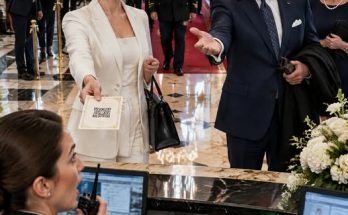
An event coordinator initially redirected me, but after reading my invitation, she apologized. The Secret Service officer scanned my military identification, then the encrypted code on my invitation. Her terminal changed, and her expression became still.
“Command, hold inner traffic at East reception,” she said into her microphone.
Behind me, Victor chuckled. “I knew there would be a credential problem.”
The officer requested confirmation from General Marcus Hale’s office. After listening to the reply, she straightened.
“Colonel Caldwell, General Hale is coming to receive you personally.”
The corridor fell silent. Double doors opened, and a four-star general strode toward us as every service member nearby snapped upright.
I had known General Hale for six years. Victor had never seen me beside someone he could neither charm nor buy. As the general passed my father’s waiting smile without slowing, I finally saw what Victor Caldwell looked like when money stopped working.
Part 2: The Salute He Could Not Buy
Victor stepped forward and extended his hand. “General Hale, Victor Caldwell of Caldwell Defense Systems. We’ve corresponded—”
The general walked past him and stopped before me. I came to attention, and General Hale raised a sharp salute.
“Colonel Caldwell, welcome. The Secretary has already asked twice whether you’ve arrived.”
“I apologize for keeping him waiting, sir.”
“You’re seven minutes early.” His expression softened. “You earned this day, Maya. Don’t let anyone convince you otherwise.”
He asked me to walk with him. Behind us, Blake blurted, “Why did he salute her?”
His confusion carried me back to the day our relationship ended. At twenty-one, I told Victor I intended to accept an Army commission instead of joining his company. He offered me a place in strategic operations and promised me a board seat within three years.
“I don’t want the board,” I said.
That refusal wounded his pride more deeply than any failure could have. He removed me from his estate plan that afternoon. Two years later, he married Lorraine, and Blake discovered that agreeing with Victor provided an effortless career.
I chose another path. My twenties were filled with field tents, diesel fumes, sleepless nights, and decisions that affected hundreds of soldiers. I learned that logistics was not merely trucks and warehouses; it was time, risk, distance, and human lives. By thirty-four, I held command. By forty, I was directing plans at levels I had never imagined.
Three weeks before the ceremony, an official courier delivered notice that I would receive the Defense Distinguished Service Medal for leading a critical military logistics program. I read the letter alone and made tea because there was no family member I could call.
Inside the East Room, my place was in the front row. Victor, however, was restricted to the mezzanine. When he demanded access to the main floor, he suddenly announced, “Colonel Maya Caldwell is my daughter.”
General Hale glanced at me. “Family?”
“Technically.”
Victor was escorted upstairs. For the first time, watching him walk away did not make me feel abandoned.
Part 3: The Name Behind Sentinel
The ceremony began with several service members receiving honors. Then the master of ceremonies turned a page.
“Colonel Maya Elizabeth Caldwell, United States Army.”
I rose as the citation revealed information omitted from my advance copy. For five years, I had directed the Sentinel Sustainment Integration Group, a program designed to keep military supply and communication networks functioning when primary systems failed.
During a major coalition communications collapse overseas, our framework restored essential routing and sustainment capabilities in under an hour, protecting mission continuity for more than eight hundred personnel.
As I approached the stage, the entire room stood.
The Secretary of Defense placed the medal around my neck. “Your people performed extraordinary work.”
“They did, sir.”
“And you kept them together.”
“That was my job.”
When I faced the audience, I finally looked toward the mezzanine. Victor sat frozen behind a pair of opera glasses. Blake was searching for Sentinel on his phone, while Lorraine stared with one hand against her chest.
My father did not look proud. He looked calculating.
Caldwell Defense Systems had tried twice to secure subcontracts related to Sentinel. Because of my family connection, I had recused myself from every matter involving the company. Both proposals had failed technical review without my participation.
Victor had spent years chasing access to a program directed by the daughter he claimed did not exist.
At the reception, General Hale introduced me to senior commanders, allied officials, legislators, and defense leaders. For several minutes, I forgot my family was there.
Then Victor’s voice cut through the room.
“Maya! Sweetheart, there you are!”
The disgust he had shown at the checkpoint had vanished. Now he appeared radiant, emotional, and publicly proud.
After twenty-six years of asking me to disappear, my father was hurrying toward me because important people finally knew my name.
Part 4: The Request I Honored
Two agents stopped Victor before he reached our group.
“There’s been a misunderstanding,” he said warmly. “Colonel Caldwell is my daughter.”
General Hale finally acknowledged him. Victor immediately declared that the entire family had always known I would accomplish extraordinary things.
I remembered a Christmas gathering years earlier when he had introduced Blake as his only child while I stood across the room.
“Maya, darling, tell them it’s fine,” Victor urged.
I gave him exactly what he had requested that morning.
“Mr. Caldwell, you instructed me to act as though I didn’t know you.”
His smile faltered.
“I agreed,” I continued. “I intend to honor your request.”
Victor called the setting inappropriate, so I calmly suggested he return to his assigned reception area. General Hale then turned his back on him and resumed our conversation. Everyone else followed his example, leaving Victor without an audience.
Later, Blake approached me privately. He claimed Victor had merely been surprised, then asked whether I could arrange a meeting concerning Sentinel.
“I don’t discuss procurement matters with family.”
“It isn’t like that.”
“It is exactly like that.”
When I refused, Blake accused me of acting superior because I wore a uniform while the rest of them had built something.
“Blake,” I asked, “what did you build?”
Before he could answer, Dr. Karen Liu arrived to escort me into a classified briefing. When she asked who Blake was, I replied, “Someone from the donor reception.”
Forty minutes later, my phone showed seven missed calls from Victor and one message:
We need to discuss Sentinel before you leave Washington. There are family and corporate matters requiring discretion.
His sudden affection had already become a business strategy.
Part 5: The Apology With a Price
Victor intercepted me after the briefing and claimed he owed me an apology.
“I misunderstood the situation,” he said.
“No. You saw your daughter in uniform, assumed her work embarrassed you, and ordered her to stay away.”
“I didn’t know the Secretary of Defense was decorating you.”
The admission hung between us. He had become proud only after powerful people showed him I mattered.
Victor then confessed that losing my mother, Amelia, had made him desperate to control whatever remained. He had wanted a future for me that he understood.
“You wanted obedience,” I replied.
For one moment, I saw the father who had once taken me for pancakes on Saturday mornings. Then he revealed the real purpose of his apology.
Caldwell Defense Systems wanted work in Sentinel’s next support phase.
“I’m not asking for classified information,” he insisted. “You could make introductions.”
“No.”
“I am your father.”
“You spent twenty-six years telling people otherwise.”
His expression turned cold. “You always were vindictive.”
“Goodbye, Victor.”
That evening, I placed my medal on the desk in my hotel room and tried to put the conversation behind me. At 9:17, Colonel Nathan Price from Army legal called.
Someone connected to Caldwell Defense Systems had approached a contracting intermediary and claimed the company possessed senior internal sponsorship for future Sentinel work. My name had been mentioned indirectly.
“I authorized nothing,” I said.
“I know,” Colonel Price replied. “Document every conversation you had with your father. And do not call him tonight.”
That was not going to be difficult.
Part 6: The Name He Used Without Permission
Before midnight, I completed a factual memorandum recording Blake’s request, Victor’s statements, and every mention of Sentinel. I removed emotion and speculation. The facts were damaging enough.
The following day, my team joined me for lunch. Major Sofia Torres brought a crooked cake with green icing congratulating me. These people had seen me exhausted, frightened, stubborn, and wrong. Their respect existed long before anyone placed a medal around my neck.
For years, part of me had continued succeeding for an imaginary audience of one, hoping that another promotion might finally change Victor’s mind. Now that he had seen me, he only wanted access.
The disappointment hurt. The freedom felt better.
That afternoon, Colonel Price confirmed that a Caldwell Defense consultant had claimed Victor had reestablished a close relationship with a senior Army officer connected to Sentinel. When challenged, the consultant used my name.
Hours later, Victor appeared at Fort Belvoir. He was stopped at the visitor center, but I eventually agreed to speak with him.
“You reported me,” he accused.
“I documented what happened after someone used my career to imply corporate influence.”
“I was trying to save the company.”
“Save it from what?”
Victor fell silent. Lorraine looked away.
That reaction answered my question.
Caldwell Defense Systems—the company Victor had spent his life building—was in serious trouble. The failed bids, aggressive networking, expensive donor access, and sudden interest in reconciling with me were not coincidences.
My father had gambled on the daughter he erased because he believed she might rescue him.
Part 7: The Price of Integrity
In a monitored conference room, Victor admitted the company had expanded too aggressively. Two commercial projects had failed, a major subcontract had expired, and investors were losing patience. He had personally guaranteed significant debt because he expected a future defense award to stabilize everything.
“Sentinel?” I asked.
“Yes.”
Lorraine quietly admitted that nearly everything depended on securing new work.
Victor reminded me that Caldwell Defense employed eleven hundred people. That gave me pause. Engineers, accountants, machinists, administrators, and warehouse workers had no responsibility for how he treated me.
Still, I refused.
“You tied their livelihoods to a contract you had no guarantee of winning. My integrity is not something you can use to repair that decision.”
When Victor asked whether anything remained between us, I told him the truth.
“There was plenty left for years. I called after my first deployment. I invited you to every promotion. Each time, you chose pride.”
He claimed he was trying now.
“No, Dad. You’re trying because you discovered what I can do for you.”
I told him I did not want the company to fail or its employees to suffer, but I would not bend the rules. He was never to use my name again.
The inquiry found no criminal conspiracy, but Caldwell Defense was temporarily removed from one opportunity while its communications were reviewed. The company later competed through normal channels and lost the lead contract. One division eventually secured a smaller project after an independent technical evaluation.
That work saved several hundred jobs, but Victor was forced to sell assets and surrender management control during restructuring.
Nine months after the White House ceremony, a handwritten letter arrived from him.
For the first time in twenty-six years, my father asked me for nothing.
Part 8: The Recognition I No Longer Needed
Victor’s letter began with Amelia. He described her laughing after he assembled my childhood bicycle with the handlebars backward. He also wrote about the hospital room where she died and admitted that grief had transformed his desire to protect me into a need to control me.
He apologized for opposing my commission, removing me from his estate, ignoring my calls, denying I was his daughter, and humiliating me outside the White House.
Then came his most honest confession:
When General Hale saluted you, my first thought was not that I had been wrong. I wondered how useful you could be to me. I have been ashamed of that thought ever since.
The letter ended without demanding forgiveness. He promised to leave me alone if that was what I wanted.
That evening, I called him.
“I believe you’re sorry,” I said. “But I’m not coming back.”
I did not hate him or want revenge, but I would not rebuild a relationship simply because he had finally recognized my value. He could send Christmas cards. I would answer if there were a genuine emergency. There would be no staged photographs, family dinners, or attempt to pretend the missing decades had been a misunderstanding.
Some damage can be forgiven without being reversed.
A year later, I was promoted at Fort Belvoir. General Hale attended, along with people from every stage of my career. Victor did not. I had filled the room with those who had actually participated in the life being honored.
Months later, I returned to the White House for another defense meeting. Standing near the same checkpoint where Victor had ordered me to deny knowing him, I finally understood that General Hale’s salute had not changed my worth.
My service mattered before the applause. My integrity existed before powerful people confirmed it. The real change came when my father finally offered the recognition I had wanted for twenty-six years—and I discovered I no longer needed it.
The officer scanned my credential and returned it.
“Have a good afternoon, General Caldwell.”
“Thank you.”
Then I walked through the gate without looking back.