I showed up to my ex-father-in-law’s funeral in uniform with 5 kids, setting off an envelope reveal that ruined my ex.

Part 1: The Funeral Where the Truth Walked In

Ten years after I was pushed off Sterling property in disgrace, I returned under a gray Georgia sky in my military dress uniform—not as the woman they had shamed into silence, but as the mother of five children no one could deny.

My name is Savannah Cole, and the black SUV stopped near the cemetery as church bells rang for Harrison Whitmore’s funeral. I stepped out first, shoulders squared, carrying a decade of silence.

Then the back doors opened.

One by one, my children climbed out.

Evan. Noah. Liam. Ruby. Emma.

The whispers started immediately.

Five children.

Five faces.

Five living reminders of the truth everyone had refused to hear.

Because every one of them looked like Grant Whitmore, my ex-husband—the man who gave me ten minutes to defend myself before signing away our marriage.

I had not come for money. I had not come to beg. I had not come to prove myself to people who had already chosen their verdict.

I came because Harrison was the only person in that family who ever treated me like I mattered. Years after the divorce, he had sent one handwritten Christmas card to my Army post office box, never knowing I kept it folded inside my Bible.

My children deserved to say goodbye to the grandfather who never knew them.

Then Victoria Hale stepped in front of us.

She was the woman who had waited for my marriage to collapse before it was even over. She looked at my children and smiled like she still controlled the story.

“Well,” she said loudly, “I suppose the military doesn’t teach shame.”

Evan tightened his hand around mine.

I looked at her. “Move.”

Victoria’s eyes swept over my children. “Do you really expect people to believe this little parade happened by accident?”

“They came to say goodbye.”

“To a man who was not their family.”

That was when Ruby stepped forward.

My youngest daughter looked toward Harrison’s grave and said clearly, “He was our grandfather.”

The cemetery changed.

Grant turned from the coffin. His eyes moved from Evan to Noah, then Liam, Ruby, and Emma.

Confusion.

Disbelief.

Recognition.

Victoria saw it too.

The past she thought she had buried had walked back into the cemetery holding my children’s hands.

Grant stepped closer, his voice shaking.

“Savannah… what is this?”

I lifted the sealed envelope in my hand.

“This,” I said, “is what you left behind ten years ago.”

Part 2: The Envelope

Grant stared at the envelope, but he was no longer looking at me.

He was looking at Victoria.

For ten years, he had believed one version of the story. One accusation. One lie repeated so often that it became easier than asking questions.

But now five children stood in front of him with his eyes, his jawline, and the same expression he saw every morning in the mirror.

Victoria reached for his arm.

“You don’t know what you’re doing,” she whispered.

But I did.

I had spent ten years raising my children, building a life, and carrying proof that could have changed everything.

Grant took the envelope from me with trembling hands.

Inside were five certified paternity reports, an old hotel folio, and a notarized statement Victoria had believed was gone forever.

He opened the first document.

The names were there in black ink.

Evan, Noah, Liam, Ruby, and Emma Whitmore.

Each report confirmed what my children’s faces already proved.

Grant’s breath caught.

“Ten years,” he whispered. “Five children?”

“I didn’t know everything when you threw me out,” I said. “You were too blinded by Victoria’s story to remember the weekend in Savannah before you accused me.”

Victoria stepped forward. “Grant, stop reading. She’s playing you.”

“Be quiet,” Grant said.

His voice was low enough to make her freeze.

He pulled out the next page.

It was the hotel record from the night Victoria claimed I had been with another man. Attached was proof that I had actually been at an Army logistics seminar under orders.

The final document was worse.

A notarized statement from the hotel clerk Victoria had paid to falsify the story.

Grant turned toward her.

“You paid him.”

Victoria backed away. “I did it for us. She didn’t belong in your world. I saved you.”

“No,” I said. “You robbed him. You robbed him of his wife, his children, and ten years he can never get back.”

The papers slipped from Grant’s hands.

He dropped to his knees beside his father’s grave.

“My children,” he whispered.

Evan stepped slightly in front of his siblings.

“Don’t touch my mother,” he said quietly. “And don’t touch my sisters.”

Grant looked up at him and saw his own face staring back without trust.

“Savannah, please. I didn’t know.”

“You didn’t know because you didn’t care to ask,” I said. “You gave me ten minutes to defend my entire life. You never looked at my proof. You only wanted me gone.”

Part 3: Harrison Knew

Victoria tried to move toward the parked cars, but two military police officers stepped from behind my SUV and blocked her path.

“Victoria Hale,” one officer said, handing her a legal document. “You are being served with a federal subpoena involving falsified records, financial misconduct, and conspiracy.”

Victoria’s polished mask shattered.

Grant stayed on his knees, staring at the children he had never known.

Then I looked toward the casket.

“Harrison knew.”

Grant’s head snapped up. “What?”

“Your father found the truth three years ago. He hired his own investigators after discovering Victoria was moving company funds offshore.”

I pulled the worn Christmas card from inside my jacket.

“He found out about the children. He wrote to my post office box at Fort Benning.”

Grant stared at the card.

“He wrote every month for two years,” I said. “He sent the children Christmas gifts. He helped create college trusts under his personal name, separate from Whitmore Enterprises.”

Grant’s face crumpled.

“He asked me to keep it quiet until after he passed because he wanted you to face the truth when there was no one left for you to hide behind.”

The sound that left Grant was not anger.

It was grief.

I turned to my children.

“Say goodbye to your grandfather.”

One by one, they stepped forward.

Evan laid a red rose on the casket. Noah followed. Then Liam. Ruby placed a hand-drawn card beside the flowers, and Emma added a small white daisy.

“Goodbye, Grandpa Harrison,” Ruby whispered.

I raised my hand to my service cap and gave Harrison Whitmore a final salute—the only man in that family who had honored the truth.

Then I turned away.

Grant stumbled after us.

“Savannah, please. Let me make this right. I’ll give you everything—the estate, the company, anything. Just let me be their father.”

I stopped at the SUV door.

“You don’t become a father because you finally see your face in theirs,” I said. “A father stays when things are hard. A father protects his children from lies instead of choosing the lie because it is convenient.”

“I’ll fight you in court.”

“You can try,” I said calmly. “But my evidence is flawless, your father secured their future, and Victoria left you with a corporate audit you cannot outrun.”

Then I guided my children into the SUV.

As we drove through the iron gates for the last time, the clouds over Georgia finally broke.

The ten years of silence were over.

Epilogue: The Life We Built

Three years later, sunlight spread across the Chesapeake Bay outside our home in Annapolis.

Inside the kitchen, the air smelled of blueberry pancakes and coffee. Evan helped Liam with history homework. Noah tied Emma’s sneakers. Ruby set juice glasses on the table.

My dress uniform hung in my office closet, now bearing my major’s oak leaves.

My phone chimed with a legal update from Atlanta.

Victoria had been convicted of financial crimes. Grant had spent years trying to rebuild his damaged company while filing custody petitions that courts dismissed again and again. Harrison’s trust agreements, my decade of parenting, and the children’s own testimony had made their future untouchable.

Grant’s last letter contained no threats.

Only five childhood photographs of himself and a broken note asking whether the children had received the birthday gifts he sent through the trust.

I did not burn it.

I did not hide the gifts.

As my children grew old enough to ask questions, I gave them the truth without bitterness. They knew who their father was. They knew what he had chosen. And they knew their worth had never depended on his approval.

Later, Colonel Marcus Reed, the man who had become my husband, stood beside me as the children rushed toward the dock.

“You built a fortress out of the truth,” he said.

I looked at my five children—confident, loved, and free from the lie that once tried to erase them.

Ten years earlier, I had been forced off a Georgia estate with a broken heart and a secret pregnancy.

Now I stood in my own home, surrounded by a family no lie could tear apart.

That day at the funeral, Grant thought he had buried the past.

Instead, five children walked across the cemetery and brought it back to life.

I showed up to my ex-father-in-law’s funeral in uniform with 5 kids, setting off an envelope reveal that ruined my ex. Read More

My brother collapsed my son and shrugged it off, setting off a paramedic’s reveal that ruined my family’s decades of lies.

Part 1: The Night Everything Changed

The last echoes of my company’s year-end party were still in my head when I pulled into my driveway that night. My company badge still hung around my neck, my lipstick had faded, and everything outside looked painfully ordinary, from the buzzing porch light to the little American flag Eli had tucked into the planter beside the steps.

The moment I entered the house, however, I knew something was wrong. The silence wasn’t peaceful or familiar, and before I could call Eli’s name, my heel touched something soft near the entrance.

I looked down and found my nine-year-old son collapsed on the tile. His cheek rested against the floor, one hand curled near his throat, his breathing was shallow, and a dark bruise marked his jaw where there had been nothing when I’d kissed him goodbye that morning.

“Eli.”

I dropped beside him and touched his shoulder. He was warm, but frighteningly limp, and when I begged him to open his eyes, his lashes barely fluttered.

“Baby, open your eyes. Eli, look at me.”

Then I realized we weren’t alone. My brother Ryan stood against the hallway wall watching us with the same detached expression he’d worn whenever someone else’s suffering became inconvenient, while my parents emerged from the living room looking disturbingly composed.

“About time.”

I stared at Ryan.

“What did you do?”

He gave a casual shrug.

“Just disciplined him.”

My mother answered from behind him without the slightest hesitation.

“He deserved it.”

Something inside me became terrifyingly clear. I’d spent my childhood being taught that Ryan’s cruelty was strength and that questioning him made me difficult, but motherhood erased those old rules the moment I saw my son lying helpless on the floor.

I pulled out my phone and dialed 911.

“Who are you calling?”

“Help.”

Ryan pushed away from the wall and immediately tried to minimize what had happened.

“Don’t be ridiculous. He’s fine.”

“No, he’s not.”

I gave the dispatcher my address and clearly explained that my child was unconscious, bruised, and struggling to breathe. Ryan tried using the same language he’d always used to justify himself, but this time I refused to let him rewrite what was happening in front of me.

“Hannah, you’re overreacting. You don’t know how to raise a boy. Somebody has to be firm.”

For one moment, I wanted to turn around and unleash every ounce of anger I felt on him. Then Eli’s breathing hitched beneath my hand, reminding me that my son needed me more than Ryan needed my rage.

Paramedics arrived with a police officer minutes later and immediately began examining Eli. While one paramedic fitted oxygen over his face, the other checked his pulse, eyes, and ribs until Eli made a weak sound that nearly broke me.

Then something strange happened.

The male paramedic looked up and saw Ryan.

His entire expression changed.

For less than a second, he simply stared at my brother, but there was no confusion in his eyes. It was unmistakable recognition, sharp enough that Ryan went still and even my parents suddenly seemed uneasy.

The paramedic leaned closer to me.

“Ma’am, is that really your brother?”

“Yes.”

He swallowed and looked at Ryan again.

“Because actually…”

He stopped himself.

“No. Never mind. We need to move your son now.”

At the hospital, doctors confirmed that Eli had suffered a concussion, significant bruising, and fractured rib cartilage. A nurse carefully used the phrase “non-accidental trauma,” while police and a social worker began taking statements from me about Ryan and my parents.

Around three that morning, I suddenly remembered the security cameras I’d installed months earlier after noticing that Eli sometimes became frightened whenever Ryan visited. I opened my laptop beside my son’s hospital bed and loaded the hallway footage.

The recording showed Ryan entering my home with the spare key my mother had insisted family should possess. Moments later, Eli appeared in the hallway, and what happened next destroyed every excuse my family had ever made for my brother.

Ryan struck him.

Then he did it again before shoving him and dragging him toward the door. What disturbed me most wasn’t uncontrolled rage but how calmly he did everything, while Eli folded inward as though this wasn’t the first time he’d learned how to survive his uncle.

When Eli finally woke the next morning, he didn’t look at me first. His frightened eyes immediately moved toward the hospital-room door.

“Mom…”

“I’m here.”

“Is Uncle Ryan coming?”

“No.”

The relief on his face made my stomach twist.

I carefully took his hand.

“Has he hurt you before?”

Eli began crying.

“Sometimes.”

“When?”

His next words changed everything I thought I knew about my family.

“When you were at work. Grandma said it was for my own good. He said if I told you, you’d get mad at me. Like she does.”

That was when I understood this hadn’t begun the night of my company party. It was simply the first night I’d arrived home early enough to discover it.

I handed the security footage to police and repeated everything Ryan and my mother had said. But while investigators began building the case, I couldn’t stop thinking about the paramedic’s reaction when he’d first seen my brother.

He hadn’t looked at Ryan like a stranger who seemed vaguely familiar.

He had looked at him like someone he’d seen before.

Later that afternoon, the paramedic returned to the hospital and introduced himself as Mark. He asked to speak with me privately because there was something he could no longer keep to himself.

“I need to tell you why I reacted the way I did.”

Years earlier, Mark had worked as an EMT in a neighboring county where one case had haunted emergency workers for decades. A newborn boy had disappeared from a hospital during the night, and although investigators had pursued several leads, the baby had never been found.

“When I saw your brother, I thought I was looking at one of those images grown up.”

My mouth went dry.

“Do you remember the baby’s name?”

Mark nodded.

“Noah Turner.”

Suddenly, Ryan hurting my son was no longer the only secret threatening to tear my family apart.

Because the paramedic wasn’t suggesting that he’d merely recognized my brother.

He was suggesting that Ryan might never have been my brother at all.

Part 2: The Secret Behind Ryan’s Identity

Mark’s words followed me long after he left the hospital. That night, while Eli slept beside me, I searched through old news archives and found the case he had described: Noah Turner, a newborn who disappeared from a hospital less than twenty miles from where my parents had been living at the time.

The dates made the coincidence even harder to ignore. Noah disappeared in March, while Ryan’s birth certificate claimed he had been born in May, leaving only two months between the disappearance of one baby and the supposed arrival of another.

I started remembering details from childhood that had never made sense. There was a missing period in our family photographs, my parents always avoided telling stories about Ryan’s birth, and whenever anyone commented that he looked nothing like us, my mother responded with the same rehearsed phrases instead of actual memories.

“He was perfect from the beginning.”

“He was meant for us.”

“God gave him to us when we needed him.”

Desperate for answers, I called my Aunt Celia and told her what Ryan had done to Eli. She became frighteningly quiet before saying something that made my fingers tighten around the phone.

“Oh God. So it finally reached a child.”

“What do you mean finally?”

Celia hesitated before explaining that my mother had supposedly lost a baby before Ryan arrived, but nobody in the family had ever understood the timeline. My mother disappeared for months, my father aggressively discouraged questions, and then suddenly they had a baby everyone was expected to accept without explanation.

“Are you saying Ryan might not be…”

“I’m saying your parents built their lives around secrets. And secrets don’t stay buried. They just wait for a child to get hurt.”

The following morning, I took everything to Detective Alvarez: the security footage showing Ryan hurting Eli, Mark’s statement, Aunt Celia’s account, the old article about Noah Turner, and the suspicious timeline surrounding Ryan’s supposed birth. The detective listened carefully, and instead of dismissing the theory as impossible, his expression became more serious with every detail.

“We can pursue the assault immediately. And we will start digging into the identity question.”

“Do it.”

That evening, my mother arrived at my house while my father waited in the car. She stood beneath the porch light expecting me to open the door simply because she’d always believed being my mother gave her unlimited access to my life.

“Hannah, we need to talk.”

I kept the door locked.

“No. You need to leave.”

Her expression hardened immediately.

“Ryan was correcting him. Boys need discipline.”

“He fractured my son’s ribs.”

My father climbed out of the car and approached the porch with the same authority he’d used to intimidate me since childhood.

“You’re making a spectacle. Dragging police into family matters.”

For the first time, his disapproval meant nothing to me.

“You made it a police matter when you let a grown man beat a child in my house.”

My mother lowered her voice.

“You can’t keep Eli from us.”

“Watch me.”

Then I finally said what I’d spent years being too frightened to admit.

“You don’t know what love is. You know possession.”

My father’s expression changed, and the carefully controlled mask I’d known all my life briefly disappeared.

“If you continue with this, you’ll regret it.”

Normally, that threat would have been enough to make me question myself. This time, I simply raised my phone and reminded him that I had security footage, hospital records, police documentation, copies of everything, and a protective order already being pursued.

Ryan was arrested the following Tuesday. Detective Alvarez called to tell me officers were at my parents’ home with a warrant connected to Eli’s assault and potentially falsified records, and I drove there because I needed to see for myself that my family could no longer protect him from consequences.

Ryan initially appeared almost amused when officers brought him outside. He looked at me and silently mouthed a single word.

“Traitor.”

Then he noticed Mark standing beside one of the patrol vehicles giving a formal statement. For the first time in my life, genuine fear appeared in Ryan’s eyes.

My mother rushed forward.

“He’s our son!”

Detective Alvarez answered without raising his voice.

“That remains to be seen.”

Even my father froze.

Over the following days, investigators began pulling apart a family history my parents had spent decades keeping sealed. Old hospital logs were requested, neighbors were interviewed, records were reopened, and investigators eventually discovered the name of a retired nurse connected to the original disappearance.

Then Detective Alvarez located Lydia Turner.

Noah’s mother was still alive.

She had spent decades wondering what had happened to the newborn taken from her, and before agreeing to DNA testing, she asked to meet me. We chose a quiet coffee shop halfway between our towns, where two women who had never met sat across from each other because of a secret neither of us had created.

“You’re telling me the man who hurt your son may be the baby they stole from me.”

“Yes.”

Lydia closed her eyes briefly. When she opened them again, tears filled them, but her voice remained steady.

“Then your boy saved the truth by surviving it.”

I told her everything: what Ryan had done to Eli, how my parents had always defended him, how they called cruelty discipline, and how Ryan had grown up believing consequences were something other people faced.

After listening quietly, Lydia asked me something I hadn’t expected.

“Was he ever kind?”

The question forced me back into childhood. I remembered Ryan carrying me on his back, telling me family was the safest place in the world, and moments when I’d genuinely believed he loved me.

“Sometimes. But I don’t know anymore whether it was kindness or practice.”

Three days later, DNA samples were collected. While we waited for the results, Eli finally came home from the hospital and began therapy, slowly trying to understand why people he’d been taught to trust had hurt him and then blamed him for it.

One night, he looked at me carefully.

“Are Grandma and Grandpa mad?”

“Yes. But that’s not your problem anymore.”

He remained quiet for several seconds.

“You picked me.”

Those three words nearly broke me.

“Always.”

Three weeks later, Detective Alvarez arrived at my house carrying a folder. The expression on his face told me the waiting was over, and when he placed the file on my kitchen table, I saw a name printed across the first page.

It wasn’t Ryan. It was Noah Turner.

The detective looked directly at me before explaining what the DNA results had confirmed.

The man I’d called my brother my entire life was the missing child Lydia Turner had spent decades searching for.

And now investigators had to determine exactly how Noah Turner had become Ryan.

Part 3: The Truth, the Consequences, and Healing

The DNA results confirmed what had once sounded impossible. Ryan was biologically Lydia Turner’s missing son, Noah, the newborn taken from a hospital decades earlier, which meant the man I’d grown up calling my brother had entered our family through a secret my parents had protected for most of my life.

Knowing his real identity didn’t excuse what Ryan had done to Eli, and it didn’t magically transform him into a different person. The assault case continued first, while the investigation into Noah’s disappearance moved more slowly because detectives had to reconstruct events buried beneath decades of missing records, silence, and fear.

Investigators questioned my parents and reopened old files connected to the hospital. The retired nurse who had surfaced earlier became increasingly difficult for them to explain away, and every recovered document seemed to pull another thread from the story my parents had spent years carefully maintaining.

Lydia received the truth she’d waited decades to hear, but there was nothing simple or joyful about it. She had finally found her missing child, yet Noah was now an adult named Ryan, shaped by another family and facing consequences for hurting my son.

The truth didn’t return the baby Lydia had lost, nor did it erase the person Ryan had become. My parents didn’t suddenly acknowledge the damage they’d caused simply because DNA had exposed what they had hidden, and I eventually understood that discovering the truth wasn’t the same thing as repairing everything.

My responsibility was no longer to repair them anyway.

It was Eli.

After leaving the hospital, he began therapy and stayed close to me while ordinary things slowly became safe again. For a while, he slept in my bed, startled easily, and watched doors more carefully than any nine-year-old should have needed to.

One evening, he returned to the question that mattered most to him.

“Are Grandma and Grandpa mad?”

“Yes. But that’s not your problem anymore.”

He studied my face for a moment.

“You picked me.”

“Always.”

That conversation changed something between us. For most of my life, my parents had taught me that protecting family meant tolerating whatever family did, but Eli showed me the opposite: sometimes protecting your family means refusing to give dangerous people another opportunity to hurt them.

Recovery didn’t happen dramatically. There was no morning when Eli woke up completely fearless or when everything that happened suddenly stopped mattering; instead, progress arrived through tiny decisions that probably looked meaningless to everyone except me.

At first, Eli couldn’t sleep unless my bedroom door remained open. Eventually, he returned to his own room and slept with his door open, and then, months later, he quietly closed it himself.

That was when I knew something inside him was beginning to heal.

A closed door had once meant danger because adults could hide terrible things behind family authority. Now my son could close one because it simply meant privacy, and that small act mattered more to me than any public confrontation or courtroom victory ever could.

The little American flag Eli had brought home from school remained in the planter beside our porch long after its paper edges began fading. He had put it there because, in his words, every house should have something outside reminding people that whoever lived inside was supposed to be safe.

For months, looking at that flag brought me back to the night I’d returned from the company party and found Eli collapsed near the door. I remembered Ryan watching from the hallway, my mother saying Eli deserved what happened, and my father behaving as though protecting the family reputation mattered more than protecting his grandson.

But eventually the flag began meaning something different.

It reminded me that the cycle had stopped at my front door.

Ryan might spend the rest of his life trying to understand how Noah Turner became the man he was. Lydia might spend hers grieving the childhood with her son that someone stole from her, while my parents would have to face whatever consequences came from the secret they’d spent decades protecting.

None of that belonged to Eli.

His future didn’t have to be built around their choices.

One evening, I stood on the porch watching him through the window as he worked on his homework. He looked ordinary again, which after everything we’d survived felt extraordinary.

I thought about something I’d understood the night I found him on the floor: a family can teach someone to apologize even while they’re the one being hurt. Mine had spent years teaching me exactly that.

Motherhood untaught me in a single night.

And whenever I remembered Eli looking at me with that careful expression and whispering those three words, I knew exactly what the rest of my life needed to prove.

“You picked me.”

Yes.

I had.

And I always would.

My brother collapsed my son and shrugged it off, setting off a paramedic’s reveal that ruined my family’s decades of lies. Read More

My SIL sneered at my cooking and called it school cafeteria food, setting off a response that ruined her entire weekend.

***My sister-in-law took one look at dinner and immediately tore it apart. “Looks like something scraped off a cafeteria tray,” she said. “Even my kids could do better!” Nobody at the table said a word. I simply lifted my glass, took a slow sip of water, and answered quietly, “I didn’t cook tonight.”***

“Looks like something scraped off a cafeteria tray,” my sister-in-law said, grimacing at her plate. “Even my kids could do better!”

The room went silent.

I took a slow sip of water.

“I didn’t cook tonight.”

Across from me, my husband, Daniel, froze with his fork halfway to his mouth.

My sister-in-law, Melissa Carter, blinked.

At the head of the table, my mother-in-law, Diane, suddenly became fascinated with her napkin.

Melissa gave an uneasy laugh.

“Okay. Then who did?”

“Your mother.”

The color disappeared from her face.

Diane slowly looked up.

For five years, I had hosted nearly every Carter family gathering at our home in Columbus, Ohio.

Thanksgiving.

Birthdays.

Graduations.

Random Sunday dinners.

Somehow, they always became my responsibility.

I planned the menu, bought groceries, cooked, cleaned, and smiled while Melissa offered criticism disguised as jokes.

Too salty.

Too dry.

Too fancy.

Too cheap.

Daniel’s answer was always the same.

“That’s just Melissa.”

Tonight, I had finally decided to stop protecting everyone from her mouth.

Diane had arrived early and proudly announced that she wanted to make dinner herself. She prepared baked chicken, mashed potatoes, green beans, and gravy from a family recipe she’d used for decades.

Melissa arrived twenty minutes late.

She never asked who had cooked.

She simply assumed it was me.

And attacked.

Melissa stared at her mother.

“Mom, I didn’t mean—”

“You said it looked scraped off a cafeteria tray,” Diane replied.

“I was joking.”

“You weren’t.”

Melissa’s husband, Scott, kept his eyes on his plate.

Daniel cleared his throat.

“Melissa, maybe apologize.”

She snapped toward him.

“Oh, please. Emily set me up.”

There it was.

I leaned back.

“How?”

“You knew I thought you cooked.”

“I never said I did.”

“You could’ve corrected me!”

“Before or after you insulted the food?”

Melissa shoved her chair backward.

Diane no longer looked embarrassed.

She looked furious.

Then Melissa’s nine-year-old daughter, Sophie, spoke.

“Mom?”

Melissa turned.

“You always tell me not to make fun of people’s food.”

Nobody moved.

Her fourteen-year-old brother, Ethan, covered his mouth as if coughing.

Scott muttered, “She’s got a point.”

Melissa looked at her own family as though they had betrayed her.

Then Diane set down her fork.

“Emily,” she said, looking at me, “has been feeding this family for years.”

Melissa opened her mouth.

Diane raised a hand.

“And I think tonight we’re finally going to talk about the way you treat her.”

Dinner, apparently, was only getting started.

Melissa crossed her arms.

“The way I treat her? Are we seriously doing this?”

“Yes,” Diane said calmly.

Daniel shifted beside me.

“Mom, maybe tonight isn’t—”

“No,” Diane interrupted. “Tonight is exactly the night.”

That surprised me more than Melissa’s insult.

For years, Diane had avoided confrontation. Whenever Melissa made a cutting remark, she changed the subject. Whenever Daniel complained, Diane reminded him that family was too important to fight over little things.

Apparently, insulting her mashed potatoes had ended decades of diplomacy.

Melissa pointed at me.

“She complains about me behind my back, doesn’t she?”

“No.”

She gave me a sarcastic smile.

“Sure.”

“I don’t need to. You usually say everything in front of witnesses.”

Scott nearly choked on his water.

Melissa glared at him.

He raised both hands.

“I didn’t say anything.”

Diane turned back to Melissa.

“Do you remember Emily’s birthday dinner last year?”

Melissa shrugged.

“You complained about the restaurant she chose.”

“It was overpriced.”

“And Thanksgiving?”

“The turkey was dry.”

“It wasn’t.”

Melissa rolled her eyes.

“Mom—”

“And when they remodeled their kitchen, you told Emily the cabinets looked cheap.”

“They did.”

Daniel finally put down his fork.

“Melissa.”

“What?”

“That kitchen cost us thirty-eight thousand dollars.”

She stared at him.

“That’s not even the point,” he continued. “The point is you always do this.”

Melissa laughed.

Nobody joined her.

Then Sophie asked, “Is this why Aunt Emily doesn’t come to our house anymore?”

Melissa froze.

So did I.

The truth was, I had stopped going to Melissa and Scott’s gatherings whenever possible.

There was always some comment waiting for me.

My clothes.

My job.

My cooking.

Our house.

Even the fact that Daniel and I had chosen not to have children yet.

Once, Melissa joked that I had “married above my pay grade.”

Daniel heard it.

He said nothing until we got home.

Then he apologized for her.

Again.

Melissa looked at Sophie.

“Aunt Emily comes over.”

“Not much,” Sophie replied.

Scott rubbed his forehead.

“Mel, maybe you should just listen.”

Melissa stared at him.

“You too?”

“I’m not taking sides.”

“You literally are.”

“No. I’m saying everybody at this table seems to remember the same thing.”

That landed harder than anything I could have said.

Melissa looked around the table.

Her mother.

Her brother.

Her husband.

Her children.

Then me.

For once, she couldn’t hide behind the idea that I was simply too sensitive.

She stood.

“I’m not sitting here while everyone gangs up on me.”

Diane stopped her.

“Sit down.”

Melissa turned.

Diane pointed toward the chair.

“You’ve spent years making comments and calling them jokes. The second anyone responds, you become the victim. Sit down.”

For several seconds, Melissa didn’t move.

Then she sat.

Diane looked at me.

“Emily, I owe you an apology.”

I shook my head.

“You don’t.”

“Yes, I do. I saw more than I admitted.”

Daniel lowered his eyes.

“I kept thinking keeping the peace meant preventing arguments,” Diane continued. “But sometimes keeping the peace just means asking the quietest person to tolerate the loudest one.”

Nobody spoke.

Then Daniel exhaled.

“She’s right.”

I looked at him.

He met my eyes.

“I’ve done that too.”

Melissa muttered, “Wonderful. Group therapy over chicken.”

This time, Daniel didn’t laugh.

“That,” he said, “is exactly what we’re talking about.”

Melissa stared at him.

Something in her expression shifted.

Not guilt.

Not yet.

But uncertainty.

For once, sarcasm wasn’t saving her.

Nobody was rushing to make her comfortable.

Diane picked up her fork.

“The food is getting cold.”

Then she looked directly at Melissa.

“You’re welcome to eat it.”

Ethan tried to hide a smile.

Melissa looked down at the dinner she had insulted fifteen minutes earlier.

Slowly, she took another bite.

Nobody asked what she thought.

For the next ten minutes, dinner continued in careful silence.

Forks scraped against plates.

Glasses were refilled.

Scott asked Ethan about baseball practice.

Diane asked Sophie about school.

Nobody mentioned Melissa’s outburst.

Eventually, she put down her fork.

“Fine.”

Daniel looked at her.

“Fine what?”

“I’m sorry.”

The words sounded automatic.

She looked at Diane.

“Sorry I insulted your dinner.”

Diane waited.

Melissa frowned.

“What?”

“Anything else?”

Melissa glanced at me.

“And I’m sorry if Emily feels like I’ve been rude to her.”

Daniel gave a short, humorless laugh.

Melissa bristled.

“What now?”

“You didn’t apologize.”

“I literally just did.”

“You apologized for how Emily feels,” he said. “Try apologizing for what you did.”

Hearing that from Daniel mattered more than I wanted to admit.

For years, he had been kind to me privately and passive around his sister publicly.

He hated conflict.

He loved his family.

Together, those things created an easy routine: I absorbed Melissa’s remarks, Daniel apologized afterward, and everyone returned for the next holiday as though nothing had happened.

Two weeks earlier, I had finally stopped accepting it.

Melissa called while Daniel and I were driving home from work. She wanted us to host Ethan’s birthday because their backyard renovation wasn’t finished.

Daniel looked at me.

I shook my head.

He told her we already had plans.

Melissa laughed through the speaker.

“What plans? Emily reorganizing her spice cabinet?”

Daniel said nothing.

Then she added, “Come on. She loves playing hostess. Makes her feel important.”

After the call, I asked him one question.

“Why do you let her talk about me like that?”

His response came automatically.

“She doesn’t mean anything by it.”

“Then why does she keep doing it?”

He had no answer.

That evening became our first serious argument in years.

No screaming.

Just uncomfortable honesty.

I told Daniel I was tired of being expected to tolerate disrespect because confronting Melissa would make family gatherings awkward.

“They’re already uncomfortable,” I said. “They’re just uncomfortable for me instead of everyone else.”

That finally reached him.

Three days later, Diane called and offered to cook dinner at our house.

I agreed.

I hadn’t planned the trap Melissa accused me of setting.

But when she arrived, looked at the dishes, and smirked at me, I knew what was coming.

“Trying something rustic tonight?”

I could have told her Diane had cooked.

Instead, I simply said, “Dinner’s ready.”

Then I waited.

Now Melissa was being asked to do something nobody in the family had required from her in years.

Take responsibility without qualification.

She looked at me.

“I’m sorry.”

I waited.

“For insulting you.”

Another pause.

“And for making comments about your cooking.”

She swallowed.

“And your house.”

Daniel raised an eyebrow.

Melissa glared at him.

“And probably other things.”

“Definitely other things,” Scott murmured.

She turned toward him.

“Could you not?”

Scott leaned back.

“No, actually.”

That surprised everyone.

Melissa stared at her husband.

“You do it to me too,” he said.

She blinked.

“What are you talking about?”

“You make jokes about my job, my clothes, my parents. You criticize me in front of the kids and call me sensitive when I don’t laugh.”

The children went quiet.

Melissa looked stunned.

“That’s completely different.”

“How?”

“Because you’re my husband.”

Scott stared at her.

“That’s not the defense you think it is.”

Ethan lowered his head to hide another smile.

Then Diane sighed.

“Melissa, your father used to do the same thing.”

The mood shifted.

Robert, Melissa’s father, had died four years earlier from a heart attack at sixty-eight.

He had been charismatic and funny, the type of man who could control a room within minutes.

He also had a sharp tongue.

His jokes often had a target.

Usually Diane.

Sometimes Daniel.

Occasionally Melissa.

Whenever anyone objected, Robert would grin and say they couldn’t take a joke.

Melissa stared at her mother.

“Dad was funny.”

“He could be.”

“He wasn’t cruel.”

“I didn’t say he was.”

“That’s what you’re implying.”

Diane shook her head.

“I’m saying you learned something from him that I should have challenged years ago.”

Melissa looked away.

For the first time that evening, she seemed more exposed than angry.

“Your father could make everyone laugh,” Diane continued. “But sometimes he made one person feel small so everyone else could have a good time.”

“He loved you.”

“I know.”

“Then why are we talking about him like this?”

“Because loving someone doesn’t mean pretending every habit they had was good.”

Melissa’s eyes grew glassy.

Then Sophie climbed down from her chair and walked over.

“Mom?”

Melissa looked at her.

“Are you crying?”

“No.”

“You look like you’re crying.”

“I’m not.”

Sophie hugged her anyway.

Melissa stayed rigid for a moment, then wrapped her arms around her daughter.

The tension softened.

I didn’t suddenly forget everything Melissa had said to me.

But I understood the pattern more clearly.

She had grown up in a family where affection and ridicule often shared the same sentence.

She had learned that being funny meant striking first.

That didn’t erase the damage.

It explained where the habit came from.

After Sophie returned to her seat, Melissa wiped beneath one eye.

“I really did think I was joking most of the time.”

“I know.”

“You never told me it bothered you.”

“I shouldn’t have needed to give you formal notification that insulting me bothered me.”

Scott looked down, hiding a smile.

Melissa almost smiled too.

“That sounded like me.”

“A little.”

For the first time all night, the tension broke without someone becoming the target.

Melissa leaned forward.

“Why didn’t you say something sooner?”

“Because whenever anyone challenged you, you made them look dramatic.”

She started to answer, then stopped.

Daniel said quietly, “She’s right.”

Melissa looked at him.

“I know.”

Those might have been the most sincere words she said all evening.

Dinner continued for another hour.

Nobody changed overnight.

Melissa still became defensive.

Diane still tried to change the subject when things got uncomfortable.

Daniel still hesitated before speaking.

People rarely transform during one dinner.

But a pattern can become visible in one evening.

And once everyone saw it, pretending became harder.

Before Melissa and Scott left, I was loading the dishwasher when Melissa entered the kitchen alone.

“Need help?”

Normally, I would have said no.

Instead, I handed her a plate.

She rinsed it.

We worked quietly for a minute.

Then she said, “The chicken actually wasn’t bad.”

I looked at her.

She gave me a cautious smile.

“You might want to tell your mother that.”

“I will.”

She rinsed another plate.

Then added, “Your lasagna is still too salty.”

I stared at her.

She stared back.

For half a second, I wondered whether the entire evening had accomplished nothing.

Then she winced.

“Sorry. Reflex.”

I laughed.

So did she.

“Okay,” she said. “I’m going to have to work on that.”

“Yes.”

“Probably a lot.”

“Yes.”

At the front door, Diane hugged me longer than usual.

Scott thanked us for dinner.

Sophie announced that Grandma’s mashed potatoes deserved “at least nine out of ten.”

Ethan whispered to me, “Best dinner ever.”

Melissa heard him.

“Get in the car.”

He grinned.

After they left, Daniel and I stood in the kitchen among dirty glasses and leftover gravy.

He began loading the dishwasher.

Finally, he said, “I’m sorry.”

“For what?”

“For all the times I told you that Melissa was just being Melissa.”

I waited.

“I thought avoiding the argument meant I wasn’t choosing sides.”

“And?”

“And I was choosing hers.”

That mattered more than another apology from Melissa.

I had never expected my sister-in-law to protect me.

I had expected my husband to be my partner.

Daniel kissed my forehead.

“Next time she starts, I’ll say something.”

“Before we get home?”

He smiled sheepishly.

“Before we get home.”

Three months later, the Carter family gathered for Diane’s sixty-fifth birthday.

This time, Melissa hosted.

When Daniel and I arrived, she was standing over a tray of slightly burned chicken.

She looked at me.

I looked at the chicken.

Then slowly raised an eyebrow.

Melissa pointed the serving spoon at me.

“Don’t.”

I laughed.

“So I’m not allowed to say it looks scraped off a cafeteria tray?”

Scott nearly dropped the salad bowl.

Diane burst out laughing.

Even Melissa eventually covered her face and laughed.

Then she looked at me.

“Okay. I deserved that.”

“Absolutely.”

She handed me the serving spoon.

“Help me save dinner?”

I took it.

Not because everything had been forgotten.

Not because our relationship was suddenly perfect.

But because something had changed.

Melissa still had a sharp tongue.

Daniel still disliked confrontation.

Diane still worried too much about keeping the family together.

And I was still learning that silence can look like patience when it is really permission.

But the Carter family had one new rule at dinner.

If you served an insult, you had better be prepared to eat it yourself.

And nobody ever criticized Diane’s mashed potatoes again.

My SIL sneered at my cooking and called it school cafeteria food, setting off a response that ruined her entire weekend. Read More


My elderly father begged me not to take off his coat, setting off a discovery that ruined his caregiver’s secret.

Part 1

The moment I reached for the buttons on my father’s heavy coat, he panicked.

Then he grabbed my hand and whispered,

“Please, Elena. Don’t let Julian know you noticed anything.”

I froze.

I had driven six hours to surprise Dad for his seventy-eighth birthday. From the outside, his house looked spotless, but the moment I stepped inside, something felt wrong.

Every curtain was closed even though sunlight filled the afternoon sky. The house was unusually quiet, and my brother Julian’s wife, Chloe, greeted me with expensive jewelry and an impatient smile.

“You should have called first,” she said.

“Why?”

“Your father gets confused sometimes.”

A moment later, Dad appeared behind her.

My heart sank.

He looked much thinner than when I had seen him three months earlier, and despite the warm temperature inside the house, he was wearing a thick wool coat.

“Dad?”

His eyes filled with tears.

But he didn’t hug me until Chloe had walked away.

Later that afternoon, Julian explained how much he and Chloe had supposedly “sacrificed” to care for Dad. He showed me grocery receipts, medication bottles, and documents claiming he had authority over Dad’s finances.

Chloe folded her arms.

“He’s lucky we’re willing to deal with all this. You disappeared into your career, Elena. Don’t come back now acting like the perfect daughter.”

They expected me to feel guilty.

Instead, I smiled.

“You’re right. I should help while I’m here.”

That evening, I offered to help Dad get ready for bed.

The moment I reached toward his coat, he pulled away.

“Please.”

His voice trembled.

“Don’t take it off.”

I locked the bathroom door and turned on the shower so nobody downstairs could easily hear us.

“Dad, tell me what’s happening.”

Slowly, he allowed me to remove the coat.

That was when I noticed clear signs that he had not been treated properly.

There were marks along his arms, shoulders, and wrists that didn’t look accidental.

I stared at him.

“Dad… who did this?”

His eyes filled again.

“Julian restrains me when I ask about my bank accounts. Chloe pressures me whenever I refuse to sign papers.”

He swallowed.

“They keep telling me no one will believe an old man who sometimes forgets things.”

Then he told me everything.

Julian and Chloe had taken control of his finances.

They had arranged the sale of his lake cabin.

Money had disappeared from two investment accounts.

They had pressured him into signing a new will leaving almost everything to Julian.

Dad had tried contacting me twice.

Julian took away his phone.

Chloe warned him that if he told anyone what was happening, they would claim he was incapable of living independently and move him somewhere he didn’t want to go.

For a moment, I wanted to walk downstairs and confront them immediately.

But I knew that would only give them time to hide evidence.

So I stayed calm.

I documented what Dad told me, took photographs of the visible signs of mistreatment, and recorded his statement with his permission.

Then I reached for my phone.

“Judge Thorne?”

I kept my voice quiet.

“This is Assistant Attorney General Elena Vance. I need an emergency protective order tonight.”

Julian and Chloe had spent years joking about my government job.

They had never bothered to learn what I actually did.

That was about to become their biggest mistake.

Part 2

By breakfast the next morning, I was pretending nothing had changed.

Julian poured himself coffee and smirked.

“Still playing important government lawyer?”

Chloe laughed.

“She does paperwork for the state and acts like she runs the whole justice department.”

I calmly buttered my toast.

What they didn’t know was that my phone was already transferring Dad’s photographs, recordings, and financial information to a secure evidence system.

For nine years, I had worked with a unit specializing in financial exploitation involving older and vulnerable adults.

I had dealt with questionable powers of attorney, manipulated wills, unauthorized transfers, and relatives who believed family connections placed them above the law.

Julian and Chloe had no idea they had been explaining their scheme to someone who knew exactly what to look for.

“I’m leaving this afternoon,” I said casually.

Dad looked worried.

Julian smiled.

“Probably best.”

I nodded.

“But before I leave, I’d like to understand Dad’s care arrangements. Just so I know everything is handled.”

Chloe immediately brought me a folder.

Her confidence was astonishing.

Inside was a power of attorney supposedly giving Julian full financial control.

A physician’s letter claimed Dad could no longer manage his own affairs.

A newly prepared will named Julian as the main beneficiary.

Julian leaned back.

“Everything is perfectly legal.”

Then he smiled.

“You’re not getting anything.”

I studied the documents.

Almost immediately, I noticed problems.

The physician’s professional number contained an error.

The notary information was even more suspicious.

The woman whose stamp appeared on the power of attorney had passed away months before the document was supposedly signed.

I kept my expression neutral.

They had apparently fabricated much of the paperwork.

“Looks organized,” I said.

Chloe smiled.

“We’ve handled everything.”

“Yes,” I replied softly.

“You certainly have.”

At 9:30 that morning, two unmarked vehicles pulled into the driveway.

Julian frowned through the window.

“Who’s that?”

Then came a firm knock at the door.

“State authorities and Adult Protective Services. Please open the door.”

Chloe’s expression changed instantly.

Julian looked toward me.

“What did you do?”

I remained seated.

“I contacted the appropriate authorities.”

His face went pale.

“Judge Thorne authorized an emergency protection order and a search warrant this morning.”

Several investigators entered the house, accompanied by social workers and a financial specialist.

Chloe immediately began protesting.

“This is a private family matter! His daughter is only doing this because she wants his money!”

One investigator calmly instructed the social workers to check on Dad upstairs.

Julian stepped forward.

“I have power of attorney!”

I stood.

“You have paperwork that appears to have been falsified.”

He stared at me.

“The notary listed on your document was no longer alive when it was supposedly signed.”

Chloe stopped talking.

“And the medical declaration contains information that doesn’t match the physician you claimed evaluated Dad.”

Julian looked at me as though he were seeing me for the first time.

“Elena, we’re family.”

I met his eyes.

“Family doesn’t pressure an elderly parent into giving up control of his finances.”

Chloe shook her head quickly.

“He’s confused! He misunderstands things!”

“I documented his statement last night.”

Her expression changed.

“And investigators already have the financial records.”

The lead investigator nodded.

“Julian Vance and Chloe Vance, you’ll need to come with us while this matter is investigated.”

Julian immediately turned toward me.

“Elena, stop this!”

I stayed calm.

“You made your choices.”

Then Chloe suddenly shouted,

“The money is gone anyway!”

The financial specialist looked up from his laptop.

“No, it isn’t.”

The room went silent.

“The account receiving several of the transfers has already been restricted while the investigation continues.”

For the first time, Julian had nothing to say.

Part 3

After Julian and Chloe were taken away for questioning, I went upstairs.

Dad was sitting beside one of the social workers.

When he saw me, he looked frightened.

“Are they coming back?”

I sat beside him.

“Not right now.”

“Are you sure?”

“You’re safe, Dad.”

His shoulders finally relaxed.

Over the following weeks, investigators reconstructed everything.

Bank transfers.

Property documents.

Legal forms.

Emails.

Messages.

The supposed medical evaluation.

The new will.

The more they examined, the clearer the pattern became.

Julian and Chloe had spent months telling relatives and neighbors that Dad was becoming confused.

That story allowed them to justify controlling his finances.

But independent medical evaluations found no basis for removing his ability to make decisions for himself.

Several important documents were determined to be unreliable.

Financial records showed substantial amounts of Dad’s money had been moved without a convincing explanation.

The lake-cabin sale was challenged.

And the new estate documents came under legal review.

Julian had always believed appearances would protect him.

He dressed well.

Spoke confidently.

Presented himself as the responsible son caring for an aging father.

But financial records don’t care about appearances.

Neither do signatures, timestamps, or legal documents.

Four months later, the case went to court.

Dad did not have to testify.

The evidence spoke for him.

I explained the timeline and the financial records in my professional capacity.

Investigators presented documents showing approximately $280,000 had been removed or redirected from Dad’s savings and investments over nine months.

They also presented the questionable paperwork and digital evidence.

The final decision came quickly.

Julian was found responsible for multiple serious offenses involving elder mistreatment, financial exploitation, theft, and falsified documents.

Chloe was also convicted for participating in the financial scheme and attempting to pressure Dad into remaining silent.

Both received substantial sentences.

The questionable cabin transaction was later reversed through civil proceedings.

Recovered assets were placed into a protected trust managed by an independent financial institution.

For the first time in years, Dad once again had security and control over his own life.

But the courtroom wasn’t the moment I remembered most.

That came six months later.

Part 4

The sun was shining over Dad’s lake cabin when I visited again.

A light breeze carried the scent of pine trees across the deck.

Dad was standing beside several flower boxes, carefully tending a row of red geraniums.

He looked completely different.

He had regained weight.

His face looked healthier.

His hair was neatly trimmed.

And most importantly, he was wearing a light short-sleeved shirt.

No heavy coat.

No extra layers hiding what he didn’t want anyone to see.

Just Dad.

Comfortable.

Safe.

Free.

“Elena, sweetheart?”

“Yes, Dad?”

He wiped his hands on a gardening towel and walked toward me.

Then he rested a hand gently on my shoulder.

“Thank you for coming home for my birthday last year.”

My throat tightened.

I took his hand.

“I’ll always come when you need me.”

He smiled.

“Always?”

“Always.”

Dad kissed my forehead and returned to his flowers.

I stayed on the porch, listening to the water moving gently along the shore.

A year earlier, silence inside Dad’s house had frightened me.

Closed curtains.

Whispered conversations.

Things nobody was supposed to ask about.

Now the house was quiet again.

But this silence felt completely different.

There was no fear behind it.

Nothing needed to be hidden anymore.

For the first time in a very long time, the quiet inside my father’s home meant only one thing.

Peace had finally returned.

My elderly father begged me not to take off his coat, setting off a discovery that ruined his caregiver’s secret. Read More

My family tried to pity my “struggling” startup, setting off a Bloomberg notification that ruined their patronizing speech.

***“We’re here to discuss your struggling company,” Mom said sympathetically. My brother choked on his coffee, staring at his phone. “Why is your company valued at $4 billion on Bloomberg?” The room fell silent as…***

The intervention began with a sympathy card.

“We’re here to discuss your struggling company,” Mom said, sliding it across the breakfast table in her Boston townhouse.

My brother, Derek, sat beside her with a legal pad and the careful expression he wore whenever he believed he was the smartest person in the room.

His wife, Heather, had already poured coffee for everyone.

I opened the card.

Inside, Mom had written:

***You do not have to fail alone.***

I nearly laughed.

For eleven years, I had built Northstar Systems from a rented desk in Cambridge into a cybersecurity company serving hospitals, utilities, and logistics networks across the country.

I still drove a six-year-old Subaru.

I still rented my apartment.

I didn’t post pictures from investor dinners or tell relatives what our shares were worth.

To my family, quiet apparently meant unsuccessful.

Derek cleared his throat.

“I’ve put together a rescue plan.”

He pushed a term sheet across the table.

His company, Mercer Advisory, would invest $250,000 in exchange for thirty-five percent of Northstar and “operational authority during restructuring.”

I looked up.

“You want control of my company for a quarter million dollars?”

“You need someone who understands scale.”

Mom touched my wrist.

“Claire, pride won’t pay employees.”

Before I could answer, Derek’s phone buzzed.

He glanced down.

Then coughed so hard coffee sprayed onto his napkin.

Heather leaned toward him.

“What?”

Derek stared at the screen.

Then read it again.

“Why is your company valued at four billion dollars on Bloomberg?”

The room went silent.

I took his phone.

The article announced Northstar’s newest financing round at a $4.08 billion valuation, led by two institutional investors.

We had signed the final documents at 6:15 that morning.

Mom stared at me.

“Four billion?”

“Company valuation,” I said. “Not cash in my checking account.”

Derek’s face had turned gray.

Then something on his term sheet caught my attention.

The ownership table showed him holding twelve percent of Northstar through something called “family seed rights.”

He owned nothing.

My phone rang.

Maya Chen, Northstar’s chief financial officer.

“Claire,” she said without greeting me, “did you authorize your brother to contact our lead investor?”

I looked at Derek.

“No.”

Maya exhaled.

“He sent them a signed document claiming he controls twelve percent of your voting shares.”

Derek stood so fast his chair scraped across the floor.

Mom whispered, “Derek… what document?”

Maya continued.

“And Claire, there’s more. He tried to sell those shares yesterday for four hundred eighty million dollars.”

PART 2

Derek didn’t deny it.

Instead, he reached for his phone.

“Give me ten minutes to explain.”

“No,” I said. “You had eleven years.”

Mom looked between us.

“What are family seed rights?”

Derek rubbed both hands over his face.

Then the story started unraveling.

When I founded Northstar, Mom had lent me $60,000 from a certificate of deposit.

We signed a straightforward promissory note.

I repaid every dollar, plus interest, three years later.

Derek had found a scanned copy of that old note in Mom’s files.

He altered it into a convertible investment agreement, changed the repayment terms, and inserted a clause claiming the money had converted into twelve percent of Northstar’s common stock.

Then he created an electronic version carrying my initials.

Heather stopped breathing for a moment.

“You forged Claire’s signature?”

“I reconstructed an agreement everyone understood existed.”

“No,” I said. “You manufactured ownership.”

Maya joined us by video.

She explained that Derek had contacted one of Northstar’s new investors through a secondary-market broker.

He claimed our family wanted liquidity after “years of supporting an unstable founder.”

Mom flinched.

But the fake shares weren’t the only problem.

Maya displayed a bank record.

Three months earlier, $380,000 had been transferred from Mom’s investment account to Mercer Advisory.

The memo read:

***NORTHSTAR EMERGENCY BRIDGE.***

I turned toward Mom.

“Did you send him that?”

Her expression changed.

Derek had told her Northstar was weeks away from missing payroll.

He said I was too embarrassed to ask for help, so she liquidated part of her retirement portfolio.

He promised to deliver the money personally and keep my “failure” private.

Northstar had never received a cent.

Heather pushed back from the table.

“Where did the money go?”

Derek stared at his untouched coffee.

Maya answered.

Corporate records showed Mercer Advisory had paid $142,000 toward Derek’s office mortgage, $87,000 to a personal line of credit, and $64,000 to a luxury-car dealer.

The rest had been transferred into an account ending in 4419.

Heather went completely still.

“That is our joint savings account.”

Derek lowered his voice.

“I was going to replace it after the share sale.”

Mom’s eyes filled.

“You told me I was saving your sister.”

“You were helping the family.”

“No,” she said. “I was helping you lie about her.”

Then Maya opened one last attachment from the broker.

The proposed $480 million transaction named two beneficiaries.

***Derek Mercer.***

And:

***Evelyn Mercer.***

My mother.

Her signature appeared beneath the transaction authorization.

Mom stared at it.

“I never signed that.”

I looked at Derek.

He hadn’t merely tried to sell shares in a company he didn’t own.

He had structured the fraud so that if everything collapsed, our mother would appear to be his partner.

PART 3

The $480 million sale never happened.

Northstar’s investor questioned the documents before any money changed hands, and Maya froze every request connected to Derek.

By noon, our outside counsel had preserved the emails, broker communications, altered agreements, and access logs.

Mom called her bank and reported the $380,000 transfer as fraud.

For the first time that morning, Derek stopped trying to explain himself.

He hired a lawyer.

The investigation lasted seven months.

Digital forensics showed that the fake convertible agreement had been created on Derek’s office laptop two weeks before the family “intervention.”

Metadata linked the electronic initials to that same device.

The broker also produced messages in which Derek repeatedly described me as emotionally unstable and financially desperate so potential investors would believe my family had grounds to force a sale.

He hadn’t simply underestimated my company.

He needed everyone else to underestimate me too.

The government charged him with wire fraud, forgery, identity theft, and attempted securities fraud.

Rather than go to trial, Derek eventually pleaded guilty to a reduced set of charges.

He received federal prison time, restitution, and a prohibition on working in securities or managing client funds after his release.

Most of Mom’s $380,000 was recovered through frozen accounts and the sale of Derek’s car and office property.

Some of it was gone permanently through legal expenses and money he had already spent.

Heather filed for divorce.

Later, she told me the fraud hadn’t been Derek’s first lie.

It was simply the first one large enough to expose all the others.

Northstar kept operating.

The $4.08 billion valuation made headlines for about a week.

Then it became what valuations actually are—a number attached to expectations, not a mountain of cash sitting in my living room.

I still owned a significant part of the company, but most of that value remained illiquid and tied directly to the business.

I kept driving my Subaru for another year.

That seemed to bother Mom more than the headlines.

Eventually, she understood that I had never been hiding failure.

I had simply stopped performing success for people who confused appearance with reality.

Our relationship changed slowly.

Mom apologized for believing Derek’s stories without ever asking me a single question.

I told her the apology mattered.

But access to my life would no longer be automatic.

Six months later, we met for breakfast at the same townhouse.

There was no intervention.

No legal pad.

No rescue plan.

No sympathy card.

Mom placed the old card between us.

Then she read the sentence she had written months earlier.

***You do not have to fail alone.***

She tore the card in half.

“I thought I was coming to rescue you,” she said.

“You were.”

Mom looked confused.

I continued.

“Just not from my company.”

Her eyes filled.

For years, I had believed the painful part was knowing my family thought I was unsuccessful.

It wasn’t.

The painful part was realizing they had made my worth dependent on whether they could recognize it.

Derek needed to see a struggling sister because that version of me made him feel bigger.

Mom needed to see someone who required rescuing because that version made her feel useful.

Neither of them had really looked at me.

The day Bloomberg published Northstar’s valuation, the room fell silent because my family suddenly understood what my company was worth.

It took much longer for them to understand that my value had never depended on the number.

My family tried to pity my “struggling” startup, setting off a Bloomberg notification that ruined their patronizing speech. Read More

My husband packed his bags while I was 7 months pregnant, setting off a legal move that ruined his new lifestyle.

Seven months pregnant, I watched my husband pack his suitcase and say, “I’m done supporting you and that baby. Figure it out yourself.”

He left me for another woman without looking back.

Three weeks later, the lottery ticket I’d bought with my last twenty dollars hit the state jackpot.

When my face appeared on the evening news, my phone started ringing.

His name flashed across the screen.

At seven months pregnant, I stood in our bedroom doorway while my husband packed his belongings into a black suitcase.

Ryan never looked at my swollen ankles or the hand resting protectively over our daughter.

He zipped the suitcase and said, “I’m done supporting you and that baby. Figure it out yourself.”

“That baby is yours,” I whispered.

He gave a humorless laugh.

“You wanted her more than I did.”

Outside our Raleigh townhouse, Vanessa waited in her silver convertible.

She had been Ryan’s “marketing consultant” until I discovered a hotel receipt on our joint card.

Before leaving, Ryan emptied our checking account, canceled the card I used for groceries, and sent me one final text:

*Our marriage is over. Do not contact me unless it concerns the divorce.*

Then he walked past me without touching my stomach once.

I had twenty-three dollars left in my purse.

Twenty went toward a lottery ticket at the corner market.

The remaining three bought oatmeal.

It wasn’t a plan. It was one irrational spark of hope on the worst night of my life.

I photographed the ticket beside the receipt and placed both inside an envelope.

Ryan had always mocked my habit of keeping records. He’d forgotten that bookkeeping was how I spotted missing numbers—and how I kept myself calm when everything else felt out of control.

Before going to bed, I wrote the date he abandoned us across the envelope.

The next three weeks were brutally practical.

I sold my earrings, arranged a payment plan with my obstetrician, and started doing remote bookkeeping from the kitchen table.

My older neighbor, Mrs. Alvarez, drove me to appointments.

I documented every dollar Ryan had taken and backed up his text in three separate places.

When he emailed a proposed separation agreement asking me to waive support “to keep things friendly,” I forwarded it to family-law attorney Naomi Brooks.

“Sign nothing,” Naomi said. “The date he left matters. So does every dollar he moved.”

On Friday night, I was sorting receipts when the lottery drawing came on.

The first four numbers matched.

Then the fifth.

When the final number appeared, my knees nearly gave out.

I gripped the counter and stared at the ticket trembling in my hand.

It was worth $38.6 million.

Naomi immediately arranged a trust, a financial adviser, and a controlled public claim.

Three days later, eight months pregnant and wearing a fitted emerald dress, I stood beneath television lights holding the ceremonial jackpot check.

Across town, Ryan and Vanessa were eating takeout in her luxury apartment when my face appeared on their television.

Vanessa dropped her wine.

Ryan lunged for his phone.

Seconds later, mine began ringing.

His name lit up the screen.

Part 2

I let the first call die.

Then the second.

On the seventh, Ryan finally left a voicemail, his voice so gentle it might have fooled the woman I had been a month earlier.

“Emily, sweetheart, I made a terrible mistake. We need to talk about our future—our family.”

Naomi listened beside me and raised one eyebrow.

“He remembered the word family remarkably fast.”

By morning, Ryan had sent flowers, baby clothes, and a photograph from our wedding.

I returned everything unopened.

Then Vanessa messaged me:

*Ryan says the ticket was bought with marital money. Be reasonable and nobody has to get ugly.*

The threat made Naomi smile.

The market receipt showed I had paid cash at 8:14 p.m.—forty-six minutes after Ryan’s timestamped message declaring our marriage over.

Doorbell footage showed him leaving with his suitcase.

Even better, Ryan and Vanessa had signed a lease two days earlier. His application listed them as “domestic partners” and gave his move-in date as the same night he left me.

In North Carolina, property acquired after separation was separate.

Ryan had created some of the strongest evidence against himself.

The lottery commission also had its recorded claim interview, where I disclosed our separation before my identity became public.

Naomi had insisted I answer carefully.

Every record told the same story long before Ryan knew there was money worth fighting over.

We didn’t tell him that.

Instead, Naomi filed for post-separation support, repayment of the money Ryan had drained from our accounts, and preservation of all financial records.

That filing uncovered something worse.

During my pregnancy, Ryan had transferred $64,000 from our home-equity line into a shell company controlled by Vanessa.

He had also forged my electronic signature on the loan documents.

Two nights later, Ryan appeared at my townhouse wearing the navy suit I had once bought him.

He carried roses and kept glancing at the small camera above the porch.

“Let me come home,” he said. “The stress confused me.”

“Did it confuse you before or after you took the grocery money?”

His smile tightened.

“Half that jackpot is mine. If you fight me, lawyers will swallow it, and people will hear things about you.”

“What things?”

He leaned closer.

“That you bought the ticket before I left. That you begged me to come back. Courts like reconciliation.”

Then I understood.

He wasn’t asking for forgiveness.

He wanted me to let him cross the threshold so he could manufacture evidence that our separation had ended.

I stepped onto the porch and closed the door behind me.

“Send every claim through Naomi.”

Ryan crushed the roses against the railing.

“You were nothing without me.”

The next morning, Vanessa posted photographs online implying Ryan had already returned to his “millionaire wife.”

Then an edited audio clip appeared, manipulated to make it sound as if I had agreed to split the prize.

Ryan petitioned the court for an emergency freeze on the winnings.

Naomi placed the original recordings, bank transfers, and forged loan documents into one evidence binder.

“Good,” she said. “Now he has made his fraud part of the court record.”

Part 3

Ryan entered the Wake County courtroom holding Vanessa’s hand.

He looked confident until Naomi played the unedited doorbell recording.

His own voice filled the room:

“Half that jackpot is mine. Courts like reconciliation.”

Then Naomi presented the timeline.

At 7:28 p.m., Ryan ended our marriage by text.

At 8:14 p.m., I bought the lottery ticket with cash from selling my earrings.

Two days earlier, Ryan and Vanessa had signed their lease.

Their messages even discussed leaving me “before the expensive baby arrives.”

The judge denied Ryan’s request to freeze the jackpot.

His attorney tried another argument.

“Even if the prize is separate, Mr. Carter is entitled to equitable treatment.”

Naomi opened the blue section of her binder.

“Then we should discuss his equitable treatment of the marital home.”

The bank’s fraud investigator testified next.

My electronic signature on the home-equity loan had originated from Vanessa’s laptop.

Security footage showed Ryan withdrawing the money.

Vanessa’s shell company had paid for her convertible, apartment deposit, and jewelry.

Ryan stopped looking at the jackpot.

He looked at me.

“Emily,” he whispered, “tell them you authorized it.”

I stood with one hand supporting my back.

“You left me with three dollars and an unborn child. Now you want me to give you my name so you can escape what you did. No.”

The judge ordered Ryan to repay the checking account, imposed temporary support, and referred the forged documents and false filings to investigators.

The lottery trust remained under my control.

Outside the courthouse, Vanessa turned on him.

“You said she couldn’t prove anything!” she shouted.

Ryan reached toward my arm, but a courthouse deputy stepped between us.

“Do not touch her.”

Within two months, prosecutors charged Ryan and Vanessa with financial fraud, identity theft, and conspiracy.

Faced with the original device records and bank footage, both accepted plea agreements.

Ryan lost his finance job and professional license.

He received probation, twelve months of home confinement, restitution, and mandatory financial-crime treatment.

Vanessa sold the convertible and surrendered the jewelry to help satisfy the judgment.

Their relationship collapsed before sentencing.

I didn’t use the jackpot to prove I was rich.

I paid my taxes, bought a quiet house with a garden, and placed most of the money into conservative investments.

I also created a grant through a local women’s center for expectant mothers facing sudden abandonment.

Mrs. Alvarez was the first person invited to see the nursery.

My daughter, Lily, arrived healthy on a bright October morning.

Ryan met her later through a court-supervised parenting plan after completing the required counseling.

I never used money to keep him from his child.

I used evidence to keep chaos away from hers.

A year after the drawing, I watched Lily toddle across the lawn beneath strings of white birthday lights.

My phone buzzed.

Ryan’s final restitution payment had arrived with a message:

*I lost everything because of one mistake.*

I deleted it.

Leaving us was his choice.

Trying to steal our future was another.

The jackpot didn’t save me.

It simply gave the woman he had underestimated enough room to save herself.

My husband packed his bags while I was 7 months pregnant, setting off a legal move that ruined his new lifestyle. Read More

My elderly father begged me not to take off his coat, setting off a discovery that ruined his caregiver’s secret.

Part 1

The moment I reached for the buttons on my father’s heavy coat, he panicked.

Then he grabbed my hand and whispered,

“Please, Elena. Don’t let Julian know you noticed anything.”

I froze.

I had driven six hours to surprise Dad for his seventy-eighth birthday. From the outside, his house looked spotless, but the moment I stepped inside, something felt wrong.

Every curtain was closed even though sunlight filled the afternoon sky. The house was unusually quiet, and my brother Julian’s wife, Chloe, greeted me with expensive jewelry and an impatient smile.

“You should have called first,” she said.

“Why?”

“Your father gets confused sometimes.”

A moment later, Dad appeared behind her.

My heart sank.

He looked much thinner than when I had seen him three months earlier, and despite the warm temperature inside the house, he was wearing a thick wool coat.

“Dad?”

His eyes filled with tears.

But he didn’t hug me until Chloe had walked away.

Later that afternoon, Julian explained how much he and Chloe had supposedly “sacrificed” to care for Dad. He showed me grocery receipts, medication bottles, and documents claiming he had authority over Dad’s finances.

Chloe folded her arms.

“He’s lucky we’re willing to deal with all this. You disappeared into your career, Elena. Don’t come back now acting like the perfect daughter.”

They expected me to feel guilty.

Instead, I smiled.

“You’re right. I should help while I’m here.”

That evening, I offered to help Dad get ready for bed.

The moment I reached toward his coat, he pulled away.

“Please.”

His voice trembled.

“Don’t take it off.”

I locked the bathroom door and turned on the shower so nobody downstairs could easily hear us.

“Dad, tell me what’s happening.”

Slowly, he allowed me to remove the coat.

That was when I noticed clear signs that he had not been treated properly.

There were marks along his arms, shoulders, and wrists that didn’t look accidental.

I stared at him.

“Dad… who did this?”

His eyes filled again.

“Julian restrains me when I ask about my bank accounts. Chloe pressures me whenever I refuse to sign papers.”

He swallowed.

“They keep telling me no one will believe an old man who sometimes forgets things.”

Then he told me everything.

Julian and Chloe had taken control of his finances.

They had arranged the sale of his lake cabin.

Money had disappeared from two investment accounts.

They had pressured him into signing a new will leaving almost everything to Julian.

Dad had tried contacting me twice.

Julian took away his phone.

Chloe warned him that if he told anyone what was happening, they would claim he was incapable of living independently and move him somewhere he didn’t want to go.

For a moment, I wanted to walk downstairs and confront them immediately.

But I knew that would only give them time to hide evidence.

So I stayed calm.

I documented what Dad told me, took photographs of the visible signs of mistreatment, and recorded his statement with his permission.

Then I reached for my phone.

“Judge Thorne?”

I kept my voice quiet.

“This is Assistant Attorney General Elena Vance. I need an emergency protective order tonight.”

Julian and Chloe had spent years joking about my government job.

They had never bothered to learn what I actually did.

That was about to become their biggest mistake.

Part 2

By breakfast the next morning, I was pretending nothing had changed.

Julian poured himself coffee and smirked.

“Still playing important government lawyer?”

Chloe laughed.

“She does paperwork for the state and acts like she runs the whole justice department.”

I calmly buttered my toast.

What they didn’t know was that my phone was already transferring Dad’s photographs, recordings, and financial information to a secure evidence system.

For nine years, I had worked with a unit specializing in financial exploitation involving older and vulnerable adults.

I had dealt with questionable powers of attorney, manipulated wills, unauthorized transfers, and relatives who believed family connections placed them above the law.

Julian and Chloe had no idea they had been explaining their scheme to someone who knew exactly what to look for.

“I’m leaving this afternoon,” I said casually.

Dad looked worried.

Julian smiled.

“Probably best.”

I nodded.

“But before I leave, I’d like to understand Dad’s care arrangements. Just so I know everything is handled.”

Chloe immediately brought me a folder.

Her confidence was astonishing.

Inside was a power of attorney supposedly giving Julian full financial control.

A physician’s letter claimed Dad could no longer manage his own affairs.

A newly prepared will named Julian as the main beneficiary.

Julian leaned back.

“Everything is perfectly legal.”

Then he smiled.

“You’re not getting anything.”

I studied the documents.

Almost immediately, I noticed problems.

The physician’s professional number contained an error.

The notary information was even more suspicious.

The woman whose stamp appeared on the power of attorney had passed away months before the document was supposedly signed.

I kept my expression neutral.

They had apparently fabricated much of the paperwork.

“Looks organized,” I said.

Chloe smiled.

“We’ve handled everything.”

“Yes,” I replied softly.

“You certainly have.”

At 9:30 that morning, two unmarked vehicles pulled into the driveway.

Julian frowned through the window.

“Who’s that?”

Then came a firm knock at the door.

“State authorities and Adult Protective Services. Please open the door.”

Chloe’s expression changed instantly.

Julian looked toward me.

“What did you do?”

I remained seated.

“I contacted the appropriate authorities.”

His face went pale.

“Judge Thorne authorized an emergency protection order and a search warrant this morning.”

Several investigators entered the house, accompanied by social workers and a financial specialist.

Chloe immediately began protesting.

“This is a private family matter! His daughter is only doing this because she wants his money!”

One investigator calmly instructed the social workers to check on Dad upstairs.

Julian stepped forward.

“I have power of attorney!”

I stood.

“You have paperwork that appears to have been falsified.”

He stared at me.

“The notary listed on your document was no longer alive when it was supposedly signed.”

Chloe stopped talking.

“And the medical declaration contains information that doesn’t match the physician you claimed evaluated Dad.”

Julian looked at me as though he were seeing me for the first time.

“Elena, we’re family.”

I met his eyes.

“Family doesn’t pressure an elderly parent into giving up control of his finances.”

Chloe shook her head quickly.

“He’s confused! He misunderstands things!”

“I documented his statement last night.”

Her expression changed.

“And investigators already have the financial records.”

The lead investigator nodded.

“Julian Vance and Chloe Vance, you’ll need to come with us while this matter is investigated.”

Julian immediately turned toward me.

“Elena, stop this!”

I stayed calm.

“You made your choices.”

Then Chloe suddenly shouted,

“The money is gone anyway!”

The financial specialist looked up from his laptop.

“No, it isn’t.”

The room went silent.

“The account receiving several of the transfers has already been restricted while the investigation continues.”

For the first time, Julian had nothing to say.

Part 3

After Julian and Chloe were taken away for questioning, I went upstairs.

Dad was sitting beside one of the social workers.

When he saw me, he looked frightened.

“Are they coming back?”

I sat beside him.

“Not right now.”

“Are you sure?”

“You’re safe, Dad.”

His shoulders finally relaxed.

Over the following weeks, investigators reconstructed everything.

Bank transfers.

Property documents.

Legal forms.

Emails.

Messages.

The supposed medical evaluation.

The new will.

The more they examined, the clearer the pattern became.

Julian and Chloe had spent months telling relatives and neighbors that Dad was becoming confused.

That story allowed them to justify controlling his finances.

But independent medical evaluations found no basis for removing his ability to make decisions for himself.

Several important documents were determined to be unreliable.

Financial records showed substantial amounts of Dad’s money had been moved without a convincing explanation.

The lake-cabin sale was challenged.

And the new estate documents came under legal review.

Julian had always believed appearances would protect him.

He dressed well.

Spoke confidently.

Presented himself as the responsible son caring for an aging father.

But financial records don’t care about appearances.

Neither do signatures, timestamps, or legal documents.

Four months later, the case went to court.

Dad did not have to testify.

The evidence spoke for him.

I explained the timeline and the financial records in my professional capacity.

Investigators presented documents showing approximately $280,000 had been removed or redirected from Dad’s savings and investments over nine months.

They also presented the questionable paperwork and digital evidence.

The final decision came quickly.

Julian was found responsible for multiple serious offenses involving elder mistreatment, financial exploitation, theft, and falsified documents.

Chloe was also convicted for participating in the financial scheme and attempting to pressure Dad into remaining silent.

Both received substantial sentences.

The questionable cabin transaction was later reversed through civil proceedings.

Recovered assets were placed into a protected trust managed by an independent financial institution.

For the first time in years, Dad once again had security and control over his own life.

But the courtroom wasn’t the moment I remembered most.

That came six months later.

Part 4

The sun was shining over Dad’s lake cabin when I visited again.

A light breeze carried the scent of pine trees across the deck.

Dad was standing beside several flower boxes, carefully tending a row of red geraniums.

He looked completely different.

He had regained weight.

His face looked healthier.

His hair was neatly trimmed.

And most importantly, he was wearing a light short-sleeved shirt.

No heavy coat.

No extra layers hiding what he didn’t want anyone to see.

Just Dad.

Comfortable.

Safe.

Free.

“Elena, sweetheart?”

“Yes, Dad?”

He wiped his hands on a gardening towel and walked toward me.

Then he rested a hand gently on my shoulder.

“Thank you for coming home for my birthday last year.”

My throat tightened.

I took his hand.

“I’ll always come when you need me.”

He smiled.

“Always?”

“Always.”

Dad kissed my forehead and returned to his flowers.

I stayed on the porch, listening to the water moving gently along the shore.

A year earlier, silence inside Dad’s house had frightened me.

Closed curtains.

Whispered conversations.

Things nobody was supposed to ask about.

Now the house was quiet again.

But this silence felt completely different.

There was no fear behind it.

Nothing needed to be hidden anymore.

For the first time in a very long time, the quiet inside my father’s home meant only one thing.

Peace had finally returned.

My elderly father begged me not to take off his coat, setting off a discovery that ruined his caregiver’s secret. Read More

My SIL sneered at my cooking and called it school cafeteria food, setting off a response that ruined her entire weekend.

***My sister-in-law took one look at dinner and immediately tore it apart. “Looks like something scraped off a cafeteria tray,” she said. “Even my kids could do better!” Nobody at the table said a word. I simply lifted my glass, took a slow sip of water, and answered quietly, “I didn’t cook tonight.”***

“Looks like something scraped off a cafeteria tray,” my sister-in-law said, grimacing at her plate. “Even my kids could do better!”

The room went silent.

I took a slow sip of water.

“I didn’t cook tonight.”

Across from me, my husband, Daniel, froze with his fork halfway to his mouth.

My sister-in-law, Melissa Carter, blinked.

At the head of the table, my mother-in-law, Diane, suddenly became fascinated with her napkin.

Melissa gave an uneasy laugh.

“Okay. Then who did?”

“Your mother.”

The color disappeared from her face.

Diane slowly looked up.

For five years, I had hosted nearly every Carter family gathering at our home in Columbus, Ohio.

Thanksgiving.

Birthdays.

Graduations.

Random Sunday dinners.

Somehow, they always became my responsibility.

I planned the menu, bought groceries, cooked, cleaned, and smiled while Melissa offered criticism disguised as jokes.

Too salty.

Too dry.

Too fancy.

Too cheap.

Daniel’s answer was always the same.

“That’s just Melissa.”

Tonight, I had finally decided to stop protecting everyone from her mouth.

Diane had arrived early and proudly announced that she wanted to make dinner herself. She prepared baked chicken, mashed potatoes, green beans, and gravy from a family recipe she’d used for decades.

Melissa arrived twenty minutes late.

She never asked who had cooked.

She simply assumed it was me.

And attacked.

Melissa stared at her mother.

“Mom, I didn’t mean—”

“You said it looked scraped off a cafeteria tray,” Diane replied.

“I was joking.”

“You weren’t.”

Melissa’s husband, Scott, kept his eyes on his plate.

Daniel cleared his throat.

“Melissa, maybe apologize.”

She snapped toward him.

“Oh, please. Emily set me up.”

There it was.

I leaned back.

“How?”

“You knew I thought you cooked.”

“I never said I did.”

“You could’ve corrected me!”

“Before or after you insulted the food?”

Melissa shoved her chair backward.

Diane no longer looked embarrassed.

She looked furious.

Then Melissa’s nine-year-old daughter, Sophie, spoke.

“Mom?”

Melissa turned.

“You always tell me not to make fun of people’s food.”

Nobody moved.

Her fourteen-year-old brother, Ethan, covered his mouth as if coughing.

Scott muttered, “She’s got a point.”

Melissa looked at her own family as though they had betrayed her.

Then Diane set down her fork.

“Emily,” she said, looking at me, “has been feeding this family for years.”

Melissa opened her mouth.

Diane raised a hand.

“And I think tonight we’re finally going to talk about the way you treat her.”

Dinner, apparently, was only getting started.

Melissa crossed her arms.

“The way I treat her? Are we seriously doing this?”

“Yes,” Diane said calmly.

Daniel shifted beside me.

“Mom, maybe tonight isn’t—”

“No,” Diane interrupted. “Tonight is exactly the night.”

That surprised me more than Melissa’s insult.

For years, Diane had avoided confrontation. Whenever Melissa made a cutting remark, she changed the subject. Whenever Daniel complained, Diane reminded him that family was too important to fight over little things.

Apparently, insulting her mashed potatoes had ended decades of diplomacy.

Melissa pointed at me.

“She complains about me behind my back, doesn’t she?”

“No.”

She gave me a sarcastic smile.

“Sure.”

“I don’t need to. You usually say everything in front of witnesses.”

Scott nearly choked on his water.

Melissa glared at him.

He raised both hands.

“I didn’t say anything.”

Diane turned back to Melissa.

“Do you remember Emily’s birthday dinner last year?”

Melissa shrugged.

“You complained about the restaurant she chose.”

“It was overpriced.”

“And Thanksgiving?”

“The turkey was dry.”

“It wasn’t.”

Melissa rolled her eyes.

“Mom—”

“And when they remodeled their kitchen, you told Emily the cabinets looked cheap.”

“They did.”

Daniel finally put down his fork.

“Melissa.”

“What?”

“That kitchen cost us thirty-eight thousand dollars.”

She stared at him.

“That’s not even the point,” he continued. “The point is you always do this.”

Melissa laughed.

Nobody joined her.

Then Sophie asked, “Is this why Aunt Emily doesn’t come to our house anymore?”

Melissa froze.

So did I.

The truth was, I had stopped going to Melissa and Scott’s gatherings whenever possible.

There was always some comment waiting for me.

My clothes.

My job.

My cooking.

Our house.

Even the fact that Daniel and I had chosen not to have children yet.

Once, Melissa joked that I had “married above my pay grade.”

Daniel heard it.

He said nothing until we got home.

Then he apologized for her.

Again.

Melissa looked at Sophie.

“Aunt Emily comes over.”

“Not much,” Sophie replied.

Scott rubbed his forehead.

“Mel, maybe you should just listen.”

Melissa stared at him.

“You too?”

“I’m not taking sides.”

“You literally are.”

“No. I’m saying everybody at this table seems to remember the same thing.”

That landed harder than anything I could have said.

Melissa looked around the table.

Her mother.

Her brother.

Her husband.

Her children.

Then me.

For once, she couldn’t hide behind the idea that I was simply too sensitive.

She stood.

“I’m not sitting here while everyone gangs up on me.”

Diane stopped her.

“Sit down.”

Melissa turned.

Diane pointed toward the chair.

“You’ve spent years making comments and calling them jokes. The second anyone responds, you become the victim. Sit down.”

For several seconds, Melissa didn’t move.

Then she sat.

Diane looked at me.

“Emily, I owe you an apology.”

I shook my head.

“You don’t.”

“Yes, I do. I saw more than I admitted.”

Daniel lowered his eyes.

“I kept thinking keeping the peace meant preventing arguments,” Diane continued. “But sometimes keeping the peace just means asking the quietest person to tolerate the loudest one.”

Nobody spoke.

Then Daniel exhaled.

“She’s right.”

I looked at him.

He met my eyes.

“I’ve done that too.”

Melissa muttered, “Wonderful. Group therapy over chicken.”

This time, Daniel didn’t laugh.

“That,” he said, “is exactly what we’re talking about.”

Melissa stared at him.

Something in her expression shifted.

Not guilt.

Not yet.

But uncertainty.

For once, sarcasm wasn’t saving her.

Nobody was rushing to make her comfortable.

Diane picked up her fork.

“The food is getting cold.”

Then she looked directly at Melissa.

“You’re welcome to eat it.”

Ethan tried to hide a smile.

Melissa looked down at the dinner she had insulted fifteen minutes earlier.

Slowly, she took another bite.

Nobody asked what she thought.

For the next ten minutes, dinner continued in careful silence.

Forks scraped against plates.

Glasses were refilled.

Scott asked Ethan about baseball practice.

Diane asked Sophie about school.

Nobody mentioned Melissa’s outburst.

Eventually, she put down her fork.

“Fine.”

Daniel looked at her.

“Fine what?”

“I’m sorry.”

The words sounded automatic.

She looked at Diane.

“Sorry I insulted your dinner.”

Diane waited.

Melissa frowned.

“What?”

“Anything else?”

Melissa glanced at me.

“And I’m sorry if Emily feels like I’ve been rude to her.”

Daniel gave a short, humorless laugh.

Melissa bristled.

“What now?”

“You didn’t apologize.”

“I literally just did.”

“You apologized for how Emily feels,” he said. “Try apologizing for what you did.”

Hearing that from Daniel mattered more than I wanted to admit.

For years, he had been kind to me privately and passive around his sister publicly.

He hated conflict.

He loved his family.

Together, those things created an easy routine: I absorbed Melissa’s remarks, Daniel apologized afterward, and everyone returned for the next holiday as though nothing had happened.

Two weeks earlier, I had finally stopped accepting it.

Melissa called while Daniel and I were driving home from work. She wanted us to host Ethan’s birthday because their backyard renovation wasn’t finished.

Daniel looked at me.

I shook my head.

He told her we already had plans.

Melissa laughed through the speaker.

“What plans? Emily reorganizing her spice cabinet?”

Daniel said nothing.

Then she added, “Come on. She loves playing hostess. Makes her feel important.”

After the call, I asked him one question.

“Why do you let her talk about me like that?”

His response came automatically.

“She doesn’t mean anything by it.”

“Then why does she keep doing it?”

He had no answer.

That evening became our first serious argument in years.

No screaming.

Just uncomfortable honesty.

I told Daniel I was tired of being expected to tolerate disrespect because confronting Melissa would make family gatherings awkward.

“They’re already uncomfortable,” I said. “They’re just uncomfortable for me instead of everyone else.”

That finally reached him.

Three days later, Diane called and offered to cook dinner at our house.

I agreed.

I hadn’t planned the trap Melissa accused me of setting.

But when she arrived, looked at the dishes, and smirked at me, I knew what was coming.

“Trying something rustic tonight?”

I could have told her Diane had cooked.

Instead, I simply said, “Dinner’s ready.”

Then I waited.

Now Melissa was being asked to do something nobody in the family had required from her in years.

Take responsibility without qualification.

She looked at me.

“I’m sorry.”

I waited.

“For insulting you.”

Another pause.

“And for making comments about your cooking.”

She swallowed.

“And your house.”

Daniel raised an eyebrow.

Melissa glared at him.

“And probably other things.”

“Definitely other things,” Scott murmured.

She turned toward him.

“Could you not?”

Scott leaned back.

“No, actually.”

That surprised everyone.

Melissa stared at her husband.

“You do it to me too,” he said.

She blinked.

“What are you talking about?”

“You make jokes about my job, my clothes, my parents. You criticize me in front of the kids and call me sensitive when I don’t laugh.”

The children went quiet.

Melissa looked stunned.

“That’s completely different.”

“How?”

“Because you’re my husband.”

Scott stared at her.

“That’s not the defense you think it is.”

Ethan lowered his head to hide another smile.

Then Diane sighed.

“Melissa, your father used to do the same thing.”

The mood shifted.

Robert, Melissa’s father, had died four years earlier from a heart attack at sixty-eight.

He had been charismatic and funny, the type of man who could control a room within minutes.

He also had a sharp tongue.

His jokes often had a target.

Usually Diane.

Sometimes Daniel.

Occasionally Melissa.

Whenever anyone objected, Robert would grin and say they couldn’t take a joke.

Melissa stared at her mother.

“Dad was funny.”

“He could be.”

“He wasn’t cruel.”

“I didn’t say he was.”

“That’s what you’re implying.”

Diane shook her head.

“I’m saying you learned something from him that I should have challenged years ago.”

Melissa looked away.

For the first time that evening, she seemed more exposed than angry.

“Your father could make everyone laugh,” Diane continued. “But sometimes he made one person feel small so everyone else could have a good time.”

“He loved you.”

“I know.”

“Then why are we talking about him like this?”

“Because loving someone doesn’t mean pretending every habit they had was good.”

Melissa’s eyes grew glassy.

Then Sophie climbed down from her chair and walked over.

“Mom?”

Melissa looked at her.

“Are you crying?”

“No.”

“You look like you’re crying.”

“I’m not.”

Sophie hugged her anyway.

Melissa stayed rigid for a moment, then wrapped her arms around her daughter.

The tension softened.

I didn’t suddenly forget everything Melissa had said to me.

But I understood the pattern more clearly.

She had grown up in a family where affection and ridicule often shared the same sentence.

She had learned that being funny meant striking first.

That didn’t erase the damage.

It explained where the habit came from.

After Sophie returned to her seat, Melissa wiped beneath one eye.

“I really did think I was joking most of the time.”

“I know.”

“You never told me it bothered you.”

“I shouldn’t have needed to give you formal notification that insulting me bothered me.”

Scott looked down, hiding a smile.

Melissa almost smiled too.

“That sounded like me.”

“A little.”

For the first time all night, the tension broke without someone becoming the target.

Melissa leaned forward.

“Why didn’t you say something sooner?”

“Because whenever anyone challenged you, you made them look dramatic.”

She started to answer, then stopped.

Daniel said quietly, “She’s right.”

Melissa looked at him.

“I know.”

Those might have been the most sincere words she said all evening.

Dinner continued for another hour.

Nobody changed overnight.

Melissa still became defensive.

Diane still tried to change the subject when things got uncomfortable.

Daniel still hesitated before speaking.

People rarely transform during one dinner.

But a pattern can become visible in one evening.

And once everyone saw it, pretending became harder.

Before Melissa and Scott left, I was loading the dishwasher when Melissa entered the kitchen alone.

“Need help?”

Normally, I would have said no.

Instead, I handed her a plate.

She rinsed it.

We worked quietly for a minute.

Then she said, “The chicken actually wasn’t bad.”

I looked at her.

She gave me a cautious smile.

“You might want to tell your mother that.”

“I will.”

She rinsed another plate.

Then added, “Your lasagna is still too salty.”

I stared at her.

She stared back.

For half a second, I wondered whether the entire evening had accomplished nothing.

Then she winced.

“Sorry. Reflex.”

I laughed.

So did she.

“Okay,” she said. “I’m going to have to work on that.”

“Yes.”

“Probably a lot.”

“Yes.”

At the front door, Diane hugged me longer than usual.

Scott thanked us for dinner.

Sophie announced that Grandma’s mashed potatoes deserved “at least nine out of ten.”

Ethan whispered to me, “Best dinner ever.”

Melissa heard him.

“Get in the car.”

He grinned.

After they left, Daniel and I stood in the kitchen among dirty glasses and leftover gravy.

He began loading the dishwasher.

Finally, he said, “I’m sorry.”

“For what?”

“For all the times I told you that Melissa was just being Melissa.”

I waited.

“I thought avoiding the argument meant I wasn’t choosing sides.”

“And?”

“And I was choosing hers.”

That mattered more than another apology from Melissa.

I had never expected my sister-in-law to protect me.

I had expected my husband to be my partner.

Daniel kissed my forehead.

“Next time she starts, I’ll say something.”

“Before we get home?”

He smiled sheepishly.

“Before we get home.”

Three months later, the Carter family gathered for Diane’s sixty-fifth birthday.

This time, Melissa hosted.

When Daniel and I arrived, she was standing over a tray of slightly burned chicken.

She looked at me.

I looked at the chicken.

Then slowly raised an eyebrow.

Melissa pointed the serving spoon at me.

“Don’t.”

I laughed.

“So I’m not allowed to say it looks scraped off a cafeteria tray?”

Scott nearly dropped the salad bowl.

Diane burst out laughing.

Even Melissa eventually covered her face and laughed.

Then she looked at me.

“Okay. I deserved that.”

“Absolutely.”

She handed me the serving spoon.

“Help me save dinner?”

I took it.

Not because everything had been forgotten.

Not because our relationship was suddenly perfect.

But because something had changed.

Melissa still had a sharp tongue.

Daniel still disliked confrontation.

Diane still worried too much about keeping the family together.

And I was still learning that silence can look like patience when it is really permission.

But the Carter family had one new rule at dinner.

If you served an insult, you had better be prepared to eat it yourself.

And nobody ever criticized Diane’s mashed potatoes again.

My SIL sneered at my cooking and called it school cafeteria food, setting off a response that ruined her entire weekend. Read More
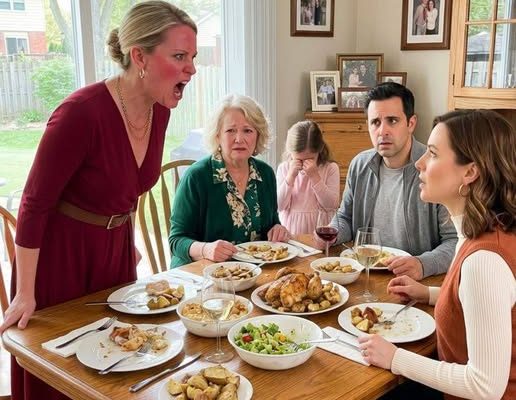
My family tried to pity my “struggling” startup, setting off a Bloomberg notification that ruined their patronizing speech.

***“We’re here to discuss your struggling company,” Mom said sympathetically. My brother choked on his coffee, staring at his phone. “Why is your company valued at $4 billion on Bloomberg?” The room fell silent as…***

The intervention began with a sympathy card.

“We’re here to discuss your struggling company,” Mom said, sliding it across the breakfast table in her Boston townhouse.

My brother, Derek, sat beside her with a legal pad and the careful expression he wore whenever he believed he was the smartest person in the room.

His wife, Heather, had already poured coffee for everyone.

I opened the card.

Inside, Mom had written:

***You do not have to fail alone.***

I nearly laughed.

For eleven years, I had built Northstar Systems from a rented desk in Cambridge into a cybersecurity company serving hospitals, utilities, and logistics networks across the country.

I still drove a six-year-old Subaru.

I still rented my apartment.

I didn’t post pictures from investor dinners or tell relatives what our shares were worth.

To my family, quiet apparently meant unsuccessful.

Derek cleared his throat.

“I’ve put together a rescue plan.”

He pushed a term sheet across the table.

His company, Mercer Advisory, would invest $250,000 in exchange for thirty-five percent of Northstar and “operational authority during restructuring.”

I looked up.

“You want control of my company for a quarter million dollars?”

“You need someone who understands scale.”

Mom touched my wrist.

“Claire, pride won’t pay employees.”

Before I could answer, Derek’s phone buzzed.

He glanced down.

Then coughed so hard coffee sprayed onto his napkin.

Heather leaned toward him.

“What?”

Derek stared at the screen.

Then read it again.

“Why is your company valued at four billion dollars on Bloomberg?”

The room went silent.

I took his phone.

The article announced Northstar’s newest financing round at a $4.08 billion valuation, led by two institutional investors.

We had signed the final documents at 6:15 that morning.

Mom stared at me.

“Four billion?”

“Company valuation,” I said. “Not cash in my checking account.”

Derek’s face had turned gray.

Then something on his term sheet caught my attention.

The ownership table showed him holding twelve percent of Northstar through something called “family seed rights.”

He owned nothing.

My phone rang.

Maya Chen, Northstar’s chief financial officer.

“Claire,” she said without greeting me, “did you authorize your brother to contact our lead investor?”

I looked at Derek.

“No.”

Maya exhaled.

“He sent them a signed document claiming he controls twelve percent of your voting shares.”

Derek stood so fast his chair scraped across the floor.

Mom whispered, “Derek… what document?”

Maya continued.

“And Claire, there’s more. He tried to sell those shares yesterday for four hundred eighty million dollars.”

PART 2

Derek didn’t deny it.

Instead, he reached for his phone.

“Give me ten minutes to explain.”

“No,” I said. “You had eleven years.”

Mom looked between us.

“What are family seed rights?”

Derek rubbed both hands over his face.

Then the story started unraveling.

When I founded Northstar, Mom had lent me $60,000 from a certificate of deposit.

We signed a straightforward promissory note.

I repaid every dollar, plus interest, three years later.

Derek had found a scanned copy of that old note in Mom’s files.

He altered it into a convertible investment agreement, changed the repayment terms, and inserted a clause claiming the money had converted into twelve percent of Northstar’s common stock.

Then he created an electronic version carrying my initials.

Heather stopped breathing for a moment.

“You forged Claire’s signature?”

“I reconstructed an agreement everyone understood existed.”

“No,” I said. “You manufactured ownership.”

Maya joined us by video.

She explained that Derek had contacted one of Northstar’s new investors through a secondary-market broker.

He claimed our family wanted liquidity after “years of supporting an unstable founder.”

Mom flinched.

But the fake shares weren’t the only problem.

Maya displayed a bank record.

Three months earlier, $380,000 had been transferred from Mom’s investment account to Mercer Advisory.

The memo read:

***NORTHSTAR EMERGENCY BRIDGE.***

I turned toward Mom.

“Did you send him that?”

Her expression changed.

Derek had told her Northstar was weeks away from missing payroll.

He said I was too embarrassed to ask for help, so she liquidated part of her retirement portfolio.

He promised to deliver the money personally and keep my “failure” private.

Northstar had never received a cent.

Heather pushed back from the table.

“Where did the money go?”

Derek stared at his untouched coffee.

Maya answered.

Corporate records showed Mercer Advisory had paid $142,000 toward Derek’s office mortgage, $87,000 to a personal line of credit, and $64,000 to a luxury-car dealer.

The rest had been transferred into an account ending in 4419.

Heather went completely still.

“That is our joint savings account.”

Derek lowered his voice.

“I was going to replace it after the share sale.”

Mom’s eyes filled.

“You told me I was saving your sister.”

“You were helping the family.”

“No,” she said. “I was helping you lie about her.”

Then Maya opened one last attachment from the broker.

The proposed $480 million transaction named two beneficiaries.

***Derek Mercer.***

And:

***Evelyn Mercer.***

My mother.

Her signature appeared beneath the transaction authorization.

Mom stared at it.

“I never signed that.”

I looked at Derek.

He hadn’t merely tried to sell shares in a company he didn’t own.

He had structured the fraud so that if everything collapsed, our mother would appear to be his partner.

PART 3

The $480 million sale never happened.

Northstar’s investor questioned the documents before any money changed hands, and Maya froze every request connected to Derek.

By noon, our outside counsel had preserved the emails, broker communications, altered agreements, and access logs.

Mom called her bank and reported the $380,000 transfer as fraud.

For the first time that morning, Derek stopped trying to explain himself.

He hired a lawyer.

The investigation lasted seven months.

Digital forensics showed that the fake convertible agreement had been created on Derek’s office laptop two weeks before the family “intervention.”

Metadata linked the electronic initials to that same device.

The broker also produced messages in which Derek repeatedly described me as emotionally unstable and financially desperate so potential investors would believe my family had grounds to force a sale.

He hadn’t simply underestimated my company.

He needed everyone else to underestimate me too.

The government charged him with wire fraud, forgery, identity theft, and attempted securities fraud.

Rather than go to trial, Derek eventually pleaded guilty to a reduced set of charges.

He received federal prison time, restitution, and a prohibition on working in securities or managing client funds after his release.

Most of Mom’s $380,000 was recovered through frozen accounts and the sale of Derek’s car and office property.

Some of it was gone permanently through legal expenses and money he had already spent.

Heather filed for divorce.

Later, she told me the fraud hadn’t been Derek’s first lie.

It was simply the first one large enough to expose all the others.

Northstar kept operating.

The $4.08 billion valuation made headlines for about a week.

Then it became what valuations actually are—a number attached to expectations, not a mountain of cash sitting in my living room.

I still owned a significant part of the company, but most of that value remained illiquid and tied directly to the business.

I kept driving my Subaru for another year.

That seemed to bother Mom more than the headlines.

Eventually, she understood that I had never been hiding failure.

I had simply stopped performing success for people who confused appearance with reality.

Our relationship changed slowly.

Mom apologized for believing Derek’s stories without ever asking me a single question.

I told her the apology mattered.

But access to my life would no longer be automatic.

Six months later, we met for breakfast at the same townhouse.

There was no intervention.

No legal pad.

No rescue plan.

No sympathy card.

Mom placed the old card between us.

Then she read the sentence she had written months earlier.

***You do not have to fail alone.***

She tore the card in half.

“I thought I was coming to rescue you,” she said.

“You were.”

Mom looked confused.

I continued.

“Just not from my company.”

Her eyes filled.

For years, I had believed the painful part was knowing my family thought I was unsuccessful.

It wasn’t.

The painful part was realizing they had made my worth dependent on whether they could recognize it.

Derek needed to see a struggling sister because that version of me made him feel bigger.

Mom needed to see someone who required rescuing because that version made her feel useful.

Neither of them had really looked at me.

The day Bloomberg published Northstar’s valuation, the room fell silent because my family suddenly understood what my company was worth.

It took much longer for them to understand that my value had never depended on the number.

My family tried to pity my “struggling” startup, setting off a Bloomberg notification that ruined their patronizing speech. Read More